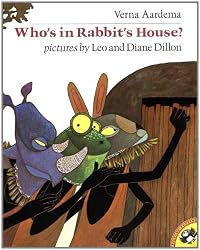
Who's In Rabbit's House?: A Masai Tale Retold
by Verna Aardema, Diane Dillon (Illustrator), Leo Dillon (Illustrator)
On This Page
Description
Rabbit has a problem - someone is inside her house and won't let her in.Tags
Recommendations



Member Reviews
When an unknown monster calling itself "The Long One" takes over her home, Rabbit isn't sure how to get rid of him. A series of animals offer their solutions, all of which turn out to be as destructive as they are helpful, until finally Rabbit turns to Frog, whose help she refused at the beginning.
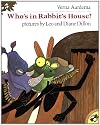
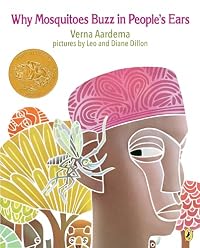
Originally published as The Long One in Aardema's 1969 collection, Tales for the Third Ear, this Masai folktale is illustrated by the marvelous Leo and Diane Dillon, who worked with Aardema on the Caldecott Medal-winning Why Mosquitos Buzz in People's Ears. The Dillons' artwork make the Masai context clear, as they present the story as a play, performed by people wearing animal masks. I understand that this format is quite appealing to young show more readers, although I found it somewhat distracting. I found myself wondering why the illustrators would choose to use masks that are not part of the Masai tradition, in order to retell a traditional Masai story. However that may be, the artwork was still gorgeous (as always), and the story engaging. show less
Originally published as The Long One in Aardema's 1969 collection, Tales for the Third Ear, this Masai folktale is illustrated by the marvelous Leo and Diane Dillon, who worked with Aardema on the Caldecott Medal-winning Why Mosquitos Buzz in People's Ears. The Dillons' artwork make the Masai context clear, as they present the story as a play, performed by people wearing animal masks. I understand that this format is quite appealing to young show more readers, although I found it somewhat distracting. I found myself wondering why the illustrators would choose to use masks that are not part of the Masai tradition, in order to retell a traditional Masai story. However that may be, the artwork was still gorgeous (as always), and the story engaging. show less
I enjoyed reading "Who's in Rabbit's House" for many reasons. First, I very much enjoyed the illustrations throughout the story. The pictures were very detailed and made it clear that the story was being presented as a play by the characters shown wearing masks; this is an inference one may make through the pictures and is not stated in the text. I also enjoyed that the story was of African culture and can inform the reader of their traditional tales. The big idea of the story is to help others in times of need, just as the community of animals did to help get the monster out of rabbit's house.
A rabbit is not allowed back into her house by a big bad voice it roared "I am the Long one. I eat trees and trample elephants. She sits in sadness thinking of what to do as she is approached by different animals. She is first approached by a frog who is willing to help. But she is very mean to him and tells him to leave since he is as small as her and would be useless. The frog stayed and a Jackal came along trying to help. They gathered a big pile of sticks due to the Jackals suggestion and placed them in the entrance of the house, The rabbit stopped this idea because it would only keep the big, bad voice inside. A leopard then came along and tried helping by scratching the house and bits of the roof began to fly off. The rabbit told show more the leopard to leave because it was only destroying the house. An elephant approached her and began to smash the house, but the rabbit told him to leave because he was smashing her home. A rhinoceros came by, but only made things worse. Finally the frog who had witnessed everything asked rabbit once again if she could just let him try to help. Finally she gives in and the frog scares away the big, bad voice by pretending to be a cobra. Out of the house comes a very scared caterpillar and all of the animals begin to laugh. This book teaches children a very meaningful lesson. The frog was the very first one to approach the rabbit willing to help, but she was very rude and did not even care to listen to what he had to say. Had she listened she would have went into her home much faster and would not have had to repair all the damage that was done by the other animals. This teaches children that it is important to hear everyone out. show less
I think as educators we should have books in the classroom that have a lesson at the end of the book. That is why I really enjoy folktales. I like this book for a couple reasons. First of all, it is a folk tale so it teaches kids a lesson. In this story the lesson is that we should not associate size with the ability to complete a task. In the book rabbit returns home to find there is an animal in his house with a big bad voice. Frog offers to help rabbit but, rabbit assumes frog is too small to help him. After all of the big animals fail to help him and get the creature out of his house frog comes to rabbits rescue and gets him out. I also enjoy the fact it introduces children to another culture, in this book it is Masai villagers. show more Another reason why I liked this book is because of the literary devices used. I think really effective children’s books utilize literary devices because they are well received by children. There is obvious personification. The characters in the book are animals and animals cannot talk but, they do in the book. I also like the sound words in the book like “gdung”. I also really love when there is repetition in a book. The book kept repeating “I am the long one, I eat trees and trample on elephants.” I love the vivid illustrations. I really believe that Diane and Leo specialize in folktale. I really like the mystery element in the book. It is a real page turner. I really love this book. show less
A great bedtime story sure to keep children fascinated, Who’s in Rabbit’s House is a Masai tale told from the perspective of a play within a play. A monster has invaded Rabbit’s house, and the other animals must gather to help investigate . . . and scare the monster away. This story teaches children it is important to help each other in times of need.
This Masia village based folktale teaches children that the size of a person does not determine if a task can be done by them. When an intruder is in Rabbit’s house, she calls on all her big animal friends to help scare the animal out. Frog is the smallest, and Rabbit’s last hope. Can frog scare the intruder away? Find out in the personification filled story that connects kids to the sounds, words and moral.
Summary: "Who's in Rabbit's House?" is a story about Masai villagers who dressed up with animal masks and perform a play based on a Masai Tale. In the play, Rabbit comes home to find someone in his house who has a "big, bad voice." Rabbit tries to get the animal out but the animal refuses. Frog happened to see this and tries to help but Rabbit tells her she is too small to help. Over the course of the day, many animals see Rabbit outside her house and finds out an animal will not leave Rabbit' house. Each animal tries a different tactic in order to remove the animal, however each strategy involves ruining Rabbit's house. This results in Rabbit telling each one to "go away." As these events take place, Frog is overlooking and laughing. show more After all the other animals try and fail to remove the animal, Frog offers her help again with the idea of scaring the animal out. Frog pretends to be a spitting cobra in order to scare the animal out of Rabbit's house, which works. Soon, a caterpillar comes running out of the house scared where all the other animals laugh to know the "big, bad voice" was only a caterpillar.
Review: The main idea of the story is Rabbit thought Frog was too small to remove the bad animal out of her house. However, after all the other bigger animals tried and failed to removed the bad animal, it turns out that Frog was the only one who could scared the animal out of Rabbit's house. I extremely enjoyed this book. I thought it had a great message by showing the irony of how people associating being small as not being able to get something done when Frog was the smallest animal but was the one to get the bad animal out of Rabbit's house. Additionally, I liked how the story included different sounds as actions in the book. For example, "And the frog laughed aloud - gdung, gdung, gdung." This is written to symbolize the sound the frog is making as he is laughing. I believe this is a good way to help students become more connected to the story because they can actually practice the sounds the animals are making. Also, I liked how the book had a portion of repetition throughout the story. Whenever a animal would try to talk to the bad animal inside Rabbit's house, he would say "I am Long One. I eat trees and trample on elephants. Go away! Or I will trample you!" I believe it was stated multiple times to emphasize how the bad animal constantly scared away the other animals. show less
Review: The main idea of the story is Rabbit thought Frog was too small to remove the bad animal out of her house. However, after all the other bigger animals tried and failed to removed the bad animal, it turns out that Frog was the only one who could scared the animal out of Rabbit's house. I extremely enjoyed this book. I thought it had a great message by showing the irony of how people associating being small as not being able to get something done when Frog was the smallest animal but was the one to get the bad animal out of Rabbit's house. Additionally, I liked how the story included different sounds as actions in the book. For example, "And the frog laughed aloud - gdung, gdung, gdung." This is written to symbolize the sound the frog is making as he is laughing. I believe this is a good way to help students become more connected to the story because they can actually practice the sounds the animals are making. Also, I liked how the book had a portion of repetition throughout the story. Whenever a animal would try to talk to the bad animal inside Rabbit's house, he would say "I am Long One. I eat trees and trample on elephants. Go away! Or I will trample you!" I believe it was stated multiple times to emphasize how the bad animal constantly scared away the other animals. show less
Members
- Recently Added By
Lists

A Child's Book Tour of East Africa ::: Ethiopia, Kenya, Sudan, Uganda
68 works; 4 members
Author Information

36+ Works 14,439 Members
Verna Aardema was born on June 6, 1911 in New Era Michigan. She received her B.A. degree from Michigan State College of Agriculture and Applied Sciences in 1934. She was a grade school teacher from 1934 to 1973 and staff correspondent for the Muskegon Chronicle from 1951 to 1972. Aardema started writing children's stories in the 1950's, and in show more 1960 she published her first books, Tales from the Story Hat and The Sky God Stories. She specializes in the modernization and adaptation of traditional African folktales. In the 1970s, Aardema joined illustrators Leo and Diane Dillon and produced three picture books. Why Mosquitoes Buzz in People's Ears received the Caldecott Medal in 1976 and the Brooklyn Art Books for Children Award in 1977. Who's in Rabbit's House? was the 1977 School Library Journal Best Book of the Year and a Lewis Carroll Shelf Award winner in 1978. Aardema received the Children's Reading Round Table Award in 1981, and several of her books have been selected as Notable Books by the American Library Association. Oh Kojo! How Could You! won the 1984 Parents' Choice Award for Literature. Verna Aardema died in 2000. show less


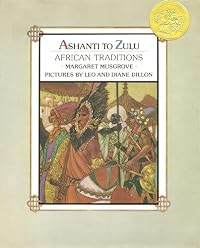
Leo Dillon was born in Brooklyn, New York on March 2, 1933. He attended Parsons School of Design in New York City, where he met his wife Diane (Sorber) Dillon. They graduated in 1956, married in 1957, and soon became a husband and wife team of illustrators. During his lifetime, they published over 40 children's books including Hakon of Rogen's show more Saga by Eric Hagard, The Ring in the Prairie by John Bierhorst, The People Could Fly: American Black Folktales by Virginia Hamilton, and If Kids Ran the World. They won the Caldecott Medal in 1976 for Why Mosquitoes Buzz in People's Ears by Verna Aardema and in 1977 for Ashanti to Zulu: African Traditions by Margaret Musgrove. They also won a Coretta Scott King Award and five Coretta Scott King Honors. In 2002, they published the first picture book they wrote themselves, Rap a Tap Tap: Here's Bojangles-Think of That! They also created cover designs for adult science fiction books. He died from complications of lung surgery on May 26, 2012 at the age of 79. (Bowker Author Biography) show less
Awards and Honors
Awards
Common Knowledge
- Canonical title
- Who's In Rabbit's House?: A Masai Tale Retold
- Related movies
- Who's in Rabbit's House? (1995 | IMDb)
Classifications
Statistics
- Members
- 387
- Popularity
- 80,399
- Reviews
- 9
- Rating
- (4.07)
- Languages
- English
- Media
- Paper, Audiobook, Ebook
- ISBNs
- 25
- ASINs
- 4