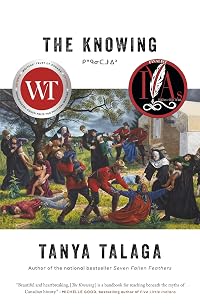
The Knowing
by Tanya Talaga
On This Page
Description
Explores the dark history of residential schools, "Indian hospitals" and asylums and their effects on indigenous peoples. "For generations, Indigenous People have known that their family members disappeared, many of them after being consigned to a coordinated system designed to destroy who the First Nations, Métis and Inuit people are. This is one of Canada's greatest open secrets, an unhealed wound that until recently lay hidden by shame and abandonment. The Knowing is the unfolding of show more history unlike anything we have ever read before. Award-winning and bestselling Anishinaabe author Tanya Talaga retells the history of her country as only she can -- through an Indigenous lens, beginning with the life of her great-great grandmother Annie Carpenter and her family as they experienced decades of government- and Church-sanctioned enfranchisement and genocide. Deeply personal and meticulously researched, The Knowing is a seminal unravelling of the centuries-long oppression of Indigenous People that continues to reverberate in these communities today." -- show lessTags
Recommendations



Member Reviews
“We all know people that never came home from residential schools.” Sadly this is a story of many first nations peoples. Records were destroyed, histories rewritten, memories lost.
The words are lyrical and flow beautifully. The relationship the author writes about with the lands is just amazing. It’s so easy to fall into this story and feel all the moments as this author struggled to find her family and the history around them. This history is horrible, ugly, sickening and heartbreaking but we must know so that it is never repeated. The way it’s written makes it very readable, with beautiful words calming the burn inflicted on our fellow humans and land.
I recommend this book to all, the lessons learned in her search are ones we show more all need to learn and understand. show less
The words are lyrical and flow beautifully. The relationship the author writes about with the lands is just amazing. It’s so easy to fall into this story and feel all the moments as this author struggled to find her family and the history around them. This history is horrible, ugly, sickening and heartbreaking but we must know so that it is never repeated. The way it’s written makes it very readable, with beautiful words calming the burn inflicted on our fellow humans and land.
I recommend this book to all, the lessons learned in her search are ones we show more all need to learn and understand. show less
This was devastating. It was difficult to read most times, but important, too. I'm from the US, but that doesn't make the history of Canada's residential schools any less important to know about, and as this book pointed out, both countries often shared information about how best to run these schools and "discipline" indigenous Americans.
When Tanya Talaga was writing as a journalist and/or historian, her writing really shone brightest. But when she tied her ancestors to the schools, her writing became lost in entire pages of hypothetical questions and far-fetched, broad-stroked assumptions ("Was she sent away by doctors? By the Indian agent? By her husband? Did he no longer want her?"; "Did Annie wonder where her children were? Did she show more mourn their loss with every step she took and every thought she had, so that it was hard to breathe? / Or did she soothe herself by hoping that gaining an education in the white man's ways would protect her children from the life she was living? Did she worry that once her children were trained in the language and customs of the settlers—how to dress like them and act like them—they might not want to come back to her and to their former way of life?" Etc. It goes on and on. Obviously, these also have some facts, but they felt clumsy. The use of so much repetition only annoyed me. But it was easy to overlook, because this is obviously something that's close to the author's heart.
I just wish that the book would pick one form of telling and stick to it: is it a memoir, a history book, etc.? It feels a little muddled.
But I will definitely pick up her two previously published books and will probably read what she writes next. show less
When Tanya Talaga was writing as a journalist and/or historian, her writing really shone brightest. But when she tied her ancestors to the schools, her writing became lost in entire pages of hypothetical questions and far-fetched, broad-stroked assumptions ("Was she sent away by doctors? By the Indian agent? By her husband? Did he no longer want her?"; "Did Annie wonder where her children were? Did she show more mourn their loss with every step she took and every thought she had, so that it was hard to breathe? / Or did she soothe herself by hoping that gaining an education in the white man's ways would protect her children from the life she was living? Did she worry that once her children were trained in the language and customs of the settlers—how to dress like them and act like them—they might not want to come back to her and to their former way of life?" Etc. It goes on and on. Obviously, these also have some facts, but they felt clumsy. The use of so much repetition only annoyed me. But it was easy to overlook, because this is obviously something that's close to the author's heart.
I just wish that the book would pick one form of telling and stick to it: is it a memoir, a history book, etc.? It feels a little muddled.
But I will definitely pick up her two previously published books and will probably read what she writes next. show less
Ratings
Members
- Recently Added By
Lists

LoanStars | Adult List: August 2024
10 works; 1 member

Globe and Mail | Canadian Non-Fiction: August 31, 2024
10 works; 1 member

Globe and Mail | Canadian Non-Fiction: September 7, 2024
10 works; 1 member

Globe and Mail | Canadian Non-Fiction: September 14, 2024
10 works; 1 member

Globe and Mail | Canadian Non-Fiction: September 21, 2024
10 works; 1 member
Globe and Mail | Canadian Non-Fiction: September 28, 2024
10 works; 1 member

Globe and Mail | Canadian Non-Fiction: October 5, 2024
10 works; 1 member

Globe and Mail | Canadian Non-Fiction: October 12, 2024
10 works; 1 member
Globe and Mail | Canadian Non-Fiction: October 19, 2024
10 works; 1 member
Globe and Mail | Canadian Non-Fiction: October 26, 2024
10 works; 1 member

Globe and Mail | Canadian Non-Fiction: November 2, 2024
10 works; 1 member
Globe and Mail | Canadian Non-Fiction: November 9, 2024
10 works; 1 member
Globe and Mail | Canadian Non-Fiction: November 16, 2024
10 works; 1 member

Globe and Mail | Canadian Non-Fiction: January 11, 2025
10 works; 1 member

Globe and Mail | Canadian Non-Fiction: August 2, 2025
10 works; 1 member
Author Information

4 Works 819 Members
Awards and Honors
Awards
Distinctions
Common Knowledge
- Epigraph
- They just made this damn thing up, the entire thing. A fiction that is absolutely made up and it shapes the world.--Montreal Lake Cree Nation author Harold Johnson, in conversation wirh Tanya Talaga, Vancouver Writers ... (show all)Fest, October 2021
- Dedication
- For my uncle Hank Bowen
- First words
- Cha-ka-pesh was a teeny, tiny person. (Prologue)
- Last words
- (Click to show. Warning: May contain spoilers.)I thank Kistachowan for the gifts she has shown me during our return to each other.
Classifications
Statistics
- Members
- 97
- Popularity
- 332,281
- Reviews
- 2
- Rating
- (4.80)
- Languages
- English
- Media
- Paper, Audiobook, Ebook
- ISBNs
- 8
- ASINs
- 5