
On This Page
Description
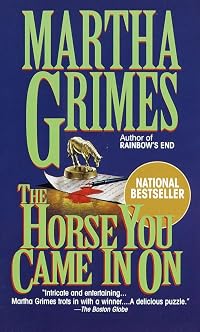
The murder is in America, but the call goes out to Scotland Yard superintendent Richard Jury. Accompanied by his aristocratic friend Melrose Plant and by Sargeant Wiggins, Jury arrives in Baltimore, Maryland, home of zealous Orioles fans, mouth-watering crabs, and Edgar Allen Poe. In his efforts to solve the case, Jury rubs elbows with a delicious and suspicious cast of characters, embarking on a trail that leads to a unique tavern called "The Horse You Came In On"…Tags
Recommendations


Member Reviews
No. 12 in the Richard Jury series.
Jury is on sick leave but when have such trivialities ever deterred Chief Superintendent Racer from his pathetic attempts to harass Jury? As a result, it is from Racer that Jury learns that Lady Cray, whom he met on a recent case, has asked for him specifically to investigate a strange murder in the US, that of Philip Calvert. Along with Melrose Plant (who has his own personal reasons for visiting the US) and that martyr to health, the long-suffering Sgt. Wiggins, Jury arrives in Baltimore, where the three are greeted by Ellen Taylor, Melrose’s “personal reason”. Ellen gives Melrose a guide to Baltimore that provides a fair amount of humor throughout the book, as Melrose, in between detecting show more tasks, sight-sees the city with one of the city’s finest—no, not a police officer or fireman, but a cab driver, the redoubtable Hughie, who is a tourist attraction in and of himself. Hughie the Cab Driver compensates brilliantly for the extended absence of Aunt Agatha and the rest of the Long Piddleton crew. Apart from Travels With Hughie, one of the better scenes in the book is Melrose’s introduction to American football in the pub of the book’s name.
The investigation into Philip’s murder leading nowhere, Ellen involves Jury in the case of the murder of a graduate student, Beverly Brown, who claimed to have found a previously-unknown manuscript by Edgar Allan Poe. Intrigued by the possibility that Brown and Calvert’s murders may somehow be connected, Jury, Wiggins and Melrose start tracking down answers to the “why” of Brown’s murder.
The plot is workmanlike with a somewhat bizarre denouement that strains credulity a bit; the story, however, is really just a vehicle and matrix for a fond tour of Baltimore . Grimes, who has taught at Johns Hopkins, through Ellen gives us a glimpse into an academia replete with the usual vain professors and somewhat absent-minded scholars. There’s also a look at the problem of plagiarism faced by successful authors that provides interest to the book. Although in the end irrelevant to the main plot, the subplot of the alleged Poe manuscript is extremely well-done and provides at least a superficial exploration of how such claims are authenticated.
While not one of the better mysteries, the book is well worth reading if only to share Grimes’ obvious affection for Baltimore and its denizens. Highly recommended. show less
Jury is on sick leave but when have such trivialities ever deterred Chief Superintendent Racer from his pathetic attempts to harass Jury? As a result, it is from Racer that Jury learns that Lady Cray, whom he met on a recent case, has asked for him specifically to investigate a strange murder in the US, that of Philip Calvert. Along with Melrose Plant (who has his own personal reasons for visiting the US) and that martyr to health, the long-suffering Sgt. Wiggins, Jury arrives in Baltimore, where the three are greeted by Ellen Taylor, Melrose’s “personal reason”. Ellen gives Melrose a guide to Baltimore that provides a fair amount of humor throughout the book, as Melrose, in between detecting show more tasks, sight-sees the city with one of the city’s finest—no, not a police officer or fireman, but a cab driver, the redoubtable Hughie, who is a tourist attraction in and of himself. Hughie the Cab Driver compensates brilliantly for the extended absence of Aunt Agatha and the rest of the Long Piddleton crew. Apart from Travels With Hughie, one of the better scenes in the book is Melrose’s introduction to American football in the pub of the book’s name.
The investigation into Philip’s murder leading nowhere, Ellen involves Jury in the case of the murder of a graduate student, Beverly Brown, who claimed to have found a previously-unknown manuscript by Edgar Allan Poe. Intrigued by the possibility that Brown and Calvert’s murders may somehow be connected, Jury, Wiggins and Melrose start tracking down answers to the “why” of Brown’s murder.
The plot is workmanlike with a somewhat bizarre denouement that strains credulity a bit; the story, however, is really just a vehicle and matrix for a fond tour of Baltimore . Grimes, who has taught at Johns Hopkins, through Ellen gives us a glimpse into an academia replete with the usual vain professors and somewhat absent-minded scholars. There’s also a look at the problem of plagiarism faced by successful authors that provides interest to the book. Although in the end irrelevant to the main plot, the subplot of the alleged Poe manuscript is extremely well-done and provides at least a superficial exploration of how such claims are authenticated.
While not one of the better mysteries, the book is well worth reading if only to share Grimes’ obvious affection for Baltimore and its denizens. Highly recommended. show less
Richard Jury and Melrose Plant cross the pond to handle a case in Baltimore involving an alleged new story by Edgar Allan Poe, a wealthy football fan, Patrick Muldare, and a dead derelict, John-Joy. Melrose wandering through Baltimore with cabbie Hugh and making friends with the homeless was fairly funny. Some open-endedness of the case when Jip gives Richard a photo of herself at age 6 and asks him to find "it", the place she was living. Melrose embarks on his career as a writer. Fun read.
Let me start with this: I have really enjoyed everything I have read (and collected) by Martha Grimes, but I couldn't get through this one. After several attempts ("Start over, I must be missing something..."), I find it is still much more dialogue than the story will support. Too many irrelevant side trips, far too confusing.
The writing style good and the lead was likeable. It started promising but it kept dwindling into a dull story. There is too much going on with the character's - interactions just to interact, extra everyday living stuff - that weighed down the story and kept it a chore to read.
The closest witness to the crime is a blind and deaf man who seems constantly angry. He is the one who finds the body.
By Special request by Lady Cray, Richard Jury is sent to Baltimore, Maryland to look into the murder. The victim is the nephew of a friend of hers. Melrose Plant travels with Jury, as he has been invited by authoress friend Helen Taylor. Sergeant Wiggins and his personal pharmacopeia also accompanies Jury. While in Baltimore, all three find themselves introduced to rabid Orioles fans, delicious crabs and Edgar Allan Poe, along with the other charms Baltimore has to offer.
Besides murder, there is also a manuscript by Edgar Allen Poe that comes to light. It is real or is it a forgery? When another murder takes place show more involving the woman who discovered the document, Jury finds he really has his hands full. Plant and Wiggins become extra eyes and ears in solving the murders.
Once again, the story line moves smoothly, with twists and left turns, as the three friends unravel and discover if there are connections between the various events. show less
By Special request by Lady Cray, Richard Jury is sent to Baltimore, Maryland to look into the murder. The victim is the nephew of a friend of hers. Melrose Plant travels with Jury, as he has been invited by authoress friend Helen Taylor. Sergeant Wiggins and his personal pharmacopeia also accompanies Jury. While in Baltimore, all three find themselves introduced to rabid Orioles fans, delicious crabs and Edgar Allan Poe, along with the other charms Baltimore has to offer.
Besides murder, there is also a manuscript by Edgar Allen Poe that comes to light. It is real or is it a forgery? When another murder takes place show more involving the woman who discovered the document, Jury finds he really has his hands full. Plant and Wiggins become extra eyes and ears in solving the murders.
Once again, the story line moves smoothly, with twists and left turns, as the three friends unravel and discover if there are connections between the various events. show less
Twelfth in the Chief Inspector Richard Jury series. In this book, Jury and Sgt. Wiggins and his friend Melrose Plant are reluctantly off to America, to investigate two different murders at the behest of two different friends, wandering into the literary world of Johns Hopkins University, Edgar Allan Poe and a football franchise for Baltimore! This was another of Grimes’ weaker Jury novels; I don’t know if it was the setting, if being away from the UK weakened the book or what, but it wasn’t a story I enjoyed overly much aside from being glad for a visit with all the recurring characters. There were a lot of side trips away from the mystery part of the story and it wasn’t, in general, very coherent nor cohesive.
The first Martha Grimes to disappoint me. A total change from the author's usual writing. Much darker, very confusing. Mainly set in the United States as opposed to Britain. I understand the author wanting to change her style, but rather than do so within an already established series, start a new one. This was sadly the last Grimes I ever finished. Tried to read the next in the series but was again disappointed and could not get through it.
Members
- Recently Added By
Lists

Crime and Mysteries to Read
746 works; 31 members

Books Read in 2014
2,343 works; 89 members
Author Information

59+ Works 29,674 Members
Martha Grimes was born on May 2, 1931 in Pittsburgh, Pennsylvania. She received a B.A. and an M.A. from the University of Maryland. The idea for Martha Grimes' first British detective novel, The Man with a Load of Mischief (1981), was inspired by the name of a British pub she noticed while leafing through a travel book. A longtime Anglophile, she show more has continued to use a British pub as both the title and part of the setting in each subsequent novel in the series which features Scotland Yard Detective Richard Jury, his assistant, Melrose Plant, and Plant's interfering Aunt Agatha. The Anodyne Necklace (1983) won her the Nero Wolfe Award. Her other works include The Stargazey, The Case Has Been Altered, The End of the Pier, Biting the Moon, and Dust. Her title, Vertigo 42, made The New York Times Best Seller List in 2014. (Bowker Author Biography) show less
Series

Belongs to Publisher Series
Goldmann (43386)
Work Relationships
Common Knowledge
- Canonical title
- The Horse You Came In On
- Original title
- The Horse You Came In On
- Original publication date
- 1993
- People/Characters
- Richard Jury; Melrose Plant
- Important places
- Baltimore, Maryland, USA; Maryland, USA
- Epigraph
- Civilized, and gay, and rotted and polite
F Scott Fitzgerald, on Baltimore - Dedication
- To
Laura Scott Perry
a friend in Nickel City - First words
- The blind man smelled something new in Cider Alley, a new scent mixed with the old ones of urine and sweat, beer and whiskey, coming from some doorway (he imagined ) where a little cluster of men liked to gather.
- Last words
- (Click to show. Warning: May contain spoilers.)The silent laughter overflowed as Jury said "So take that, mates" - he pounded his pint on the table - "and the horse you came in on!"
- Original language*
- Amerikanisch
*Some information comes from Common Knowledge in other languages. Click "Edit" for more information.
Classifications
Statistics
- Members
- 1,055
- Popularity
- 24,310
- Reviews
- 10
- Rating
- (3.43)
- Languages
- English, French, German
- Media
- Paper, Audiobook, Ebook
- ISBNs
- 31
- ASINs
- 13