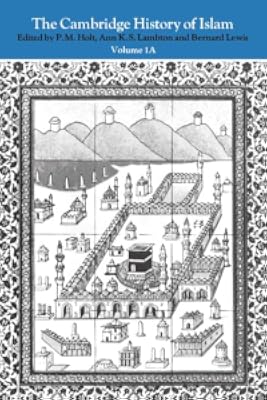
The Central Islamic Lands from Pre-Islamic Times to the First World War
by P. M. Holt
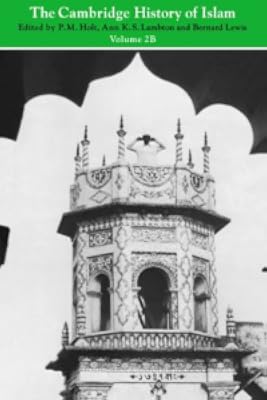
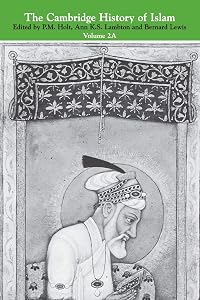
The Cambridge History of Islam (1A)
On This Page
Description
First published in 1970, The Cambridge History of Islam is the most comprehensive and ambitious collaborative survey of Islamic history and civilization yet to appear in English. On publication it was welcomed as a work useful for both reference and reading, for the general reader, student and specialist alike. It has now been reprinted, with corrections, and for ease of handling the original two hardcover volumes have each been divided into two separate paperbacks.Tags
Recommendations














Member Reviews
HISTORY OF ISLAM. VOLUME 1 A
INTRODUCTION
P. M. HOLT
A reader taking up a work entitled The Cambridge history of Islam may
reasonably ask, '"What is Islam? In what sense is Islam an appropriate
field for historical enquiry?' Primarily, of course, Islam is, like
Christianity, a religion, the antecedents, origin and development of
which may, without prejudice to its transcendental aspects, be a legitimate
concern of historians. Religious history in the narrow sense is not,
however, the only, or even the main, concern of the contributors to
these volumes. For the faith of Islam has, again like Christianity, been a
great synthesizing agent. From its earliest days it displayed features of
kinship with the earlier monotheisms of Judaism and show more Christianity.
Implanted in the former provinces of the Byzantine and Sasanian
empires, it was compelled to maintain and define its autonomy against
older and more developed faiths. Like Judaism and Christianity before
it, it met the challenge of Greek philosophy, and adopted the conceptual
and logical tools of this opponent to expand, to deepen, and to render
articulate its self-consciousness. In this connexion, the first three cen
turies of Islam, like the first three centuries of Christianity, were critical
for establishing the norms of belief and practice, and for embodying
them in a tradition which was, or which purported to be, historical
The Islamic synthesis did not stop at this stage. The external frontier
of Islam has continued to move until our own day. For the most part,
this movement has been one of expansion--into Central Asia, into the
Indian sub-continentand south-east Asia, andintotrans-Saharan Africabut
there have also been phases of retreat and withdrawal, notably in
Spain, and in central and south-eastern Europe. But besides this external
frontier, which has largely been the creation of conquering armies
(although with important exceptions in Central and south-east Asia and
Africa) there has also been throughout Islamic history an internal
frontier-the invisible line of division between Muslim and non
Muslim. Here also over the centuries there has been an expansion of
Islam, so that, for example, in the former Byzantine and Sasanian lands
the Christian and Zoroastrian communities were reduced to numerical
insignificance, and became minority-groups like the Jews. This twofold...
1 I should like to thank my co-editors, Professors Lambton and Lewis, for reading and
commenting on this Introduction in draft show less
INTRODUCTION
P. M. HOLT
A reader taking up a work entitled The Cambridge history of Islam may
reasonably ask, '"What is Islam? In what sense is Islam an appropriate
field for historical enquiry?' Primarily, of course, Islam is, like
Christianity, a religion, the antecedents, origin and development of
which may, without prejudice to its transcendental aspects, be a legitimate
concern of historians. Religious history in the narrow sense is not,
however, the only, or even the main, concern of the contributors to
these volumes. For the faith of Islam has, again like Christianity, been a
great synthesizing agent. From its earliest days it displayed features of
kinship with the earlier monotheisms of Judaism and show more Christianity.
Implanted in the former provinces of the Byzantine and Sasanian
empires, it was compelled to maintain and define its autonomy against
older and more developed faiths. Like Judaism and Christianity before
it, it met the challenge of Greek philosophy, and adopted the conceptual
and logical tools of this opponent to expand, to deepen, and to render
articulate its self-consciousness. In this connexion, the first three cen
turies of Islam, like the first three centuries of Christianity, were critical
for establishing the norms of belief and practice, and for embodying
them in a tradition which was, or which purported to be, historical
The Islamic synthesis did not stop at this stage. The external frontier
of Islam has continued to move until our own day. For the most part,
this movement has been one of expansion--into Central Asia, into the
Indian sub-continentand south-east Asia, andintotrans-Saharan Africabut
there have also been phases of retreat and withdrawal, notably in
Spain, and in central and south-eastern Europe. But besides this external
frontier, which has largely been the creation of conquering armies
(although with important exceptions in Central and south-east Asia and
Africa) there has also been throughout Islamic history an internal
frontier-the invisible line of division between Muslim and non
Muslim. Here also over the centuries there has been an expansion of
Islam, so that, for example, in the former Byzantine and Sasanian lands
the Christian and Zoroastrian communities were reduced to numerical
insignificance, and became minority-groups like the Jews. This twofold...
1 I should like to thank my co-editors, Professors Lambton and Lewis, for reading and
commenting on this Introduction in draft show less
Jun 29, 2018Spanish
Ratings
Members
- Recently Added By
Author Information
22+ Works 463 Members
Series

Work Relationships
Is contained in
Common Knowledge
- Canonical title
- The Central Islamic Lands from Pre-Islamic Times to the First World War
Classifications
Statistics
- Members
- 56
- Popularity
- 548,293
- Reviews
- 1
- Rating
- (3.67)
- Languages
- English
- Media
- Paper, Ebook
- ISBNs
- 7