A Smugglers Bible
by Joseph McElroy
On This Page
Description
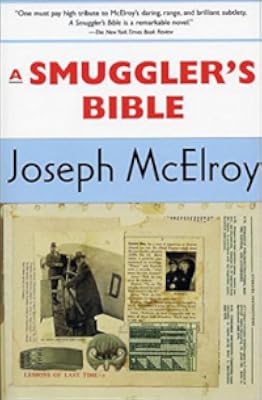
In its depth of vision and omnidirectional grasp of the rhythms and textures of modern life. A Smuggler's Bible marked the debut of one of contemporary fiction's most compelling and original authors. Upon its first publication in 1966, it drew a chorus of critical acclaim and comparisons to William Gaddis's The Recognitions and Malcolm Lowry's Under the Volcano. Used once upon a time to convey contraband, the familiar hollowed-out bible reappears transformed as a metaphor for the earnest show more attempt, perhaps futile, by David Brooke to project his life into the lives of those who have affected him to varying degrees of residual puzzlement, fascination, profit, frustration, and damage. These people -- a reserved English bookseller in Brooklyn Heights, the bizarre tenants of a Manhattan rooming house, his mother on a day of haunting insight, a mercurial and narcissistic professor of history, and finally his own father confronting death -- are the subject of David's vaunted "projections," the eight pseudo-autobiographical manuscripts he has written, now housed safely aboard a transatlantic liner on their way to a mysterious old man in London. David is the reader of his life, and as he broods over the stories, attempting to conjure his identity from its disjointed parts, yet another voice intercedes, a cunning interlocutor who alternately guides and thwarts his attempts to find a pattern of meaning in the profuse details of life. Book jacket. show lessTags
Recommendations









Member Reviews
Do we not use each other to slip across the frontiers of self-scrutiny as something other than lonely people?
I found The Smuggler's Bible to be a rumination on parasite and host. Much like an article on deconstruction, and even more like a slugfest between Bellow protagonists: imagine Herzog and Mr. Sammler in a practical death struggle over influence and affectation. Imagine constructing a musical canon and adding middlebrow references in maddening sequences. Listen to Roger Waters cover REM's Strange Currencies and consider the ironies. The Smuggler's Bible transports and imprints, much like the protagonist's penchant for chain letters, each confesses, obscures and by proxy contributes to these Chinese Whispers of life.
I found The Smuggler's Bible to be a rumination on parasite and host. Much like an article on deconstruction, and even more like a slugfest between Bellow protagonists: imagine Herzog and Mr. Sammler in a practical death struggle over influence and affectation. Imagine constructing a musical canon and adding middlebrow references in maddening sequences. Listen to Roger Waters cover REM's Strange Currencies and consider the ironies. The Smuggler's Bible transports and imprints, much like the protagonist's penchant for chain letters, each confesses, obscures and by proxy contributes to these Chinese Whispers of life.
Some books I can get absorbed in, losing myself in the story, or the characters, or the structure, or the style. A very few books I can read without being interested in any of this in anything other than a purely intellectual way, and this is one of them. 'A Smuggler's Bible' is more or less seven often quite bad novellas and short stories connected in so many ways that my mind, at least, was boggled; the novel that comprises these short fictions is mainly a frame designed to investigate questions of identity and solipsism.
The frame itself is intriguing [plot spoilers ahead, but if you're reading for plot, you should just skip this book]. A man has some kind of psychotic break and decides he needs to reconstitute his identity. He show more decides to do this by writing the aforementioned stories/novellas, which are told from the perspectives of his friends, his wife, his family and finally himself. He takes these narratives to an 'old man,' probably a friend's father, certainly a mythical stand-in for at least one god, in the U.K. He reads and edits the narratives on the way. We are told all of this by the narrator of the frame story, who is possibly a demiurge creator of David Brooke (the man in question), or a part of David Brooke's mind, which makes sense to anyone who's ever written a narrative through another person's voice.
The links between the stories are as small as individual words ('infusoria', implausibly, shows up multiple times) and as large as mythical structural parallels (a lot of people being followed, a lot of father/son strife, and so on). It was first published in 1966, so there's an unfortunately large amount of existential nonsense and bad philosophizing (note to those who still get worried by Descartes' demons or Sartre's nausea: the very possibility of these problems has been refuted many, many, many times since). Luckily, treating these problems in literature can be more rewarding than just treating them philosophically, and McElroy almost succeeds in making it interesting here.
He doesn't entirely succeed because most of the stories David Brooke writes about others/himself aren't all that interesting, with the exception of the glorious 'An American Hero,' which would make a great self-standing realist novella. This is hardly surprising. McElroy is out for much bigger game than realism can bring down; he's not likely to waste energy on writing good realism; the realism is therefore not very good. And you're left with an interesting intellectual game, part cod-existentialism, part Joyce (endless mythic analogues).
Foster Wallace was still trying to solve these non-existent problems decades later. 'Smuggler's Bible' is most interesting at the end, when the difficulties of subjectivity are tied to the difficulties of religious faith (Brooke's stories are, at one point, stored in a smuggler's bible, a bible from which a hole has been cut, to act as a small box).
"Do you not see how Christ was in fact hte most remarkable contraband of all time, and was simultaneously himself an arch-smuggler? And the Virgin Mary, too?... (Sartre's wrong: *God* is other people!)"
Some people believe in god, some people do not; in any case, god's existence cannot be proven or disproven. Similarly, the fact that we're existentially alone cannot be proven or disproven; to state that we're existentially alone is as much a theological statement as the statement that we are in a state of divine grace, and, strictly speaking, about as meaningful/less, depending on your assumptions.
So 'A Smuggler's Bible' gives you lots of space to think about what it means to be an individual subject, and how that subjectivity is related to other people, without forcing you to take one position or another. That's a pretty great achievement. It's worth checking out for its formal ingenuity. But you can easily skip the stories that aren't holding your interest without losing much; in a sense, this is a piece of conceptual art, and it's more fun to think about the concept than it is to experience the art. That might be a problem. show less
The frame itself is intriguing [plot spoilers ahead, but if you're reading for plot, you should just skip this book]. A man has some kind of psychotic break and decides he needs to reconstitute his identity. He show more decides to do this by writing the aforementioned stories/novellas, which are told from the perspectives of his friends, his wife, his family and finally himself. He takes these narratives to an 'old man,' probably a friend's father, certainly a mythical stand-in for at least one god, in the U.K. He reads and edits the narratives on the way. We are told all of this by the narrator of the frame story, who is possibly a demiurge creator of David Brooke (the man in question), or a part of David Brooke's mind, which makes sense to anyone who's ever written a narrative through another person's voice.
The links between the stories are as small as individual words ('infusoria', implausibly, shows up multiple times) and as large as mythical structural parallels (a lot of people being followed, a lot of father/son strife, and so on). It was first published in 1966, so there's an unfortunately large amount of existential nonsense and bad philosophizing (note to those who still get worried by Descartes' demons or Sartre's nausea: the very possibility of these problems has been refuted many, many, many times since). Luckily, treating these problems in literature can be more rewarding than just treating them philosophically, and McElroy almost succeeds in making it interesting here.
He doesn't entirely succeed because most of the stories David Brooke writes about others/himself aren't all that interesting, with the exception of the glorious 'An American Hero,' which would make a great self-standing realist novella. This is hardly surprising. McElroy is out for much bigger game than realism can bring down; he's not likely to waste energy on writing good realism; the realism is therefore not very good. And you're left with an interesting intellectual game, part cod-existentialism, part Joyce (endless mythic analogues).
Foster Wallace was still trying to solve these non-existent problems decades later. 'Smuggler's Bible' is most interesting at the end, when the difficulties of subjectivity are tied to the difficulties of religious faith (Brooke's stories are, at one point, stored in a smuggler's bible, a bible from which a hole has been cut, to act as a small box).
"Do you not see how Christ was in fact hte most remarkable contraband of all time, and was simultaneously himself an arch-smuggler? And the Virgin Mary, too?... (Sartre's wrong: *God* is other people!)"
Some people believe in god, some people do not; in any case, god's existence cannot be proven or disproven. Similarly, the fact that we're existentially alone cannot be proven or disproven; to state that we're existentially alone is as much a theological statement as the statement that we are in a state of divine grace, and, strictly speaking, about as meaningful/less, depending on your assumptions.
So 'A Smuggler's Bible' gives you lots of space to think about what it means to be an individual subject, and how that subjectivity is related to other people, without forcing you to take one position or another. That's a pretty great achievement. It's worth checking out for its formal ingenuity. But you can easily skip the stories that aren't holding your interest without losing much; in a sense, this is a piece of conceptual art, and it's more fun to think about the concept than it is to experience the art. That might be a problem. show less
What is it with debut novels written by young male authors about withdrawn, over-intellectual, under-socialized young men? I'm starting to see how Charles Bukowski got a foothold: read enough of these, and a book about a womanizing drunk becomes a welcome breath of fresh air.
Still, McElroy does a good job with this one. David Brooke, his protagonist, has set himself the task of creating a self-portrait, or perhaps a memoir, by "projecting himself" into other people, and using their point of view to convey impressions of himself (most of which are, tragically, reflections of his own self-concept).
The characters are ultimately uninteresting, as is the protagonist, making one wonder why it is worth reading either their stories or his. To show more be sure, they are well-conceived : the famous and possibly-fraudulent interdisciplinary professor, the pseudopaedophile ex-pat, the grasping denizens of the boarding-house, the various fish-out-of-water Englishmen. It is hard to say whether these characters are just uninteresting *people*, or whether it is Brooke's interest in them that is so shallow and limited (and the novel does imply the latter).
Towards the end, I was starting to wonder if McElroy was having trouble trying to pull everything together (suddenly everyone is using red hardbound journals, the same joke about the wise men is being told by every character, and the quotation marks and parentheses don't quite match up). Brooke's project seems to spiral out of control when it turns out that many of his acquaintances already know each other; the novel itself suffers a similar fate, though that may be art instead of accident.
Unexpectedly, I read the last half of this at the same time as I watched the first season of True Detective. The poorly-received observations and witticisms of David Brooke are jarringly similar to Rust Cohle's nihilistic monologues. In my head, I started to read them in Rust Cohle's voice, to rather comic effect. show less
Still, McElroy does a good job with this one. David Brooke, his protagonist, has set himself the task of creating a self-portrait, or perhaps a memoir, by "projecting himself" into other people, and using their point of view to convey impressions of himself (most of which are, tragically, reflections of his own self-concept).
The characters are ultimately uninteresting, as is the protagonist, making one wonder why it is worth reading either their stories or his. To show more be sure, they are well-conceived : the famous and possibly-fraudulent interdisciplinary professor, the pseudopaedophile ex-pat, the grasping denizens of the boarding-house, the various fish-out-of-water Englishmen. It is hard to say whether these characters are just uninteresting *people*, or whether it is Brooke's interest in them that is so shallow and limited (and the novel does imply the latter).
Towards the end, I was starting to wonder if McElroy was having trouble trying to pull everything together (suddenly everyone is using red hardbound journals, the same joke about the wise men is being told by every character, and the quotation marks and parentheses don't quite match up). Brooke's project seems to spiral out of control when it turns out that many of his acquaintances already know each other; the novel itself suffers a similar fate, though that may be art instead of accident.
Unexpectedly, I read the last half of this at the same time as I watched the first season of True Detective. The poorly-received observations and witticisms of David Brooke are jarringly similar to Rust Cohle's nihilistic monologues. In my head, I started to read them in Rust Cohle's voice, to rather comic effect. show less
Would you like to know what Virginia Woolf might have written if she was a man writing in the early 1960s? Here it is!
Ratings
Members
- Recently Added By
Author Information

15+ Works 1,339 Members
Joseph McElroy is the author of eight novels, including A Smuggler's Bible and Lookout Cartridge. He is the recipient of the Award in Literature from the American Academy of Arts and Letters and fellowships from the Guggenheim, Rockefeller, Ingram Merrill Foundations, and the National Endowment for the Arts. He lives in New York City
Common Knowledge
- Original publication date
- 1966
Classifications
Statistics
- Members
- 179
- Popularity
- 183,748
- Reviews
- 4
- Rating
- (3.56)
- Languages
- English
- Media
- Paper
- ISBNs
- 4
- ASINs
- 3