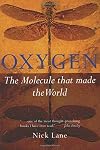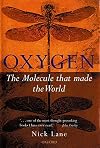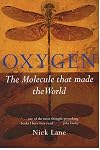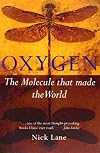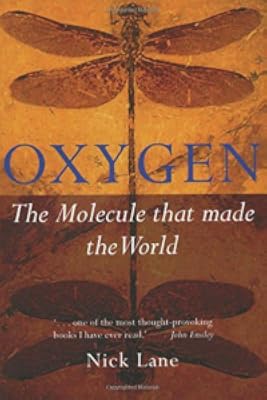
Oxygen: The Molecule that Made the World
by Nick Lane
On This Page
Description
Three hundred million years ago, in Carboniferous times, dragonflies grew as big as seagulls, with wingspans of nearly a meter. Researchers claim they could have flown only if the air had contained more oxygen than today-probably as much as thirty-five percent. Giant spiders, tree-ferns, marine rock formations, and fossil charcoals all tell the same story. High oxygen levels may also explain the global firestorm that contributed to the demise of the dinosaurs after the asteroid impact. The show more strange and profound effects that oxygen has had on the evolution of life pose a riddle, which this book sets out to answer. Oxygen is a toxic gas. Divers breathing pure oxygen at depth suffer from convulsions and lung injury. Fruit flies raised at twice normal atmospheric levels of oxygen live half as long as their siblings. Reactive forms of oxygen, known as free radicals, are thought to cause aging in people. Yet if atmospheric oxygen reached thirty-five percent in the Carboniferous, why did it promote exuberant growth, instead of rapid aging and death? Oxygen takes the listener on an enthralling journey, as gripping as a thriller, as it unravels the unexpected ways in which oxygen spurred the evolution of life and death. show lessTags
Recommendations




Member Reviews
Though Lane is more of a scientist than Bill Bryson this book reminded me in many ways of Bryson's wonderful 'A short history of nearly everything'. Lane is an interesting writer and this book tells the oxymoronic tale of Oxygen as both healer and killer, saint and sinner, good guy and villain. There is a distinctly science feel to the text and Lane does not shy away from detailed analysis/presentation of data and theoretical conjecture but the tone is almost always decidedly in awe of life's majesty and at times playful (hence my comparison with Bryson). Oxygen tells a good yarn and it's one that will make you go, at times, 'Wow, who'd have guessed?'
There are two things to take into consideration when approaching this book: target audience and volume of quality content. In my case, one was a con and the other a potential pro.
The author claims this book is for the general public. No, it is not. Even people who love this book admit this is a hard read. An educational background in biochemistry with some understanding of geochemistry and genetics are a remarkable plus. Other than that you need a lot of patience. Despite my moderate knowledge in these fields (low level college), I read this book incredibly slowly for the first third. Eventually I became reluctant to read it at all, so I gave myself permission to skim.
Did I learn a lot? Yes. In fact, it's an incredibly fact dense show more book, especially if you don't mind the history of all the studies leading to current speculations on oxygen and its influence on life. Much--okay, page per page, it's probably most--of the book is dedicated to fleshing out the research that has theories on oxygen. Most negative reviews focus on this aspect. You can't read this book for it's conclusions, you have to enjoy reading the process.
A part of me would love to come back in a few years after bulking up my biochemistry background so that I can read faster and hold the information instead of letting the thoughts bounce back.
Here's the thing. If I could follow the book better I'd probably give it 4 stars--I truly suspect it'd be that fun and enlightening if it was accessible. However, this is where the mismatch of author intent and execution have to be my priority when deciding how I feel about the book overall. What's the point of great content if it's too disheartening to read because it's a few too many humps of challenges to bother with? No point. I did like what I did learn, but I can't give it any more credit than the 2 stars I'll give it. If I come back, I might rebalance it in consideration of it's value of knowledge as whole versus how much of that whole I grasped as a "general audience" the first time. show less
The author claims this book is for the general public. No, it is not. Even people who love this book admit this is a hard read. An educational background in biochemistry with some understanding of geochemistry and genetics are a remarkable plus. Other than that you need a lot of patience. Despite my moderate knowledge in these fields (low level college), I read this book incredibly slowly for the first third. Eventually I became reluctant to read it at all, so I gave myself permission to skim.
Did I learn a lot? Yes. In fact, it's an incredibly fact dense show more book, especially if you don't mind the history of all the studies leading to current speculations on oxygen and its influence on life. Much--okay, page per page, it's probably most--of the book is dedicated to fleshing out the research that has theories on oxygen. Most negative reviews focus on this aspect. You can't read this book for it's conclusions, you have to enjoy reading the process.
A part of me would love to come back in a few years after bulking up my biochemistry background so that I can read faster and hold the information instead of letting the thoughts bounce back.
Here's the thing. If I could follow the book better I'd probably give it 4 stars--I truly suspect it'd be that fun and enlightening if it was accessible. However, this is where the mismatch of author intent and execution have to be my priority when deciding how I feel about the book overall. What's the point of great content if it's too disheartening to read because it's a few too many humps of challenges to bother with? No point. I did like what I did learn, but I can't give it any more credit than the 2 stars I'll give it. If I come back, I might rebalance it in consideration of it's value of knowledge as whole versus how much of that whole I grasped as a "general audience" the first time. show less
A very mind expanding and thought provoking book.
There is a lot more here than you might be expecting even from the title. What you get are new perspectives on life and death, why we age and what we might be able to do about it.
Two main themes are the evolution of life and the various health claims surrounding vitamin C and anti-oxidants. Regarding this later theme you shouldn't be surprised to hear that the actual science is very different from the version of it you may have gathered from either the popular press or from those trying to sell you vitamin C or other products with anti-oxidant properties.
Almost as a casual aside we find out about how and why there is sex, how life made earth liveable and the likely cause of many show more diseases.
This chap likes to argue rationally and he certainly follows the evidence, but what I also like about him is that he is prepared to look just a little bit further and speculate sensibly about how he thinks things may be found to be in the near future.
Science writing at its best.
A great book from a great author. Read all his stuff . show less
There is a lot more here than you might be expecting even from the title. What you get are new perspectives on life and death, why we age and what we might be able to do about it.
Two main themes are the evolution of life and the various health claims surrounding vitamin C and anti-oxidants. Regarding this later theme you shouldn't be surprised to hear that the actual science is very different from the version of it you may have gathered from either the popular press or from those trying to sell you vitamin C or other products with anti-oxidant properties.
Almost as a casual aside we find out about how and why there is sex, how life made earth liveable and the likely cause of many show more diseases.
This chap likes to argue rationally and he certainly follows the evidence, but what I also like about him is that he is prepared to look just a little bit further and speculate sensibly about how he thinks things may be found to be in the near future.
Science writing at its best.
A great book from a great author. Read all his stuff . show less
This is an extremely interesting and well written book about oxygen - how oxygen spurred the evolution of life, the functioning of oxygen in biological systems, aging, how oxygen relates to everyday life (besides breathing), amongst others. The nice thing about this book is that the author assumes his readers are intelligent and so doesn't simplify his writing or the concepts so much that it practically turns into gibberish.
NOTE: The author's view of junk DNA is a bit dated - the book was published in 2002 and research on junk DNA has advanced since then. Some other information might also be dated, but that is simply how science and science writing work.
OTHER RELATED RECOMMENDED BOOKS:
* The Emerald Planet: How Plants Changed Earth's show more History by David Beerling
* Why We Get Sick: The New Science of Darwinian Medicine by Randolph M. Nesse, George C. Williams
* Under a Green Sky: Global Warming, the Mass Extinctions of the Past, and What They Can Tell Us About Our Future by Peter D. Ward show less
NOTE: The author's view of junk DNA is a bit dated - the book was published in 2002 and research on junk DNA has advanced since then. Some other information might also be dated, but that is simply how science and science writing work.
OTHER RELATED RECOMMENDED BOOKS:
* The Emerald Planet: How Plants Changed Earth's show more History by David Beerling
* Why We Get Sick: The New Science of Darwinian Medicine by Randolph M. Nesse, George C. Williams
* Under a Green Sky: Global Warming, the Mass Extinctions of the Past, and What They Can Tell Us About Our Future by Peter D. Ward show less
This book can be treated as the bible of Oxygen. I enjoyed the author's style of writing about O2 and various related topics. This is a book on the chemistry of Oxygen and how it influenced the formation of life on our planet.
While I do not agree with the evolutionary standpoint of this book, I think the creativity of this book about such a common, yet unknown molecule could be very stimulating for students.
Oxygen is slowly killing me! I didn't realise it was so toxic. Unfortunately, a rudimentary knowledge of biochemistry prevented any real enjoyment of this book.
Members
- Recently Added By
Lists

Chemistry
53 works; 3 members

Books Read in 2014
2,344 works; 89 members

In Our Time books
4,934 works; 2 members
Author Information

5+ Works 2,793 Members
Awards and Honors
Notable Lists
Series
Belongs to Publisher Series
Common Knowledge
- Canonical title
- Oxygen: The Molecule that Made the World
- Original publication date
- 2002
- People/Characters
- LUCA; oxygen; mitochondria
Classifications
Statistics
- Members
- 522
- Popularity
- 57,636
- Reviews
- 12
- Rating
- (4.19)
- Languages
- Czech, English, Polish
- Media
- Paper, Audiobook, Ebook
- ISBNs
- 10
- ASINs
- 4