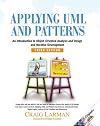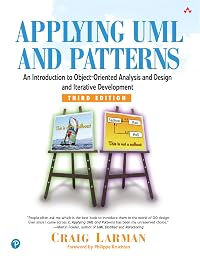
Applying UML and Patterns: An Introduction to Object-Oriented Analysis and Design and Iterative Development
by Craig Larman
On This Page
Description
“This edition contains Larman’s usual accurate and thoughtful writing. It is a very good book made even better.” — Alistair Cockburn, author, Writing Effective Use Cases and Surviving OO Projects “Too few people have a knack for explaining things. Fewer still have a handle on software analysis and design. Craig Larman has both.” — John Vlissides, author, Design Patterns and Pattern Hatching “People often ask me which is the best book to introduce them to the world of OO show more design. Ever since I came across it Applying UML and Patterns has been my unreserved choice.” — Martin Fowler, author, UML Distilled and Refactoring “This book makes learning UML enjoyable and pragmatic by incrementally introducing it as an intuitive language for specifying the artifacts of object analysis and design. It is a well written introduction to UML and object methods by an expert practitioner.” — Cris Kobryn, Chair of the UML Revision Task Force and UML 2.0 Working Group A brand new edition of the world’s most admired introduction to object-oriented analysis and design with UML Fully updated for UML 2 and the latest iterative/agile practices Includes an all-new case study illustrating many of the book’s key points Applying UML and Patterns is the world’s #1 business and college introduction to “thinking in objects”—and using that insight in real-world object-oriented analysis and design. Building on two widely acclaimed previous editions, Craig Larman has updated this book to fully reflect the new UML 2 standard, to help you master the art of object design, and to promote high-impact, iterative, and skillful agile modeling practices. Developers and students will learn object-oriented analysis and design (OOA/D) through three iterations of two cohesive, start-to-finish case studies. These case studies incrementally introduce key skills, essential OO principles and patterns, UML notation, and best practices. You won’t just learn UML diagrams—you’ll learn how to apply UML in the context of OO software development. Drawing on his unsurpassed experience as a mentor and consultant, Larman helps you understand evolutionary requirements and use cases, domain object modeling, responsibility-driven design, essential OO design, layered architectures, “Gang of Four” design patterns, GRASP, iterative methods, an agile approach to the Unified Process (UP), and much more. This edition’s extensive improvements include A stronger focus on helping you master OOA/D through case studi... show lessTags
Recommendations


Member Reviews
The clearest book about the software development process. The title is somewhat misleading, this is not a book only about UML, but digs deep into the whole software lifecycle showing which artifacts you need at every stage of the development process, and which information to expect in each one of them. If yo still haven't got what the UML is really for, this is the book.
This is an excellent book on OO analysis and design. Despite the title suggest, it provide a comprehensive illustration on iterative development process, requirement analysis, OO design, applying UML, applying well known design patterns, and it also provide introductory materials on architectural analysis, packaging, as well as agile development method.
The material covered by this book is quite wide, with reasonable depth on most topics.
The material covered by this book is quite wide, with reasonable depth on most topics.
I acquired this book as a result of a course I took. I have never really had the opportunity to use UML on the job. But the idea sounded great. This book supports the excellent ideas inherent in this approach.
An Introduction to Object-Oriented Analysis & design
Ratings
Members
- Recently Added By
Author Information

Common Knowledge
- Canonical title
- Applying UML and Patterns: An Introduction to Object-Oriented Analysis and Design and Iterative Development
- Original publication date
- 2004-10-30 (3rd Ed.) (3rd Ed.)
Classifications
- Genres
- Technology, Nonfiction, General Nonfiction
- DDC/MDS
- 005.117 — Computer science, information & general works Computer science, knowledge & systems Artificial Intelligence/Virtual Reality Software development Software development methods; programming paradigms Object-Oriented Programming
- LCC
- QA76.9 .O35 .L37 — Science Mathematics Mathematics Instruments and machines Calculating machines Electronic computers. Computer science
- BISAC
Statistics
- Members
- 721
- Popularity
- 39,247
- Reviews
- 4
- Rating
- (3.66)
- Languages
- 6 — Chinese, English, French, German, Portuguese, Spanish
- Media
- Paper, Ebook
- ISBNs
- 21
- UPCs
- 3
- ASINs
- 2