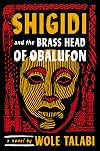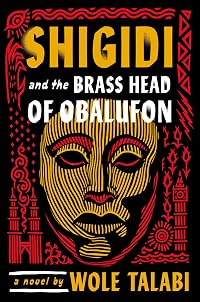
Shigidi and the Brass Head of Obalufon
by Wole Talabi
On This Page
Description
The debut fantasy novel from an award-winning, Nebula-nominated Nigerian author A mythic tale of disgruntled gods, revenge, and a heist across two worlds, perfect for fans of Nnedi Okorafor, Neil Gaiman, Marlon James, and Karen Lord Shigidi is a disgruntled and demotivated nightmare god in the Orisha spirit company, reluctantly answering 1 / 7 prayers of his few remaining believers to maintain his existence long enough to find his next drink. When he meets Nneoma, a sort-of succubus with a show more long and secretive past, everything changes for him. Together, they attempt to break free of his obligations and the restrictions that have bound him to his godhood and navigate the parameters of their new relationship in the shadow of her past. But the elder gods that run the Orisha spirit company have other plans for Shigidi, and they are not all aligned-or good. From the boisterous streets of Lagos to the swanky rooftop bars of Singapore and the secret spaces of London, Shigidi and Nneoma will encounter old acquaintances, rival gods, strange creatures, and manipulative magicians as they are drawn into a web of revenge, spirit business, and a spectacular heist across two worlds that will change Shigidi's understanding of himself forever and determine the fate of the Orisha spirit company. show lessTags
Recommendations








Member Reviews
Shigidi is one of the minor Yoruba deities, a short, ugly god of nightmares who specializes in playing on people's fears and scaring them to death as they sleep. He works for the Orisha Spirit Company -- Talabi here conceives of the various deities as part of a corporate bureaucracy -- and doesn't enjoy his work very much.
Things change when he meets the gorgeous succubus Nneoma, who convinces Shigidi to leave Orisha, go independent, and team up with her on various demonic enterprises; in exchange, she'll transform him into a tall, powerful hunk and teach him to use all of the power he never knew he had.
But the elder gods at Orisha aren't done with Shigidi, and they rope him and Nneoma into doing One Last Job -- a heist in which they show more must recover a stolen artifact from the British Museum.
That's a marvelous premise, but I'm afraid it doesn't live up to its potential. The novel bounces around in time with every chapter. It gets hard to keep track of where/when we are, and Talabi often steps on his own big moments by revealing their eventual outcomes before actually showing us the events.
And the climactic gods-vs-gods battle has the same problem that has led to growing exhaustion with the Marvel Cinematic Universe and other superhero stories. When the characters are this powerful, their fights aren't all that interesting. Bash bash rip off an arm smash crush stab the giant beat hit thrash. Yawn. The characters are so powerful, so close to omnipotence, that it's hard for me as a mere mortal to feel like there are any real stakes. Even when Talabi finds a way to put one of his gods at risk of something like death, it never feels like an actual threat; we know there's going to be some godly loophole of salvation.
As lively and colorful as Talabi's god characters are, I wanted a bigger touch of humanity. There's only one significant human among the supporting players (their identity is one of the book's more unexpected revelations), and even they have already cheated death at least once.
I liked the energy Talabi brings to the story, his characters are vivid, and some of the set pieces are filled with great energy. I will certainly be interested to see what he might do in a second novel (and there are already two collections of short stories that might be worth a look). But this one didn't quite work for me. show less
Things change when he meets the gorgeous succubus Nneoma, who convinces Shigidi to leave Orisha, go independent, and team up with her on various demonic enterprises; in exchange, she'll transform him into a tall, powerful hunk and teach him to use all of the power he never knew he had.
But the elder gods at Orisha aren't done with Shigidi, and they rope him and Nneoma into doing One Last Job -- a heist in which they show more must recover a stolen artifact from the British Museum.
That's a marvelous premise, but I'm afraid it doesn't live up to its potential. The novel bounces around in time with every chapter. It gets hard to keep track of where/when we are, and Talabi often steps on his own big moments by revealing their eventual outcomes before actually showing us the events.
And the climactic gods-vs-gods battle has the same problem that has led to growing exhaustion with the Marvel Cinematic Universe and other superhero stories. When the characters are this powerful, their fights aren't all that interesting. Bash bash rip off an arm smash crush stab the giant beat hit thrash. Yawn. The characters are so powerful, so close to omnipotence, that it's hard for me as a mere mortal to feel like there are any real stakes. Even when Talabi finds a way to put one of his gods at risk of something like death, it never feels like an actual threat; we know there's going to be some godly loophole of salvation.
As lively and colorful as Talabi's god characters are, I wanted a bigger touch of humanity. There's only one significant human among the supporting players (their identity is one of the book's more unexpected revelations), and even they have already cheated death at least once.
I liked the energy Talabi brings to the story, his characters are vivid, and some of the set pieces are filled with great energy. I will certainly be interested to see what he might do in a second novel (and there are already two collections of short stories that might be worth a look). But this one didn't quite work for me. show less
My expectation going into this novel was that I was going to be reading a kind of modern-day "sword and sorcery" type epic, and there is some of that as it's definitely a caper book and it's very hard-boiled; the main characters are far from nice and individual motivations tend to be "transactional" and expedient. That said, the characters grew on me and I thought that the flashback structure of the book worked, as it all eventually coalesces down to a really good climax of emotional and personal transcendence for the main characters. If Talabi intends to set more novels in this milieu I'll be happy to give them a try.
As for who I think might like this book, assuming you're coming to Talabi cold (I've had no exposure to his short show more fiction), if you've been reading Ben Aaronovitch ("Rivers of London") and Charlie Stross ('The Laundry"), this might scratch the same itch. show less
As for who I think might like this book, assuming you're coming to Talabi cold (I've had no exposure to his short show more fiction), if you've been reading Ben Aaronovitch ("Rivers of London") and Charlie Stross ('The Laundry"), this might scratch the same itch. show less
https://fromtheheartofeurope.eu/shigidi-and-the-brass-head-of-obalufon-by-wole-t...
There is probably a whole subgenre out there of books about stealing items from the British museum. The only other one I have read is a Lovejoy novel, The Very Last Gambado. Both Lovejoy and the protagonist here, Shigidi, arbitrate between their own homelands and cultures (East Anglia and Nigeria respectively) and the symbolic centre of imperial cultural theft, the British Museum, and obviously we cheer for the insurgents both times.
It’s a richly imagined, sexy contemporary magical world, with the metaphors about colonialism and cultural appropriation text rather than subtext; and the sense of place is very good in both Nigeria and London. Entertaining show more to see Aleister Crowley still alive and taking an interest in contemporary affairs. I did feel that the system of magic and godhood was rather over-bureaucratised, using frankly Western concepts of management which are good for the 21st century in Nigeria or England but would hardly have been around for the millennia! Still, enjoyable and short. show less
There is probably a whole subgenre out there of books about stealing items from the British museum. The only other one I have read is a Lovejoy novel, The Very Last Gambado. Both Lovejoy and the protagonist here, Shigidi, arbitrate between their own homelands and cultures (East Anglia and Nigeria respectively) and the symbolic centre of imperial cultural theft, the British Museum, and obviously we cheer for the insurgents both times.
It’s a richly imagined, sexy contemporary magical world, with the metaphors about colonialism and cultural appropriation text rather than subtext; and the sense of place is very good in both Nigeria and London. Entertaining show more to see Aleister Crowley still alive and taking an interest in contemporary affairs. I did feel that the system of magic and godhood was rather over-bureaucratised, using frankly Western concepts of management which are good for the 21st century in Nigeria or England but would hardly have been around for the millennia! Still, enjoyable and short. show less
The first novel by Nigerian author Wole Talabi is a rational fantasy with the orisha Shigidi as the protagonist, and his succubus partner Nneoma receiving at least as much attention. In pacing and tone, it reminded me a little of Charles Stross' Laundry books, although its presentation of the supernatural is of course somewhat different.
The orishas are organized in a quasi-commercial "spirit company," and the story suggests that the same is true for deities of other cultures. Shigidi's understanding of the cosmos relates to an Isese creation narrative. Nneoma meanwhile is preoccupied with an originary Fall.
There are some rough edges to the writing, which overall tends in a somewhat cinematic direction. It stumbles a bit with show more parliamentary jargon in the board meeting of the Orisha Spirit Company. The instances of explicit sex are written tastefully and effectively.
I was surprised on page 87 to discover that Aleister Crowley is a key and persistent supporting character. The characterization is reasonably well-handled and features Victor Neuburg also. Strangely, a couple of references to Samuel Liddell Mathers changed him to "Samuel Albus Dell" (90, 183) just as the Hermetic Order of the Golden Dawn is called "the Third Dawn."
On the strength of this book, I might well try other stories by Talabi. show less
The orishas are organized in a quasi-commercial "spirit company," and the story suggests that the same is true for deities of other cultures. Shigidi's understanding of the cosmos relates to an Isese creation narrative. Nneoma meanwhile is preoccupied with an originary Fall.
There are some rough edges to the writing, which overall tends in a somewhat cinematic direction. It stumbles a bit with show more parliamentary jargon in the board meeting of the Orisha Spirit Company. The instances of explicit sex are written tastefully and effectively.
I was surprised on page 87 to discover that Aleister Crowley is a key and persistent supporting character. The characterization is reasonably well-handled and features Victor Neuburg also. Strangely, a couple of references to Samuel Liddell Mathers changed him to "Samuel Albus Dell" (90, 183) just as the Hermetic Order of the Golden Dawn is called "the Third Dawn."
On the strength of this book, I might well try other stories by Talabi. show less
**.5
American Gods, but African, with 350% more sex, Alastair Crowley, office politics, and an art heist. It doesn't really work.
And like so many recent books I've read, told out of order, jumping around through time for no good reason than to prevent the reader to ever get into a flow with the story or characters. No wait, that's a terrible reason.
A couple of positives saved it from being awful. The writing, although clumsy in spots, was luridly and provocatively descriptive. And the themes of love, faith, power, and redemption provided a mythic quality that made the otherwise unrealistic elements somewhat palatable.
American Gods, but African, with 350% more sex, Alastair Crowley, office politics, and an art heist. It doesn't really work.
And like so many recent books I've read, told out of order, jumping around through time for no good reason than to prevent the reader to ever get into a flow with the story or characters. No wait, that's a terrible reason.
A couple of positives saved it from being awful. The writing, although clumsy in spots, was luridly and provocatively descriptive. And the themes of love, faith, power, and redemption provided a mythic quality that made the otherwise unrealistic elements somewhat palatable.
Realistically, this is just under 4 stars, I wanted more from this story, but it was still an interesting, fun look into Nigerian lore and mythos, along with an unusual heist story.
Members
- Recently Added By
Lists

Fiction Featuring Real People
81 works; 17 members
Author Information

20+ Works 359 Members
Some Editions
Awards and Honors
Awards
Distinctions
Notable Lists
Common Knowledge
- Original title
- Shigidi and the Brass Head of Obalufon
- Original publication date
- 2023
- People/Characters
- Shigidi; Nneoma; Olorun; Aleister Crowley; Victor Neuburg
- Important places
- London, England, UK
- Dedication
- For my mother, Sola, who left us too soon. Thank you for your love and your words and for letting me help you with your theology studies all those years ago.
- First words
- So, there he was, barely conscious in the back of a black cab being driven down the Haymarket road on the spirit-side of London by a man who died seventy years ago, when Nneoma finally told Shigidi that she loved him.
- Last words
- (Click to show. Warning: May contain spoilers.)And with that, they stepped into the gateway, together.
- Original language
- English
Classifications
Statistics
- Members
- 192
- Popularity
- 170,646
- Reviews
- 7
- Rating
- (3.35)
- Languages
- English
- Media
- Paper, Audiobook, Ebook
- ISBNs
- 7
- ASINs
- 5