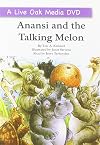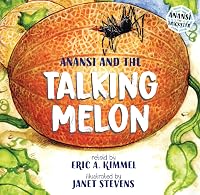
Anansi and the Talking Melon
by Eric A. Kimmel
On This Page
Description
A clever spider tricks Elephant and some other animals into thinking the melon in which he is hiding can talk.Tags
Recommendations

Member Reviews
Elephant works industriously in his garden while that trickster spider Anansi watches, yearning after the melons he is too lazy to cultivate himself. When Elephant goes inside for a rest, Anansi eats his way into the ripest melon, but gorges so much that he is too fat to get out again. Convincing Elephant that his voice is that of the melon, that the melon can in fact talk, the trickster is carried along to the king, with a growing procession of animals accompanying him on his journey. When his sarcasm earns the king's ire, the melon is smashed and Anansi released...
Anansi and the Talking Melon is the second picture-book about this famous West African trickster figure that I have read from author Eric A. Kimmel and illustrator Janet show more Stevens, following upon their Anansi and the Moss-Covered Rock. It pairs an amusing cumulative tale with expressive artwork that perfectly captures the humor of the story. The ending here, in which Elephant vows never to listen to talking melons again, only for Anansi, hidden inside a banana he is eating, to commend his choice, had me laughing out loud. It was such a pleasant and amusing ending to the story that I raised my rating from three to four stars. My only criticism of the book, and it is the same I made for Kimmel and Stevens' earlier book, is that no source material is given for this retelling, something I really look for in folkloric works. Recommended to Anansi fans, and to folklore lovers in general. show less
Anansi and the Talking Melon is the second picture-book about this famous West African trickster figure that I have read from author Eric A. Kimmel and illustrator Janet show more Stevens, following upon their Anansi and the Moss-Covered Rock. It pairs an amusing cumulative tale with expressive artwork that perfectly captures the humor of the story. The ending here, in which Elephant vows never to listen to talking melons again, only for Anansi, hidden inside a banana he is eating, to commend his choice, had me laughing out loud. It was such a pleasant and amusing ending to the story that I raised my rating from three to four stars. My only criticism of the book, and it is the same I made for Kimmel and Stevens' earlier book, is that no source material is given for this retelling, something I really look for in folkloric works. Recommended to Anansi fans, and to folklore lovers in general. show less
This is a humorous book about a mischievous little spider. The spider tricks an elephant into thinking a melon can actually talk. I really enjoyed this book and the humor that the spider brought to it.
Eric Kimmel’s comical retelling of West African trickster tale, Anansi and the Talking Melon, is ideal material for story time read alouds. The insolent Anansi entertains himself by tricking all the animals into thinking he is the voice of a talking melon. As each animal has a joke made at their expense, they assemble to present the talking melon to the king monkey. When the melon insults the king with a real humdinger, the melon gets thrown and broken, freeing Anansi to tease again. The illustrations by Janet Stevens add to the humor of the story with outraged expressions of the offended animals. This Anansi tale would be a welcome addition to any Anansi folklore collection
The few Anansi folktales that I have read are some are the quirkiest books I’ve read in a while. This one is particular is fairly strange but nothing compared to the other I’m reviewing later. This is so great for younger readers for how differently these are retold. Anansi is a great character for younger kids to live through, especially considering how flawed he is as a person. He isn’t necessarily bad, but mischievous and kids would be able to tell that he isn’t the greatest role model. I would defiantly recommend this to children.
Anansi, the spider, has got some tricks up his sleeve when he decides to mess with an elephant one day. Anansi decided he was going to eat one of the elephants melons because they looked so good and he was too lazy to plant one of his own. However, after Anansi got into the melon he could not get out. Anansi tricked all of the others in town into thinking the elephant had a talking melon, but he was just having fun messing with everyone. This story was a great story to read, and students would probably get a good laugh out of it. This book could also open up discussions about right and wrong, and if the students thought what Anansi did was right or. wrong. Anansi never gets punished in the end, but maybe he should for the trick he show more played on everyone. Overall, it was a great book and I would absolutely read it to a class of students. show less
This African Myth tells of Anansi the spider, a mischief maker who loves to tease others almost as much as he likes to eat. Lazy Anansi, who does'nt want to grow his own melons, eats his way into the center of one of his neighbor elepantsmelons, and proceeds to eat so much that he can't get out of the hole he made because his tummy is too big! Bored, he tricks all the animals into thinking that the melon is talking (and one with a sharp tounge at that!).
Anansi and the Talking Melon
Bryan O’Keeffe
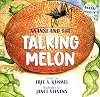
This book was extremely cute and I enjoyed reading this book a lot. The first thing that caught my eye was the cover. It is a giant elephant holding a melon with a spider on top. At first I thought Anansi was going to be the Elephant not the spider. Of course I was wrong but that was stated on the first page. The other thing that caught my eye were the illustrations. I always like a book with good illustrations. I feel as if they either make or break a book. These illustrations made the book. With the story having talking insects and animals as the main characters the illustrations certainly helped make the characters be even more believable. The story though helped as well because all of the show more animals had great personalities. That was obvious when the spider Anansi or the “talking melon” would insult the animals because they did not believe the melon could talk. One insult was, “Warthog started to laugh. ‘A talking melon? Why that’s as ridiculous as…’ ‘… a handsome warthog.’ said the melon. Warthog got so angry he shook all over.” Having conflicts as these and the reactions seem like they would actually happen helps make the characters believable and helps make the story really enjoyable.
The plot was well organized and was written really well. Everything flowed together nicely as the Elephant traveled to see the King; going from animal to animal to show the talking melon. The point of view is once again in the third person point of view. Any other and the story might not have be as engaging. The message of this book kind of gets a little muddied in the middle of the story. I feel once the Elephant brings the melon to the King does the message become clear again; never believe everything you hear until you see it for yourself. show less
Bryan O’Keeffe
This book was extremely cute and I enjoyed reading this book a lot. The first thing that caught my eye was the cover. It is a giant elephant holding a melon with a spider on top. At first I thought Anansi was going to be the Elephant not the spider. Of course I was wrong but that was stated on the first page. The other thing that caught my eye were the illustrations. I always like a book with good illustrations. I feel as if they either make or break a book. These illustrations made the book. With the story having talking insects and animals as the main characters the illustrations certainly helped make the characters be even more believable. The story though helped as well because all of the show more animals had great personalities. That was obvious when the spider Anansi or the “talking melon” would insult the animals because they did not believe the melon could talk. One insult was, “Warthog started to laugh. ‘A talking melon? Why that’s as ridiculous as…’ ‘… a handsome warthog.’ said the melon. Warthog got so angry he shook all over.” Having conflicts as these and the reactions seem like they would actually happen helps make the characters believable and helps make the story really enjoyable.
The plot was well organized and was written really well. Everything flowed together nicely as the Elephant traveled to see the King; going from animal to animal to show the talking melon. The point of view is once again in the third person point of view. Any other and the story might not have be as engaging. The message of this book kind of gets a little muddied in the middle of the story. I feel once the Elephant brings the melon to the King does the message become clear again; never believe everything you hear until you see it for yourself. show less
Members
- Recently Added By
Lists

A Child's Book Tour of West Africa ::: Côte d'Ivoire, Mali, Ghana, Nigeria
59 works; 5 members
Author Information

142+ Works 16,978 Members
Eric Kimmel was born in Brooklyn, NY in 1946. He received a bachelor's degree in English Literature from Lafayette College. He also has a Ph.D. in Education from the University of Illinois. He was an elementary school teacher and college professor before becoming a full-time writer. He has published over fifty titles, many of which have won state show more and national awards. His titles "Hershel and the Hanukkah Goblins" won the Caldecott Honor Medal, "The Chanukkah Guest" and "Gershon's Monster" won the Sydney Taylor Picture Book Award and "Anansi and the Talking Melon" won the Utah Children's Choice Award. Kimmel travels nationally and internationally visiting schools and talking about his books and telling stories. (Bowker Author Biography) show less
All Editions
Some Editions
Awards and Honors
Awards
Common Knowledge
- Canonical title
- Anansi and the Talking Melon
- Original publication date
- 1994
- People/Characters
- Anansi
- Dedication
- To Thomas and Timothy- E.A.K. To my friend, Gail-J.S.
- First words
- One fine morning Anansi the Spider sat high up in a thorn tree looking down into Elephant's garden.
- Quotations
- "Good for you, Elephant!" Anansi called from the bananas. "We bananas should have warned you. Talking melons are nothing but trouble."
- Last words
- (Click to show. Warning: May contain spoilers.)"Talking melons are nothing but trouble."
- Original language
- English
Classifications
- Genres
- Children's Books, Picture Books
- DDC/MDS
- 398.24 — Society, government, & culture Customs, etiquette & folklore Folklore & Folktales Folk literature Fables, Magical Creatures
- LCC
- PZ8.1 .K567 .A — Language and Literature Fiction and juvenile belles lettres Fiction and juvenile belles lettres Juvenile belles lettres
- BISAC
Statistics
- Members
- 575
- Popularity
- 51,571
- Reviews
- 27
- Rating
- (3.98)
- Languages
- English
- Media
- Paper, Audiobook, Ebook
- ISBNs
- 21