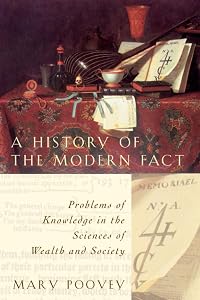
A History of the Modern Fact: Problems of Knowledge in the Sciences of Wealth and Society
by Mary Poovey
On This Page
Description
How did the fact become modernity's most favored unit of knowledge? How did description come to seem separable from theory in the precursors of economics and the social sciences? Mary Poovey explores these questions in A History of the Modern Fact, ranging across an astonishing array of texts and ideas from the publication of the first British manual on double-entry bookkeeping in 1588 to the institutionalization of statistics in the 1830's. She shows how the production of systematic show more knowledge from descriptions of observed particulars influenced government, how numerical representation became the privileged vehicle for generating useful facts, and how belief-whether figured as credit, credibility, or credulity-remained essential to the production of knowledge. Illuminating the epistemological conditions that have made modern social and economic knowledge possible, A History of the Modern Fact provides important contributions to the history of political thought, economics, science, and philosophy, as well as to literary and cultural criticism. show lessTags
Recommendations


























Member Reviews
Mary Poovey's extraordinary analysis begins, as she notes in the introduction, with her noting a curious shift that occurs in historical discourse, in which numbers somehow acquire an authority and trustworthiness in describing reality that they simply did not possess in earlier periods. This apparent objectivity of numbers and statistics, in other words, is not a natural state of affairs, but the product of a long historical debate about knowledge, reality, and what can be trusted when attempting to describe the world.
Chapter 1 begins by reflecting on what exactly we mean by a fact. A fact is usually thought of as a particular, a particular that in turn needs to be understood within the larger context or system of which it is a part. show more That said, there have been different ways of approaching this question of the fact. The ancient, Aristotelian way was to look upon facts as things that confirmed the order of things, as "commonplaces." This way of looking at things is overturned in the seventeenth century by Francis Bacon, who reverses Aristotle's perspective by asking how we account for those facts that don't fit into the commonplace, that disrupt the system.
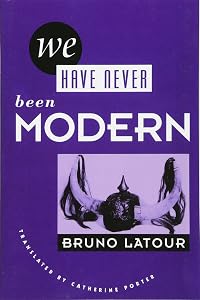
Poovey locates Bacon's revolutionary new perspective within a larger discourse that owes an explicit debt to Bruno Latour's [b:We Have Never Been Modern|134569|We Have Never Been Modern|Bruno Latour|https://i.gr-assets.com/images/S/compressed.photo.goodreads.com/books/1348835649l/134569._SY75_.jpg|3058288]. Latour argues that early thinkers of modernity, from Bacon to Boyle to Hobbes, engaged in a false separation of nature and society. On one side, there is the objective reality, on the other, the discourse that describes it. This division makes possible a theoretical separation between "objective" or "scientific" description of facts, and their political interpretation.
Poovey's task, then, is to question and interrogate this separation, to reveal the extent to which knowledge and interpretation, fact and rhetoric are inextricably intertwined with each other. The emphasis on numbers and statistics, which is grounded in a denial of rhetoric in favor of "plain speaking" and "hard facts," is just one strategy among many that conceals the reality that numbers are also selective and interpretive. To prove this point, Poovey signals her intention of looking at the historical tools that were developed to promote the illusion of the modern fact, beginning with the phenomenon of double-entry book-keeping. show less
Chapter 1 begins by reflecting on what exactly we mean by a fact. A fact is usually thought of as a particular, a particular that in turn needs to be understood within the larger context or system of which it is a part. show more That said, there have been different ways of approaching this question of the fact. The ancient, Aristotelian way was to look upon facts as things that confirmed the order of things, as "commonplaces." This way of looking at things is overturned in the seventeenth century by Francis Bacon, who reverses Aristotle's perspective by asking how we account for those facts that don't fit into the commonplace, that disrupt the system.
Poovey locates Bacon's revolutionary new perspective within a larger discourse that owes an explicit debt to Bruno Latour's [b:We Have Never Been Modern|134569|We Have Never Been Modern|Bruno Latour|https://i.gr-assets.com/images/S/compressed.photo.goodreads.com/books/1348835649l/134569._SY75_.jpg|3058288]. Latour argues that early thinkers of modernity, from Bacon to Boyle to Hobbes, engaged in a false separation of nature and society. On one side, there is the objective reality, on the other, the discourse that describes it. This division makes possible a theoretical separation between "objective" or "scientific" description of facts, and their political interpretation.
Poovey's task, then, is to question and interrogate this separation, to reveal the extent to which knowledge and interpretation, fact and rhetoric are inextricably intertwined with each other. The emphasis on numbers and statistics, which is grounded in a denial of rhetoric in favor of "plain speaking" and "hard facts," is just one strategy among many that conceals the reality that numbers are also selective and interpretive. To prove this point, Poovey signals her intention of looking at the historical tools that were developed to promote the illusion of the modern fact, beginning with the phenomenon of double-entry book-keeping. show less
Ratings
Members
- Recently Added By
Lists

Books referenced in David Weinberger's Too Big to Know
65 works; 2 members

Books referenced in History by Numbers by Pat Hudson
88 works; 1 member
Author Information
7+ Works 410 Members
Mary Poovey is the Samuel Rudin University Professor in the Humanities and professor of English at New York University
Awards and Honors
Awards
Classifications
- Genres
- Nonfiction, History, Economics, Sociology, General Nonfiction, Science & Nature, Philosophy
- DDC/MDS
- 300.7 — Society, government, & culture Social sciences, sociology & anthropology Social sciences Education And Research
- LCC
- HA29 .P639 — Social sciences Statistics Statistics Theory and method of social science statistics
- BISAC
Statistics
- Members
- 128
- Popularity
- 255,666
- Reviews
- 1
- Rating
- (4.08)
- Languages
- English
- Media
- Paper, Ebook
- ISBNs
- 4