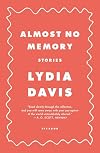
Almost No Memory
by Lydia Davis
On This Page
Description
Stories by an experimental writer, ranging in length from a sentence to several pages. One story describes the way a few ill-chosen words can turn a minor dispute into high drama, another is on the bad luck of an explorer who accomplishes a perilous expedition, only to die on his way home. By the author of The End of the Story.Tags
Recommendations














Member Reviews
I've broken up reading this book into the four previous books that are collected into the one because reading Davis is not something to be rushed through but to be savored. Most of these are not, strictly speaking, short stories. They are not prose poems either. I don't know what they are. Disarming. They are closer to meditations, but without the stern attention, say of Marcus Aurelius or the . . . no wait . . . I was going to write "bemusement" of Montaigne, but in fact, there is bemusement, there is philosophizing, there is seriousness, there is wicked humor (perhaps more wicked and sustained than Montaigne's). Davis is a treasure. Don't say to yourself, "I don't read short stories." *****
Lydia Davis, also known as Lydia Fucking Davis to her adoring & mindblown fans, is not for everyone, but she is certainly for me. Her voice is characteristically clever, playful, effortlessly humorous, ruminating, unpretentiously philosophical, and it is an especial delight to be caught in one of those short stories where it's pure wordplay in the most crystallised, simplest of sentences. Forget Hemingway, if we want to teach the art of simple, clear sentences that hold the full weight of suggestion, we ought to teach Lydia Fucking Davis!
I mean, look at this sentence alone:
Her stories are a peek into the banal every day and the pure complexity those moments can have, and she does this even with fiction that is speculative (wife turning into cedar trees / in a village of 12 people there was the 13th person). She parses down the twisted depths of our interiority, our thought processes that we've all been through before but never really thought was worth writing about. The subtle indignities of everyday life. She does not tackle issues so much as present its absurdity. The couples in her story are mildly discontented and always seem to be halfway out of love, and these stories are my favourite because it seems to be where her humour is best employed.
No wonder she's such a cult favourite. Her short stories are such an unadulterated delight. To know that it's possible, that we can be free to write a short story this way, in so little words, in so many permutations of the same kinds of sentences -- how liberating, how fun! show less
I mean, look at this sentence alone:
"She probably said something casual about how the evening was. If she hadn't spoken, his fury might not have been unleashed by the gentle sound of her voice. But inshow more
that instant he must have realized that for him the evening could never be as soft as it was for her."
Her stories are a peek into the banal every day and the pure complexity those moments can have, and she does this even with fiction that is speculative (wife turning into cedar trees / in a village of 12 people there was the 13th person). She parses down the twisted depths of our interiority, our thought processes that we've all been through before but never really thought was worth writing about. The subtle indignities of everyday life. She does not tackle issues so much as present its absurdity. The couples in her story are mildly discontented and always seem to be halfway out of love, and these stories are my favourite because it seems to be where her humour is best employed.
"Often I think that his idea of what we should do is wrong, and my idea is right. Yet I know that he has often been right before, when I was wrong. And so I let him make the wrong decision, telling myself, though I can't believe it, that his wrong decision may actually be right. And then later it turns out, as it often has before, that his decision was the right one, after all. Or, rather, his decision was still wrong, but wrong for circumstances different from the circumstances as they actually were, while it was right for circumstances I clearly did not understand."
No wonder she's such a cult favourite. Her short stories are such an unadulterated delight. To know that it's possible, that we can be free to write a short story this way, in so little words, in so many permutations of the same kinds of sentences -- how liberating, how fun! show less
Between the considerable avoirdupois of Zola's Germinal and Perec's Life A User's Manual I needed to insert some verbal economy into my reading life. Lydia Davis's Almost No Memory was the perfect choice: subtly unlike anything else I have ever read, Davis takes the short story to new heights of concision, and does so in such a distinctive narrative voice that I walked around for days with a Davis-esque internal narrator commenting on my every move. Then I read a selection of these stories over again, out loud to David, and we had entire conversations in which both sides mimicked her tone. Her stories—she calls them stories; I might have been tempted to use the word "pieces" instead—are sometimes as short as half a page; they are show more crystal-like in their precision; yet they have a movement and a logic which are intensely compelling. I found myself re-reading many of the pieces in Almost No Memory, each time more slowly, to try to elicit their secrets, to figure out exactly how she was doing that—indeed, to discern what it was she was doing. Here, for example, is the entirety of her story "How He is Often Right":
How He Is Often Right
I love how the last sentence here, like the third line of a haiku, nudges the reader into a different, slightly unsettling perspective on what has gone before. The "reality" of the situation here is so contingent, so shifting, and the speaker's insistence that "his" decision was still wrong, just for circumstances different than the ones that turned out to be true, gives me a bit of vertigo when I think of making any decisions at all—territory intimately familiar to many speakers in this collection.
Davis's stories often have to do with perceptual differences and difficulties, and the distance between people who are attempting to communicate. She also seems preoccupied with movement and stagnation, and how attempts at communication affect that movement—or fail to affect it. Here, for example, is one of my favorite stories, "In the Garment District":
In the Garment District
I think this may be one of the most perfect stories I have ever read, although I still don't totally understand why I feel that way. Despite its brevity, it has such flow and texture; the way the long, bustling sentence about the complex shop/warehouse dynamic is followed by the stillness of "To the man all this is nothing," for example. It's as if the ludicrous tension building between the shop and the warehouse, the speaker's (or reader's) incredulity, even anger, at this bizarre situation in which a man is getting paid to transport the same clothes back and forth day after day, suddenly just...breaks. The building frustration of the first sentences is suddenly dispelled: nothing need change about this daily routine, because of the still waters of the man's indifference. The last portion of the final sentence, that the man "intends to leave the company soon, though the right moment has not yet come," deposits the reader softly into a state of stasis which, though indefinite, may nonetheless break at any time.
There are longer stories in Almost No Memory, including one I particularly loved involving a speaker who was once taken with the idea of marrying a cowboy. In some cases these longer pieces feel more like traditional "stories" to me, although in other cases, like the sad and excellent "Glen Gould," they maintain Davis's unique quality of laconically considering a situation while refusing to reach resolution. Several stories, in particular "The Center of the Story" and "What was Interesting" are metafictions (unsurprising considering that Davis was once married to Paul Auster), but, I thought, very successful in managing to carry emotional weight as well as being clever bits of writing-about-writing-about-writing.
Although I began to form an idea of a "typical" Davis narrator by the end of the collection—a female college professor, prone to drink and quietly unhappy in her marriage—her range of subjects is actually much wider. From the grand tour of an eighteenth-century English lord, to more grotesque, fantastical events like those in "The Cedar Trees" ("When our women had all turned into cedar trees they would group together in a corner of the graveyard..."), Davis spreads her net wide. And yet, I think there's a reason I feel surprised at this realization: her odd magic works independently of her subject matter. Even at her most mundane, all her stories seemed a bit unnerving— and likewise, even at her most fantastical, her tone remains wry and analytical, observing well and following each thought through to its logical conclusion, which often turns out not to seem logical at all. One of my favorite examples of this happens in the longer story "St. Martin," in which Davis's speaker describes going for (and returning from) a walk.
I mean, how quotidian is that, and how eerie? What a gorgeous scene. What a gorgeous collection. show less
How He Is Often Right
Often I think that his idea of what we should do is wrong, and my idea is right. Yet I know that he has often been right before, when I was wrong. And so I let him make his wrong decision, telling myself, though I can't believe it, that his wrong decision may actually be right. And then later it turns out, as it often has before, that his decision was the right one, after all. Or rather, his decision was still wrong, but wrong for circumstances different from the circumstances as they actually were, while it was right for circumstances I clearly did not understand.
I love how the last sentence here, like the third line of a haiku, nudges the reader into a different, slightly unsettling perspective on what has gone before. The "reality" of the situation here is so contingent, so shifting, and the speaker's insistence that "his" decision was still wrong, just for circumstances different than the ones that turned out to be true, gives me a bit of vertigo when I think of making any decisions at all—territory intimately familiar to many speakers in this collection.
Davis's stories often have to do with perceptual differences and difficulties, and the distance between people who are attempting to communicate. She also seems preoccupied with movement and stagnation, and how attempts at communication affect that movement—or fail to affect it. Here, for example, is one of my favorite stories, "In the Garment District":
In the Garment District
A man has been making deliveries in the garment district for years now: every morning he takes the same garments on a moving rack through the streets to a shop and every evening takes them back again to the warehouse. This happens because there is a dispute between the shop and the warehouse which cannot be settled: the shop denies it ever ordered the clothes, which are badly made and of cheap material and by now years out of style; while the warehouse will not take responsibility because the clothes cannot be returned to the wholesalers, who have no use for them. To the man all this is nothing. They are not his clothes, he is paid for this work, and he intends to leave the company soon, though the right moment has not yet come.
I think this may be one of the most perfect stories I have ever read, although I still don't totally understand why I feel that way. Despite its brevity, it has such flow and texture; the way the long, bustling sentence about the complex shop/warehouse dynamic is followed by the stillness of "To the man all this is nothing," for example. It's as if the ludicrous tension building between the shop and the warehouse, the speaker's (or reader's) incredulity, even anger, at this bizarre situation in which a man is getting paid to transport the same clothes back and forth day after day, suddenly just...breaks. The building frustration of the first sentences is suddenly dispelled: nothing need change about this daily routine, because of the still waters of the man's indifference. The last portion of the final sentence, that the man "intends to leave the company soon, though the right moment has not yet come," deposits the reader softly into a state of stasis which, though indefinite, may nonetheless break at any time.
There are longer stories in Almost No Memory, including one I particularly loved involving a speaker who was once taken with the idea of marrying a cowboy. In some cases these longer pieces feel more like traditional "stories" to me, although in other cases, like the sad and excellent "Glen Gould," they maintain Davis's unique quality of laconically considering a situation while refusing to reach resolution. Several stories, in particular "The Center of the Story" and "What was Interesting" are metafictions (unsurprising considering that Davis was once married to Paul Auster), but, I thought, very successful in managing to carry emotional weight as well as being clever bits of writing-about-writing-about-writing.
Although I began to form an idea of a "typical" Davis narrator by the end of the collection—a female college professor, prone to drink and quietly unhappy in her marriage—her range of subjects is actually much wider. From the grand tour of an eighteenth-century English lord, to more grotesque, fantastical events like those in "The Cedar Trees" ("When our women had all turned into cedar trees they would group together in a corner of the graveyard..."), Davis spreads her net wide. And yet, I think there's a reason I feel surprised at this realization: her odd magic works independently of her subject matter. Even at her most mundane, all her stories seemed a bit unnerving— and likewise, even at her most fantastical, her tone remains wry and analytical, observing well and following each thought through to its logical conclusion, which often turns out not to seem logical at all. One of my favorite examples of this happens in the longer story "St. Martin," in which Davis's speaker describes going for (and returning from) a walk.
We would walk, and return with burrs in our socks and scratches on our legs and arms where we had pushed through the brambles to get up into the forest, and go out again the next day and walk, and the dogs always trusted that we were setting out in a certain direction for a reason, and then returning home for a reason, but in the forest, which seemed so endless, there was hardly a distinguishing feature that could be taken as a destination for a walk, and we were simply walking, watching the sameness pass on both sides, the thorny, scrubby oaks growing densely together along the dusty track that ran quite straight until it came to a gentle bend and perhaps a slight rise and then ran straight again.
If we came home by an unfamiliar route, skirting the forest, avoiding a deeply furrowed, overgrown field and then stepping into the edge of a reedy marsh, veering close to a farmyard, where a farmer in blue and his wife in red were doing chores trailed by their dog, we felt so changed ourselves that we were surprised nothing about home had changed: for a moment the placidity of the house and yard nearly persuaded us we had not even left.
I mean, how quotidian is that, and how eerie? What a gorgeous scene. What a gorgeous collection. show less
Well, such an odd one! I don't know what to make of it.
This is the first collection of short stories I have read by Lydia Davis. I had no idea what it would be like, and if I had read the back cover that would not have given me much clue.
Most of these stories are very short, and it is hard to call them "stories" at all. Many of them explore a state of mind, a thought, an observation, turning it this way and that and looking at it. A few stories are longer, some identifiable as a story, others more like a journal. Lord Royston's Tour, for example, is a collection of brief descriptions of Royston's experiences in each locality, ending in tragedy, all of it written economically and directly, with no hint of emotion. A recording of events. show more Affecting nonetheless.
The Professor tells us about the narrator's dream of marrying a cowboy. Simple enough on the surface. It explores what a "cowboy" is, why she is interested. We find out how she wants to escape her own thinking at times. I suspect that Davis is compelled to write her thoughts to get them out, to free her from them, and that accounts for many of the little stories as well as this longer explanation.
St. Martin is a rather disturbing story about caretakers of a house, who let so much go, even a dog. It too is told without emotion, just an accounting, perhaps the more devastating because of this. I couldn't wait to get to the end of it, to be done.
Some of the little ones are funny, a little funny, a little odd. Meanderings of a unique mind.
I couldn't help but think that if I were to write stories some of them would be like these, although not really like these. I am not a story-teller. I think and wonder, and odd thoughts cross my mind. If I were to write those down I might have another version of this book. show less
This is the first collection of short stories I have read by Lydia Davis. I had no idea what it would be like, and if I had read the back cover that would not have given me much clue.
Most of these stories are very short, and it is hard to call them "stories" at all. Many of them explore a state of mind, a thought, an observation, turning it this way and that and looking at it. A few stories are longer, some identifiable as a story, others more like a journal. Lord Royston's Tour, for example, is a collection of brief descriptions of Royston's experiences in each locality, ending in tragedy, all of it written economically and directly, with no hint of emotion. A recording of events. show more Affecting nonetheless.
The Professor tells us about the narrator's dream of marrying a cowboy. Simple enough on the surface. It explores what a "cowboy" is, why she is interested. We find out how she wants to escape her own thinking at times. I suspect that Davis is compelled to write her thoughts to get them out, to free her from them, and that accounts for many of the little stories as well as this longer explanation.
St. Martin is a rather disturbing story about caretakers of a house, who let so much go, even a dog. It too is told without emotion, just an accounting, perhaps the more devastating because of this. I couldn't wait to get to the end of it, to be done.
Some of the little ones are funny, a little funny, a little odd. Meanderings of a unique mind.
I couldn't help but think that if I were to write stories some of them would be like these, although not really like these. I am not a story-teller. I think and wonder, and odd thoughts cross my mind. If I were to write those down I might have another version of this book. show less
I was disappointed by 'Samuel Johnson is Indignant,' which had a great title. I was even more disappointed by ANM, which did not have a great title, and had most of the bad qualities of the following volume (dull, generic short stories; fascination with a very narrow strip of human experience; over-use of the contemporary "talky but also intelligent because I went to a good school" style) with less of SJiI's best qualities (formal inventiveness; humor; Satie-esque irreverence). Not to say that ANM has none of that good stuff, just less.
Now, please note that readers of Davis are guaranteed to divide over what is good about her. Some prefer the long, traditional short stories; some (me) prefer the inventive, show more who-gives-a-shit-if-this-isn't-comme-il-faut snippets, fables, parables and quotations. I suspect that I should focus on later Davis, rather than try to read her first collection, but if anyone reading this can tell me otherwise, please do. I'm willing to read one more, and I want it to be the one I'll like most. show less
Now, please note that readers of Davis are guaranteed to divide over what is good about her. Some prefer the long, traditional short stories; some (me) prefer the inventive, show more who-gives-a-shit-if-this-isn't-comme-il-faut snippets, fables, parables and quotations. I suspect that I should focus on later Davis, rather than try to read her first collection, but if anyone reading this can tell me otherwise, please do. I'm willing to read one more, and I want it to be the one I'll like most. show less
What? You haven't read Lydia Davis? This novel is really original, and is a solid example of Davis's sparse, distant narration.
delightful shorts - really delightful and deep
Members
- Recently Added By
Author Information

35+ Works 4,957 Members
Lydia Davis is the author of several works of fiction. She is also a noted translator. She teaches at Bard College and lives in Port Ewen, New York. (Publisher Provided) Lydia Davis is a writer and translator. She is a professor of creative writing at the University at Albany, SUNY, and was a Lillian Vernon Distinguished Writer-in-Residence at New show more York University in 2012. Davis has published six collections of short stories, including The Thirteenth Woman and Other Stories (1976) and Break It Down (1986), a Finalist for the PEN/Hemingway Award. Her most recent collection was Varieties of Disturbance, published by Farrar, Straus and Giroux in 2007 and a Finalist for the National Book Award. Davis' stories are acclaimed for their brevity and humor. Many are only one or two sentences. Her book Can't and Won't made the New York Times Bestseller List in 2014. She has also translated Proust, Flaubert, Blanchot, Foucault, Michel Leiris, Pierre Jean Jouve and other French writers, as well as the Dutch writer A.L. Snijders. In October 2003 Davis received a MacArthur Fellowship. She was elected a Fellow of the American Academy of Arts and Sciences in 2005. Davis was announced as the winner of the 2013 Man Booker International Prize on 22 May 2013. Davis won £60,000 as part of the biennial award. (Bowker Author Biography) show less
Work Relationships
Is contained in
Common Knowledge
- Canonical title
- Almost No Memory
- Original publication date
- 1997
- First words
- My husband's favorite food, in childhood, was corned beef.
- Last words
- (Click to show. Warning: May contain spoilers.)We feel an affinity with a certain thinker because we agree with him; or because he shows us what we were already thinking; or because he shows us in a more articulate form what we were already thinking; or he shows us what we were on the point of thinking; or what we sooner or later would have thought; or what we would have thought much later if we hadn't read it now; or what we would have been likely to think but never would have thought if we hadn't read it now; or what we would have liked to think but never would have thought if we hadn't read it now.
- Blurbers
- Baxter, Charles; Dybek, Stuart; Eugenides, Jeffrey; Franzen, Jonathan; Paley, Grace
Classifications
Statistics
- Members
- 282
- Popularity
- 114,822
- Reviews
- 7
- Rating
- (4.00)
- Languages
- English, German
- Media
- Paper, Ebook
- ISBNs
- 7
- ASINs
- 2