Anna Karenina (2/2)
by Leo Tolstoy
On This Page
Description
Anna Karenina is often referred to as a pinnacle of realist fiction and flawless work of art embedding Tolstoy's true stylistic magic. Leo Tolstoy himself considered Anna Karenina his first true novel which follows life of a married socialite and her affair with the affluent Count Vronsky. The novel explores a diverse range of topics from politics to family, religion, morality, gender, social class and romance. The novel consists of eight volumes. This audio book instalment presents volume show more two. Read in Russian, unabridged, by Aleksey Bagdasarov. show lessTags
Recommendations


















Member Reviews
Bedensel rahatsızlıklar, aile içi skandallar, ideolojik, politik buhranlar. Tanrı inancına duyulan kuşkular biçiminde görünürleşen sayısız fiziksel ve ruhsal krizden ve Ortodoks Kilisesi'nden çıkartılışından bir yıl sonra (1902), yaşlı Tolstoy, Anna Karenina'yı yazdığı orta yaş yıllarını hüzün ve iç sızısıyla hatırlar. Sanatının doruğundaki en iyi yıllarının ürünü olan bu roman, yazara göre temel bir "fikri" soyut formülasyonlara başvurmadan açıklayan sanatta "biçimi" bağımsızlaştırmayıp içerik ile, fikir ile bütünleştiren bir yapıyı temsil eder. İçerik ile, sanatsal biçimin bu uyumunun sentezinde yazarın sözünü ettiği o dışavuran fikir ya da düşünce nedir? show more Yaşlı bir erkekle evlendirilmiş genç kadın (Anna Karenina) genç subay Vronski ile içine sürüklendiği ilişkiyi niçin evlilikle sonuçlandıramaz? Sosyetedeki statüsünü gözden çıkartamadığı için mi? Yoksa, Tolstoy'unu aristokrasi temelinde kurulu ideal "aile mitosunda", bireyin bütünlüğünü koruyan o büyük "organizasyonda", kadının doğal, cinsel dürtülerini yıkıcı bir tehdit gibi gören ve ona evhanımı-anne rolünün ötesinde bir sosyal varoluş alanı tanımayan muhafazakar anlayışla mı karşı karşıyayız?
Anna Karenina: Sosyal statüye feda edilen aşk.
(Arka Kapak) show less
Anna Karenina: Sosyal statüye feda edilen aşk.
(Arka Kapak) show less
A true masterpiece of world literature this colossal work spreads over two volumes with almost a thousand pages in this digital edition. What is the most intriguing is the ever so accurate depiction of the diverse feminine state of mind, the hypocritical Russian society as the backdrop of the action and the sad conclusion that even in our times things haven't changed much. Women still pay a disproportionate price for breaking free from a marriage, regardless of how meaningless it might be for them.
I listened to this book which I downloaded from my library’s electronic book site. It was read by Nadia May and I thought she did a very good job. She differentiated between the different characters by slight but unmistakable changes in intonation. I listened last year to War and Peace and I much preferred this work.
The title character is married and a mother of a young boy when the novel opens. She lives in St. Petersburg but was called to Moscow to mediate between her brother, Obolonsky, and his wife. The brother’s wife, Dolly, has discovered that Oblonsky has been unfaithful and she threatens to leave him. Anna convinces Dolly to reconcile with her husband. Dolly’s sister, Kitty, is unmarried but has recently fallen in love show more with the Count Vronsky. Vronsky seems about to propose marriage so when another suitor, Levin, proposes Kitty refuses him. However, Vronsky has met Anna and is smitten with her. He completely ignores Kitty at a ball and the next morning leaves for St. Petersburg when Anna does.
That introduces all the major characters although there are many minor players who sometimes play a role in the ultimate tragedy that befalls Anna. Vronsky and Anna have a love affair which results in a child and Anna decides to leave her husband in order to live with Vronsky. Of course this scandalizes all proper Russian society. Anna discovers that even though she is with the man she loves she cannot be happy. It is unclear to me what would make Anna happy. She knows that Vronsky loves her but she picks quarrels with him and is madly jealous whenever he goes out without her. She pines for her son who continues to live with his father but almost ignores her daughter who lives with her and Vronsky. Perhaps the opium that she takes every night to help her sleep plays a role in her increasing unhappiness. Whatever the cause she is a tragic figure and her story, of course, has an unhappy ending.
On the other hand Levin and Kitty do ultimately marry and are quite blissful. Levin is a good man who tries to improve the lot of his workers and to help his friends. He searches for a philosophy that would make sense of life for him but nothing seems quite right. At the end of the book he rediscovers his religious roots and that makes sense for him. Levin and Kitty will live happily ever after.
I’m not sure I could have waded through this book in its printed form. Even listening to it took a lot of time and attention. However I am glad I am finally able to tick this one off the list of those books that always seem to get mentioned as great literature. show less
The title character is married and a mother of a young boy when the novel opens. She lives in St. Petersburg but was called to Moscow to mediate between her brother, Obolonsky, and his wife. The brother’s wife, Dolly, has discovered that Oblonsky has been unfaithful and she threatens to leave him. Anna convinces Dolly to reconcile with her husband. Dolly’s sister, Kitty, is unmarried but has recently fallen in love show more with the Count Vronsky. Vronsky seems about to propose marriage so when another suitor, Levin, proposes Kitty refuses him. However, Vronsky has met Anna and is smitten with her. He completely ignores Kitty at a ball and the next morning leaves for St. Petersburg when Anna does.
That introduces all the major characters although there are many minor players who sometimes play a role in the ultimate tragedy that befalls Anna. Vronsky and Anna have a love affair which results in a child and Anna decides to leave her husband in order to live with Vronsky. Of course this scandalizes all proper Russian society. Anna discovers that even though she is with the man she loves she cannot be happy. It is unclear to me what would make Anna happy. She knows that Vronsky loves her but she picks quarrels with him and is madly jealous whenever he goes out without her. She pines for her son who continues to live with his father but almost ignores her daughter who lives with her and Vronsky. Perhaps the opium that she takes every night to help her sleep plays a role in her increasing unhappiness. Whatever the cause she is a tragic figure and her story, of course, has an unhappy ending.
On the other hand Levin and Kitty do ultimately marry and are quite blissful. Levin is a good man who tries to improve the lot of his workers and to help his friends. He searches for a philosophy that would make sense of life for him but nothing seems quite right. At the end of the book he rediscovers his religious roots and that makes sense for him. Levin and Kitty will live happily ever after.
I’m not sure I could have waded through this book in its printed form. Even listening to it took a lot of time and attention. However I am glad I am finally able to tick this one off the list of those books that always seem to get mentioned as great literature. show less
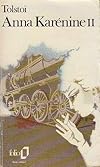
D'un pas rapide et léger, elle descendit le! marches et, postée près de la voie, elle scruta les oeuvres basses du train qui la frôlait, les chaînes, les essieux, les grandes roues de fonte cherchant à mesurer de l'oeil la distance qui séparait les roues de devant de celles de derrière «Là, se dit-elle en fixant dans ce trou noir le traverses recouvertes de sable et de poussier là, au beau milieu; il sera puni et je sera délivrée de tous et de moi-même.
Ratings
Members
- Recently Added By
Author Information

2,509+ Works 129,715 Members
Count Lev Nikolayevich Tolstoy was born on September 9, 1828 in Russia. He is usually referred to as Leo Tolstoy. He was a Russian author who is regarded as one of the greatest authors of all time. Leo Tolstoy is best known for his novels War and Peace (1869) and Anna Karenina (1877). Tolstoy's fiction includes dozens of short stories and several show more novellas such as The Death of Ivan Ilyich, Family Happiness, and Hadji Murad. He also wrote plays and numerous philosophical essays. Tolstoy had a profound moral crisis and spiritual awakening in the 1870's which he outlined in his work, A Confession. His literal interpretation of the ethical teachings of Jesus, centering on the Sermon on the Mount, caused him to become a fervent Christian anarchist and pacifist. His ideas of nonviolent resistance which he shared in his works The Kingdom of God is Within You, had a profund impact on figures such as Mohandas Gandhi and Martin Luther King, Jr. On September 23, 1862 Tolstoy married Sophia Andreevna Behrs. She was the daughter of a court physician. They had 13 children, eight of whom survived childhood. Their early married life allowed Tolstoy much freedom to compose War and Peace and Anna Karenina with his wife acting as his secretary and proofreader. The Tolstoy family left Russia in the aftermath of the Russian Revolution and the subsequent establishment of the Soviet Union. Leo Tolstoy's relatives and descendants moved to Sweden, Germany, the United Kingdom, France and the United States. Tolstoy died of pneumonia at Astapovo train station, after a day's rail journey south on November 20, 1910 at the age of 82. (Bowker Author Biography) Count Leo Tolstoy was born in 1828 on the family estate of Yasnaya Polyana in the Tula province. He married in 1862 & was the father of 13 children. Tolstoy managed the estate of Yasnaya Polyana & ran its peasant schools, while writing his great novels, "War & Peace" (1869) & "Anna Karenina" (1877). He died in 1910. (Publisher Provided) show less
Some Editions
Series
Belongs to Publisher Series
Work Relationships
Is contained in
I capolavori (Anna Karenina - Guerra e pace - La morte di Ivan Il'ič- Resurrezione - La sonata a Kreutzer e altri racconti) (Italian Edition) by Lev Tolstoj (indirect)
90 Masterpieces You Must Read (Vol.1): Novels, Poetry, Plays, Short Stories, Essays, Psychology & Philosophy by Various (indirect)
Common Knowledge
- Canonical title
- Anna Karenina (2/2) (2/2)
- Original title
- Анна Каренина
- Original publication date
- 1875-1877
- People/Characters
- Anna Karenina
- Original language
- Russian
Classifications
- Genres
- General Fiction, Fiction and Literature
- DDC/MDS
- 891.733 — Literature & rhetoric Literatures of other languages East Indo-European and Celtic literatures Russian and East Slavic languages Russian fiction 1800–1917
- LCC
- PG3366 .A6 — Language and Literature Slavic languages and literatures. Baltic languages. Albanian language Slavic. Baltic. Albanian Russian literature Individual authors and works 1800-1870 Tolstoi
- BISAC
Statistics
- Members
- 411
- Popularity
- 75,499
- Reviews
- 4
- Rating
- (4.33)
- Languages
- 25 — Catalan, Czech, Danish, Dutch, English, Estonian, Finnish, French, German, Hebrew, Hungarian, Indonesian, Italian, Japanese, Lithuanian, Norwegian (Bokmål), Polish, Portuguese, Russian, Serbian, Slovak, Slovenian, Spanish, Swedish, Turkish
- Media
- Paper, Audiobook, Ebook
- ISBNs
- 46
- ASINs
- 30