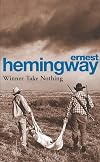
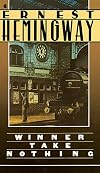
Winner Take Nothing
by Ernest Hemingway 
On This Page
Description
Ernest Hemingway's first new book of fiction, since the publication of A Farewell to Arms in 1929, contains fourteen stories of varying length. Some of them have appeared in magazines but the majority have not been published before. The characters and backgrounds are widely varied. "A Clean, Well-Lighted Place" is about an old Spanish Beggar. "Homage to Switzerland" concerns various conversations at a Swiss railway-station restaurant. "The Gambler, the Nun, and the Radio" is laid in the show more accident ward of a hospital in Western United States, and so on. Ernest Hemingway made his literary start as a short-story writer. He has always excelled in that medium, and this volume reveals him at his best. show lessTags
Recommendations













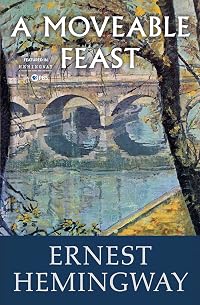
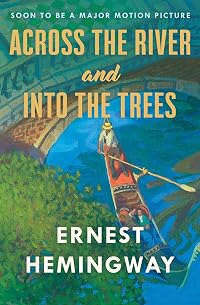




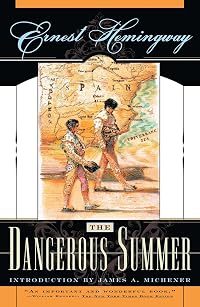

Member Reviews
Despite considering myself a staunch Hemingway fan for a few years now, I've still never been entirely sold on his short stories. Winner Take Nothing came closest for me to opening my eyes to the merits of this part of his writing career. There were still a couple of duds, and the collection as a whole ran out of steam before the end (the best ones are at the start of the book), but the writing is as clean and precise as ever. It also contains the best Hemingway short story I've yet read: 'The Short Happy Life of Francis Macomber.' I really liked some of the other stories – particularly 'The Capital of the World', 'After the Storm' and 'A Natural History of the Dead' – but the Macomber story was flawless, a story that epitomises all show more the praise which I've often heard Hemingway receive for his short stories but never really personally identified before. I may still not appreciate his short stories as much as I do his novels but Winner Take Nothing, and the Macomber story in particular, has helped me a great deal in getting there. show less
My third and final collection of Hemingway short stories.
Favorites include of course A Clean, Well-Lighted Place, A Way You’ll Never Be, The Gambler The Nun and The Radio, Fathers and Sons, and A Natural History of the Dead.
I'll be honest, bingeing on Hemingway is hard. If all you are eating are nouns and verbs you start to crave adjectives, adverbs and complex interior monologues. With Hemingway, it's often what is not written but merely suggested that is the real story. The stuff left out.
Favorites include of course A Clean, Well-Lighted Place, A Way You’ll Never Be, The Gambler The Nun and The Radio, Fathers and Sons, and A Natural History of the Dead.
I'll be honest, bingeing on Hemingway is hard. If all you are eating are nouns and verbs you start to crave adjectives, adverbs and complex interior monologues. With Hemingway, it's often what is not written but merely suggested that is the real story. The stuff left out.
I'm a Hemingway fan, but that doesn't mean I like everything he's done, nor all the topics he chose to write about. Nevertheless there is no denying his power as a writer. This story collection dates to 1933 and includes one of his most famous short works, "A Clean Well-lighted Place" as well as what I consider to be one of his very finest and most memorable short stories, the opener "The Short Happy Life of Frances Macomber."
In all there are 17 short stories in this collection and several to me were very minor things which keeps me from rating this book higher. Anyone who is interested in Hemingway should read this however for the better stories and to see his breadth as a writer. There is some powerful stuff in here.
In all there are 17 short stories in this collection and several to me were very minor things which keeps me from rating this book higher. Anyone who is interested in Hemingway should read this however for the better stories and to see his breadth as a writer. There is some powerful stuff in here.
A veried collection of Hemingway stories, it is a strong group punctuated by the absolutely brilliant 'A Clean Well-Lighted Place' which is arguably his best story ever.
ex-Library
Ratings
Members
- Recently Added By
Published Reviews
"The reporting in almost all these stories is superlative; the dialogue is admirable, the rapidly sketched-in picture is vivid, whole; the way of life is caught and conveyed without a hitch. . . But Hemingway has explored it beyond its worth."
added by GYKM
"[The stories] ring hollow. But this need not necessarily be urged against Hemingway, for he believes . . . that we are the hollow men . . . The effect he aims at is emptiness, and to say he achieves emptiness is to praise his artistry."
added by GYKM
Lists

Authors from the United States
245 works; 3 members

Read in 2007
55 works; 1 member
Author Information

661+ Works 173,948 Members
Ernest Miller Hemingway was born in the family home in Oak Park, Ill., on July 21, 1899. In high school, Hemingway enjoyed working on The Trapeze, his school newspaper, where he wrote his first articles. Upon graduation in the spring of 1917, Hemingway took a job as a cub reporter for the Kansas City Star. After a short stint in the U.S. Army as a show more volunteer Red Cross ambulance driver in Italy, Hemingway moved to Paris, and it was here that Hemingway began his well-documented career as a novelist. Hemingway's first collection of short stories and vignettes, entitled In Our Time, was published in 1925. His first major novel, The Sun Also Rises, the story of American and English expatriates in Paris and on excursion to Pamplona, immediately established him as one of the great prose stylists and preeminent writers of his time. In this book, Hemingway quotes Gertrude Stein, "You are all a lost generation," thereby labeling himself and other expatriate writers, including F. Scott Fitzgerald, T.S. Eliot, and Ford Madox Ford. Other novels written by Hemingway include: A Farewell To Arms, the story, based in part on Hemingway's life, of an American ambulance driver on the Italian front and his passion for a beautiful English nurse; For Whom the Bell Tolls, the story of an American who fought, loved, and died with the guerrillas in the mountains of Spain; and To Have and Have Not, about an honest man forced into running contraband between Cuba and Key West. Non-fiction includes Green Hills of Africa, Hemingway's lyrical journal of a month on safari in East Africa; and A Moveable Feast, his recollections of Paris in the Roaring 20s. In 1954, Hemingway won the Nobel Prize in Literature for his novella, The Old Man and the Sea. A year after being hospitalized for uncontrolled high blood pressure, liver disease, diabetes, and depression, Hemingway committed suicide on July 2, 1961, in Ketchum, Idaho. (Bowker Author Biography) show less
Ernest Hemingway has a Legacy Library. Legacy libraries are the personal libraries of famous readers, entered by LibraryThing members from the Legacy Libraries group.
Series
Belongs to Publisher Series
rororo (280)
Salamanderpockets (414)
Work Relationships
Is contained in
Ernest Hemingway Book-of-the-Month-Club Set of 6: A Farewell to Arms, A Moveable Feast, For Whom the Bell Tolls, The Sun Also Rises, The Old Man and the Sea, The Complete Short Stories by Ernest Hemingway (indirect)
The Complete Short Stories of Ernest Hemingway: The Finca Vigía Edition by Ernest Hemingway (indirect)
The Sun Also Rises / A Farewell to Arms / For Whom the Bell Tolls / The Old Man and the Sea / The Complete Short Stories by Ernest Hemingway (indirect)
Contains
Common Knowledge
- Canonical title
- Winner Take Nothing
- Original publication date
- 1933-10-27
- People/Characters
- Nick Adams
- Important places
- Spain; American West; Switzerland
- Epigraph
- "Unlike all other forms of lutte or combat the conditions are that the winner shall take nothing; neither his ease, nor his pleasure, nor any notions of glory; nor, if he win far enough, shall there be any reward within himse... (show all)lf."
- Dedication
- To A. MacLeish
- First words
- It wasn't about anything, something about making punch, and then we started fighting and I slipped and he had me down kneeling on my chest and choking me with both hands like he was trying to kill me and all the time I was tr... (show all)ying to get the knife out of my pocket to cut him loose.
Classifications
Statistics
- Members
- 521
- Popularity
- 57,478
- Reviews
- 5
- Rating
- (3.80)
- Languages
- 7 — Dutch, English, German, Hungarian, Romanian, Turkish, Ukrainian
- Media
- Paper, Audiobook, Ebook
- ISBNs
- 18
- UPCs
- 1
- ASINs
- 29