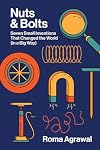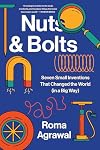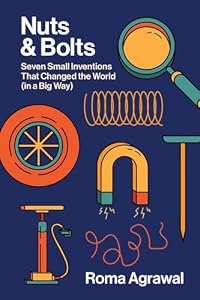
Nuts and Bolts: Seven Small Inventions That Changed the World in a Big Way
by Roma Agrawal
On This Page
Description
A structural engineer examines the seven most basic building blocks of engineering that have shaped the modern world. Some of engineering's mightiest achievements are small in scale, even hidden-and yet, without them, the complex machinery on which our modern world runs would not exist. In Nuts and Bolts, Roma Agrawal examines seven of these extraordinary elements: the nail, the wheel, the spring, the lens, the magnet, the string, and the pump. From the physics behind both Roman nails and show more modern skyscrapers to rudimentary springs that inspired lithium batteries, Agrawal shows us how even the most sophisticated items are built on the foundations of these ancient and fundamental breakthroughs in engineering. Agrawal explores an array of intricate technologies-dishwashers, spacesuits, microscopes, suspension bridges, breast pumps-making surprising connections and explaining how they work. Along the way, she recounts the stories of remarkable scientists and engineers from all over the world, and reveals how engineering has fundamentally changed the way we live. show lessTags
Recommendations













Member Reviews
I've been fascinated with simple (and complex) machines since I can remember, so this is a book that calls out to me. Being an engineer, this was more than appealing, but obviously one need not be one to enjoy it. Ms Agrawal has written a delightful book that is easily a single-sitting read (after which I sat for a couple of weeks before writing this.) She gives the history of her revided simp[le machines, expands on some particulars of their evolution to contemporary uses, and connects with personal experiences - example: learning to make nails with a blacksmith.
Ms. Agrawal updates the traditional six simple machines of inclined planes, levers, wheel and axles, pullies, wedges, and screws to seven: the nail, the wheel, the spring, the show more magnet, the lens, the string, and the pump. She says herself, "During the Renaissance, scientists and engineers defined six 'simple machines,' described as being the basis of all complex machines. These were the lever, the wheel and axle, the pulley, the inclined plane, the wedge, and the screw. But today, those six feel outdated and insufficient. So, I got rid of a few and added some others to showcase seven elements that I believe form the basis of the modern world." And she says, "In the pages that follow, I will show you that engineering is the meeting of science, design, and history." Yep. I started out long ago majoring in physics, and along the way determined that I enjoy application more than theory.
You may learn a few things, and I think you'll enjoy the ride. I did.
Note: I received an advance uncorrected proof from the publisher through NetGalley and when it comes out, I'll be looking for it to add to my library so I can loan it out to friends and family.
I didn't take a lot of notes; just a going with the flow kind of read.
"One, Joe Fosset, toiled in the nailery from the time he was twelve, alongside other young boys who together made between 8,000 and 10,000 nails every day by hand— enough to fund the Jefferson family while the depleted soils of the plantation replenished themselves during fallow years."
{Per day??? Toiled might be an understatement. I've tried my hand at smithing - my father had a small forge, anvils, and a large battery of tools. I had thought I'd like to have that one day, but smithing takes a hard toll on the body.}
"Someone really did have to invent the wheel - or, at least, in the way in which it was used. And it does seem to have a leap: most inventions evolve over time. A naturally sharp piece of rock, for example, inspired us to sharpen other rocks into tools, and gradually we began to attach them to handles, long poles, or arrow shafts— but with the wheel and axle, there’s no such evolution in getting to its basic form. It either works or it doesn’t."
{I need to go find Invention of Miracles by Katie Booth.}
"The most rewarding— and disconcerting— day of my career as an engineer was standing for the first time on the solid steel deck of the Northumbria University bridge. Eighteen months earlier, when I started my first full- time job, I was handed designs for this beautiful structure. I marveled at the fact that what was then only a notion would one day become a fully formed, three- dimensional reality. When that day arrived, I traveled to Newcastle (hoping I’d done all the math right) to stand on the steel that I had previously seen only on paper."
{This made me happy. Too often, engineers don’t go look at their work. I was managing the rehab of a water pumping station and had to force the design team to actually bring their electrical engineer out to verify the control panels were installed to his specs. And on a data center project, one of my technicians pointed out to the design mechanical engineer - who did make plenty of site visits - that an access panel would be blocked if we expanded the system (by design intent) to add another CRAC unit. That engineer got to see first hand what the problem was and was able to design up a quick fix. (And, he was rightly embarrassed.)}
[On a specific type of pumps - an artifical heart] "Rohin said that tall people often end up struggling to get a donor because you can put a big heart into a small person, but not a small heart into a tall person: it wouldn’t be strong enough to get the blood to the longer extremities. (He added that this, and sitting comfortably in economy seats on a plane, are the only two wins for short people.)"
{Chuckle out loud. I think we have more wins than that.} show less
Ms. Agrawal updates the traditional six simple machines of inclined planes, levers, wheel and axles, pullies, wedges, and screws to seven: the nail, the wheel, the spring, the show more magnet, the lens, the string, and the pump. She says herself, "During the Renaissance, scientists and engineers defined six 'simple machines,' described as being the basis of all complex machines. These were the lever, the wheel and axle, the pulley, the inclined plane, the wedge, and the screw. But today, those six feel outdated and insufficient. So, I got rid of a few and added some others to showcase seven elements that I believe form the basis of the modern world." And she says, "In the pages that follow, I will show you that engineering is the meeting of science, design, and history." Yep. I started out long ago majoring in physics, and along the way determined that I enjoy application more than theory.
You may learn a few things, and I think you'll enjoy the ride. I did.
Note: I received an advance uncorrected proof from the publisher through NetGalley and when it comes out, I'll be looking for it to add to my library so I can loan it out to friends and family.
I didn't take a lot of notes; just a going with the flow kind of read.
"One, Joe Fosset, toiled in the nailery from the time he was twelve, alongside other young boys who together made between 8,000 and 10,000 nails every day by hand— enough to fund the Jefferson family while the depleted soils of the plantation replenished themselves during fallow years."
{Per day??? Toiled might be an understatement. I've tried my hand at smithing - my father had a small forge, anvils, and a large battery of tools. I had thought I'd like to have that one day, but smithing takes a hard toll on the body.}
"Someone really did have to invent the wheel - or, at least, in the way in which it was used. And it does seem to have a leap: most inventions evolve over time. A naturally sharp piece of rock, for example, inspired us to sharpen other rocks into tools, and gradually we began to attach them to handles, long poles, or arrow shafts— but with the wheel and axle, there’s no such evolution in getting to its basic form. It either works or it doesn’t."
{I need to go find Invention of Miracles by Katie Booth.}
"The most rewarding— and disconcerting— day of my career as an engineer was standing for the first time on the solid steel deck of the Northumbria University bridge. Eighteen months earlier, when I started my first full- time job, I was handed designs for this beautiful structure. I marveled at the fact that what was then only a notion would one day become a fully formed, three- dimensional reality. When that day arrived, I traveled to Newcastle (hoping I’d done all the math right) to stand on the steel that I had previously seen only on paper."
{This made me happy. Too often, engineers don’t go look at their work. I was managing the rehab of a water pumping station and had to force the design team to actually bring their electrical engineer out to verify the control panels were installed to his specs. And on a data center project, one of my technicians pointed out to the design mechanical engineer - who did make plenty of site visits - that an access panel would be blocked if we expanded the system (by design intent) to add another CRAC unit. That engineer got to see first hand what the problem was and was able to design up a quick fix. (And, he was rightly embarrassed.)}
[On a specific type of pumps - an artifical heart] "Rohin said that tall people often end up struggling to get a donor because you can put a big heart into a small person, but not a small heart into a tall person: it wouldn’t be strong enough to get the blood to the longer extremities. (He added that this, and sitting comfortably in economy seats on a plane, are the only two wins for short people.)"
{Chuckle out loud. I think we have more wins than that.} show less
Really enjoyed the east stuff - the nails, the wheels, bolts...had a harder time with springs...and when we got to magnets and pumps it all just became a slog. I appreciate that the author tried to bring it around to "real" people to keep it readable but I have come to terms with the fact that I will never truly understand the details behind things like artificial hearts...
A fascinating overview of some small technologies (string, anyone?) that have had a huge impact on the way the world has developed.
Ratings
Members
- Recently Added By
Lists

Books Read in 2023
5,547 works; 145 members

read in 2024
21 works; 1 member
Author Information

8+ Works 484 Members
Roma Agrawal is a structural engineer who builds BIG-bridges, sculptures, train stations, and skyscrapers, including The Shard, western Europe's tallest tower. A promoter of technical careers to young people, she has written articles, done TEDX talks, and presented documentaries about building our world. She was awarded the Royal Academy of show more Engineering's prestigious Rooke Award and an MBE for services to engineering. She lives in London. romatheengineer.com @RomaTheEngineer show less
Awards and Honors
Common Knowledge
- Original title
- Nuts and Bolts: Seven Small Inventions That Changed the World in a Big Way
- Original publication date
- 2023
- Dedication
- And finally, for you, my Flirtman.
- Blurbers
- Mars, Roman; Miodownik, Mark; Saini, Angela; Harford, Tim; Wade, Jess; Vince, Gaia
- Original language
- English
Classifications
Statistics
- Members
- 161
- Popularity
- 202,719
- Reviews
- 3
- Rating
- (3.91)
- Languages
- English, German
- Media
- Paper, Audiobook, Ebook
- ISBNs
- 9
- ASINs
- 5