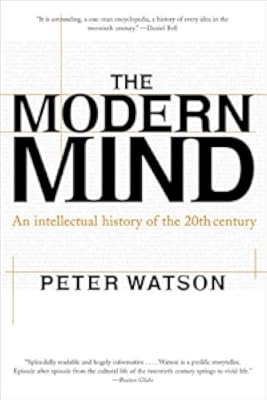
The Modern Mind: An Intellectual History of the 20th Century
by Peter Watson
On This Page
Description
The author of "War on the Mind" presents a major narrative history of the thoughts, ideas, individuals, scientific discoveries, literature, and art of the 20th century. This major narrative history of the people and ideas that shaped the modern world is a brilliantly reasoned examination of the thought and individuals that made twentieth-century culture. From Freud to Babbitt, from Relativity to Susan Sontag, from Proust to Henri Bergson to Saul Bellow, the books range is encyclopedic, show more covering the major writers, artists, scientists, and philosophers who produced the ideas by which we live. Beginning with four seminal ideas that were introduced in 1900 -- the unconscious, the gene, the quantum, and Picasso's first paintings in Paris-Peter Watson has produced a fluent and engaging narrative of the intellectual tradition of the past century. The book is divided into four parts -- Freud to Wittgenstein; Spengler to Animal Farm; Sartre to the Sea of Tranquillity; the counterculture to Kosovo -- and there are forty-two chapters. Watson emphasizes that "the century may be understood as a period during which the scientific method colonized all modes of thought and changed the way thinking is done." He sees the first half of the century as a period of discovery and the last half as a period of analysis, synthesis, and understanding, and he explores the role of the United States in setting the century's agenda in many areas. Unlike more conventional histories, in which the focus is on political events and personalities, The Modern Mind is an illuminating blueprint of twentieth-century thought and culture and the men and women who created it. show lessTags
Recommendations




Member Reviews
Jan 3, 2010 8:04 PM
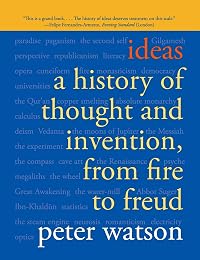
Ideas, A History: From Wittgenstein to the World Wide Web
Peter Watson
I read this continuously for about two weeks, with one break to tackle another shorter book. This general history of ideas and intellectual progress is about 1,000 pages, starting with pre-history, proceeding mostly historically to science and Romanticism in about 1900. I discovered that I had read or at least knew about many of the sources discussed, most of which are secondary sources and analyses, but the skill Watson demonstrates, putting thousands of years of thought together into a readable narrative, is considerable and appreciated. I cannot convey the whole narrative, but have marked some passages of interest. The prologue opens with a story show more about the realization in Europe of the origin of stone tools, and the implication that stone tools imply a time before history, and imply a time of earth origin much older than allowed by Biblical accounts. The ancient Greeks, Plato and Aristotle, are of course discussed at length. The Stoic philosophy mentioned with a quote from Zeno: “Man is a dog tied to a cart; if he is wise he will run with it”. I was surprised to find a reference to the Goddess of Wisdom, participating in the creative acts of God, in the Old Testament (Proverbs 8), perhaps a residual of the worship of woman gods that seemed to be common in late pre-history, and attesting to pagan influences on Hebraic religion. Empiricism in Alexandria may have begun with physicians, originally theoreticians (“iatrosophists”), who were allowed to perform autopsies on criminals, leading to “so many discoveries the Greek language was unable to name them all”. I encountered lattice, or “gelosia” multiplication, using a diagonal grid to simplify the calculation, in Venice, adapted from Arabic and Hindu numerals, in the early middle ages. The idea of the period 1050 to 1200 as the key time in which the idea of Europe and seeds of its dominance was planted, as more important than the Renaissance, is a new concept for me.
Many will criticize the book on these grounds as Eurocentric, but Watson does credit and discuss Islam, China, India, and the Americas, returning to the theme of Western European dominance in trade, industry, science and discovery, which he says “cannot be denied.” Orientalism, the respect Europe paid to Sanskrit and Buddhist philosophy in the 18th century, was a new theme to me; Emerson was very attracted to Buddhist thought, for instance. The American revolution is discussed in the second volume, along with the Enlightenment. “Tradition has a fine ring to it, especially in the Old World. But another way of looking at it is as a principle by which the dead govern the living...” There was great reversal in the social and libertarian thought of the Enlightenment in Romanticism, when internal sensations would become the arbiter of truth. Fichte, puts it in terms of a creation of the will “I do not accept anything because I must. I believe it because I will.” In discussing Darwin, Watson points out that Robert Chamber’s popular account of Darwinism “Vestiges of the Natural History of Creation” was much more widely read. The account of American pragmatist philosophy, Watson admits, is taken from Menand’s book “The Metaphysical Club”. I admire the pragmatists and read Menand’s account previously. Freud, although as Watson points out is now thoroughly discredited as contributing anything in a scientific sense, is respectfully discussed as summing up the ideas of the unconscious that had been developing in Charcot, Schopenhauer, and others in the 19th century. One slip was identifying “propranolol” as a neurotransmitter. His discussion of early chemistry, the insight that oxygen combined with metals to yield bases and with non-metals to yield acids, was a generalization I missed as a chemistry major. 1900 is the end of this volume, although I have another on my shelf starting at that point, and the last scientific achievement discussed was the discovery of the electron. In a summary chapter, Watson chooses the soul, Europe, and experimentation, as the three greatest ideas. He argues that the Aristotelian concentration on the external world has been a success in advancing thought and the happiness of men, the Platonic concentration on introspection and ideas less successful. One can argue with the choice of emphasis on certain ideas, but to contain so much and tell it in a readable way is a remarkable accomplishment. show less
Ideas, A History: From Wittgenstein to the World Wide Web
Peter Watson
I read this continuously for about two weeks, with one break to tackle another shorter book. This general history of ideas and intellectual progress is about 1,000 pages, starting with pre-history, proceeding mostly historically to science and Romanticism in about 1900. I discovered that I had read or at least knew about many of the sources discussed, most of which are secondary sources and analyses, but the skill Watson demonstrates, putting thousands of years of thought together into a readable narrative, is considerable and appreciated. I cannot convey the whole narrative, but have marked some passages of interest. The prologue opens with a story show more about the realization in Europe of the origin of stone tools, and the implication that stone tools imply a time before history, and imply a time of earth origin much older than allowed by Biblical accounts. The ancient Greeks, Plato and Aristotle, are of course discussed at length. The Stoic philosophy mentioned with a quote from Zeno: “Man is a dog tied to a cart; if he is wise he will run with it”. I was surprised to find a reference to the Goddess of Wisdom, participating in the creative acts of God, in the Old Testament (Proverbs 8), perhaps a residual of the worship of woman gods that seemed to be common in late pre-history, and attesting to pagan influences on Hebraic religion. Empiricism in Alexandria may have begun with physicians, originally theoreticians (“iatrosophists”), who were allowed to perform autopsies on criminals, leading to “so many discoveries the Greek language was unable to name them all”. I encountered lattice, or “gelosia” multiplication, using a diagonal grid to simplify the calculation, in Venice, adapted from Arabic and Hindu numerals, in the early middle ages. The idea of the period 1050 to 1200 as the key time in which the idea of Europe and seeds of its dominance was planted, as more important than the Renaissance, is a new concept for me.
Many will criticize the book on these grounds as Eurocentric, but Watson does credit and discuss Islam, China, India, and the Americas, returning to the theme of Western European dominance in trade, industry, science and discovery, which he says “cannot be denied.” Orientalism, the respect Europe paid to Sanskrit and Buddhist philosophy in the 18th century, was a new theme to me; Emerson was very attracted to Buddhist thought, for instance. The American revolution is discussed in the second volume, along with the Enlightenment. “Tradition has a fine ring to it, especially in the Old World. But another way of looking at it is as a principle by which the dead govern the living...” There was great reversal in the social and libertarian thought of the Enlightenment in Romanticism, when internal sensations would become the arbiter of truth. Fichte, puts it in terms of a creation of the will “I do not accept anything because I must. I believe it because I will.” In discussing Darwin, Watson points out that Robert Chamber’s popular account of Darwinism “Vestiges of the Natural History of Creation” was much more widely read. The account of American pragmatist philosophy, Watson admits, is taken from Menand’s book “The Metaphysical Club”. I admire the pragmatists and read Menand’s account previously. Freud, although as Watson points out is now thoroughly discredited as contributing anything in a scientific sense, is respectfully discussed as summing up the ideas of the unconscious that had been developing in Charcot, Schopenhauer, and others in the 19th century. One slip was identifying “propranolol” as a neurotransmitter. His discussion of early chemistry, the insight that oxygen combined with metals to yield bases and with non-metals to yield acids, was a generalization I missed as a chemistry major. 1900 is the end of this volume, although I have another on my shelf starting at that point, and the last scientific achievement discussed was the discovery of the electron. In a summary chapter, Watson chooses the soul, Europe, and experimentation, as the three greatest ideas. He argues that the Aristotelian concentration on the external world has been a success in advancing thought and the happiness of men, the Platonic concentration on introspection and ideas less successful. One can argue with the choice of emphasis on certain ideas, but to contain so much and tell it in a readable way is a remarkable accomplishment. show less
Peter Watson has tackled a huge task in writing about ideas in the 20th century in his book, THE MODERN MIND. In my opinion he has done a commendable job in a comprehensive way. Those of us whose lives cover most of that century will find it very useful in providing our lives a context to reflect upon. Those of us who will probably spend most of our lives in the current century will undoubtedly have a firm foundation on which to understand new ideas as they come along. Mr. Watson's conclusion that the "century has been dominated intellectually by a coming to terms with science" is right on target. This conclusion provides much needed insight into our current intellectual, political, and cultural environment in our post 9/11 world.
Massive overview of the ideas that blossomed in the twentieth century. I enjoy dipping into this book in conjunction with my other reading for context and background.
A marvelous intellectual history of the 20th century. Amazingly he gets it right: Marx and Freud have nothing to say to us.
Ratings
Members
- Recently Added By
Lists

Non-Fiction Worth Reading
1,016 works; 262 members

Fake Top 100 Nonfiction
79 works; 3 members
Author Information

34+ Works 5,011 Members
Peter Watson is an intellectual historian, journalist, and author of thirteen books, including The Age of Atheists; Ideas: A History; The German Genius; The Medici Conspiracy; and The Great Divide. He has written for the Sunday Times, the New York Times, the Observer, and the Spectator. He lives in London.
Classifications
Statistics
- Members
- 492
- Popularity
- 61,463
- Reviews
- 5
- Rating
- (4.33)
- Languages
- English
- Media
- Paper
- ISBNs
- 2