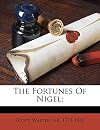
On This Page
Description
From the quotations which I have produced the selfish and disgusting conduct of Lord Dalgarno will not perhaps appear overstrained; nor will the scenes in Whitefriars and places of similar resort seem too highly coloured.Tags
Recommendations



















Member Reviews
#1 A 19th century classic
The basic story of the fortunes of Nigel, Lord Glenvarloch, might be considered simple and might possibly be compared with a Western where the deed to the ranch is in danger. However, many elements make this story so much more than just a Polly Pureheart story with a male lead. There are definite villians, but our hero has his character flaws also, despite a certain innocence and nobility. King James, of whom I knew little more than his authorization of the translation of the Bible, was much less austere and, well, "kingly" than I would have imagined him. There are immoral acts commited, but there is a moral tone to the book and there are lessons that can be learned. There are well-drawn characters from many show more walks of life.
But more than the story-line and the characters is the way Scott tells his tale. He is writing historical fiction and his fascination for history shows. In this, as in all of his works which I have read, he has numerous notes which further explain some historical practice or refer to an actual event or person on which he based an incident in the book. I am also fascinated by his ability to place a piece of poetry or snippet from a play at the beginning of each chapter that has to do with the content to come. He must have had, or had access to, a vast library, or had an excellent memory, to be able to consistently come up with an applicable quote for each chapter of each book. His characters each speak as befits his station, and although I find the Scots dialect difficult to decipher when analized word for word, when read all together the gist can be easily found. Scott also has a chummy yet not overly familiar way of including the reader in the fact that he is reading a story which Scott, although under an assumed identity, is writing. This goes beyond the "gentle reader" some authors have used in the past to an almost post-modern degree of self-reference in spots.
One of my favorite parts occurs when Nigel has to confront some of the bad choices he has made, and finds it almost impossible to convince others that they were not much worse than they were. Because he allowed some untrue accusations on his character to be thrown about without remonstrance on his part, under the guise of idle banter, his accuser believes him to be untrustworthy in his protests against other allegations. This our hero finds extremely frustrating, but I found much there to reflect upon. Yet there is also humor to be found in the book, and clever phrasing. For example, when one of the characters is being advised to marry someone below his social standing for money, the man encouraging him to take this step says, "If she should become rather intolerable, which is not unlikely, your hounourable house, which I presume to be a castle, hath, doubtless, both turrets and dungeons, and ye may bestow your bonny bride in either the one or the other, and then you know you will be out of hearing of her tongue, and she will be either above or below the contempt of your friends."
Although I would not name this as my favorite work by Sir Walter Scott, The Fortunes of Nigel is an enjoyable story that is well worth the effort to read. show less
The basic story of the fortunes of Nigel, Lord Glenvarloch, might be considered simple and might possibly be compared with a Western where the deed to the ranch is in danger. However, many elements make this story so much more than just a Polly Pureheart story with a male lead. There are definite villians, but our hero has his character flaws also, despite a certain innocence and nobility. King James, of whom I knew little more than his authorization of the translation of the Bible, was much less austere and, well, "kingly" than I would have imagined him. There are immoral acts commited, but there is a moral tone to the book and there are lessons that can be learned. There are well-drawn characters from many show more walks of life.
But more than the story-line and the characters is the way Scott tells his tale. He is writing historical fiction and his fascination for history shows. In this, as in all of his works which I have read, he has numerous notes which further explain some historical practice or refer to an actual event or person on which he based an incident in the book. I am also fascinated by his ability to place a piece of poetry or snippet from a play at the beginning of each chapter that has to do with the content to come. He must have had, or had access to, a vast library, or had an excellent memory, to be able to consistently come up with an applicable quote for each chapter of each book. His characters each speak as befits his station, and although I find the Scots dialect difficult to decipher when analized word for word, when read all together the gist can be easily found. Scott also has a chummy yet not overly familiar way of including the reader in the fact that he is reading a story which Scott, although under an assumed identity, is writing. This goes beyond the "gentle reader" some authors have used in the past to an almost post-modern degree of self-reference in spots.
One of my favorite parts occurs when Nigel has to confront some of the bad choices he has made, and finds it almost impossible to convince others that they were not much worse than they were. Because he allowed some untrue accusations on his character to be thrown about without remonstrance on his part, under the guise of idle banter, his accuser believes him to be untrustworthy in his protests against other allegations. This our hero finds extremely frustrating, but I found much there to reflect upon. Yet there is also humor to be found in the book, and clever phrasing. For example, when one of the characters is being advised to marry someone below his social standing for money, the man encouraging him to take this step says, "If she should become rather intolerable, which is not unlikely, your hounourable house, which I presume to be a castle, hath, doubtless, both turrets and dungeons, and ye may bestow your bonny bride in either the one or the other, and then you know you will be out of hearing of her tongue, and she will be either above or below the contempt of your friends."
Although I would not name this as my favorite work by Sir Walter Scott, The Fortunes of Nigel is an enjoyable story that is well worth the effort to read. show less
Thistle Edition
Een bijna berooide Schotse lord, wiens vader geld geleend heeft aan koning James, de Schot op de Engelse troon, gaat naar Londen om het verlies van zijn ouderlijk landgoed te voorkomen. Hij wil daarvoor de koning aanspreken. Valse vrienden, praatjes en zijn eigen temperament brengen hem in grote problemen. Maar gelukkig zijn er ook mensen in zijn omgeving die het goed met hem menen, zoals zijn knecht, een goudsmid die ook nog een verwante van Nigel Olifaunt, lord of Glenvarloch, blijkt te huisvesten. Uiteindelijk komt het allemaal, zij het op het nippertje, nog goed. Heerlijk romantisch verhaal met de nodige verkleedpartijen en al. En met wederzijdse vooroordelen tussen Engelsen en Schotten.
Apr 1, 2019Dutch
Ratings
Members
- Recently Added By
Lists

Fifty Representative Historical Novels
50 works; 2 members

F. B. Perkins' List of 100 Best Fiction
100 works; 5 members
Author Information

1,004+ Works 40,587 Members
Series


Belongs to Publisher Series
Work Relationships
Is contained in
Contains
Has the adaptation
Is abridged in
Common Knowledge
- Canonical title
- The Fortunes of Nigel
- Original title
- The Fortunes of Nigel
- Original publication date
- 1822
- People/Characters
- John Christie; George Heriot; Laurence Linklater; Richie Monoplies; Nigel Olifaunt (aka Lord Glenvarloch); Dame Nelly (show all 30); David Ramsay; Margaret Ramsay; Benjamin Studdlechop; Francis Tunstall; Dame Ursula; Jenkin Vincent; James VI and I, King of Scots and King of England; Maxwell; Stephen, Duke of Buckingham; Lord Huntinglen; Lord Dalgarno; Reginald Lowestoffe; Beaujeu; Sir Mungo Mallagrowther; Charles I, King of England, Scotland, and Ireland (as Prince of Wales); Old Trapbois; Martha Trapbois; Lady Hermione (aka Lady Dalgarno); Monna Paula; Captain Colepepper; Hildebrod; The Governor of the Tower; Lady Mansell; Andrew Skurliewhitter
- Important places
- London, England, UK; Greenwich, London, England, UK; Enfield Chase, England, UK
Classifications
Statistics
- Members
- 231
- Popularity
- 140,467
- Reviews
- 3
- Rating
- (4.17)
- Languages
- English, French, Hungarian, Swedish
- Media
- Paper, Ebook
- ISBNs
- 51
- ASINs
- 24