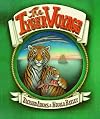
The Tyger Voyage
by Richard Adams
On This Page
Description
The adventures of two young inexperienced Tygers who set out from Victorian England into the timeless unknown.Tags
Recommendations























Member Reviews
A lavish children’s book, I loved enough to keep readily to hand, but which I’d not opened for years. Mine is a hardback, given to me shortly after first publication, when I was in primary school. We had lots of books at home, but mostly paperbacks. This, with the exotic spelling of “tyger”, printed on thick glossy paper, with full colour, gloriously detailed illustrations, was a rare treat. I read it many times, and to my own child, but it’s still almost pristine.
The tale is told in verse, but it opens with a map. There’s always something special about a story that starts with a map.
Reading it now, I’m struck by the inclusiveness of the opening stanza:
“My father’s got some curious friends -
At least, I s’pose it show more all depends
On what you mean by curious -
But some are not at all like us.”
This refers to a tyger family across the street, but it’s good to have friendships beyond one’s age, sex, class, and race.
Ezekiel and Raphael Dubb (father and son), are waved off in a boat the narrator’s father thinks unsafe.
“They sailed away, the wind blew high,
All around them naught but sea and sky.”
Weeks pass, and there’s no news. The narrator’s father feels guilty for not advising them against the voyage. But this is a children’s book; it will not have a tragic ending. We’re told the rest of the story is what was learned when the Dubbs returned.
They survive a storm - just - and end up on “An empty and unpeopled land”. Given all the places the British colonised, including those where tygers roamed and were then hunted to the brink of extinction, that’s a nice touch.
Image: “Crossing on rafts the muddy lakes / Infested with bright water snakes.”
There are swamps, snakes, a talking fox, and a snow-covered, but smoking, mountain. They decide to climb it!
“As they crossed the ice-cracks deep
The mountain muttered in its sleep.”
At the peak, they plant the Tyger Flag.
They sense danger, and then bitter dust. They run:
“Sliding and stumbling down the rock,
They felt the first eruption shock,
As from the mountain’s peak there came
A horrid and malicious flame.”
Image: Watching the “glowing lava stream”.
For many hungry miles they walk, until they’re rescued by Romany gypsies, who take them in and teach them their ways and crafts. They travel together from land to land. An indeterminate amount of time passes.
The narrator’s father always takes an autumn holiday (apparently alone?!) in a secluded watering-place. En route, he recognises Ezekiel Dubb selling clothes pegs. Relieved to see them, he takes charge, as Victorian gents were wont to do. He puts them on the train home - against the wishes of the gypsies and even Ezekiel and Raphael themselves!
Back home, they’re welcomed at a civic reception, despite the faux pas of Raphael insisting on wearing his gypsy handkerchief around his neck. Raphael asks the narrator to write the story we’re reading. But the narrator’s father, wants the last word:
“He says that while he must admit
The pair showed admirable grit,
He thinks that I should emphasize
Their trip was really most unwise.”
However, there is another member of the Dubbs family. She’s seen in the first and last pictures, but she’s not at the civic reception for her husband(?) and son. Her face is inscrutable as she holds the book featuring their fantastic voyage.
Image: All three of the Dubbs family, with this book.
See also
* The works of Henri Rousseau, especially Tiger in a Tropical Storm.
* William Blake’s The Tyger (aka Tyger Tyger, burning bright). show less
The tale is told in verse, but it opens with a map. There’s always something special about a story that starts with a map.
Reading it now, I’m struck by the inclusiveness of the opening stanza:
“My father’s got some curious friends -
At least, I s’pose it show more all depends
On what you mean by curious -
But some are not at all like us.”
This refers to a tyger family across the street, but it’s good to have friendships beyond one’s age, sex, class, and race.
Ezekiel and Raphael Dubb (father and son), are waved off in a boat the narrator’s father thinks unsafe.
“They sailed away, the wind blew high,
All around them naught but sea and sky.”
Weeks pass, and there’s no news. The narrator’s father feels guilty for not advising them against the voyage. But this is a children’s book; it will not have a tragic ending. We’re told the rest of the story is what was learned when the Dubbs returned.
They survive a storm - just - and end up on “An empty and unpeopled land”. Given all the places the British colonised, including those where tygers roamed and were then hunted to the brink of extinction, that’s a nice touch.
Image: “Crossing on rafts the muddy lakes / Infested with bright water snakes.”
There are swamps, snakes, a talking fox, and a snow-covered, but smoking, mountain. They decide to climb it!
“As they crossed the ice-cracks deep
The mountain muttered in its sleep.”
At the peak, they plant the Tyger Flag.
They sense danger, and then bitter dust. They run:
“Sliding and stumbling down the rock,
They felt the first eruption shock,
As from the mountain’s peak there came
A horrid and malicious flame.”
Image: Watching the “glowing lava stream”.
For many hungry miles they walk, until they’re rescued by Romany gypsies, who take them in and teach them their ways and crafts. They travel together from land to land. An indeterminate amount of time passes.
The narrator’s father always takes an autumn holiday (apparently alone?!) in a secluded watering-place. En route, he recognises Ezekiel Dubb selling clothes pegs. Relieved to see them, he takes charge, as Victorian gents were wont to do. He puts them on the train home - against the wishes of the gypsies and even Ezekiel and Raphael themselves!
Back home, they’re welcomed at a civic reception, despite the faux pas of Raphael insisting on wearing his gypsy handkerchief around his neck. Raphael asks the narrator to write the story we’re reading. But the narrator’s father, wants the last word:
“He says that while he must admit
The pair showed admirable grit,
He thinks that I should emphasize
Their trip was really most unwise.”
However, there is another member of the Dubbs family. She’s seen in the first and last pictures, but she’s not at the civic reception for her husband(?) and son. Her face is inscrutable as she holds the book featuring their fantastic voyage.
Image: All three of the Dubbs family, with this book.
See also
* The works of Henri Rousseau, especially Tiger in a Tropical Storm.
* William Blake’s The Tyger (aka Tyger Tyger, burning bright). show less
A literary and exciting poem equalled by its illustraions.
Fine condition
Ratings
Members
- Recently Added By
Author Information

87+ Works 39,703 Members
Richard George Adams was born in Newbury, England on May 9, 1920. He enrolled at the University of Oxford in 1938, but his studies were interrupted by World War II. During the war, he served with the British airborne forces in the Middle East and India. After the war, he returned to Oxford and received a degree in history in 1948. He joined the show more Ministry of Housing and Local Government and worked his way up over 20 years to a senior post in the clean-air section of the environmental department. He retired in 1974 to become a full-time writer. His first his novel, Watership Down, was published in 1972. It received the Carnegie Medal in Literature in 1972 and the Guardian Children's Fiction Prize in 1973. His other books include Shardik, The Plague Dogs, Traveller, and Tales from Watership Down. He also wrote an autobiography entitled The Day Gone By. He died on December 24, 2016 at the age of 96. (Bowker Author Biography) show less
All Editions
Common Knowledge
- Canonical title*
- Le voyage du Tygre
- Original publication date
- 1976
*Some information comes from Common Knowledge in other languages. Click "Edit" for more information.
Classifications
Statistics
- Members
- 175
- Popularity
- 186,441
- Reviews
- 3
- Rating
- (4.19)
- Languages
- 8 — Dutch, English, Finnish, French, German, Norwegian (Bokmål), Spanish, Swedish
- Media
- Paper
- ISBNs
- 13
- ASINs
- 3