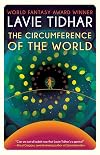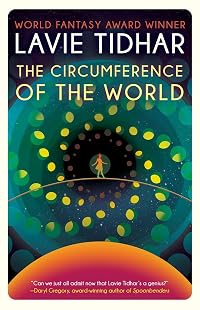
The Circumference of the World
by Lavie Tidhar
On This Page
Description
"Delia Welegtabit discovered two things during her childhood on a South Pacific island: her love for mathematics and a novel that isn't supposed to exist. But the elusive book proves unexpectedly dangerous. Oskar Lens, a science fiction-obsessed mobster in the midst of an existential crisis, will stop at nothing to find the novel. After Delia's husband Levi goes missing, she seeks help from Daniel Chase, a young, face-blind book dealer. The infamous novel Lode Stars was written by the show more infamous Eugene Charles Hartley: legendary pulp science-fiction writer and founder of the Church of the All-Seeing Eyes. In Hartley's novel, a doppelganger of Delia searches for her missing father in a strange star system. But is any of Lode Stars real? Was Hartley a cynical conman on a quest for wealth and immortality, creating a religion he did not believe in? Or was he a visionary who truly discovered the secrets of the universe?"-- show lessTags
Recommendations










Member Reviews
Lavie Tidhar’s The Circumference of the World is the second 2023 book I have encountered that sets its plot in the postwar West Coast science fiction community of L. Ron Hubbard, Jack Parsons, and Robert Heinlein. Exadelic by Jon Evans uses an AI with suspicious motives to move characters to an alternate 1946 where the party at the Parsons estate is going full blast.
Tidhar employs a more complicated device. A mathematician is married to a physicist who becomes obsessed with a legendary book by Eugene Charles Hartley, a stand-in for Hubbard with a bit of Philip K. Dick for spice. When her husband goes missing, the mathematician hires a reclusive rare book dealer to investigate. In the book, we find that a double of the mathematician show more is a major character. (Add creepy sound effect here.) Along the way, we are given Hartley’s backstory with some amusing jibes about Heinlein’s fascination with nudism.
Now that all the Golden-Age pulpsters are dead, they seem to be fair game for the mythmakers. Tidhar offers a stylish example. show less
Tidhar employs a more complicated device. A mathematician is married to a physicist who becomes obsessed with a legendary book by Eugene Charles Hartley, a stand-in for Hubbard with a bit of Philip K. Dick for spice. When her husband goes missing, the mathematician hires a reclusive rare book dealer to investigate. In the book, we find that a double of the mathematician show more is a major character. (Add creepy sound effect here.) Along the way, we are given Hartley’s backstory with some amusing jibes about Heinlein’s fascination with nudism.
Now that all the Golden-Age pulpsters are dead, they seem to be fair game for the mythmakers. Tidhar offers a stylish example. show less
As with some of his other "novels", this one is really more of a collection of linked short stories, with a few different protagonists. It starts off fairly normal, with an intriguing mystery and interesting characters (a mathematician, a rare book seller, a gangster), but gets weird and trippy, and the initial plot mostly falls by the wayside. There's also a lengthy digression into the world of "pulp" golden age sci-fi, a favourite topic of Tidhar, but rather boring to me. Personally I would have preferred a slightly more conventional and focused approach, one that did a better job of connecting the various subplots instead of leaving them disjointed.
If you love a novel of ideas, and are a fan of Mid-Century pulp science fiction, and are up for unconventional story telling, this inventive novel will knock your socks off.
An albino woman from a Pacific island is losing her husband to his obsession over a book, a book that can’t be found but is rumored to hold the answer to life’s biggest questions about the nature of reality.
The book is The Lode Star, written by Eugene Hartley, a pulp fiction sci-fi writer who turned his ideas into a religion. The book is about a woman named Delia who crosses the universe to find her missing father. Hartley believed that all of what we call real and reality are only reconstructed memories from matter swirling inside a black hole through which the show more eyes of God watches us.
It’s a story, everything is a story. Without stories we can’t really be human.
from Circumference of the World by Lavie Tidhar
Tidhar was inspired by golden age sci-fi writers and draws from esoteric scientific theories. This wildly inventive novel is quite a trip! From Delia’s early life on a South Seas island to searching for her missing husband, to the fictional Delia’s otherworldly journey, the novel proves again the power of story.
Thanks to the publisher for a free book. show less
An albino woman from a Pacific island is losing her husband to his obsession over a book, a book that can’t be found but is rumored to hold the answer to life’s biggest questions about the nature of reality.
The book is The Lode Star, written by Eugene Hartley, a pulp fiction sci-fi writer who turned his ideas into a religion. The book is about a woman named Delia who crosses the universe to find her missing father. Hartley believed that all of what we call real and reality are only reconstructed memories from matter swirling inside a black hole through which the show more eyes of God watches us.
It’s a story, everything is a story. Without stories we can’t really be human.
from Circumference of the World by Lavie Tidhar
Tidhar was inspired by golden age sci-fi writers and draws from esoteric scientific theories. This wildly inventive novel is quite a trip! From Delia’s early life on a South Seas island to searching for her missing husband, to the fictional Delia’s otherworldly journey, the novel proves again the power of story.
Thanks to the publisher for a free book. show less
A chase for a book that disappears on being read, in a world that may or may not be real… a vibrant, engaging premise - sadly let down by the book’s execution.
But first, the good. The premise really is something, and the book thoughtfully poses big questions about how we know that what we’re experiencing is real - questions it knows better than to take a firm stance on. The first perspective is genuinely fascinating too - it’s not difficult to believe that Lavie Tidhar has spent time in Vanuatu based on the detail and the warmth for the setting and characters.
But this short novel soon hops onto the next viewpoint around which the story spins, and the the next, and the next. There’s surprisingly little plot, and what there is show more is often doled out with brevity as well as a lack of depth and, ironically enough, realism. Five viewpoints spread across a modest 250 pages, all covering across loosely related events, doesn’t give the reader enough time or nuance to buy-in with many of the characters. The elements themselves are disparate in quality too: while Delia and Oskar’s tales are intriguing, the attempt to make Daniel’s vague comes across as amateurish and the epistolary component feels like a very light re-skin of certain real life events.
All in all… while this book promises much, I think the reality is that others have done it better. If you want a story-within-a-story, Rian Hughes’s XX pulls that off with more success. If you want delightfully weird and open, Phillip K Dick’s Ubik reigns supreme. And the book that doesn’t-exist-but-did-it? is handled with more skill by Jeremy Dronfield in The Alchemist’s Apprentice.
Ultimately this is a 3/5 for me. Thank you to Netgalley, Tachyon Publications and Lavie Tidhar for the opportunity to read an ARC of this upcoming book in exchange for an honest review. show less
But first, the good. The premise really is something, and the book thoughtfully poses big questions about how we know that what we’re experiencing is real - questions it knows better than to take a firm stance on. The first perspective is genuinely fascinating too - it’s not difficult to believe that Lavie Tidhar has spent time in Vanuatu based on the detail and the warmth for the setting and characters.
But this short novel soon hops onto the next viewpoint around which the story spins, and the the next, and the next. There’s surprisingly little plot, and what there is show more is often doled out with brevity as well as a lack of depth and, ironically enough, realism. Five viewpoints spread across a modest 250 pages, all covering across loosely related events, doesn’t give the reader enough time or nuance to buy-in with many of the characters. The elements themselves are disparate in quality too: while Delia and Oskar’s tales are intriguing, the attempt to make Daniel’s vague comes across as amateurish and the epistolary component feels like a very light re-skin of certain real life events.
All in all… while this book promises much, I think the reality is that others have done it better. If you want a story-within-a-story, Rian Hughes’s XX pulls that off with more success. If you want delightfully weird and open, Phillip K Dick’s Ubik reigns supreme. And the book that doesn’t-exist-but-did-it? is handled with more skill by Jeremy Dronfield in The Alchemist’s Apprentice.
Ultimately this is a 3/5 for me. Thank you to Netgalley, Tachyon Publications and Lavie Tidhar for the opportunity to read an ARC of this upcoming book in exchange for an honest review. show less
This book starts in Vanuatu, with snatches of bislama (pidgin/creole) - not something you find every day! It goes on to feature a face-blind detective (yes, really!) and a religious cult based on the science of black holes. With occasional visits to Heinlein, Asimov atc.
So, eclectic, original, and worth reading - but it wasn't my favourite book of the year.
So, eclectic, original, and worth reading - but it wasn't my favourite book of the year.
Series Info/Source: This is a stand alone book. I got a copy of this as an ebook through NetGalley to review.
Thoughts: I liked this but didn't love it as much as some of Tidhar's other books. It gets pretty abstract at points and can be a bit hard to follow. It is interesting food for thought and beautifully written though.
The book is broken into different parts that follow different characters. At first we follow is Delia, a math professor whose husband, Levi, goes suddenly missing after obsessing over a book called Lode Stars. Then we follow Daniel Chase, a young book dealer that Delia comes to for help when her husband goes missing. Next we hear from Oskar Lens a mobster obsessed with finding Lode Stars. Then we also hear from Eugene show more Hartley himself as he writes Lode Stars and then back to Delia but this is Delia as shown in the book Lode Stars as she journeys back to Earth.
The theory that goes throughout the book is around a religion that was created from the Lode Stars book that speculates that everything in the world is a construct and nothing is really real anymore. There is some theory that the world is being recycled through black holes (I may have misunderstood this theory, it's a bit ambiguous). The story kind of twists around itself as we journey through space and time and reality to mostly end up back where we started.
I enjoyed the beautiful writing and found this very readable. However, it can be hard to follow at times and ends up being a bit ambiguous. It's one of those books that I think you have to read through a few times to really understand everything that is happening here. I enjoyed it but I didn't love it and I probably won't pick it up again.
My Summary (4/5): Overall this was interesting and provides some intriguing food for thought. However, it's also a bit twisty, turny...hard to follow...and ambiguous. Some of the theories explored here are unique and interesting, but it takes some effort to try and understand what happens in the end. This isn't my favorite Tidhar book, I liked "The Escapement" better. However, it did feed my itch for a unique and different read...which is something Tidhar excels at. show less
Thoughts: I liked this but didn't love it as much as some of Tidhar's other books. It gets pretty abstract at points and can be a bit hard to follow. It is interesting food for thought and beautifully written though.
The book is broken into different parts that follow different characters. At first we follow is Delia, a math professor whose husband, Levi, goes suddenly missing after obsessing over a book called Lode Stars. Then we follow Daniel Chase, a young book dealer that Delia comes to for help when her husband goes missing. Next we hear from Oskar Lens a mobster obsessed with finding Lode Stars. Then we also hear from Eugene show more Hartley himself as he writes Lode Stars and then back to Delia but this is Delia as shown in the book Lode Stars as she journeys back to Earth.
The theory that goes throughout the book is around a religion that was created from the Lode Stars book that speculates that everything in the world is a construct and nothing is really real anymore. There is some theory that the world is being recycled through black holes (I may have misunderstood this theory, it's a bit ambiguous). The story kind of twists around itself as we journey through space and time and reality to mostly end up back where we started.
I enjoyed the beautiful writing and found this very readable. However, it can be hard to follow at times and ends up being a bit ambiguous. It's one of those books that I think you have to read through a few times to really understand everything that is happening here. I enjoyed it but I didn't love it and I probably won't pick it up again.
My Summary (4/5): Overall this was interesting and provides some intriguing food for thought. However, it's also a bit twisty, turny...hard to follow...and ambiguous. Some of the theories explored here are unique and interesting, but it takes some effort to try and understand what happens in the end. This isn't my favorite Tidhar book, I liked "The Escapement" better. However, it did feed my itch for a unique and different read...which is something Tidhar excels at. show less
File under: Interesting, but just interesting.
This is essentially an interlinked set of novelettes that really didn't hang together for me, as Tidhar considers the nature of reality on one hand, and conducts a somewhat nostalgic throwback to the "Golden Age" of Science Fiction on the other. I think folks who are already fans of Tidhar will get something out it, to one degree or another. If you were thinking of making this your first exposure to Tidhar, I think you'd be better off reading "The Violent Century" or "Unholy Land."
This is essentially an interlinked set of novelettes that really didn't hang together for me, as Tidhar considers the nature of reality on one hand, and conducts a somewhat nostalgic throwback to the "Golden Age" of Science Fiction on the other. I think folks who are already fans of Tidhar will get something out it, to one degree or another. If you were thinking of making this your first exposure to Tidhar, I think you'd be better off reading "The Violent Century" or "Unholy Land."
Members
- Recently Added By
Lists

Books Read in 2023
5,617 works; 144 members

2024 Hugo Awards -- Eligible Works -- Novels
44 works; 6 members
Author Information

187+ Works 5,341 Members
Some Editions
Awards and Honors
Distinctions
Common Knowledge
- First words
- We can start this anywhere.
- Blurbers
- Tanzer, Molly; Morrow, James; Díaz, Junot; Duncan, Andy; Gregory, Daryl
Classifications
Statistics
- Members
- 113
- Popularity
- 285,621
- Reviews
- 8
- Rating
- (3.58)
- Languages
- English
- Media
- Paper, Audiobook, Ebook
- ISBNs
- 8
- ASINs
- 2