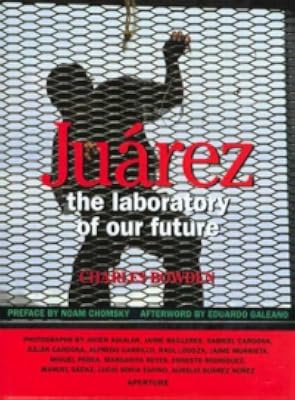
Juarez: The Laboratory of Our Future
by Charles Bowden
On This Page
Description
"Juarez: The Laboratory of Our Time challenges the propaganda and the realities of the current relationship between the United States and Mexico, focusing on the more intimate connection between the border towns of El Paso and Juarez. Charles Bowden, who first brought attention to the story of the Juarez photographers in "Harper's (December 1996), has written an uncompromising, piercing work that combines insightful and informed reporting with a poetic and wry style. His powerful text, show more integrated with brutal and revealing images by a group of unknown Mexican street photographers, takes on issues of NAFTA, immigration, gangs, corruption, drug trafficking, and poverty, uncovering a very different Mexico than generally depicted in the press and by the United States and Mexican governments. Conditions in the impoverished "colonias (urban settlements), work on "maquiladora (foreign-owned factory) assembly lines, arrests and victims resulting from drug and gang violence, the hardships for women andchildren--,in short, everyday life in Juarez-- are all depicted here with an urgency and passion that could only grow from pure desperation. This group of guerrilla photographers, most of whom work for one of the daily newspapers in Juarez, earning the equivalent of only $50 to $100 per week (although the cost of living in Juarez is nearly that of El Paso), risk their lives daily with the photographs they take, alienating themselves from the local governments in both Juarez and El Paso, the police, the drug traffickers, and the gangs. It is all too easy for the American media (and, consequently, the American public) to ignore the plight of the almost two million residents of a cityseemingly so distant and foreign, yet the brutal irony is that many of these people-- our not-so-distant neighbors-- suffer directly from the effects of our "progress." Many Mexicans continue to work in subhuman conditions, with litt show lessTags
Recommendations




























Member Reviews
Published in 1998, "Juárez: The Laboratory of Our Future" is essentially an expanded magazine article by Charles Bowden on his impressions of Ciudad Juárez as reflected by various freelance photographers. The focus is primarily on a series of ongoing and infamous female homicides (often associated with the ubiquitous maquiladoras), with additional musings on narcotraficante violence, economic privation, and the unrelenting pressure that NAFTA and border policy continue to exert on the people of Cd. Juárez. Many of the photographs included in the book are meant to shock the conscience; the operative assumption being that certain gruesome realities of the rape, torture and murder can best be understood viscerally.
I was interested in show more reading this book as a kind of supplementary companion to Roberto Bolaño's novel, "2666" (a purpose for which it seems particularly well-suited). Bowen's writing is both lyrical and blunt, evocative of the universal despair attendant to most incidents of systemic poverty on a grand scale. The overwhelming impression is that Juárez represents something ghastly, inescapable and prophetic for human society generally. The vagueness of Bowen's existential insights are actually (and oddly) more acutely truthful than the detailed political harangues that bookend the text as its Preface (Noam Chomsky) and Afterward (Eduardo Galeano). show less
I was interested in show more reading this book as a kind of supplementary companion to Roberto Bolaño's novel, "2666" (a purpose for which it seems particularly well-suited). Bowen's writing is both lyrical and blunt, evocative of the universal despair attendant to most incidents of systemic poverty on a grand scale. The overwhelming impression is that Juárez represents something ghastly, inescapable and prophetic for human society generally. The vagueness of Bowen's existential insights are actually (and oddly) more acutely truthful than the detailed political harangues that bookend the text as its Preface (Noam Chomsky) and Afterward (Eduardo Galeano). show less
Ratings
Members
- Recently Added By
Author Information
31+ Works 1,335 Members
Charles Bowden is a journalist. He lives in Tucson, Arizona. Charles Bowden was born in Joliet, Illinois on July 20, 1945. He received an undergraduate degree from the University of Arizona and a master's degree in American intellectual history from the University of Wisconsin. He completed work toward his doctorate there but walked out while show more defending his dissertation, because he was frustrated with what he felt were uninformed questions from his review committee. He was a reporter for The Tucson Citizen in the early 1980s. He wrote several books during his lifetime including Down by the River: Drugs, Money, Murder and Family, Juárez: The Laboratory of Our Future, A Shadow in the City: Confessions of an Undercover Drug Warrior, Murder City: Ciudad Juárez and the Global Economy's New Killing Fields, and Blood Orchid: An Unnatural History of America. He died on August 30, 2014 at the age of 69. (Bowker Author Biography) show less
Common Knowledge
- Important places
- Ciudad Juárez, Chihuahua, Mexico
Classifications
- Genres
- Nonfiction, Economics, Art & Design, General Nonfiction
- DDC/MDS
- 306.097216 — Society, government, & culture Social sciences, sociology & anthropology Social Behavior - Dating, Marriage, Divorce Social history North America Mexico, Central America, and the Caribbean
- LCC
- HN120 .C48 .B69 — Social sciences Social history and conditions. Social problems. Social reform Social history and conditions. Social problems. By region or country
- BISAC
Statistics
- Members
- 52
- Popularity
- 581,977
- Reviews
- 1
- Rating
- (4.25)
- Languages
- English
- Media
- Paper
- ISBNs
- 1