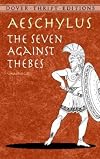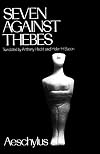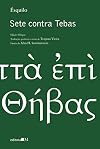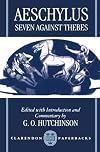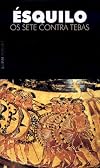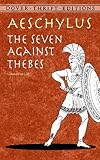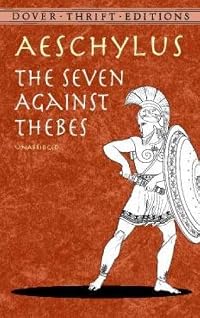
The Seven Against Thebes
by Aeschylus
On This Page
Description
The third and final play in Aeschylus' Oedipodea trilogy, Seven Against Thebes is the only one of the three plays that has survived intact to this day. During the course of the action-packed play, seven would-be usurpers storm the city's gates in a series of brutal attacks. Will the family—still weakened by the curse put on its patriarch, Oedipus—be able to marshal the strength to fight back?.
Tags
Recommendations
















Member Reviews
To be honest, I consider this one of the weaker plays by the Greek tragedian Aeschyles (c. 525–c. 455 BCE). It tells the mythical story of the siege of the city of Thebes, with its seven gates, by an army led by Polyneikes, the exiled brother of the city's strongman, Eteocles. Both were sons of the infamous Oedipus, so you know you are in stormy waters. And for Aeschyles, it was also a point of reference to proclaim his recurring message: man is trapped in a divine order that he can barely understand and must above all endure, even though—in this case—it concerns a curse that can haunt a family for generations.
There is much pathos in this play, many moral messages, and a composition that is not entirely balanced, especially due to show more the passage at the end with Antigone (perhaps not added by Aeschyles himself), a foreshadowing of Sophocles' moving play later on. There are certainly strong scenes, but because Aeschyles has the action scenes in this play described only through third parties, this becomes – in my opinion – one of the less dynamic ones.
There is only one striking aspect that gives this play somewhat more value: it indirectly highlights the inferior position of women in Greek society. For this, see my History account on Goodreads: https://www.goodreads.com/review/show/8507780684 show less
There is much pathos in this play, many moral messages, and a composition that is not entirely balanced, especially due to show more the passage at the end with Antigone (perhaps not added by Aeschyles himself), a foreshadowing of Sophocles' moving play later on. There are certainly strong scenes, but because Aeschyles has the action scenes in this play described only through third parties, this becomes – in my opinion – one of the less dynamic ones.
There is only one striking aspect that gives this play somewhat more value: it indirectly highlights the inferior position of women in Greek society. For this, see my History account on Goodreads: https://www.goodreads.com/review/show/8507780684 show less
Sete contra Tebas, de Ésquilo, é a única peça que chegou até nós de uma tetralogia que inclui Laio, Édipo e a comédia A Esfinge, e que venceu as Dionísias de Atenas em 467 a.C. Como pano de fundo da tragédia, temos a maldição lançada sobre a dinastia dos Labdácidas, reis da cidade-estado de Tebas, na Grécia, que causou o assassinato de Laio, a desgraça de seu filho Édipo, e uma guerra fratricida entre os dois filhos de Édipo, Etéocles e Polinices, para herdar seu trono. A história se inicia quando Polinices, alijado do poder por seu irmão, reúne um exército com mais seis generais gregos e cerca as muralhas de Tebas. Diante da invasão iminente, o rei Etéocles, protagonista da peça, procura acalmar os cidadãos show more em pânico e organizar a defesa da cidade. Destaca-se no texto a bela passagem em que Etéocles, informado por um espião sobre os sete generais que atacarão as portas de Tebas, identificados por seus escudos, designa os sete guerreiros tebanos que irão enfrentá-los. A extrema plasticidade desta obra-prima do teatro grego é realçada na apurada tradução poética de Trajano Vieira, autor também do posfácio a esta edição bilíngue, que inclui ainda um ensaio historiográfico do helenista inglês Alan H. Sommerstein. show less
A decent enough play about a siege with both sides being lead by the sons of Oedipus. Not really too interesting though.
A sort of continuation of the Oedipus trilogy
I didn't really like this one.
To really enjoy these plays I recommend a great translation that works for you!
*i did not read this exact translation, but this story by Euripides
Members
- Recently Added By
Lists

Great Books Favorites
71 works; 6 members

Plays I Like
230 works; 31 members

Truly old classics
63 works; 6 members

Harold Bloom - The Western Canon: A. The Theocratic Age
97 works; 13 members

Favourite Books
1,817 works; 308 members

Favourite Greek Books
97 works; 1 member
100 Books to Read in a Lifetime (That Are Older Than 200 Years)
415 works; 175 members

Oedipus & the Theban Cycle
22 works; 1 member

Books Read in 2019
4,052 works; 110 members

Books Read in 2010
631 works; 10 members

Next Plays / 2025
352 works; 1 member
Author Information

311+ Works 22,815 Members
Aeschylus was born at Eleusis of a noble family. He fought at the Battle of Marathon (490 b.c.), where a small Greek band heroically defeated the invading Persians. At the time of his death in Sicily, Athens was in its golden age. In all of his extant works, his intense love of Greece and Athens finds expression. Of the nearly 90 plays attributed show more to him, only 7 survive. These are The Persians (produced in 472 b.c.), Seven against Thebes (467 b.c.), The Oresteia (458 b.c.)---which includes Agamemnon, Libation Bearers, and Eumenides (or Furies) --- Suppliants (463 b.c.), and Prometheus Bound (c.460 b.c.). Six of the seven present mythological stories. The ornate language creates a mood of tragedy and reinforces the already stylized character of the Greek theater. Aeschylus called his prodigious output "dry scraps from Homer's banquet," because his plots and solemn language are derived from the epic poet. But a more accurate summation of Aeschylus would emphasize his grandeur of mind and spirit and the tragic dignity of his language. Because of his patriotism and belief in divine providence, there is a profound moral order to his plays. Characters such as Clytemnestra, Orestes, and Prometheus personify a great passion or principle. As individuals they conflict with divine will, but, ultimately, justice prevails. Aeschylus's introduction of the second actor made real theater possible, because the two could address each other and act several roles. His successors imitated his costumes, dances, spectacular effects, long descriptions, choral refrains, invocations, and dialogue. Swinburne's (see Vol. 1) enthusiasm for The Oresteia sums up all praises of Aeschylus; he called it simply "the greatest achievement of the human mind." Because of his great achievements, Aeschylus might be considered the "father of tragedy." (Bowker Author Biography) show less
Some Editions
Awards and Honors
Awards
Series
Belongs to Publisher Series
Work Relationships
Is contained in
Has as a student's study guide
Common Knowledge
- Canonical title
- The Seven Against Thebes
- Original publication date
- 467 BCE
- People/Characters
- Eteocles; Antigone; Ismene; spy; herald
- Important places
- Thebes, Greece
- Important events
- Expedition of the Seven against Thebes
- First words
- You citizens of Cadmus, he must speak home/ that in the ship's prow watches the event/ and guides the rudder, his eye not drooped in sleep. - (tr. Grene, 1956)
- Last words
- (Click to show. Warning: May contain spoilers.)For after the Blessed Ones and the strength of Zeus/ he is the one who saved the city/ from utter destruction, from being overwhelmed/ by the wave of foreign invaders. - (tr. Grene, 1956)
Classifications
- Genres
- Fiction and Literature, Poetry
- DDC/MDS
- 882.01 — Literature & rhetoric Classical & modern Greek literatures Classical Greek dramatic poetry and drama standard subdivisions; collections; history, description, critical appraisal; Specific periods Ancient period to ca. 499
- LCC
- PA3827 .S4 .H4 — Language and Literature Greek language and literature. Latin language and literature Greek literature Individual authors Aeschylus
- BISAC
Statistics
- Members
- 407
- Popularity
- 75,738
- Reviews
- 11
- Rating
- (3.28)
- Languages
- 16 — Catalan, Czech, Danish, Dutch, English, French, German, Greek (Ancient), Greek, Italian, Latin, Multiple languages, Portuguese (Portugal), Russian, Spanish, Swedish
- Media
- Paper, Audiobook, Ebook
- ISBNs
- 59
- UPCs
- 1
- ASINs
- 12