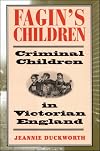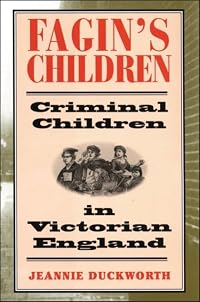
Fagin's Children: Criminal Children in Victorian England
by Jeannie Duckworth
On This Page
Description
Charles Dickens' ""Oliver Twist"", with Fagin, Sykes, the Artful Dodger and children trained as pickpockets and sent out as burglars' accomplices, provides an unforgettable fictional image of the Victorian underworld. ""Fagin's Children"" is an account of the reality of child crime in 19th-century England and the reaction of the authorities to it. It reveals the poverty and misery of many children's lives in the growing industrial cities of Britain and explores the changing attitudes of the show more authorities towards the problem. Inevitably most is known about children who were arrested. While few ch show lessTags
Recommendations




Member Recommendations
Member Reviews
Most people's image of child crime in the Victorian era is taken from the pages of Dickens - who could forget the Artful Dodger, Bill Sykes and of course, Fagin. This book is a very well researched account of the reality of child crime in that period and how it was dealt with by society. Britain was becoming increasingly industrialised which caused many children to suffer poverty and misery, and their numbers grew and grew til in London alone it was estimated that there were up to 100 thousand boys and girls with no-one providing for them, and therefore likely to fall into criminality. Whereas the authorities started by punishing the children (and these punishments seem savage by modern standards) the attitudes towards child criminals show more slowly began changing, and training, reclamation and rehabilitation came into the system - though even those methods seem harsh to us now.
Today, at the start of the c21st the debate still rages on about how to deal with children who break the law. As a JP in a central London Youth Court, I have always been interested in how children are treated by society and authority, and this book is an important contribution to the history of childhood and to the history of crime in Victoria's England. show less
Today, at the start of the c21st the debate still rages on about how to deal with children who break the law. As a JP in a central London Youth Court, I have always been interested in how children are treated by society and authority, and this book is an important contribution to the history of childhood and to the history of crime in Victoria's England. show less
An interesting, if at times dry, study of how children were treated in the 19th century under the criminal law, and the general plight of the poor in that period. The book actually covers the period before Victoria, who came to the throne in 1837, though it concentrates on the 1840s and 1850s, with some coverage of the later 19th century. Children were subject to the same penalties as adults initially, which included capital punishment for what we would view as minor offences, though over time this was increasingly commuted to transportation, mainly to Australia and Van Diemen's land (present day Tasmania), which were being settled as colonies.
The author considers the various initiatives made to rehabilitate criminal children and show more destitute children (who were not considered in the same category). Most of these were private initiatives and consisted of various schools and refuges run by charities. In the earlier part of the period, many of these trained children, mainly boys, who had been sentenced for criminal offences, and would be shipped to the colonies when they reached the age of fifteen or so, so that they could serve their term of transporation (seven years for many, fourteen or so for others, and life for some).
Transporation eventually came to an end in the early 1850s, mainly because there were by that time so many ordinary colonists that they came to dislike the idea of their communities being dumping grounds for criminals. The emphasis then switched to the provision of more institutions at home for the care and reform of children. Eventually, the problem of criminal children became so troublesome that the government increasingly became involved, passing acts of parliament. One of these regularised the reformatory schools, which had begun as a private initiative by a benefactor, and which grew to a network across the country, offering a stable environment with regular meals and a disciplined regime in which some education was offered and vocational training given.
Child criminality continued to be a major problem throughout the period, for which the government had to take more responsibility, and was only eased when the conditions of the poor became better in the later Victorian period, with universal education being introduced.
At times, I did think the book's title could have substituted 'boys' for children. The biggest emphasis during the period was to rehabilitate the huge number of boy thieves to be useful members of society. There are a few mentions of girls scattered through the book, and one chapter about their treatment, but the book concentrates on boys probably because most of the reforming effort was directed towards them. Girls were seen as a problem mainly as prostitutes and 'fallen women' with illegitimate chidren: due to the double standard during this period they were considered more hardened because they were supposed to be morally superior to men by nature and therefore females who failed to conform to this standard were failures as women. The vocations offered to them in the institutions which did take them in were heavilly skewed towards domestic work, needlework (garment making) and the like, with the assumption that they would go into domestic service - the vast majority of working women during this period did, in fact, work as servants - and also marry. In fact, one initiative involving those transported did award boys at the end of their sentence land and livestock etc to be able to set up as farmers, whereas the girls each received a bed and bedding and other domestic items on the assumption that they would, of course, marry immediately.
One quote taken from a journal of the 1880s, summed up the position after an act concerning industrial schools had been passed to place girls on the same basis as boys so that magistrates could finally send them to such schools, but which rarely happened in practice due to expense. "The present accommodation in industrial schools is for boys 19,037 and for girls 4656. Boys are to be rescued from thieves and bad company; girls may rot and die because it is too expensive to train them in the right ways. Girls are considered able to take care of themselves; boys must have every care taken of them."
The book is quite thorough and features quite a few tables of figures giving various breakdowns of crimes, ages, prison terms etc. There were so many different institutions over the period though, that it did tend to blur into a bit of an indistinguishable morass. Also the book describes the various institutions, their regimes, the conditions of the poor and especially the children, but doesn't really form an opinion and rather peters out at the end. I would rate it as a solid 3 stars. show less
The author considers the various initiatives made to rehabilitate criminal children and show more destitute children (who were not considered in the same category). Most of these were private initiatives and consisted of various schools and refuges run by charities. In the earlier part of the period, many of these trained children, mainly boys, who had been sentenced for criminal offences, and would be shipped to the colonies when they reached the age of fifteen or so, so that they could serve their term of transporation (seven years for many, fourteen or so for others, and life for some).
Transporation eventually came to an end in the early 1850s, mainly because there were by that time so many ordinary colonists that they came to dislike the idea of their communities being dumping grounds for criminals. The emphasis then switched to the provision of more institutions at home for the care and reform of children. Eventually, the problem of criminal children became so troublesome that the government increasingly became involved, passing acts of parliament. One of these regularised the reformatory schools, which had begun as a private initiative by a benefactor, and which grew to a network across the country, offering a stable environment with regular meals and a disciplined regime in which some education was offered and vocational training given.
Child criminality continued to be a major problem throughout the period, for which the government had to take more responsibility, and was only eased when the conditions of the poor became better in the later Victorian period, with universal education being introduced.
At times, I did think the book's title could have substituted 'boys' for children. The biggest emphasis during the period was to rehabilitate the huge number of boy thieves to be useful members of society. There are a few mentions of girls scattered through the book, and one chapter about their treatment, but the book concentrates on boys probably because most of the reforming effort was directed towards them. Girls were seen as a problem mainly as prostitutes and 'fallen women' with illegitimate chidren: due to the double standard during this period they were considered more hardened because they were supposed to be morally superior to men by nature and therefore females who failed to conform to this standard were failures as women. The vocations offered to them in the institutions which did take them in were heavilly skewed towards domestic work, needlework (garment making) and the like, with the assumption that they would go into domestic service - the vast majority of working women during this period did, in fact, work as servants - and also marry. In fact, one initiative involving those transported did award boys at the end of their sentence land and livestock etc to be able to set up as farmers, whereas the girls each received a bed and bedding and other domestic items on the assumption that they would, of course, marry immediately.
One quote taken from a journal of the 1880s, summed up the position after an act concerning industrial schools had been passed to place girls on the same basis as boys so that magistrates could finally send them to such schools, but which rarely happened in practice due to expense. "The present accommodation in industrial schools is for boys 19,037 and for girls 4656. Boys are to be rescued from thieves and bad company; girls may rot and die because it is too expensive to train them in the right ways. Girls are considered able to take care of themselves; boys must have every care taken of them."
The book is quite thorough and features quite a few tables of figures giving various breakdowns of crimes, ages, prison terms etc. There were so many different institutions over the period though, that it did tend to blur into a bit of an indistinguishable morass. Also the book describes the various institutions, their regimes, the conditions of the poor and especially the children, but doesn't really form an opinion and rather peters out at the end. I would rate it as a solid 3 stars. show less
An interesting book on the terrible plight of destitute children in 19th-century England. (The word "Victorian" doesn't really fit, though; most of what Duckworth writes about is from before Victoria took the throne.) Loads of primary sources are quoted here. You learn about the social/economic conditions that left children with pretty much no choice but to turn to crime, children being punished the same ways as adults (fines, prison hulks, transportation, etc), and efforts at rehabilitation of children. Of course, those problems are still very much in existence today.
What the book lacks, however, is an argument. Most historical texts have the author trying to prove a point, but I couldn't find any in this book. I kept thinking to show more myself: Okay, what is she getting at here? It was vaguely frustrating. show less
What the book lacks, however, is an argument. Most historical texts have the author trying to prove a point, but I couldn't find any in this book. I kept thinking to show more myself: Okay, what is she getting at here? It was vaguely frustrating. show less
Ratings
Members
- Recently Added By
Author Information
1 Work 20 Members
Classifications
- Genres
- Nonfiction, Sociology
- DDC/MDS
- 364.36094109034 — Social sciences Social problems and social services Criminology Criminals Juvenile criminals
- LCC
- HV9145 .A5 .D83 — Social sciences Social pathology. Social and public welfare. Criminology Social pathology. Social and public welfare. Criminal justice administration Penology. Prisons. Corrections The juvenile offender. Juvenile delinquency.
- BISAC
Statistics
- Members
- 20
- Popularity
- 1,275,333
- Reviews
- 3
- Rating
- (4.00)
- Languages
- English
- Media
- Paper, Ebook
- ISBNs
- 2