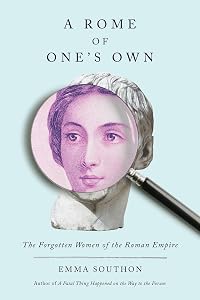
A Rome of One's Own: The Forgotten Women of the Roman Empire
by Emma Southon
On This Page
Description
From the acclaimed author of A Fatal Thing Happened on the Way to the Forum comes a wildly entertaining new history of Rome that uses the lives of twenty-one extraordinary women to upend our understanding of the ancient worldThe history of Rome has long been narrow and one-sided, essentially a history of "the Doing of Important Things." It is a history of winning battles, passing laws, and "Having Important Opinions in Public." And as far as Roman historians have been concerned, women don't show more make that history. From Romulus through "the political stab-fest of the late Republic," and then on to all the emperors, Roman historians may deign to give you a wife or a mother to show how bad things get when women get out of control, but history is more than that.
A Rome of One's Own will correct that. This is a retelling of the history of Rome with the Important Things, but also all the things Roman history writers relegate to the background—or designate as domestic, feminine, or worthless. This is a history of individuals, twenty-one women who span the length of its territory and its centuries, who caused outrage, led armies in rebellion, wrote poetry, lived independently or under the thumb of emperors.
A social and cultural history told with humor and verve as well as a deep scholarly background, A Rome of One's Own highlights women overlooked and misunderstood, and through them offers a fascinating and groundbreaking chronicle of the ancient world.
. show less
Tags
Recommendations







Member Reviews
History far too often focuses on kings and battles, completely overlooking women and the ordinary people going about their daily lives. In contrast, A Rome of One’s Own by Emma Southon steps forwards through Rome’s history, profiling individual women. One is known because of the wonderful epitaph her husband wrote when she died. Another was a Christian martyr, and there’s a grandmother who was the power behind the throne. I particularly enjoyed reading about a businesswoman in Pompeii who owned an elaborate leisure centre with restaurants, pools, and gardens. Southon writes in a surprisingly colloquial style, which fascinated me as a writer.
Emma Southon's history which focuses on various women from throughout Rome and the Roman Empire's history is both highly informative and full of sharp humour that brings her subject to life. Whether discussing the wife of the founder of Rome, the owner of an entertainment venue in Pompei, or a poet who left her poems engraved on a statue in Egypt, Southon brings each woman and her time period to life in excellent detail. I can only imagine how fun it would be to have Southon as a prof as her writing style is full of wry asides that often had me laughing as I listened. While my personal interests when I studied classics in undergrad always leaned more towards ancient Greece rather than to ancient Rome, Southon's book was so highly show more enjoyable that I have every intention of trying her other books to enjoy her writing even more. I'll also note I listened to this on audio and Danielle Cohen's narration is highly enjoyable, with both her British accent and her perfectly capturing in tone all of Southon's humour and asides. show less
I'm very torn about A History of the Roman Empire in 21 Women. On the one hand there is a lot of good material in here and Southon's work is a good balance from all of the old white men histories. On the other hand, her style is very informal, sometimes refreshing, but more often irritating. I should not need to be googling 21 century actors to figure out what she is saying about ancient Rome. Not to mention that this book is going to age very quickly.
For what it's worth, she says early on that Somebody or other is probably the only one most people have heard of. I did not recognize her, but certainly had heard of most of the Christian women she writes about.
For what it's worth, she says early on that Somebody or other is probably the only one most people have heard of. I did not recognize her, but certainly had heard of most of the Christian women she writes about.
It was interesting in that I'd not come across some of the women's stories, but to my mind Southon's writing style was far too gossipy and sniggery for the subject matter. A deeper discussion on the theme would have been better - the style was too light-weight and didn't do it justice.
The stories were arranged chronologically from the founding of Rome to the late Empire, and came across as a bit disjointed. I think perhaps it would have been better to look at this thematically; contrasting similar women at different times, and seeing how perspectives changed.
Recommended if you can get past the style.
The stories were arranged chronologically from the founding of Rome to the late Empire, and came across as a bit disjointed. I think perhaps it would have been better to look at this thematically; contrasting similar women at different times, and seeing how perspectives changed.
Recommended if you can get past the style.
My expectations of works by Emma Southon are high, and she never disappoints. These stories of 21 women from Roman history give us quite a few surprises and a lot of different perspectives. They were chosen from the earliest days of Rome to the end of the Western Roman Empire, from the city itself but also from the frontiers of the empire. Southon describes their lives unflaggingly in her light, entertaining style, even though some of these stories are rather grim.
As Southon reminds us, women had an important role in Roman society, which was very family oriented indeed -- extended families were also political clans. But much of what we know about women in antiquity was written by men, and some of them, such as Juvenalis or Tacitus, show more wrote with undisguised misogyny. (Juvenalis’ notorious sixth satire is at least good satire in the sense that you cannot know whether the author intends his furious rant to be taken seriously or not.)
This book gives a wider and more honest perspective. Some of the women in this book are only known by what men wrote about them. (In one case, a lengthy eulogy by a bereaved husband.) But Southon also chose many women who wrote themselves and whose words have survived through the ages, a dismally small group. In letters, poetry, inscriptions and edicts, they make themselves heard. They are not always very sympathetic, and Southon is particularly snarky about the weird attitudes of some Christian saints. Maybe they didn’t all write well. But they lived, their often struggled bravely in their adversity, and they wrote. It is good that we can still hear their story. show less
As Southon reminds us, women had an important role in Roman society, which was very family oriented indeed -- extended families were also political clans. But much of what we know about women in antiquity was written by men, and some of them, such as Juvenalis or Tacitus, show more wrote with undisguised misogyny. (Juvenalis’ notorious sixth satire is at least good satire in the sense that you cannot know whether the author intends his furious rant to be taken seriously or not.)
This book gives a wider and more honest perspective. Some of the women in this book are only known by what men wrote about them. (In one case, a lengthy eulogy by a bereaved husband.) But Southon also chose many women who wrote themselves and whose words have survived through the ages, a dismally small group. In letters, poetry, inscriptions and edicts, they make themselves heard. They are not always very sympathetic, and Southon is particularly snarky about the weird attitudes of some Christian saints. Maybe they didn’t all write well. But they lived, their often struggled bravely in their adversity, and they wrote. It is good that we can still hear their story. show less
A history of Rome told through brief biographies of 21 women, from the women associated by tradition with the city's semi-mythical origins through to the Empress Galla Placidia, whom Emma Southon frames as "the last Roman." As with Southon's other books, the degree to which this works for you will probably depend to a great extent on whether Southon's sense of humour vibes with yours. If you find yourself not clicking with it early on, bail on the book, because it's not going to change. If it does work for you, though, stick with it because Southon does a very good job at presenting some of the main conclusions of the historiography of ancient women of the last 40-50 years or so, and making an argument about the centrality of women to show more an understanding of the Roman state, in an accessible, pop history format. Those who've already read a lot on the topic probably won't find much new here, but if you're new to the topic and/or thinking about women's history as more than just the "add woman and stir" approach, you might well like this. show less
The stories of the women featured in this book were really interesting, but the authorial voice does them a disservice - it's jarring and comes across as a bit 'how do you do, fellow kids?'
The book also seems confused about who its intended audience is. In some places it seemed to expect a high level of prior knowledge (e.g the speed at which Christianity spread throughout the Roman Empire) but in other places explains more basic things like what a dowry is.
More trust in the topic and a better idea of the target audience would have made this a more enjoyable read.
The book also seems confused about who its intended audience is. In some places it seemed to expect a high level of prior knowledge (e.g the speed at which Christianity spread throughout the Roman Empire) but in other places explains more basic things like what a dowry is.
More trust in the topic and a better idea of the target audience would have made this a more enjoyable read.
Members
- Recently Added By
Lists

Books Read in 2024
4,623 works; 126 members
Author Information

6+ Works 1,054 Members
Emma Southon has a PhD in Ancient History from the University of Birmingham and researches subjects of sex, the family, gender, and religion. She holds a long running obsession with the bad guys of the Roman empire, blogs at emmasouthon.com, and tweets at @NuclearTeeth. She lives in England.
Some Editions
Awards and Honors
Distinctions
Common Knowledge
- Original publication date
- 2023
- People/Characters
- Tarpeia; Hersilia; Tanaquil; Lucretia; Tullia; Oppia (show all 21); Hispala Faecenia; Clodia; Turia; Julia Caesari Filia; Cartimandua; Boudicca; Julia Felix; Sulpicia Lepidina; Julia Balbilla; Perpetua; Julia Maesa; Julia Mamaea; Zenobia; Melania the Elder; Galla Placidia
- Dedication
- For Professor Mary Harlow and my mum: the women who shaped me.
Classifications
- Genres
- History, General Nonfiction, Nonfiction, Biography & Memoir, Sexuality and Gender Studies
- DDC/MDS
- 937.06082 — History & geography History of ancient world (to ca. 499) Italian Peninsula to 476 and adjacent territories to 476 Empire 31 B.C.-476 A.D.
- LCC
- HQ1136 — Social sciences The family. Marriage, Women and Sexuality The Family. Marriage. Women Women. Feminism
- BISAC
Statistics
- Members
- 323
- Popularity
- 98,451
- Reviews
- 8
- Rating
- (3.82)
- Languages
- English, German, Norwegian, Spanish
- Media
- Paper, Audiobook, Ebook
- ISBNs
- 14
- ASINs
- 5