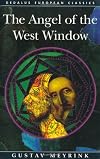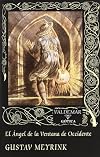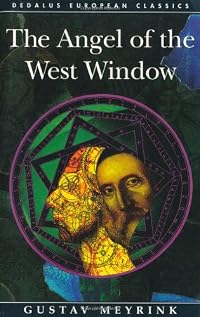
The Angel of the West Window
by Gustav Meyrink
On This Page
Description
A complex and ambitious novel which centres on the life of the Elizabethan magus, John Dee, in England, Poland and Prague, as it intertwines past and present, dreams and visions, myth and reality in a world of the occult, culminating in the transmutation of physical reality into a higher spiritual existence.John Dee, through his 20th century descendant, is led by the Green Angel to the 'Other Side of the Mirror'. From the erotically alluring Assja Shotokalungin (in all her incarnations), the show more pliant Jane, the mischievous Queen Elizabeth 1 to the earless charlatan Kelley, the truly grotesque Bartlett Greene and the sinister Emperor Rudolph1, John Dee heads a cast which lingers in the mind long after the book has been put down. show lessTags
Recommendations

















Member Reviews
Baron Muller, a Viennese dealer in antiquities, discovers he's a descendant of John Dee, who was Queen Elizabeth's astronomer and adviser and, most famously, a seeker of occult truths. The significance of this link becomes both more evident and changes, as Muller reads through Dee's diaries. The world becomes double, with the hitherto occult one gradually emerging from beyond the shallow appearance of reality. The story (or history) becomes double too, as contemporary events mirror events in the past, and the figures from John Dee's time reappear in Muller's life as modern counterparts. Some of these people are Dee's (and Muller's) mortal enemies; some are friends, but he struggles to recognise their identities and aims. There is an show more overarching occult theme to the plot too, the alchemical rite which was foiled in Dee's time, a mystical wedding, to which Muller now blindly grapples in a very literal sense--but has he identified his "bride" correctly? Does he understand what the rite is supposed to mean, and which elements need to unite to bring it through?
Meyrink's a master at making the stitches between dreams and reality shimmer uncannily, at projection of mysteries that point to the deepest being. show less
Meyrink's a master at making the stitches between dreams and reality shimmer uncannily, at projection of mysteries that point to the deepest being. show less
There are some conspicuous similarities between Gustav Meyrink's Angel of the West Window and the Aegypt Cycle of John Crowley. Both of them embed the story of Elizabethan magus John Dee in a narrative about a 20th-century intellectual undergoing mysterious trials. The big differences in the way they do so are reflections of the fact that Meyrink was an occultist, and Crowley is not. In Crowley's books, the Dee story is related in a novel written by Fellowes Kraft, whose literary estate is an object of professional concern for the modern protagonist. In The Angel of the West Window, Dee's life is first detailed in Dee's own journals and papers, preserved as a family inheritance. Then later the story is completed with the 20th-century show more protagonist's visionary experiences of his ancestor's latter days.
Although it is a single volume (contrasted with the four of the Aegypt Cycle, which admittedly have a much wider focus), The Angel of the West Window is a substantial one, possibly exceeding the length of any two of Meyrink's other novels combined. Its mood and themes are probably closest to The White Dominican, which may actually be a better book, but The Angel has more to offer readers interested in occult history, by exploring the career of Dee.
Like Meyrink's The Green Face and The White Dominican, this story has supernatural elements partaking of a certain measure of gender essentialism from a masculine perspective, to which feminist critics may take offense. It is, however, firmly in the libidinal Rosicrucian tradition of literature, including works like Randolph's Ravalette, Bulwer-Lytton's Zanoni, and Naglowska's Sacred Rite of Magical Love.
Mike Mitchell's English translation seems to be solid enough (judged without access to the German original) and reads smoothly, although his consistent misspelling of elixir as "elixier" is a little irritating. For a long book, it lacks all parsing beyond the level of a paragraph break. There are no chapter headings, and with the narrative's tendency to pass between recollection, reading, vision, dream, and empirical states with very little notice, any place the reader might pause has a tendency to feel very arbitrary.
Other reviewers have cautioned that the book may be opaque to those unversed in the occult, an estimation which I am not in a good position to judge. The first-person protagonist Baron Mueller, who is in some measure a cipher for the author, does not indulge in expository hand-holding regarding general theories or traditions of occultism. Certainly, the social and technical aspects of 17th-century alchemy are an important context which the book tends to take for granted. I felt as if the ending made some of the story's enigmas a little too clear, and the newspaper-clipping denouement has a bit of cliche about it. But there is still a deep sense of mystery maintained through the final revelations. show less
Although it is a single volume (contrasted with the four of the Aegypt Cycle, which admittedly have a much wider focus), The Angel of the West Window is a substantial one, possibly exceeding the length of any two of Meyrink's other novels combined. Its mood and themes are probably closest to The White Dominican, which may actually be a better book, but The Angel has more to offer readers interested in occult history, by exploring the career of Dee.
Like Meyrink's The Green Face and The White Dominican, this story has supernatural elements partaking of a certain measure of gender essentialism from a masculine perspective, to which feminist critics may take offense. It is, however, firmly in the libidinal Rosicrucian tradition of literature, including works like Randolph's Ravalette, Bulwer-Lytton's Zanoni, and Naglowska's Sacred Rite of Magical Love.
Mike Mitchell's English translation seems to be solid enough (judged without access to the German original) and reads smoothly, although his consistent misspelling of elixir as "elixier" is a little irritating. For a long book, it lacks all parsing beyond the level of a paragraph break. There are no chapter headings, and with the narrative's tendency to pass between recollection, reading, vision, dream, and empirical states with very little notice, any place the reader might pause has a tendency to feel very arbitrary.
Other reviewers have cautioned that the book may be opaque to those unversed in the occult, an estimation which I am not in a good position to judge. The first-person protagonist Baron Mueller, who is in some measure a cipher for the author, does not indulge in expository hand-holding regarding general theories or traditions of occultism. Certainly, the social and technical aspects of 17th-century alchemy are an important context which the book tends to take for granted. I felt as if the ending made some of the story's enigmas a little too clear, and the newspaper-clipping denouement has a bit of cliche about it. But there is still a deep sense of mystery maintained through the final revelations. show less
You have to REALLY be interested in and somewhat (even a teensy bit like myself) knowledgeable about the basics of alchemy in its "spiritual" form to get through this book. It's pretty good, very interesting and definitely one to reread at some point.
The narrator of this story is one Baron Muller, who inherits a bunch of old papers & diaries that belonged to the Elizabethan astrologer/physician/magician/alchemist Dr. John Dee. He decides to go through them randomly, and as he does, he comes to realize that he is holding the life story of Dee, and that in Dee's lifetime he left many things undone that need to be finished. In the introduction to this book, Mike Mitchell (who is also the translator in my edition), wrote that "Meyrink's show more universe is multi-layered and different worlds exist alongside, interlinked with, each other." (15) And as the story goes on, Muller becomes aware that his fate is linked with that of Dee's unfinished business, and that he has a responsibility to pick up various threads across time and space to fulfill both his and Dee's destiny.
If you're into the occult at all, or into alchemy in its various forms, or if you're interested in the story of Doctor John Dee, you may want to try this. I'm always fascinated by this person, and the story did not let me down. It is a book you need to read slowly because it is so incredibly full, but well worth it in the end. You should also wait until the end to read the introduction. show less
The narrator of this story is one Baron Muller, who inherits a bunch of old papers & diaries that belonged to the Elizabethan astrologer/physician/magician/alchemist Dr. John Dee. He decides to go through them randomly, and as he does, he comes to realize that he is holding the life story of Dee, and that in Dee's lifetime he left many things undone that need to be finished. In the introduction to this book, Mike Mitchell (who is also the translator in my edition), wrote that "Meyrink's show more universe is multi-layered and different worlds exist alongside, interlinked with, each other." (15) And as the story goes on, Muller becomes aware that his fate is linked with that of Dee's unfinished business, and that he has a responsibility to pick up various threads across time and space to fulfill both his and Dee's destiny.
If you're into the occult at all, or into alchemy in its various forms, or if you're interested in the story of Doctor John Dee, you may want to try this. I'm always fascinated by this person, and the story did not let me down. It is a book you need to read slowly because it is so incredibly full, but well worth it in the end. You should also wait until the end to read the introduction. show less
Just too heavy on the mysticism for my taste
http://www.fireandsword.com/Reviews/angelwest.html
Gustav Meyrink evoked the brooding spirit of Prague in novels rich with mystical symbolism, novels that might be coded with kabalistic messages themselves and capable of working a strange alchemy in their readers. Meyrink was a banker and man-about-town in fin de siecle Prague until series of duels and a false accusation of mishandling bank funds smashed the manacles of respectability that held him back. Thereafter he penned his odd novels mixing his Judeo-Buddhist mysticism with zestful fantasy yarns.
Gustav Meyrink evoked the brooding spirit of Prague in novels rich with mystical symbolism, novels that might be coded with kabalistic messages themselves and capable of working a strange alchemy in their readers. Meyrink was a banker and man-about-town in fin de siecle Prague until series of duels and a false accusation of mishandling bank funds smashed the manacles of respectability that held him back. Thereafter he penned his odd novels mixing his Judeo-Buddhist mysticism with zestful fantasy yarns.
Members
- Recently Added By
Lists

Books set in Prague
40 works; 1 member
Author Information

Awards and Honors
Notable Lists
Series
Belongs to Publisher Series
Common Knowledge
- Canonical title
- The Angel of the West Window
- Original title
- Der Engel vom westlichen Fenster
- Original publication date
- 1927
- People/Characters
- John Dee; Edward Kelley; Baphomet; Baron Mueller; Jane Dee; Emperor Rudolf II (show all 10); Mascee; Bartlett Greene; Black Isaïs; Princess Assja Shotokalungin
- First words
- A strange feeling: this packet I am holding in my hand was all neatly tied up and sealed by a dead man!
Sonderbares Gefühl: das verschnürte und versiegelte Eigentum eines Toten in der Hand zu halten! - Last words
- (Click to show. Warning: May contain spoilers.)Eine nicht in Abrede zu stellende Familienähnlichkeit läßt immerhin vermuten, daß Baron Müllers diesbezügliche Annahme keineswegs gänzlich von der Hand zu weisen ist.
Classifications
Statistics
- Members
- 257
- Popularity
- 125,453
- Reviews
- 10
- Rating
- (3.60)
- Languages
- 10 — Czech, Dutch, English, French, German, Hungarian, Italian, Russian, Serbian, Spanish
- Media
- Paper, Ebook
- ISBNs
- 29
- ASINs
- 3