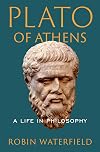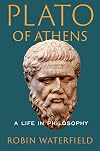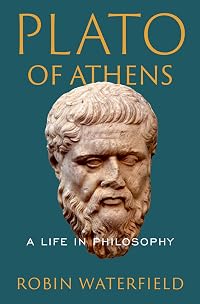
Plato of Athens: A Life in Philosophy
by Robin Waterfield
On This Page
Description
This book, the first ever biography of the father of philosophy, tracks Plato's life from his childhood in war-torn Athens at the end of the fifth century BCE to his founding of the Academy, adventures in Sicily, death, and immense legacy. Throughout, it sheds light on Plato's many timeless works of philosophy.Tags
Recommendations





Member Reviews
The risk of writing a biography with thin source material is that you spend most of the time debating the legitimacy of sources and stories rather than presenting a seamless narrative of the individual's life. The result is a lot of detail and pedantic discussion that the reader may or may not find all that interesting.
This on top of the fact that Plato intentionally removed himself from his dialogues, placing the emphasis instead on active reader engagement with the philosophical ideas themselves. We could rightfully ask: If biographical details were unimportant to Plato, then why should they be important to us? Especially considering that Plato’s reputed travels to Egypt and elsewhere—the most exciting part of his show more biography—probably didn’t even happen.
This is all to say, don’t expect the most riveting biography you’ve ever read. But if you have an interest in philosophy, and ancient philosophy or Plato in particular, you’ll probably enjoy learning everything there is to know about the life of philosophy’s most famous practitioner. And Waterfield’s book will give you more than sufficient background to jump directly into Plato’s dialogues themselves.
The most interesting parts of the book cover the development of Plato’s dialogues and ideas. For example, Waterfield notes that the story of the Oracle proclaiming Socrates to be the wisest man in Athens—which Plato says launched Socrates on his Socratic mission of questioning others—is almost certainly false, because Socrates could have only been considered wise by the Oracle in the first place because he had already been engaging people in Socratic questioning. Plato is simply dramatizing the context by which he wants posterity to remember the wisdom and teachings of Socrates.
Another key takeaway is that Plato’s philosophy was anti-dogmatic in character (this was important for the subsequent development of Western philosophy). It’s telling that Plato’s most prominent followers, including his successor as head of the Academy, Speusippus, ultimately disagreed with Plato’s core doctrines. This fact signifies that the point of the Academy was not the unchanging proliferation of Plato’s ideas, but rather critical engagement and progress in philosophical research questions. In our current environment of shallow and closed-minded thinking, there are few lessons that could be more well-received. show less
This on top of the fact that Plato intentionally removed himself from his dialogues, placing the emphasis instead on active reader engagement with the philosophical ideas themselves. We could rightfully ask: If biographical details were unimportant to Plato, then why should they be important to us? Especially considering that Plato’s reputed travels to Egypt and elsewhere—the most exciting part of his show more biography—probably didn’t even happen.
This is all to say, don’t expect the most riveting biography you’ve ever read. But if you have an interest in philosophy, and ancient philosophy or Plato in particular, you’ll probably enjoy learning everything there is to know about the life of philosophy’s most famous practitioner. And Waterfield’s book will give you more than sufficient background to jump directly into Plato’s dialogues themselves.
The most interesting parts of the book cover the development of Plato’s dialogues and ideas. For example, Waterfield notes that the story of the Oracle proclaiming Socrates to be the wisest man in Athens—which Plato says launched Socrates on his Socratic mission of questioning others—is almost certainly false, because Socrates could have only been considered wise by the Oracle in the first place because he had already been engaging people in Socratic questioning. Plato is simply dramatizing the context by which he wants posterity to remember the wisdom and teachings of Socrates.
Another key takeaway is that Plato’s philosophy was anti-dogmatic in character (this was important for the subsequent development of Western philosophy). It’s telling that Plato’s most prominent followers, including his successor as head of the Academy, Speusippus, ultimately disagreed with Plato’s core doctrines. This fact signifies that the point of the Academy was not the unchanging proliferation of Plato’s ideas, but rather critical engagement and progress in philosophical research questions. In our current environment of shallow and closed-minded thinking, there are few lessons that could be more well-received. show less
Plato was so devoted to the memory of his teacher Socrates, who in his view had been unjustly executed by his fellow Athenians, that he spent much of his life writing and disseminating his thoughts through Socrates’ voice rather than his own. Just as Christianity might have looked very different had it not been for St Paul’s writings and teachings, the nature of Greek (and subsequent Western) philosophy would have looked very different had it not been for Plato’s advocacy of what he presented, at least initially, as the thoughts and methods of his teacher. From Plato’s extensive writings, along with those of Xenophon and a few other contemporary and later sources, we can construct a reasonably full biography of Socrates, show more culminating with his trial and execution. We also get a strong sense of Socrates’ personality, as a challenging and ironic interlocutor and a tough, courageous soldier. But what of Plato himself? Did Socrates’ most adept pupil also live a life worth recording and describing?
The idea of subjecting Plato to biographical treatment seems unpromising. Evidence for his life is scarce or uncertain. He passed most of his later years ‘in the groves of Academe’ – the Academy that he founded as a school of philosophy. As Robin Waterfield tells us in this well-researched and attractively written book, ‘the last dedicated biography in English of any length was published in 1839’. There are grounds for renewing the attempt, especially if one argues (as Waterfield does) that at least some of the 13 letters attributed to Plato that have survived are from the philosopher’s own hand.
Plato’s long Seventh Letter in particular has been considered spurious, but there is a growing consensus that it is a genuine and crucial document of Plato’s experiences. In it, Plato describes how he attempted to put his political theories into practice by travelling to Sicily to educate Dionysius II, the tyrant of Syracuse, about how a just and harmonious city-state should be run. The attempt was a failure, with Plato suffering the disillusionment of learning that his ideas could not compensate for the capricious nature of a tyrant. The episode, however, in addition to testimonies about Plato’s earlier foray to Sicily (during which he was allegedly captured and ransomed by pirates), supports Plato’s assertion that he was for many years intent on a career of political action rather than philosophical investigation.
That proposition underpins a biography of Plato that was published in 1919 by the eminent Prussian philologist Ulrich von Wilamowitz-Moellendorff (which, surprisingly, is not mentioned in this book). Wilamowitz’s imaginative depiction of Plato and his world raised scholarly eyebrows at the time; but the Oxford Hellenist E.R. Dodds noted that ‘the enduring importance of Wilamowitz’s “biographical novel” or “Plato for housemaids” (as the stuffier sort of critics called it) is that it has compelled subsequent writers to think of Plato as a man and not as a self-generating system of metaphysics’. The latter impression tends to make an appearance from time to time in Waterfield’s account. While he discusses the Sicilian adventures, he is more comfortable talking about the corpus of philosophical dialogues (28 of which he considers genuine) than about Plato as a person. While we learn about Plato’s close friendship with the mathematician-inventor Archytas of Tarentum, it’s a shame that no mention is made of his most sensational invention – a mechanical bird that flew using steam power – presumably because Plato nowhere mentions it himself.
Read the rest of the review at HistoryToday.com
Armand D’Angour is Professor of Classics at Jesus College, Oxford. show less
The idea of subjecting Plato to biographical treatment seems unpromising. Evidence for his life is scarce or uncertain. He passed most of his later years ‘in the groves of Academe’ – the Academy that he founded as a school of philosophy. As Robin Waterfield tells us in this well-researched and attractively written book, ‘the last dedicated biography in English of any length was published in 1839’. There are grounds for renewing the attempt, especially if one argues (as Waterfield does) that at least some of the 13 letters attributed to Plato that have survived are from the philosopher’s own hand.
Plato’s long Seventh Letter in particular has been considered spurious, but there is a growing consensus that it is a genuine and crucial document of Plato’s experiences. In it, Plato describes how he attempted to put his political theories into practice by travelling to Sicily to educate Dionysius II, the tyrant of Syracuse, about how a just and harmonious city-state should be run. The attempt was a failure, with Plato suffering the disillusionment of learning that his ideas could not compensate for the capricious nature of a tyrant. The episode, however, in addition to testimonies about Plato’s earlier foray to Sicily (during which he was allegedly captured and ransomed by pirates), supports Plato’s assertion that he was for many years intent on a career of political action rather than philosophical investigation.
That proposition underpins a biography of Plato that was published in 1919 by the eminent Prussian philologist Ulrich von Wilamowitz-Moellendorff (which, surprisingly, is not mentioned in this book). Wilamowitz’s imaginative depiction of Plato and his world raised scholarly eyebrows at the time; but the Oxford Hellenist E.R. Dodds noted that ‘the enduring importance of Wilamowitz’s “biographical novel” or “Plato for housemaids” (as the stuffier sort of critics called it) is that it has compelled subsequent writers to think of Plato as a man and not as a self-generating system of metaphysics’. The latter impression tends to make an appearance from time to time in Waterfield’s account. While he discusses the Sicilian adventures, he is more comfortable talking about the corpus of philosophical dialogues (28 of which he considers genuine) than about Plato as a person. While we learn about Plato’s close friendship with the mathematician-inventor Archytas of Tarentum, it’s a shame that no mention is made of his most sensational invention – a mechanical bird that flew using steam power – presumably because Plato nowhere mentions it himself.
Read the rest of the review at HistoryToday.com
Armand D’Angour is Professor of Classics at Jesus College, Oxford. show less
Ratings
Members
- Recently Added By
Published Reviews
Robin Waterfield has established himself, over a period of several decades, as the world’s leading anglophone translator of ancient Greek prose literature. In a remarkable body of work (approaching some thirty volumes), he has produced characteristically fluent and stylish versions of such authors as Herodotus (complete), Xenophon (Anabasis and the Socratica), Aristotle (Physics and show more Rhetoric), Demosthenes, Polybius, Plutarch, Marcus Aurelius, and Epictetus. But at the heart of his output have been the dialogues of Plato, of which he has translated sixteen to date, including Republic, Symposium, Theaetetus, and Timaeus. He has also published several trade books on topics in Greco-Roman history, so he is highly experienced at writing for a general audience, the explicit target of the present work. In Plato of Athens Waterfield even anticipates readers who may not have sampled any of Plato’s own writing (94), and he is mostly very careful to take nothing for granted historically or philosophically; his light footnotes cite primary sources but contain only very occasional references to secondary literature (though a fifteen-page bibliography is supplied, surely overkill for novices). He certainly writes with a clarity and eloquence which will make his book engaging for non-specialists. But does the aim of writing for such an audience justify Waterfield’s willingness to talk in terms of a ‘biography’ of Plato, when he knows full well the scarcity and shortcomings of the evidence available for such an undertaking? In a way, yes, since the book does not purport to be a rigorous reappraisal of the evidence for Plato’s life but, instead, one kind of ‘introduction to [Plato’s] work’ (x). Even so, Plato of Athens prompts some difficult questions about what it means, or might mean, to think about Plato biographically. show less
added by cinaedus
Lists

Book wishlist
78 works; 1 member
Author Information

45+ Works 3,109 Members
Robin Waterfield is an independent scholar and translator, living in southern Greece. In addition to more than twenty-five translations of works of Greek literature, he is the author of numerous books, including Dividing the Spoils and Taken at the Flood.
Awards and Honors
Notable Lists
Common Knowledge
- Epigraph
- “Plato himself, shortly before his death, had a dream of himself as a swan, darting from tree to tree and causing great trouble to the fowlers, who were unable to catch him. When Simmias the Socratic heard this dream, he ex... (show all)plained that all men would endeavor to grasp Plato's meaning. None, however, would succeed, but each would interpret him according to their own views.”
—Anonymous Prolegomena to Platonic Philosophy 1.29–37 - Dedication
- For Kathryn
my best friend and co-author of my books
Classifications
Statistics
- Members
- 114
- Popularity
- 286,421
- Reviews
- 2
- Rating
- (3.80)
- Languages
- Dutch, English, Spanish
- Media
- Paper, Audiobook, Ebook
- ISBNs
- 8
- ASINs
- 2