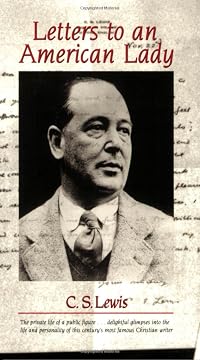
Letters to an American Lady
by C. S. Lewis
On This Page
Description
When Lewis was 51 years old and long established at Magdalen College, Oxford, he wrote the first of this collection of letters to an American widow. She was described as a "very charming, gracious, southern aristocratic lady who loved to talk and speak well". In them are his antipathy to journalism, advertising, snobbery, psychoanalysis, and the petty practices that sap freedoms. They identify events in his life after 1950 including his marriage to Joy Davidman and her death three years later.Tags
Recommendations











Member Reviews
Letters to an American Lady is a compilation of letters C.S. Lewis wrote to a woman in the US named Mary, whom he never met face-to-face, over the last 13 years of his life (1950-1963). While most other Lewis books, essays, lectures, etc, introduce the reader to his theology, philosophy and imagination, this book provides a behind-the-scenes look at the man himself. We learn of his day-to-day routine, his various health maladies, his thoughts on cats and dogs (turns out he's more of a "cat person"), and his genuine humility and desire to encourage others. The reader also learns how Lewis dealt with the sickness and death of his wife, and, just three years after that, his own impending demise. And although these letters are "mere" show more personal correspondences not originally meant for publication, one may still glean a good bit of wisdom from them, as well. Lewis ("Jack" to his friends) has much to say to Mary about dependence upon God and others, the need for one to live in the present, the Christian's appropriate attitude toward death, and much more. For anyone who wants to get to know C.S. Lewis as a person--and receive some wise counsel while so doing--this is a great little book. show less
I haven't read as much [a:C.S. Lewis|1069006|C.S. Lewis|http://photo.goodreads.com/authors/1211981595p2/1069006.jpg] as I would like (I've read neither all of [b:Mere Christianity|11138|Mere Christianity|C.S. Lewis|http://ecx.images-amazon.com/images/I/51VSXR6P61L._SL75_.jpg|801500] or [b:The Screwtape Letters|11149|The Screwtape Letters (Paperback)|C.S. Lewis|http://photo.goodreads.com/books/1166457934s/11149.jpg|2920952], horror of all horrors), but I've very much liked his more autobiographical works - [b:Surprised by Joy|121732|Surprised By Joy |C.S. Lewis|http://photo.goodreads.com/books/1171834912s/121732.jpg|877675] and [b:A Grief Observed|49221|A Grief Observed|C.S. show more Lewis|http://photo.goodreads.com/books/1170358052s/49221.jpg|894384] particularly. I first read some of Lewis' letters in [b:A Severe Mercy|56594|A Severe Mercy|Sheldon Vanauken|http://photo.goodreads.com/books/1170459081s/56594.jpg|55155] where Sheldon Vanauken begins a correspondence and friendship with him - an influential one, to say the least. These letters, however, are a another kettle of fish altogether. They are one side of clearly a voluminous correspondence of thirteen years, and nothing is seen of what was written to him. But, somethings do come out, looking at his responses. In truth, I would certainly think that they started as fan mail - and of a strange sort. Come, do tell me if you were writing to your favorite author would you mention that your back hurts, your friends are mean, your dog is sick, and you can't find a job? Or, persist in writing him long letters to which he can't help but respond in short and say, 'I really do hate writing?' And, have him say almost plaintively for three years in a row, please do not write (or expect an answer!) during Christmastide! And yet, there is something very comforting in Lewis' continued kindness, seen from his reactions to her letters to him. He assures her of his continued prayers, doles advice, and even supports her via a stipend from his American publisher. There is the hint of the scholarly professor who got up early, wrote his books on the side, can laugh at a joke, and misses his long walks but wouldn't trade his health for that of his dying wife's. Indeed, one of my favorite parts of the book, however, was a letter written by Joy Davidson Lewis (writing in his place, when he was conducting exams at Cambridge) - there you can see some of the spark that hides behind the bare 'H' in A Grief Observed. And that strikes me as one of the more telling parts of this correspondence - yes, this may have been a marvelously one sided conversation at times, but whether it be simple responsibility, kindness, or Christian charity, it continued for thirteen years, even when he himself was facing a great deal of pain and personal grief.One of the questions that came to me while reading this book was why were these letter published as a collection? Indeed, their very ordinariness was appealing, I suspect, but really, how did they reflect said "American Lady"? And what becomes obvious is this: these were some of the first letters given to the Marion Wade Center at Wheaton College right when they were beginning to collect writings by Lewis and others of his circle. Their publication - and the collection's curator who as the book's editor has an obvious admiration for Lewis - did much to recommend the rather new center and its collections, I would think. And who can begrudge them that?There is nothing particularly special about these letters, no great insights or bursts of wisdom. But there is a steady stream of kindness, wisdom, and patience, one that makes me rather jealous I never had the chance to write to him myself. show less
I enjoyed this tremendously. It gives such insight into Lewis, the man. He is so patient, gentle, humorous and kind. I wish we could have seen some of the American woman's letters, to get an idea of what he was responding to. At times it seems as if she only speaks of her ills, but I don't think that is so. I'm betting she only mentions them in passing, but he responds to them as being that which is most pressing in her life. It also seems that she doesn't understand his sense of humour at times. I love his thoughts on cats, as well as his encouragements in living the life of faith.
30. [Letters to an American Lady] by C. S. Lewis (1967) (reread) 3/5
C. S. Lewis was a prolific letter-writer and kept up an impressive correspondence with readers, friends, colleagues etc. The American lady is constantly complaining about smaller and major things in her life and Lewis tries his best to cheer her up. There are interesting thoughts from Lewis on various subjects in the letters, also interesting details on his private life. Recommended only to fans of C. S. Lewis.
C. S. Lewis was a prolific letter-writer and kept up an impressive correspondence with readers, friends, colleagues etc. The American lady is constantly complaining about smaller and major things in her life and Lewis tries his best to cheer her up. There are interesting thoughts from Lewis on various subjects in the letters, also interesting details on his private life. Recommended only to fans of C. S. Lewis.
I love C.S. Lewis, so it was interesting to have a little insight into this private exchange. But most of their conversation is superficial.
When Lewis was 51 years old and long established at Magdalen College, Oxford, he wrote the first of this collection of letters to an American widow. She was described as a "very charming, gracious, southern aristocratic lady who loved to talk and speak well". In them are his antipathy to journalism, advertising, snobbery, psychoanalysis, and the petty practices that sap freedoms. They identify events in his life after 1950 including his marriage to Joy Davidman and her death three years later.
This book provides a unique insight into the personal Lewis, unguarded and informal. His kindness in both form and deed is evident throughout. Occasional references to his writing and publication activities were very good mortar to fill in between the bricks of his works. This was a wonderful wind-down-before-bed book.
Members
- Recently Added By
Author Information

542+ Works 524,899 Members
C. S. (Clive Staples) Lewis, "Jack" to his intimates, was born on November 29, 1898 in Belfast, Ireland. His mother died when he was 10 years old and his lawyer father allowed Lewis and his brother Warren extensive freedom. The pair were extremely close and they took full advantage of this freedom, learning on their own and frequently enjoying show more games of make-believe. These early activities led to Lewis's lifelong attraction to fantasy and mythology, often reflected in his writing. He enjoyed writing about, and reading, literature of the past, publishing such works as the award-winning The Allegory of Love (1936), about the period of history known as the Middle Ages. Although at one time Lewis considered himself an atheist, he soon became fascinated with religion. He is probably best known for his books for young adults, such as his Chronicles of Narnia series. This fantasy series, as well as such works as The Screwtape Letters (a collection of letters written by the devil), is typical of the author's interest in mixing religion and mythology, evident in both his fictional works and nonfiction articles. Lewis served with the Somerset Light Infantry in World War I; for nearly 30 years he served as Fellow and tutor of Magdalen College at Oxford University. Later, he became Professor of Medieval and Renaissance English at Cambridge University. C.S. Lewis married late in life, in 1957, and his wife, writer Joy Davidman, died of cancer in 1960. He remained at Cambridge until his death on November 22, 1963. (Bowker Author Biography) show less
All Editions
Work Relationships
Common Knowledge
- Canonical title
- Letters to an American Lady
- Original publication date
- 1967
- People/Characters
- C. S. Lewis
- First words
- [Preface] When C. S. Lewis wrote the first letter in the following collection he was 51 years old and long established at Magdalen College, Oxford, as university lecturer and tutor.
Thank you for your most kind and encouraging letter. - Quotations
- Old Scottish version of Psalm 137:8-
O blessed may that trooper be
Who, riding on his naggie,
Wull tak thy wee bairns by the taes
And ding them on the craggie.
And I know how, when one is on one's own, even a nice meal and a good appetite can hardly make the whole time-wasting business getting it and clearing it away seem worth the few minutes of actually eating.
I am often struck in reading the records of the past (e.g. letters written during our civil war in the 17rh century) how unimportant the things the historians make so much of seem to have been to ordinary people who were aliv... (show all)e at the time. Does not what we call 'history' in fact leave out nearly the whole of real life?
The elephant looks as if he wore trousers already, but terribly baggy ones. What he needs is braces. The Rhino seems to wear a suit much to big for him, can it be taken in? What sort of collars will giraffes wear? Will seals ... (show all)and otters have ordinary clothes or bathing suits? The hedgehog will wear his shirts out terribly quickly, I should think. - Last words
- (Click to show. Warning: May contain spoilers.)[Preface] To Major W. H. Lewis for his friendship and encouragement I feel endless gratitude.
(Click to show. Warning: May contain spoilers.)More of a wave of the hand than a letter.
Classifications
- Genres
- Religion & Spirituality, Nonfiction, Biography & Memoir
- DDC/MDS
- 283.0924 — Religion Christian denominations Anglican churches Biography And History Biography
- LCC
- BX5199 .L53 .A42 — Philosophy, Psychology and Religion Christian Denominations Christian Denominations Protestantism Church of England Biography
- BISAC
Statistics
- Members
- 1,073
- Popularity
- 23,924
- Reviews
- 14
- Rating
- (3.79)
- Languages
- Dutch, English, Polish, Portuguese
- Media
- Paper, Ebook
- ISBNs
- 8
- ASINs
- 18