On This Page
Tags
Recommendations












Member Reviews
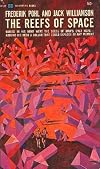
I don’t know when I first read it, but The Reefs of Space is just the sort of story that would have led me to pick up a copy of If magazine in 1963. I would have wondered if there was a connection between the reefs and Asimov's Currents of Space. There wasn’t one.
I would have known the authors. Fredrik Pohl (1919-2013) and Jack Williamson (1908-2006) had both been writing science fiction for more than 30 years and had been collaborating since the mid-1950s. So, yes, seasoned veterans of Golden Age pulp. They knew how to build a world and tell a story.
A computer program known as The Plan of Man has led to a gulag society that would make Big Brother blush. Steve Reyland is a mathematician who has been thoroughly brainwashed and made show more to wear a metal collar with an explosive charge. Even if it does not go bang, his body may be salvaged for parts if he is deemed surplus to requirements. The Plan of Man wants something from him, but someone not under the government's eye has given him induced amnesia. Government agents repeatedly question him about “spacelings,” a jetless drive, and a man he remembers meeting only once when he was a child. Solving the mystery will take him to the “reefs” beyond Pluto.
The pace is quick, and there is enough science to inhibit my no-way response. The armored girl in the bubble bath was a bit much, but that is a minor complaint. 3.75 show less
I would have known the authors. Fredrik Pohl (1919-2013) and Jack Williamson (1908-2006) had both been writing science fiction for more than 30 years and had been collaborating since the mid-1950s. So, yes, seasoned veterans of Golden Age pulp. They knew how to build a world and tell a story.
A computer program known as The Plan of Man has led to a gulag society that would make Big Brother blush. Steve Reyland is a mathematician who has been thoroughly brainwashed and made show more to wear a metal collar with an explosive charge. Even if it does not go bang, his body may be salvaged for parts if he is deemed surplus to requirements. The Plan of Man wants something from him, but someone not under the government's eye has given him induced amnesia. Government agents repeatedly question him about “spacelings,” a jetless drive, and a man he remembers meeting only once when he was a child. Solving the mystery will take him to the “reefs” beyond Pluto.
The pace is quick, and there is enough science to inhibit my no-way response. The armored girl in the bubble bath was a bit much, but that is a minor complaint. 3.75 show less
I am not sure why I came to this short novel with fairly low expectations, but I am happy to report that it was quite a bit better than I expected. Despite the title, most of this story takes place on Earth, a dystopian overpopulated Earth where the need to maximize the efficiency of the utilization of scarce resources has led to the development of the all controlling “Plan of Man.” Under the Plan, computers micromanage every aspect of every person’s life, supposedly under the guidance of the human “Planner.” Every person is required to be an efficient cog in the wheel, and those who can’t meet the Plan’s performance expectations are consigned to the Body Bank, where their limbs and organs are made available to more show more efficient workers.
In the first third of the book, our protagonist Ryeland is working with a team of scientists to unlock the mystery of an alien reaction-less drive; in the middle third Ryeland has been sent to the Body Bank, after being sabotaged by military types who have learned to manipulate the Plan computers by feeding them misinformation; in the final third he escapes the Body Bank with all bodily appendages intact (thanks to some outside help from a completely predictable source) and flees into space, ultimately to the titular reefs thereof. It sounds pretty formulaic, but it is carried off pretty well, with plenty of tension, a few surprises, and surprising shades of grey in what could easily have been a black and white world.
There was one funny editing gaffe later in the book. At one point Ryeland looks out at the awe inspiring galaxy of stars and notices that he cannot identify any of the familiar constellations, as they are lost in the overwhelming myriad of stars that cannot be seen from earth. Then, about fifteen pages later, he looks out into space and makes similarly poetic observations while picking out constellations in the beautiful heavens. I can only assume that these kinds of things happen when you have two authors working on a book and an editor who didn’t pay enough attention. show less
In the first third of the book, our protagonist Ryeland is working with a team of scientists to unlock the mystery of an alien reaction-less drive; in the middle third Ryeland has been sent to the Body Bank, after being sabotaged by military types who have learned to manipulate the Plan computers by feeding them misinformation; in the final third he escapes the Body Bank with all bodily appendages intact (thanks to some outside help from a completely predictable source) and flees into space, ultimately to the titular reefs thereof. It sounds pretty formulaic, but it is carried off pretty well, with plenty of tension, a few surprises, and surprising shades of grey in what could easily have been a black and white world.
There was one funny editing gaffe later in the book. At one point Ryeland looks out at the awe inspiring galaxy of stars and notices that he cannot identify any of the familiar constellations, as they are lost in the overwhelming myriad of stars that cannot be seen from earth. Then, about fifteen pages later, he looks out into space and makes similarly poetic observations while picking out constellations in the beautiful heavens. I can only assume that these kinds of things happen when you have two authors working on a book and an editor who didn’t pay enough attention. show less
A dystopian story. Ryeland comes to see that his heavily managed society is also, a corrupt society, and flees to the freer frontier areas....not badly written.
Enthält einerseits ein paar interessante Ideen, wirkt andererseits dreigeteilt, nicht wie aus einem Guß. Das Ende war auch nicht komplett befriedigend, kam plötzlich.
Aber: unterhaltsam genug, dass ich drei Viertel an einem Abend gelesen habe.
Aber: unterhaltsam genug, dass ich drei Viertel an einem Abend gelesen habe.
Feb 17, 2015German
De Ruimteriffen zijn een gebied voorbij Pluto waar kleine in de ruimte levende organismen waterstof fuseren tot zwaardere elementen. In de loop van miljoenen jaren ontstaan zo ware ruimteriffen analoog aan de aardse koraalriffen. Hierin leven talloze grote en kleine ruimte organismen. Deze ruimteriffen bieden een ideale schuilplaats aan vluchtelingen van de overbevolkte en autoritair geregeerde Aarde die wachten op betere tijden. Steven Ryeland is een belangrijke nieuwkomer, met kennis van een effectieve ruimteaandrijving die de mensheid toegang kan geven tot de sterren. Er is echter een dynamietring om zijn hals aangebracht toen hij in een aards gevangenenkamp vastzat. Zullen de bannelingen zijn ring op tijd kunnen verwijderen voordat show more deze ontploft? show less
May 1, 2025Dutch
Ratings
Members
- Recently Added By
Author Information

641+ Works 42,883 Members
Frederik Pohl was born in New York City on November 26, 1919. More interested in writing than in school, he dropped out of high school in his senior year and took a job with a publishing company. After serving as a public relations officer in the United States Army from 1943 to 1945, he returned to publishing as copywriter for Popular Science, a show more literary agent for several sci-fi writers, and the editor for the magazines Galaxy and If from 1959 until 1969, with If winning three successive Hugo awards. His first published work, a poem entitled Elegy to a Dead Satellite: Luna, was printed in Amazing Stories magazine in 1937 under the pen name Elton Andrews. His first science fiction novels were published in the mid 1960's, some written in collaboration with other writers, others created alone. During his lifetime, he won over 16 major awards for his writing (much of which was published pseudonymously) including six Hugo Awards and three Nebula Awards. His works include Gateway, which won the Campbell Memorial, Hugo, Locus SF, and Nebula Awards, Beyond the Blue Event Horizon, and Jem, which won the National Book Award in 1979. He also embraced blogging in his later years, using his online journal as an ongoing sequel to his autobiography, The Way the Future Was. He died on September 2, 2013 at the age 93. (Bowker Author Biography) show less

210+ Works 10,095 Members
Author Jack Williamson was born in Bisbee, Arizona on April 29, 1908. In the 1950's, he received both his BA and MA degress in English from Eastern New Mexico University. After receiving his PhD from the University of Colorado, he taught linguistics, the modern novel and literary criticism at Eastern New Mexico University until he retired in 1977. show more At the age of 20, he published his first story, The Metal Man, in a December 1928 issue of Amazing Stories. Since then he has written more than 50 novels and at least 15 short story collections. Some of his best known works are The Humanoids, The Legion of Time, Manseed, and Lifeburst. He also published numerous collaborations with fellow science fiction author Frederik Pohl. He received numerous awards including the Pilgrim Award from the Science Fiction Research Association, the Hugo Award, and the Nebula Award. He was an inaugural inductee in the Science Fiction and Fantasy Hall of Fame and was named a Grand Master of Science Fiction by the Science Fiction Writers of America in 1976. He died at his home in Portales, New Mexico on November 10, 2006. (Bowker Author Biography) show less
Some Editions
Series

Belongs to Publisher Series
Work Relationships
Is contained in
Common Knowledge
- Canonical title*
- Riffe im All
- Original title
- The Reefs of Space
- Original publication date
- 1963
- People/Characters*
- Steven Ryeland; Donna Creery; Ron Donderevo; Oddball Oporto; Planer Creery
- First words*
- »Los, ihr Risks!« fauchte der Major.
- Last words*
- (Click to show. Warning: May contain spoilers.)Und das Mädchen sagte fest: »Unsere Kinder werden sie alle kennen lernen.«
- Publisher's editor*
- Schelwokat, Günter M.
- Original language*
- Englisch
*Some information comes from Common Knowledge in other languages. Click "Edit" for more information.
Classifications
Statistics
- Members
- 264
- Popularity
- 122,443
- Reviews
- 5
- Rating
- (3.65)
- Languages
- 6 — Dutch, English, French, German, Portuguese, Swedish
- Media
- Paper
- ISBNs
- 8
- ASINs
- 17