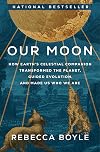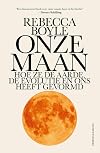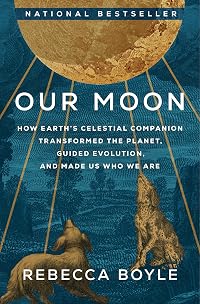
Our Moon: How Earth's Celestial Companion Transformed the Planet, Guided Evolution, and Made Us Who We Are
by Rebecca Boyle
On This Page
Description
"Far from being a lifeless ornament in the sky, the Moon holds the answers to some of science's central questions. Silent, dry, and barren, Earth's 4.34-billion-year-old companion is essential to life on earth. Its gravity stabilized the Earth's orbit, and, as it once guided evolution, its tide stirring up nutrients that fostered complex life, it now influences everything from animal migrations and reproduction to the movements of plants' leaves. More than 30,000 years before humans invented show more writing, they used the Moon's waxing and waning to track the passage of time, and, in a tectonic shift for human consciousness, used it to plan for the future. Unsurprisingly, the Moon was a primary feature of the first religions, written language, and philosophy. But our relationship to the Moon became more concrete when Apollo landed on it in 1969 in a moment of scientific and political triumph. And both engineering and politics promise to shape our relationship with it in the near future. Scientists advocate for a return to the moon to do research; governments and billionaires want to return to turn a profit from its mineral resources. Who gets to decide how we use a celestial body that, Boyle argues, belongs to everyone and no one? How can we learn to protect this beautiful, spectral thing that we all share?"-- show lessTags
Recommendations














Member Reviews
Think again, Jimmy. You see, the firing pin in your gun was made of, yep, zinc!
I do like these history books that try to capture the history of everything through one particular aspect. Mark Kurlansky's Salt springs to mind. Boyle tries to do the same thing to the moon here, and often succeeds; there are some truly interesting bits here, whether it's her visiting stoneage monuments, tracking selenology through Greeks and renaissance thinkers, or staring in awe at moon rocks.
The trouble is... it's just too damn big. It's THE MOON. You could write five thousand pages on its effects on human mythology, science and culture and barely get past the many times it's been rhymed with June. Trying to jam it all into 250 pages often makes it show more strained; she has to connect everything just to the moon, nothing is NOT about the moon. It's never not interesting, but maybe they really should have sent a poet. show less
I do like these history books that try to capture the history of everything through one particular aspect. Mark Kurlansky's Salt springs to mind. Boyle tries to do the same thing to the moon here, and often succeeds; there are some truly interesting bits here, whether it's her visiting stoneage monuments, tracking selenology through Greeks and renaissance thinkers, or staring in awe at moon rocks.
The trouble is... it's just too damn big. It's THE MOON. You could write five thousand pages on its effects on human mythology, science and culture and barely get past the many times it's been rhymed with June. Trying to jam it all into 250 pages often makes it show more strained; she has to connect everything just to the moon, nothing is NOT about the moon. It's never not interesting, but maybe they really should have sent a poet. show less
Made me really enthusiastic about the moon. A creative way to provide a perspective on the moon. Now I have a little better understanding of why suddenly rockets are being sent to South Pole of moon. On one level it is exciting to think people will probably be back in less than two years. I still remember the first landing and almost being bored by the last landings. I remember the Apollo fire. The moon is still worthy of study.
I loved this. Sometimes these books that look at one topic from the POV of several different disciplines (geology, history, mythology, etc) are a pain to follow, but this was either well done or the perfect topic for me. I could have been so engrossed in the content I overlooked some rough transitions. This gave me just enough from each perspective to feel informed but curious to find out more. I did not know the lunar cycle impacted our evolution so early on. Amazing.
An interesting exploration of how humans have viewed the moon throughout history. Sometimes I wish I could go back before we knew anything about the moon, before science, when it was spiritual, a goddess, a heavenly body filled with beings looking down on us.
I was reminded of Ayla's month observing and documenting the lunar cycle in the Earth's Children series (as repetitive as those books are, Auel's interpretation of ancient civilizations was kind of accurate).
I was reminded of Ayla's month observing and documenting the lunar cycle in the Earth's Children series (as repetitive as those books are, Auel's interpretation of ancient civilizations was kind of accurate).
I saw the first moon landing on a grainy TV screen in Rome and, so, I never heard those iconic words spoken by Neil Armstrong. But I grew up hearing about the various Apollo missions to the Moon and I dreamed that someday humans would explore space. We’re back to planning moon missions and even missions to Mars may occur in the future. Humans have been looking up into the sky at the moon for millennia, as Rebecca Boyle shows in this book.
From ancient artifacts, we know that people figured out how the Moon affects the Earth a long time ago. A series of holes in Scotland were dug and maintained for centuries to keep track of when the high tides would come and bring the best fish to the nearby river. For a long time, humans believed that show more the Earth was the centre of the Universe with the sun and the moon and all the planets revolving around it. Once telescopes were available, studying the planets and the moon became easier. Johannes Kepler in the 17th century realized that only the moon revolved around the Earth thus transforming astronomy. It was an idea that was opposed by the Church so he had to tread carefully in writing about it. Nevertheless, his writings allowed others to formulate the model of the solar system that we now know to be true.
There are many other fascinating stories in this book about the Moon. We will continue to look up to the Moon and beyond. show less
From ancient artifacts, we know that people figured out how the Moon affects the Earth a long time ago. A series of holes in Scotland were dug and maintained for centuries to keep track of when the high tides would come and bring the best fish to the nearby river. For a long time, humans believed that show more the Earth was the centre of the Universe with the sun and the moon and all the planets revolving around it. Once telescopes were available, studying the planets and the moon became easier. Johannes Kepler in the 17th century realized that only the moon revolved around the Earth thus transforming astronomy. It was an idea that was opposed by the Church so he had to tread carefully in writing about it. Nevertheless, his writings allowed others to formulate the model of the solar system that we now know to be true.
There are many other fascinating stories in this book about the Moon. We will continue to look up to the Moon and beyond. show less
This is many different histories of the moon: an astronomical history of how it was created and how it interacts with the Earth and life on Earth; a history of early civilizations' reverence for the moon; and a history of the modern science and exploration of the moon. Unfortunately, this book is trying to do too many things, and ends up not doing any of them very well.
I was particularly annoyed that the human history sections, particularly the sections on ancient civilizations, only covered Western history. There is no discussion of how the moon was regarded in the science or mythology of Asia, Africa, or the Americas.
I was particularly annoyed that the human history sections, particularly the sections on ancient civilizations, only covered Western history. There is no discussion of how the moon was regarded in the science or mythology of Asia, Africa, or the Americas.
This is a fascinating and informative book about our moon and our human relationship to it. The book goes back to its formation caused by a gigantic crash when the Earth is struck by another heavenly body cracking off what will become the moon. The book goes back to early man, the Mesopotamians, the Egyptians to eventually ends up with today's space program and the possible future mining of the moon's resources. I learned a lot from this book which is pretty lively for such a historical scientific topic.
Members
- Recently Added By
Lists

Science: Astronomy
62 works; 2 members

TBR of Books I Don't Own
132 works; 1 member
Author Information
2+ Works 285 Members
Awards and Honors
Awards
Distinctions
Classifications
Statistics
- Members
- 262
- Popularity
- 123,883
- Reviews
- 9
- Rating
- (3.98)
- Languages
- Dutch, English
- Media
- Paper, Audiobook, Ebook
- ISBNs
- 5
- ASINs
- 2