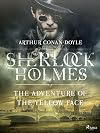
The Adventure of the Yellow Face [short story]
by Arthur Conan Doyle 
The Memoirs of Sherlock Holmes - short stories 1892-1893 {Conan Doyle} (3)
On This Page
Description
In "The Yellow Face", Sherlock Holmes and Dr. Watson are approached by Grant Munro, a distraught husband troubled by his wife's mysterious behavior and a strange figure seen in their cottage. Holmes investigates, but the case takes an unexpected turn, revealing a heartwarming story of love, acceptance, and a hidden past. This tale challenges prejudices and showcases Doyle's ability to weave human emotion into mystery.Tags
Recommendations























Member Reviews
At the beginning of his narrative, Dr. Watson describes this adventure as one of Holmes’s two failures. Holmes’s client is troubled by a secret his wife is keeping from him. She had been a widow when they married, her first husband having died in America. Their marriage has been a happy one until this secret came between them. The secret is somehow connected to the new tenant in a neighboring cottage in Norbury, whom the client describes as having a yellow face. Holmes is sure that he knows the new neighbor’s identity. Holmes and Watson accompany their client to the cottage, where they discover the tenant is not the person Holmes thought it was. As things turned out well for his client, Holmes is happy to have been wrong .
I have show more mixed feelings about this one. Doyle was ahead of many of his time in portrayinga mixed race marriage , yet it’s disappointing that a Victorian woman who had the courage to marry an African American man would choose as her second husband a man that she didn’t think could accept her biracial child. She was wrong about her second husband, but what damage had she already done to her child by keeping her hidden for so long? show less
I have show more mixed feelings about this one. Doyle was ahead of many of his time in portraying
Another superb short story featuring Sherlock Holmes and his friend, Dr. Watson.
In this story, Sherlock Holmes, suffering from boredom due to a want of cases, returns home from a walk with Dr. Watson in the early spring of 1888 to find he has missed a visitor, but that the caller has left his pipe behind. From it, Holmes deduces that he was disturbed of mind (because he forgot the pipe); that he valued it highly (because he had repaired, rather than replaced it when it was broken); that he was muscular, left-handed, had excellent teeth, was careless in his habits and was well-off.
None of these deductions is particularly germane to the story: they are merely Holmesian logical exercises. When the visitor, Mr. Grant Munro (whose name show more Holmes observed from his hatband) returns, Holmes and Watson hear the story of Munro's deception by his wife Effie. She had been previously married in America, but her husband and child had died of yellow fever, whereupon she returned to England and met and married Munro. Their marriage had been blissful — "We have not had a difference, not one, in thought, or word, or deed," says Grant Munro — until she asked for a hundred pounds and begged him not to ask why. Two months later, Effie Munro was caught conducting secret liaisons with the occupants of a cottage near the Munro house in Norbury.
Grant Munro has seen a mysterious yellow-faced person in this cottage. Overcome with jealousy, he breaks in and finds the place empty. However, the room where he saw the mysterious figure is very comfortable and well-furnished, with a portrait of his wife on the mantelpiece.
Holmes, after sending Munro home with instructions to wire for him if the cottage was reoccupied, confides in Watson his belief that the mysterious figure is Effie Munro's first husband. He postulates that the husband, having been left in America, has come to England to blackmail her.
After Munro summons Holmes and Watson, the three enter the cottage, brushing aside the entreaties of Effie Munro. They find the strange yellow-faced character; Holmes peels that face away, showing it to be a mask and revealing a young black girl. Effie Munro's first husband was John Hebron, a black man; he did die in America, but the couple's daughter Lucy survived. Afraid that Grant Munro would repudiate his love for her if he knew she was mother to a mixed race child, she had endeavored to keep Lucy's existence hidden. Overcome with desire to see her child again, Effie Munro used the hundred pounds to bring Lucy and her nurse to England and installed them in the cottage near the Munro house.
Both Watson and Holmes are touched by Munro's response. Watson observes:
"...when [Munro's] answer came it was one of which I love to think. He lifted the little child, kissed her, and then, still carrying her, he held his other hand out to his wife and turned towards the door."
Holmes says:
"Watson, if it should ever strike you that I am getting a little overconfident in my powers, or giving less pains to a case than it deserves, kindly whisper 'Norbury' in my ear, and I shall be infinitely obliged to you."
I recommend this book to the permanent library of any reader who appreciates a well written mystery involving Sherlock Holmes. show less
In this story, Sherlock Holmes, suffering from boredom due to a want of cases, returns home from a walk with Dr. Watson in the early spring of 1888 to find he has missed a visitor, but that the caller has left his pipe behind. From it, Holmes deduces that he was disturbed of mind (because he forgot the pipe); that he valued it highly (because he had repaired, rather than replaced it when it was broken); that he was muscular, left-handed, had excellent teeth, was careless in his habits and was well-off.
None of these deductions is particularly germane to the story: they are merely Holmesian logical exercises. When the visitor, Mr. Grant Munro (whose name show more Holmes observed from his hatband) returns, Holmes and Watson hear the story of Munro's deception by his wife Effie. She had been previously married in America, but her husband and child had died of yellow fever, whereupon she returned to England and met and married Munro. Their marriage had been blissful — "We have not had a difference, not one, in thought, or word, or deed," says Grant Munro — until she asked for a hundred pounds and begged him not to ask why. Two months later, Effie Munro was caught conducting secret liaisons with the occupants of a cottage near the Munro house in Norbury.
Grant Munro has seen a mysterious yellow-faced person in this cottage. Overcome with jealousy, he breaks in and finds the place empty. However, the room where he saw the mysterious figure is very comfortable and well-furnished, with a portrait of his wife on the mantelpiece.
Holmes, after sending Munro home with instructions to wire for him if the cottage was reoccupied, confides in Watson his belief that the mysterious figure is Effie Munro's first husband. He postulates that the husband, having been left in America, has come to England to blackmail her.
After Munro summons Holmes and Watson, the three enter the cottage, brushing aside the entreaties of Effie Munro. They find the strange yellow-faced character; Holmes peels that face away, showing it to be a mask and revealing a young black girl. Effie Munro's first husband was John Hebron, a black man; he did die in America, but the couple's daughter Lucy survived. Afraid that Grant Munro would repudiate his love for her if he knew she was mother to a mixed race child, she had endeavored to keep Lucy's existence hidden. Overcome with desire to see her child again, Effie Munro used the hundred pounds to bring Lucy and her nurse to England and installed them in the cottage near the Munro house.
Both Watson and Holmes are touched by Munro's response. Watson observes:
"...when [Munro's] answer came it was one of which I love to think. He lifted the little child, kissed her, and then, still carrying her, he held his other hand out to his wife and turned towards the door."
Holmes says:
"Watson, if it should ever strike you that I am getting a little overconfident in my powers, or giving less pains to a case than it deserves, kindly whisper 'Norbury' in my ear, and I shall be infinitely obliged to you."
I recommend this book to the permanent library of any reader who appreciates a well written mystery involving Sherlock Holmes. show less
This is my favourite Sherlock Holmes story hands-down. Even though the mystery is not that complicated, the ending more than makes up for it and I wish that this story got more attention. More than any of the others, this is one that could be adapted for a more child-friendly audience and still work for adults.
I seem to be enjoying only those Sherlock books in which he is thrown off his high horse!
I seem to be enjoying only those Sherlock books in which he is thrown off his high horse!
From BBC Radio 4 Extra:
The sleuth investigates when a hideous apparition at a cottage window troubles an anxious husband. Stars Clive Merrison.
The sleuth investigates when a hideous apparition at a cottage window troubles an anxious husband. Stars Clive Merrison.
From BBC Radio 4 Extra:
The sleuth investigates when a hideous apparition at a cottage window troubles an anxious husband. Stars Clive Merrison.
The sleuth investigates when a hideous apparition at a cottage window troubles an anxious husband. Stars Clive Merrison.
Members
- Recently Added By
Author Information

3,998+ Works 169,674 Members
The most famous fictional detective in the world is Arthur Conan Doyle's Sherlock Holmes. However, Doyle was, at best, ambivalent about his immensely successful literary creation and, at worst, resentful that his more "serious" fiction was relatively ignored. Born in Edinburgh, Doyle studied medicine from 1876 to 1881 and received his M.D. in show more 1885. He worked as a military physician in South Africa during the Boer War and was knighted in 1902 for his exceptional service. Doyle was drawn to writing at an early age. Although he attempted to enter private practice in Southsea, Portsmouth, in 1882, he soon turned to writing in his spare time; it eventually became his profession. As a Liberal Unionist, Doyle ran, unsuccessfully, for Parliament in 1903. During his later years, Doyle became an avowed spiritualist. Doyle sold his first story, "The Mystery of the Sasassa Valley," to Chambers' Journal in 1879. When Doyle published the novel, A Study in Scarlet in 1887, Sherlock Holmes was introduced to an avid public. Doyle is reputed to have used one of his medical professors, Dr. Joseph Bell, as a model for Holmes's character. Eventually, Doyle wrote three additional Holmes novels and five collections of Holmes short stories. A brilliant, though somewhat eccentric, detective, Holmes employs scientific methods of observation and deduction to solve the mysteries that he investigates. Although an "amateur" private detective, he is frequently called upon by Scotland Yard for assistance. Holmes's assistant, the faithful Dr. Watson, provides a striking contrast to Holmes's brilliant intellect and, in Doyle's day at least, serves as a character with whom the reader can readily identify. Having tired of Holmes's popularity, Doyle even tried to kill the great detective in "The Final Problem" but was forced by an outraged public to resurrect him in 1903. Although Holmes remained Doyle's most popular literary creation, Doyle wrote prolifically in other genres, including historical adventure, science fiction, and supernatural fiction. Despite Doyle's sometimes careless writing, he was a superb storyteller. His great skill as a popular author lay in his technique of involving readers in his highly entertaining adventures. (Bowker Author Biography) show less
Arthur Conan Doyle has a Legacy Library. Legacy libraries are the personal libraries of famous readers, entered by LibraryThing members from the Legacy Libraries group.
Series

Work Relationships
Is contained in
Sherlock Holmes: Complete (56) Stories (Adventures, Memoirs, Return, His Last Bow, & The Case-Book) by Arthur Conan Doyle (indirect)
The Complete Sherlock Holmes: All 4 Novels and 56 Short Stories by Sir Arthur Conan Doyle (indirect)
Treasury of World Masterpieces "The Celebrated Cases of Sherlock Holmes" & "H.G. Wells (Treasury of World Masterpieces) by Sir Arthur Conan Doyle (indirect)
Sherlock Holmes - Edição Completa Romances & Contos (Em Portuguese do Brasil) by Arthur Conan Doyle (indirect)
Sherlock Holmes: The Complete Novels and Stories, Vol. 1 (Bantam Classics 1/2) by Arthur Conan Doyle (indirect)
Sherlock Holmes: The Complete Novels and Stories, Vol. 1 and 2 (Bantam) by Arthur Conan Doyle (indirect)
THE COMPLETE SHERLOCK HOLMES and THE COMPLETE TALES OF TERROR AND MYSTERY by Sir Arthur Conan Doyle (indirect)
British Mystery Megapack Volume 5 - The Sherlock Holmes Collection: 4 Novels and 43 Short Stories + Extras by Arthur Conan Doyle (indirect)
study in scarlet / sign of four / hound of the baskervilles / memoirs of sherlock holmes by Sir Arthur Conan Doyle (indirect)
The Adventures of Sherlock Holmes / The Memoirs of Sherlock Holmes / The Return of Sherlock Holmes / A Study in Scarlet by Sir Arthur Conan Doyle (indirect)
The New Annotated Sherlock Holmes: The Short Stories, Volume 1 of 2 (The Adventures of Sherlock Holmes + The Memoirs of Sherlock Holmes) by Arthur Conan Doyle (indirect)
Sherlock Holmes: Volume 2: Memórias de Sherlock Holmes | O cão dos Baskerville (Portuguese Edition) by Arthur Conan Doyle (indirect)
The Sherlock Holmes illustrated omnibus : The adventures of Sherlock Holmes, The memoirs of Sherlock Holmes, The hound of the Baskervilles, The return of Sherlock Holmes : a facsimile of the stories and the adventure as they were first published in the Strand magazine, London by Sir Arthur Conan Doyle (indirect)
A Study In Scarlet, The Sign of the Four, The Adventures of Sherlock Holmes, The Memoirs of Sherlock Holmes, The Return of Sherlock Holmes (Sherlock Holmes - Bouquin Complete works - volume 1/2) by Arthur Conan Doyle (indirect)
The Adventures of Sherlock Holmes, The Memoirs of Sherlock Holmes, The Return of Sherlock Holmes (Classics Omnibus) by Arthur Conan Doyle (indirect)
The adventures of Sherlock Holmes ; The memoirs of Sherlock Holmes ; The return of Sherlock Holmes ; The hound of the Baskervilles ; A study in ... the Bruce-Partington plans (Masters Library) by Arthur Conan Doyle (indirect)
A Study in Scarlet / The Sign of the Four / The Adventures of Sherlock Holmes / The Memoirs of Sherlock Holmes by Arthur C. Doyle (indirect)
Adventures of Sherlock Holmes / Memoirs of Sherlock Holmes / The Sign Of Four by Arthur Conan Doyle (indirect)
Common Knowledge
- Canonical title
- The Adventure of the Yellow Face [short story]
- Original title
- The Adventure of the Yellow Face
- Alternate titles
- The Yellow Face
- Original publication date
- 1893
- People/Characters
- Sherlock Holmes; John H. Watson (M.D.); Grant Munro; Effie Munro; Lucy Hebron
- Important places
- 221B Baker Street, London, England, UK; Norbury, London, England, UK
- Disambiguation notice
- This is the short story "The Adventure of the Yellow Face". It should not be combined with any collection of which it is only a part.
Classifications
Statistics
- Members
- 104
- Popularity
- 310,465
- Reviews
- 9
- Rating
- (3.80)
- Languages
- 5 — English, French, German, Portuguese (Brazil), Spanish
- Media
- Paper, Audiobook, Ebook
- ISBNs
- 16
- ASINs
- 8