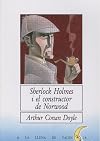
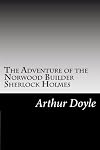
The Adventure of the Norwood Builder (short story)
by Arthur Conan Doyle 
The Return of Sherlock Holmes - short stories 1903-1904 {Conan Doyle} (2)
On This Page
Description
Retold in graphic novel form, Sherlock Holmes investigates the case of a solicitor accused of murder.Tags
Recommendations



















Member Reviews
A young lawyer is hired by a stranger to draw up a will. To the lawyer’s surprise, the client makes him the sole beneficiary. The next day the lawyer is alarmed to read of the man’s murder in the newspaper. Knowing that the police are likely to suspect him of the crime, he calls on Sherlock Holmes. Before he can finish his story, Inspector Lestrade arrives, hot on his trail. Lestrade is sure that Holmes has got it wrong this time. Of course, Holmes proves him wrong but allows Lestrade to take credit for solving the crime.
This case is almost too easy for Holmes. It doesn’t take a lot of effort for him to solve the crime. He usually finds pleasure in the intellectual stimulation of solving a complex puzzle. In this case, his show more pleasure seems to come from listening to Lestrade repeatedly draw the wrong conclusions about the case. show less
This case is almost too easy for Holmes. It doesn’t take a lot of effort for him to solve the crime. He usually finds pleasure in the intellectual stimulation of solving a complex puzzle. In this case, his show more pleasure seems to come from listening to Lestrade repeatedly draw the wrong conclusions about the case. show less
Another superb story: The Norwood Builder is Jonas Oldacre, 52, reclusive retired bachelor, who vanished the night before (July 1894) from his house, not found when the lumber in his yard caught fire in a tremendous conflagration. His bed was unused, his safe open, papers scattered, signs of struggle, a large object dragged from safe to woodpile then burned, and blood on an oak cane belonging to late-night visitor, junior lawyer John McFarlane. The suspect bursts into Baker Street distraught, showing Holmes the news article that diverted him from his homeward train, and begs Holmes to help him.
As McFarlane relates his story, Lestrade, accompanied by constables, suddenly arrests his man, but agrees to listen to his story for half an show more hour. Yesterday at 3 pm, ferret-faced Oldacre, his name known as an acquaintance of the youth's parents, bade McFarlane turn scribbles into a legal will, with McFarlane learning to his surprise that Oldacre has made him his sole heir as Oldacre lacks any other family and has heard good things about him due to his past connection to McFarlane's parents. After witnessing and signing, the benefactor asked him for dinner at nine, to see essential paperwork details, and not tell his parents. Around midnight they finished sorting paper into sealed envelopes, and, admonished not to disturb the housekeeper, he was ushered, without his cane, out of the French window, safe still ajar. After the constables leave with their prisoner, Holmes explains the will's rough draft varies from clear to unreadable where the writer's train stopped at stations, then rumbled roughly.
Holmes investigates. At Blackheath, fluffy little mother McFarlane reveals Oldacre to be a vicious vengeful ex-suitor, rejected after he loosed a cat in an aviary. At Norwood trouser buttons from Oldacre's tailor are found among charred organic remains, examination of the remaining documents reveals allusions to missing valuable deeds, and a low bank balance attributable to recent large cheques to Mr. Cornelius. Defiant, guilty-eyed housekeeper Mrs. Lexington smelled burnt flesh the night before, and knows more than she says, that the visitor's hat and cane were both left in the front hall.
Next morning, Lestrade telegrams Holmes to come see McFarlane's bloody right thumbprint below the hat-peg, pointed out by Lexington. Holmes knows the evidence was not there yesterday, and minutely examines the whole house. He asks Lestrade for loud-voiced constables, and all cry "fire" after large straw bundles are lit, to smoke out their missing witness, Oldacre, from behind solid-seeming walls. Holmes gives Lestrade the victory, wagers one of the thumbprints sealing the safe papers is McFarlane's, that Oldacre filled with blood and transferred. Mr. Cornelius is probably an alter identity Oldacre had intended to take on permanently, the bitter man seeking revenge on his former lover by creating the illusion that he was murdered by her only child. Holmes notes with amusement that the thumb-print was actually the give-away clue; prior to the print's discovery, even Holmes suspected that McFarlane might be guilty, but Oldacre's inability to know when to stop creating his illusion caused him to expose himself. Under guard in the parlor, the villain whines that he intended it all to be a joke, and refuses to admit what flesh burned in the fire, so Holmes suggests Watson ascribe rabbits. Oldacre will be charged with conspiracy to commit murder and "Mr Connelius" bank account will be confiscated by Oldacre's crediters.
I recomment this book to all readers that enjoy a well written mystery book. show less
As McFarlane relates his story, Lestrade, accompanied by constables, suddenly arrests his man, but agrees to listen to his story for half an show more hour. Yesterday at 3 pm, ferret-faced Oldacre, his name known as an acquaintance of the youth's parents, bade McFarlane turn scribbles into a legal will, with McFarlane learning to his surprise that Oldacre has made him his sole heir as Oldacre lacks any other family and has heard good things about him due to his past connection to McFarlane's parents. After witnessing and signing, the benefactor asked him for dinner at nine, to see essential paperwork details, and not tell his parents. Around midnight they finished sorting paper into sealed envelopes, and, admonished not to disturb the housekeeper, he was ushered, without his cane, out of the French window, safe still ajar. After the constables leave with their prisoner, Holmes explains the will's rough draft varies from clear to unreadable where the writer's train stopped at stations, then rumbled roughly.
Holmes investigates. At Blackheath, fluffy little mother McFarlane reveals Oldacre to be a vicious vengeful ex-suitor, rejected after he loosed a cat in an aviary. At Norwood trouser buttons from Oldacre's tailor are found among charred organic remains, examination of the remaining documents reveals allusions to missing valuable deeds, and a low bank balance attributable to recent large cheques to Mr. Cornelius. Defiant, guilty-eyed housekeeper Mrs. Lexington smelled burnt flesh the night before, and knows more than she says, that the visitor's hat and cane were both left in the front hall.
Next morning, Lestrade telegrams Holmes to come see McFarlane's bloody right thumbprint below the hat-peg, pointed out by Lexington. Holmes knows the evidence was not there yesterday, and minutely examines the whole house. He asks Lestrade for loud-voiced constables, and all cry "fire" after large straw bundles are lit, to smoke out their missing witness, Oldacre, from behind solid-seeming walls. Holmes gives Lestrade the victory, wagers one of the thumbprints sealing the safe papers is McFarlane's, that Oldacre filled with blood and transferred. Mr. Cornelius is probably an alter identity Oldacre had intended to take on permanently, the bitter man seeking revenge on his former lover by creating the illusion that he was murdered by her only child. Holmes notes with amusement that the thumb-print was actually the give-away clue; prior to the print's discovery, even Holmes suspected that McFarlane might be guilty, but Oldacre's inability to know when to stop creating his illusion caused him to expose himself. Under guard in the parlor, the villain whines that he intended it all to be a joke, and refuses to admit what flesh burned in the fire, so Holmes suggests Watson ascribe rabbits. Oldacre will be charged with conspiracy to commit murder and "Mr Connelius" bank account will be confiscated by Oldacre's crediters.
I recomment this book to all readers that enjoy a well written mystery book. show less
This is one of my favorite case. After I read this case,I thought Mr.McFarlane was
just idiot person,but when I first heard his story,I did'n t feel guilty to Mr.Oldaker.
I thought he was killed by someone. But he was't.. He was the true murderer!
He tried to kill Mr.McFarlane. This was out of my expect! I was cheated by him like Mr.McFarlane.
Only Holmes revealed Oldaker' attempt and catched him! He was too clever! I respected him!
just idiot person,but when I first heard his story,I did'n t feel guilty to Mr.Oldaker.
I thought he was killed by someone. But he was't.. He was the true murderer!
He tried to kill Mr.McFarlane. This was out of my expect! I was cheated by him like Mr.McFarlane.
Only Holmes revealed Oldaker' attempt and catched him! He was too clever! I respected him!
Ratings
Members
- Recently Added By
Lists

Favourite Short Stories
157 works; 9 members
Author Information

4,034+ Works 170,537 Members
The most famous fictional detective in the world is Arthur Conan Doyle's Sherlock Holmes. However, Doyle was, at best, ambivalent about his immensely successful literary creation and, at worst, resentful that his more "serious" fiction was relatively ignored. Born in Edinburgh, Doyle studied medicine from 1876 to 1881 and received his M.D. in show more 1885. He worked as a military physician in South Africa during the Boer War and was knighted in 1902 for his exceptional service. Doyle was drawn to writing at an early age. Although he attempted to enter private practice in Southsea, Portsmouth, in 1882, he soon turned to writing in his spare time; it eventually became his profession. As a Liberal Unionist, Doyle ran, unsuccessfully, for Parliament in 1903. During his later years, Doyle became an avowed spiritualist. Doyle sold his first story, "The Mystery of the Sasassa Valley," to Chambers' Journal in 1879. When Doyle published the novel, A Study in Scarlet in 1887, Sherlock Holmes was introduced to an avid public. Doyle is reputed to have used one of his medical professors, Dr. Joseph Bell, as a model for Holmes's character. Eventually, Doyle wrote three additional Holmes novels and five collections of Holmes short stories. A brilliant, though somewhat eccentric, detective, Holmes employs scientific methods of observation and deduction to solve the mysteries that he investigates. Although an "amateur" private detective, he is frequently called upon by Scotland Yard for assistance. Holmes's assistant, the faithful Dr. Watson, provides a striking contrast to Holmes's brilliant intellect and, in Doyle's day at least, serves as a character with whom the reader can readily identify. Having tired of Holmes's popularity, Doyle even tried to kill the great detective in "The Final Problem" but was forced by an outraged public to resurrect him in 1903. Although Holmes remained Doyle's most popular literary creation, Doyle wrote prolifically in other genres, including historical adventure, science fiction, and supernatural fiction. Despite Doyle's sometimes careless writing, he was a superb storyteller. His great skill as a popular author lay in his technique of involving readers in his highly entertaining adventures. (Bowker Author Biography) show less
Arthur Conan Doyle has a Legacy Library. Legacy libraries are the personal libraries of famous readers, entered by LibraryThing members from the Legacy Libraries group.
Series

Belongs to Publisher Series
Work Relationships
Is contained in
Sherlock Holmes: Complete (56) Stories (Adventures, Memoirs, Return, His Last Bow, & The Case-Book) by Arthur Conan Doyle (indirect)
The Complete Sherlock Holmes: All 4 Novels and 56 Short Stories by Sir Arthur Conan Doyle (indirect)
Treasury of World Masterpieces "The Celebrated Cases of Sherlock Holmes" & "H.G. Wells (Treasury of World Masterpieces) by Sir Arthur Conan Doyle (indirect)
Sherlock Holmes - Edição Completa Romances & Contos (Em Portuguese do Brasil) by Arthur Conan Doyle (indirect)
Sherlock Holmes: The Complete Novels and Stories, Vol. 1 (Bantam Classics 1/2) by Arthur Conan Doyle (indirect)
Sherlock Holmes: The Complete Novels and Stories, Vol. 1 and 2 (Bantam) by Arthur Conan Doyle (indirect)
The Return of Sherlock Holmes / The Hound of the Baskervilles (The Later Adventures of Sherlock Holmes) by Sir Arthur Conan Doyle (indirect)
THE COMPLETE SHERLOCK HOLMES and THE COMPLETE TALES OF TERROR AND MYSTERY by Sir Arthur Conan Doyle (indirect)
British Mystery Megapack Volume 5 - The Sherlock Holmes Collection: 4 Novels and 43 Short Stories + Extras by Arthur Conan Doyle (indirect)
The Adventures of Sherlock Holmes / The Memoirs of Sherlock Holmes / The Return of Sherlock Holmes / A Study in Scarlet by Sir Arthur Conan Doyle (indirect)
Doyle: O. completas. 3. Reaparición de Sherlock Holmes; Su último saludo en el escenario; El Valle by Arthur Conan Doyle (indirect)
The Sherlock Holmes illustrated omnibus : The adventures of Sherlock Holmes, The memoirs of Sherlock Holmes, The hound of the Baskervilles, The return of Sherlock Holmes : a facsimile of the stories and the adventure as they were first published in the Strand magazine, London by Sir Arthur Conan Doyle (indirect)
A Study In Scarlet, The Sign of the Four, The Adventures of Sherlock Holmes, The Memoirs of Sherlock Holmes, The Return of Sherlock Holmes (Sherlock Holmes - Bouquin Complete works - volume 1/2) by Arthur Conan Doyle (indirect)
EL REGRESO DE SHERLOCK HOLMES - SU ÚLTIMO SALUDO - EL ARCHIVO DE SHERLOCK HOLMES by Arthur Conan Doyle (indirect)
The Adventures of Sherlock Holmes, The Memoirs of Sherlock Holmes, The Return of Sherlock Holmes (Classics Omnibus) by Arthur Conan Doyle (indirect)
The adventures of Sherlock Holmes ; The memoirs of Sherlock Holmes ; The return of Sherlock Holmes ; The hound of the Baskervilles ; A study in ... the Bruce-Partington plans (Masters Library) by Arthur Conan Doyle (indirect)
Contains
Has the adaptation
Common Knowledge
- Canonical title
- The Adventure of the Norwood Builder (short story) (short story)
- Original publication date
- 1892
- People/Characters
- Sherlock Holmes; John H. Watson; John Hector McFarlane; Jonas Oldacre; Inspector G. Lestrade; Mrs. McFarlane (show all 7); Mrs. Lexington
- Important places
- 221B Baker Street, London, England, UK; Lower Norwood, London, England, UK
- Original language
- English
Classifications
Statistics
- Members
- 72
- Popularity
- 438,136
- Reviews
- 3
- Rating
- (3.71)
- Languages
- 5 — Catalan, English, German, Portuguese (Brazil), Spanish
- Media
- Paper, Audiobook, Ebook
- ISBNs
- 23
- ASINs
- 5