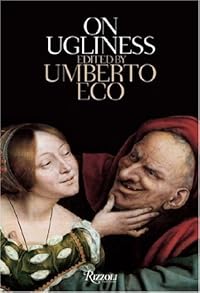
On Ugliness
by Umberto Eco
On This Page
Description
In a companion volume to his "History of Beauty," the renowned philosopher and cultural critic analyzes our attraction to the gruesome, horrific, and repellant in visual culture and the arts, drawing on abundant examples of painting and sculpture, ranging from antiquity to the works of Bosch, Goya, and others.Tags
Recommendations















Member Reviews
Umberto Eco begins ‘On Ugliness’ with the observation that there is an entire history of beauty but such a history did not happen with ugliness. Why is this? Perhaps, the author reasons, since ugliness was frequently defined throughout the ages as the opposite of beauty.
Well, if there ever was a book taking a giant step to rectify a neglect of ugliness, this is the book – 450 pages and nearly 1000 full-color illustrations as well as dozens of primary source excerpts chock-full of the ugly. And here’s a sampling of the synonyms Eco lists for the word: repellent, horrible, disgusting, grotesque, abominable, repulsive, odious, indecent, foul, obscene, repugnant, monstrous, horrifying, nightmarish, revolting, sickening, deformed, show more disfigured.
If anybody wonders why we are so fascinated and drawn to the ugly and monstrous, such wondering has a long history. For example, Umberto Eco quotes Bernard of Clarevaux bemoaning how Christians are fascinated with monsters and monstrosities, “What place is there in the cloisters for that ridiculous monstrosity, that strange kind of deformed shape or shaped deformity? What are foul apes doing there? Or ferocious lions? Or monstrous centaurs? Or half-men? Or dappled tigers? You can see many bodies beneath a single head and vice versa many heads atop a single body. On the one side you can see a quadruped with a serpent’s tail, and on the other a fish with a quadruped’s head. Here, a beast that looks like a horse with the hindquarters of a goat, there a horned animal with the hindquarters of horse. In short there is everywhere such a great and strange variety of heterogeneous forms that there is more pleasure to be had in reading the marbles than the codices and in spending the whole day admiring one by one these images rather than meditating on the law of God.”
Again, why is this? The answer is as complex as human nature is complex. Taking one approach, we can look at a quote Eco includes from a novel by J.-K. Huysmans, “These nightmares attached him repeatedly. He was afraid to fall asleep. For hours he remained stretched on his bed, now a prey to feverish and agitated wakefulness, now in the grip of oppressive dreams in which he tumbled down flights of stairs and felt himself sinking, powerless, into abysmal depths.”
In a word, the monsters portrayed in paint, sculpture, photography, film and literature mirror the content of our dreamscape visions. On some level we want to come to grips with our nocturnal experience and the monstrous in art is a prime way to do so.
The author includes Andy Warhol’s ‘Orange Car Crash’ a print using the photograph of an overturned car with three people pinned underneath. This is a nightmare we in the modern world face as a living possibility nearly every day. Again, the ugly is very much part of our day to day experience and a living nightmare is forever looming. show less
Well, if there ever was a book taking a giant step to rectify a neglect of ugliness, this is the book – 450 pages and nearly 1000 full-color illustrations as well as dozens of primary source excerpts chock-full of the ugly. And here’s a sampling of the synonyms Eco lists for the word: repellent, horrible, disgusting, grotesque, abominable, repulsive, odious, indecent, foul, obscene, repugnant, monstrous, horrifying, nightmarish, revolting, sickening, deformed, show more disfigured.
If anybody wonders why we are so fascinated and drawn to the ugly and monstrous, such wondering has a long history. For example, Umberto Eco quotes Bernard of Clarevaux bemoaning how Christians are fascinated with monsters and monstrosities, “What place is there in the cloisters for that ridiculous monstrosity, that strange kind of deformed shape or shaped deformity? What are foul apes doing there? Or ferocious lions? Or monstrous centaurs? Or half-men? Or dappled tigers? You can see many bodies beneath a single head and vice versa many heads atop a single body. On the one side you can see a quadruped with a serpent’s tail, and on the other a fish with a quadruped’s head. Here, a beast that looks like a horse with the hindquarters of a goat, there a horned animal with the hindquarters of horse. In short there is everywhere such a great and strange variety of heterogeneous forms that there is more pleasure to be had in reading the marbles than the codices and in spending the whole day admiring one by one these images rather than meditating on the law of God.”
Again, why is this? The answer is as complex as human nature is complex. Taking one approach, we can look at a quote Eco includes from a novel by J.-K. Huysmans, “These nightmares attached him repeatedly. He was afraid to fall asleep. For hours he remained stretched on his bed, now a prey to feverish and agitated wakefulness, now in the grip of oppressive dreams in which he tumbled down flights of stairs and felt himself sinking, powerless, into abysmal depths.”
In a word, the monsters portrayed in paint, sculpture, photography, film and literature mirror the content of our dreamscape visions. On some level we want to come to grips with our nocturnal experience and the monstrous in art is a prime way to do so.
The author includes Andy Warhol’s ‘Orange Car Crash’ a print using the photograph of an overturned car with three people pinned underneath. This is a nightmare we in the modern world face as a living possibility nearly every day. Again, the ugly is very much part of our day to day experience and a living nightmare is forever looming. show less
On Ugliness considers what makes ugliness so compelling. In art and literature, motifs of ugliness and the grotesque elicit a more complex audience response than pure revulsion: they are oddly fascinating, more aesthetically engaging (if not pleasing) than much of merely 'beautiful' art. Whether ugliness sets off pureness and beauty all the more, or invites audiences into taboo considerations of the darker aspects of the world, it has been used time and again to lend evocative depths to art.
The format of the book is interesting: rather than the straight-up theory I expected from Eco, the book instead is equal parts artwork, literary passages, and Eco's thoughts on both. This makes it an accessible work for readers, but also less focused show more than I had anticipated. Nevertheless, it made for a really interesting reading experience to pick through and consider the media myself. The texts and art were really well-chosen for their diversity, illustrating how 'ugliness' in the texts was variously used for the purposes of revulsion, demonization, subversions of beauty, or reflections of humanity. Eco isn't an art critic nor art historian, and doesn't pretend to be, but this book provides a lot of material to reflect upon the aesthetics of ugliness used throughout history. show less
The format of the book is interesting: rather than the straight-up theory I expected from Eco, the book instead is equal parts artwork, literary passages, and Eco's thoughts on both. This makes it an accessible work for readers, but also less focused show more than I had anticipated. Nevertheless, it made for a really interesting reading experience to pick through and consider the media myself. The texts and art were really well-chosen for their diversity, illustrating how 'ugliness' in the texts was variously used for the purposes of revulsion, demonization, subversions of beauty, or reflections of humanity. Eco isn't an art critic nor art historian, and doesn't pretend to be, but this book provides a lot of material to reflect upon the aesthetics of ugliness used throughout history. show less
Umberto Eco begins On Ugliness with the observation that there is an entire history of beauty but such a history did not happen with ugliness. Why is this? Perhaps, the author reasons, since ugliness was frequently defined throughout the ages as the opposite of beauty.
Well, if there ever was a book taking a giant step to rectify a neglect of ugliness, this is the book – 450 pages and nearly 1000 full-color illustrations as well as dozens of primary source excerpts chock-full of the ugly. And here’s a sampling of the synonyms Eco lists for the word: repellent, horrible, disgusting, grotesque, abominable, repulsive, odious, indecent, foul, obscene, repugnant, monstrous, horrifying, nightmarish, revolting, sickening, deformed, show more disfigured.
Why are we so fascinated and drawn to the ugly and monstrous? Turns out, such wondering has a long history. For example, Umberto Eco quotes Bernard of Clarevaux bemoaning how Christians are fascinated with monsters and monstrosities, “What place is there in the cloisters for that ridiculous monstrosity, that strange kind of deformed shape or shaped deformity? What are foul apes doing there? Or ferocious lions? Or monstrous centaurs? Or half-men? Or dappled tigers? You can see many bodies beneath a single head and vice versa many heads atop a single body. On the one side you can see a quadruped with a serpent’s tail, and on the other a fish with a quadruped’s head. Here, a beast that looks like a horse with the hindquarters of a goat, there a horned animal with the hindquarters of horse. In short there is everywhere such a great and strange variety of heterogeneous forms that there is more pleasure to be had in reading the marbles than the codices and in spending the whole day admiring one by one these images rather than meditating on the law of God.”
Again, why is this? The answer is as complex as human nature is complex. Taking one approach, we can look at a quote Eco includes from a novel by J.-K. Huysmans, “These nightmares attached him repeatedly. He was afraid to fall asleep. For hours he remained stretched on his bed, now a prey to feverish and agitated wakefulness, now in the grip of oppressive dreams in which he tumbled down flights of stairs and felt himself sinking, powerless, into abysmal depths.”
In a word, the monsters portrayed in paint, sculpture, photography, film and literature mirror the content of our dreamscapes and nightmare visions. On some level we want to come to grips with our nocturnal experience and the monstrous in art is a prime way to do so.
The author includes Andy Warhol’s Orange Car Crash, a print using the photograph of an overturned car with three people pinned underneath. This is a nightmare we in the modern world face as a living possibility nearly every day. Again, the ugly is very much part of our day to day experience and a living nightmare is forever looming. show less
Este livro dá seqüência ao História da Beleza.
Aparentemente beleza e feiúra são conceitos com implicações mútuas, e, em geral, entende-se a feiúra como o oposto da beleza, tanto que bastaria definir a primeira para saber o que seria a outra. No entanto, as várias manifestações do feio através dos séculos são mais ricas e imprevisíveis do que se pensa habitualmente.
E assim, tanto os textos antológicos quanto as extraordinárias ilustrações deste livro nos fazem percorrer um surpreendente itinerário entre pesadelos, terrores e amores de quase três mil anos, em que movimentos de repúdio seguem lado a lado com tocantes gestos de compaixão e a rejeição da deformidade se faz acompanhar de êxtases decadentes com as show more mais sedutoras violações de qualquer cânone clássico. Entre demônios, loucos, inimigos horrendos e presenças perturbantes, entre abismos medonhos e deformidades que esfloram o sublime, entre freaks e mortos vivos, descobre-se uma via iconográfica vastíssima e muitas vezes insuspeitada. show less
Aparentemente beleza e feiúra são conceitos com implicações mútuas, e, em geral, entende-se a feiúra como o oposto da beleza, tanto que bastaria definir a primeira para saber o que seria a outra. No entanto, as várias manifestações do feio através dos séculos são mais ricas e imprevisíveis do que se pensa habitualmente.
E assim, tanto os textos antológicos quanto as extraordinárias ilustrações deste livro nos fazem percorrer um surpreendente itinerário entre pesadelos, terrores e amores de quase três mil anos, em que movimentos de repúdio seguem lado a lado com tocantes gestos de compaixão e a rejeição da deformidade se faz acompanhar de êxtases decadentes com as show more mais sedutoras violações de qualquer cânone clássico. Entre demônios, loucos, inimigos horrendos e presenças perturbantes, entre abismos medonhos e deformidades que esfloram o sublime, entre freaks e mortos vivos, descobre-se uma via iconográfica vastíssima e muitas vezes insuspeitada. show less
Maybe the grotesque, all that is bizzare, the multi faces of evil are indeed more appealing than beauty for one reason it's easier to understand. This book was way much better than Eco's studies of beauty, like I said before, probably because ugliness it's just something that stands out and therefore easier to define, but not only that, the supportive texts the author used to base his thoughts were more precise and let's just say more interresting. The funny part is that, it is known that in order to place something "ugly" you'd only have to identify the "beautiful", but as it happens the author's book "History of Beauty" was not so good and after reading this you'll actually find that it's easier to identify the "beauty" after you get show more the "ugly". show less
I finally plodded through Umberto Eco's On Ugliness. And a lot of plodding the book needed indeed.
Bear in mind before commencing that Eco is a semiologist, not an art historian.
As to the art history he has a stab at: it lacks both depth and accuracy. When I say he, I mean the other writers. The book was edited by Mr Eco.
It rakes up old suppositions and mismatched theories that have been debunked long ago by thorough research. It reflects more of Eco's own tastes instead of the consensus now generally circulating among historians. Granted, it does not try to present itself as a scolarly work, packed with references etc. But it does adopt a tone very much like it.
Even to the casual language savvy reader words like pancalistic, show more goliarchic, hypertrophic, demiurgic and antipetrarkism (yes, I did make a list of words I'd trouble understanding) are a bit much at times when he's simply stacking up the adjectives.
Nevertheless, the book might appeal to someone needing an introduction to whatever kind of history in the humanities they’re into. For me, an art historian in the making, it was frankly, a waste of time.
I did enjoy a lot of the text excerpts Eco added to show some of the sources he bases his overview on. But, sadly, some of them give away the plot or crux of a novel because he cites the key passages! Luckily, most works are on my shelves and I have already read them.
It does include a bibliography at the end of all works cited. Alas, they are the translated titles with publishers mentioned and the last print date.
Which is very annoying. In the Dutch translation it says thing like:
Shakespeare, William
De storm
Bert Bakker, Amsterdam 1990
On a positive note: the book has tons of pretty pictures. show less
Bear in mind before commencing that Eco is a semiologist, not an art historian.
As to the art history he has a stab at: it lacks both depth and accuracy. When I say he, I mean the other writers. The book was edited by Mr Eco.
It rakes up old suppositions and mismatched theories that have been debunked long ago by thorough research. It reflects more of Eco's own tastes instead of the consensus now generally circulating among historians. Granted, it does not try to present itself as a scolarly work, packed with references etc. But it does adopt a tone very much like it.
Even to the casual language savvy reader words like pancalistic, show more goliarchic, hypertrophic, demiurgic and antipetrarkism (yes, I did make a list of words I'd trouble understanding) are a bit much at times when he's simply stacking up the adjectives.
Nevertheless, the book might appeal to someone needing an introduction to whatever kind of history in the humanities they’re into. For me, an art historian in the making, it was frankly, a waste of time.
I did enjoy a lot of the text excerpts Eco added to show some of the sources he bases his overview on. But, sadly, some of them give away the plot or crux of a novel because he cites the key passages! Luckily, most works are on my shelves and I have already read them.
It does include a bibliography at the end of all works cited. Alas, they are the translated titles with publishers mentioned and the last print date.
Which is very annoying. In the Dutch translation it says thing like:
Shakespeare, William
De storm
Bert Bakker, Amsterdam 1990
On a positive note: the book has tons of pretty pictures. show less
Loved it. A fascinating survey of ugliness in all its myriad forms.
Members
- Recently Added By
Published Reviews
ThingScore 81
Angreppsvinkeln är hyfsat bred – konst, litteratur, religion och filosofi täcks in till fullo – ändå kunde det ha lönat sig med utökade ansatser åt även sociologiska, psykologiska eller mediala perspektiv.
added by andejons
En kvalitet hos ”Om fulhet” är att den är så befriande ohistorisk. I en tid då epoktänkande och kronologier kommit att uppfattas som själva inbegreppet av kunskap, ibland också som dess slutpunkt, är Eco associativ och fri. Han kryssar mellan tre årtusendens konst, filosofi, teologi, skönlitteratur, reklam, fotografi och film som mellan möbler i sitt eget vardagsrum. Hans show more hemhörighet i olika tider är lika självklar som häpnadsväckande. show less
added by andejons
Allvetande i den europeiska traditionen, den västliga, icke-ortodoxa traditionen. Det är Ecos signum, hans beläsenhet är med dessa gränser närmast oändlig.
added by andejons
Author Information

501+ Works 115,188 Members
Umberto Eco was born in Alessandria, Italy on January 5, 1932. He received a doctorate of philosophy from the University of Turin in 1954. His first book, Il Problema Estetico in San Tommaso, was an extension of his doctoral thesis on St. Thomas Aquinas and was published in 1956. His first novel, The Name of the Rose, was published in 1980 and won show more the Premio Strega and the Premio Anghiar awards in 1981. In 1986, it was adapted into a movie starring Sean Connery. His other works include Foucault's Pendulum, The Island of the Day Before, Baudolino, The Prague Cemetery, and Numero Zero. He also wrote children's books and more than 20 nonfiction books including Serendipities: Language and Lunacy. He taught philosophy and then semiotics at the University of Bologna. He also wrote weekly columns on popular culture and politics for L'Espresso. He died from cancer on February 19, 2016 at the age of 84. (Bowker Author Biography) show less
Some Editions
Common Knowledge
- Canonical title
- On Ugliness
- Original title
- Storia della bruttezza
- Original publication date
- 2007
- First words*
- In ogni secolo, filosofi e artisti hanno fornito definizioni del bello; grazie alle loro testimonianze è così possibile ricostruire una storia delle idee estetiche attraverso i tempi. Diversamente è accaduto col brutto. Il... (show all) più delle volte si è definito il brutto in opposizione al bello ma a esso non sono state quasi mai dedicate trattazioni distese, bensì accenni parentetici e marginali.
*Some information comes from Common Knowledge in other languages. Click "Edit" for more information.
Classifications
- Genres
- Art & Design, Nonfiction, Philosophy, General Nonfiction, History
- DDC/MDS
- 111.8509 — Philosophy & psychology Metaphysics (existence, purpose, and the nature of reality) Ontology Properties of being Aesthetics Aesthetics Biography And History
- LCC
- BH301 .U5 .S7613 — Philosophy, Psychology and Religion Aesthetics Aesthetics Special topics
- BISAC
Statistics
- Members
- 1,303
- Popularity
- 18,483
- Reviews
- 17
- Rating
- (4.00)
- Languages
- 19 — Chinese, Czech, Dutch, English, Estonian, French, German, Hungarian, Italian, Japanese, Latvian, Polish, Portuguese, Romanian, Russian, Slovenian, Spanish, Swedish, Turkish
- Media
- Paper
- ISBNs
- 33
- ASINs
- 1