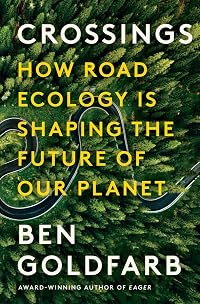
Crossings: How Road Ecology Is Shaping the Future of Our Planet
by Ben Goldfarb
On This Page
Description
Some 40 million miles of roadways encircle the earth, yet we tend to regard them only as infrastructure for human convenience. While roads are so ubiquitous they're practically invisible to us, wild animals experience them as entirely alien forces of death and disruption. In Crossings, environmental journalist Ben Goldfarb travels throughout the United States and around the world to investigate how roads have transformed our planet. A million animals are killed by cars each day in the US show more alone, but as the new science of road ecology shows, the harms of highways extend far beyond roadkill. Creatures from antelope to salmon are losing their ability to migrate in search of food and mates; invasive plants hitch rides in tire treads; road salt contaminates lakes and rivers; and the very noise of traffic chases songbirds from vast swaths of habitat. Yet road ecologists are also seeking to blunt the destruction through innovative solutions. Goldfarb meets with conservationists building bridges for California's mountain lions and tunnels for English toads, engineers deconstructing the labyrinth of logging roads that web national forests, animal rehabbers caring for Tasmania's car-orphaned wallabies, and community organizers working to undo the havoc highways have wreaked upon American cities. show lessTags
Recommendations



Member Recommendations
Member Reviews
I first heard about this book when I was reading the author’s previous text, “Eager,” about beavers. My initial response was, “do I really want to read a book about roadkill?” “Eager” is a book that will change your life; Goldfarb makes a bulletproof case for beavers being nothing short of revolutionary for the planets ecology and hydrology (and hence their restoration is imperative for the future of the Civilization Project). You can only come down from such heights, right?
Wrong. Goldfarb has done it again. He has taken a seemingly mundane, possibly even dry, subject—roads—and turned it into a riveting, scientifically-rigorous, gushingly-poetic, mournful, and vibrating tribute.
First, I should establish what this book show more is actually about: animism. In this case: kinship with our animal and insect friends—from turtles, to grizzlies, to Monarch butterflies, to ant eaters. I can only assume that for Goldfarb, it was a journalistic choice to leave this cornerstone of his narrative implicit as opposed to explicit. Why? Possibly because Western Culture has become so anthropocentric as to look down on people who recognize animals as other people. Possibly because the book would need to be much longer if it became not only an ecological, but also a philosophical and phenomenological text.
Regardless—I’m telling you now: “Crossings” will turn you into an animist, at least when it comes to our creaturely kin.
As a driver myself, this book hits close to home. If you’ve ever ridden in a car, let alone pilot one, you’ve inevitable come across the mutilated carcasses of your kin—in my community, they might be deer, possum, toad, fox, porcupine. In all likelihood, your usage of roads has been associated with your witnessing direct animal death (we’ll get to the magnitudes more indirect animal death in a bit here).
For me, the most poignant memory that comes to mind occurred in late Fall, 2010. I was driving home on rural road, late at night. Out of the corner of my eye, I saw something, someone, dragging herself. I slowed down and was able to identify a big doe whose rear end was paralyzed from a collision that must have happened only minutes ago. My heart immediately went out to her but in my mind I couldn’t come up with anything I could do for her. As I drove by tears started streaming by my face. I knew I had to turn back, regardless of the fact that I had absolutely no idea how I could help. Luck would have it that the car behind me also noticed the doe. It was driven by a man named Justin, who felt the same way I did, but who lived a mile down the road. He went home to get his gun. We found the doe down the hill a little ways, locked in down pine, her head resting on the trunk. Justin shot her in the head, and I spent some time with her afterwards, my hand resting on the soft, now bloodied, fur between her ears.
When I see roadkill, I can’t help but think of the kin that animal is leaving behind. I recall driving by a dead porcupine one time. Another porcupine had come up to her, placing his nose against hers. In a human community, when someone dies, a gap opens up in their community. The web of relationships now has a hole; they will be missed. I can only assume it is the same for non-human animals. As the deer gather around the stream in the evening for a cold drink before bedding down for the night, one of their number is missing.
I have participated in animal death over the years: slaughtering chickens, butchering fish, witnessing sheep, pig, and cow processing. Death is part of the cycle of nourishment and life.
What is so wrong about roadkill is that it is a profoundly unnecessary form of death. There’s a reverence that humans have practiced for tens of thousands of years, holding those beings whose lives we take in high regard. Roadkill is some terrible perversion of this cycle, “accidental” and nourishing only the world-destroying machine.
In Brazil, legal precedent has established that it is the civil engineer that designed the road and the governmental employee who operates the road that are liable for roadkill. Rather than seeing roadkill as haphazard occurrences between individuals drivers and doomed animals, it is seen as a systemic failure. There is a brilliance to this paradigm-shift; I would love to see such an outlook take hold in the States.
You’ve lively heard of the insect apocalypse. Depending on what numbers you’re looking at, somewhere around a third of insect are endangered (a much higher rate than mammals, amphibians, etc.—which are already catastrophically high). Goldfarb spends some time in his pages with the Monarch butterfly (whose Californian type has seen a 99% population decline in recent decades). When you see roads for what they are, it becomes apparent that they too are an apocalypse, an apocalypse for animals. I’ve heard about life in the partitioned villages of war-torn Syria: the checkpoints, the food insecurity, the armed guards, the razor wire, the inability to visit friends and family even one village over. Is this not what it is like to be an animal in a road-crossed world?
Roadkill is only the tip of the iceberg when it comes to the violence that roads perpetrate. They split populations, leading to lower genetic diversity (and ultimately less vital stock). They contribute to noise pollution, elevating the stress levels of animals for many miles around, and dampening the effectiveness of auditory communication and perception (in one study of birds, background road noise resulted in body mass declines because they couldn’t rely on their ears to alert them for predators, meaning they needed to spend more time watching, and less time eating). For migratory animals, roads might as well be cliffs—toss your defenseless body into the meat grinder, or abort the migration and face starvation. In one migration of mule deer in Colorado in the 1980s, 3,000 deer died along one road segment. Whereas for humans, roads connect, for animals, roads dissect and destroy.
There are a few practical bits of information as it relates to minimizing roadkill in the text: roadkill rarely occurs with vehicles moving under twenty-five miles-per-hour, and most animal death occurs especially at dawn and dusk, but also at night. And, thoughtfully designed animal crossings can work!
Goldfarb doesn’t go quite as far as Charles Marohn in his book “Strong Towns,” or as far as McBay, Keith, and Jensen in “Deep Green Resistance.” He doesn’t outright advocate for the removal of existing paved roads. Maybe he should. That said, he does report on the malicious racialized history of road construction (the ways in which they've benefited white communities at the expense of block communities), and some of these roads are being removed (often inner-city freeways).
Goldfarb’s breadth is magnificent. The book covers a history of roads and roadkill, going back to the suburbs of Persia and the turtles, crushed under the chariot wheels of the Romans. It covers the US Forrest service, and their countless millions of miles of forest roads (still ravaging ecology, even when a vehicle hasn’t set wheel on them for fifty years). You’ll read about “design speed,” (the speed at which you naturally want to drive a road, as opposed to the posted speed limit). You’ll learn about the extirpation of the deer from a majority of the United States, and their recovery. You’ll hear about the Salmon Superhighway, a massive culvert upgrade project in the Pacific Northwest that went all the way to the Supreme Count. There’s a section on the Carers in Australia and Tazmania who donate $6 billion of time annually for the care of animals who have been impacted by cars. You’ll learn about the sheep herds of Denali and the ten-minute gap between buses to ensure their safe passage. Page after page, chapter after chapter, Goldfarb’s words will evoke tears. I treat tears as an indicator of truth, and this is one of the trust books I’ve read in quite some time.
Having completed the book, I’m left pondering both the phenomenology and the philosophy of roads. In our human minds, roads are an afterthought—a way to get from point A to B. But for animals, they’re very much in the world of things, and concrete things at that. In a car, we experience a road in a wafting quality, as though we’re floating on a gust of wind. For animals, they represent sensory overload (and death): blinding lights, impossibly fast and hard gleaming beasts, oblivious to your agency and semiotics. One reconciler here are pedestrians. Civil engineering has been forced in recent years to account for the pesky two-leggeds, doggedly insisting that they too deserve a place in our infrastructure. Is the rest of Animalia all that different? Don’t they too deserve a place? show less
Wrong. Goldfarb has done it again. He has taken a seemingly mundane, possibly even dry, subject—roads—and turned it into a riveting, scientifically-rigorous, gushingly-poetic, mournful, and vibrating tribute.
First, I should establish what this book show more is actually about: animism. In this case: kinship with our animal and insect friends—from turtles, to grizzlies, to Monarch butterflies, to ant eaters. I can only assume that for Goldfarb, it was a journalistic choice to leave this cornerstone of his narrative implicit as opposed to explicit. Why? Possibly because Western Culture has become so anthropocentric as to look down on people who recognize animals as other people. Possibly because the book would need to be much longer if it became not only an ecological, but also a philosophical and phenomenological text.
Regardless—I’m telling you now: “Crossings” will turn you into an animist, at least when it comes to our creaturely kin.
As a driver myself, this book hits close to home. If you’ve ever ridden in a car, let alone pilot one, you’ve inevitable come across the mutilated carcasses of your kin—in my community, they might be deer, possum, toad, fox, porcupine. In all likelihood, your usage of roads has been associated with your witnessing direct animal death (we’ll get to the magnitudes more indirect animal death in a bit here).
For me, the most poignant memory that comes to mind occurred in late Fall, 2010. I was driving home on rural road, late at night. Out of the corner of my eye, I saw something, someone, dragging herself. I slowed down and was able to identify a big doe whose rear end was paralyzed from a collision that must have happened only minutes ago. My heart immediately went out to her but in my mind I couldn’t come up with anything I could do for her. As I drove by tears started streaming by my face. I knew I had to turn back, regardless of the fact that I had absolutely no idea how I could help. Luck would have it that the car behind me also noticed the doe. It was driven by a man named Justin, who felt the same way I did, but who lived a mile down the road. He went home to get his gun. We found the doe down the hill a little ways, locked in down pine, her head resting on the trunk. Justin shot her in the head, and I spent some time with her afterwards, my hand resting on the soft, now bloodied, fur between her ears.
When I see roadkill, I can’t help but think of the kin that animal is leaving behind. I recall driving by a dead porcupine one time. Another porcupine had come up to her, placing his nose against hers. In a human community, when someone dies, a gap opens up in their community. The web of relationships now has a hole; they will be missed. I can only assume it is the same for non-human animals. As the deer gather around the stream in the evening for a cold drink before bedding down for the night, one of their number is missing.
I have participated in animal death over the years: slaughtering chickens, butchering fish, witnessing sheep, pig, and cow processing. Death is part of the cycle of nourishment and life.
What is so wrong about roadkill is that it is a profoundly unnecessary form of death. There’s a reverence that humans have practiced for tens of thousands of years, holding those beings whose lives we take in high regard. Roadkill is some terrible perversion of this cycle, “accidental” and nourishing only the world-destroying machine.
In Brazil, legal precedent has established that it is the civil engineer that designed the road and the governmental employee who operates the road that are liable for roadkill. Rather than seeing roadkill as haphazard occurrences between individuals drivers and doomed animals, it is seen as a systemic failure. There is a brilliance to this paradigm-shift; I would love to see such an outlook take hold in the States.
You’ve lively heard of the insect apocalypse. Depending on what numbers you’re looking at, somewhere around a third of insect are endangered (a much higher rate than mammals, amphibians, etc.—which are already catastrophically high). Goldfarb spends some time in his pages with the Monarch butterfly (whose Californian type has seen a 99% population decline in recent decades). When you see roads for what they are, it becomes apparent that they too are an apocalypse, an apocalypse for animals. I’ve heard about life in the partitioned villages of war-torn Syria: the checkpoints, the food insecurity, the armed guards, the razor wire, the inability to visit friends and family even one village over. Is this not what it is like to be an animal in a road-crossed world?
Roadkill is only the tip of the iceberg when it comes to the violence that roads perpetrate. They split populations, leading to lower genetic diversity (and ultimately less vital stock). They contribute to noise pollution, elevating the stress levels of animals for many miles around, and dampening the effectiveness of auditory communication and perception (in one study of birds, background road noise resulted in body mass declines because they couldn’t rely on their ears to alert them for predators, meaning they needed to spend more time watching, and less time eating). For migratory animals, roads might as well be cliffs—toss your defenseless body into the meat grinder, or abort the migration and face starvation. In one migration of mule deer in Colorado in the 1980s, 3,000 deer died along one road segment. Whereas for humans, roads connect, for animals, roads dissect and destroy.
There are a few practical bits of information as it relates to minimizing roadkill in the text: roadkill rarely occurs with vehicles moving under twenty-five miles-per-hour, and most animal death occurs especially at dawn and dusk, but also at night. And, thoughtfully designed animal crossings can work!
Goldfarb doesn’t go quite as far as Charles Marohn in his book “Strong Towns,” or as far as McBay, Keith, and Jensen in “Deep Green Resistance.” He doesn’t outright advocate for the removal of existing paved roads. Maybe he should. That said, he does report on the malicious racialized history of road construction (the ways in which they've benefited white communities at the expense of block communities), and some of these roads are being removed (often inner-city freeways).
Goldfarb’s breadth is magnificent. The book covers a history of roads and roadkill, going back to the suburbs of Persia and the turtles, crushed under the chariot wheels of the Romans. It covers the US Forrest service, and their countless millions of miles of forest roads (still ravaging ecology, even when a vehicle hasn’t set wheel on them for fifty years). You’ll read about “design speed,” (the speed at which you naturally want to drive a road, as opposed to the posted speed limit). You’ll learn about the extirpation of the deer from a majority of the United States, and their recovery. You’ll hear about the Salmon Superhighway, a massive culvert upgrade project in the Pacific Northwest that went all the way to the Supreme Count. There’s a section on the Carers in Australia and Tazmania who donate $6 billion of time annually for the care of animals who have been impacted by cars. You’ll learn about the sheep herds of Denali and the ten-minute gap between buses to ensure their safe passage. Page after page, chapter after chapter, Goldfarb’s words will evoke tears. I treat tears as an indicator of truth, and this is one of the trust books I’ve read in quite some time.
Having completed the book, I’m left pondering both the phenomenology and the philosophy of roads. In our human minds, roads are an afterthought—a way to get from point A to B. But for animals, they’re very much in the world of things, and concrete things at that. In a car, we experience a road in a wafting quality, as though we’re floating on a gust of wind. For animals, they represent sensory overload (and death): blinding lights, impossibly fast and hard gleaming beasts, oblivious to your agency and semiotics. One reconciler here are pedestrians. Civil engineering has been forced in recent years to account for the pesky two-leggeds, doggedly insisting that they too deserve a place in our infrastructure. Is the rest of Animalia all that different? Don’t they too deserve a place? show less
What an interesting & wide-ranging book on road ecology! While it may sound wonky, it's written for the general reader; he makes it very clear how "new" of a scientific field road ecology is. It's obvious some of the chapters were first written for magazine publications but this serves the book well; he's able to share his detailed visits to roadways throughout the U.S. and even other parts of the world. His "on the ground" interviews with Forest Service/Nat'l Park leaders, road ecologists, wildlife biologists,city planners, urban community leaders, and even animal rescue volunteers are woven into the analysis of each chapter's topic in an engaging and seamless way. His book examines everything from the enormous complexity & ongoing show more tragedy of "roadkill" (about one million killed by cars every day!?) and also the very specific biome of roads and roadsides for everything from frogs to cougars. He provides chapters on the history of the "rise of the automobile" in our country, the subsequent explosion of roadways and interstates, even the building of roads throughout our country's wilderness areas via the Forest Service. He traces how roads have both helped and hindered, even debilitated communities within urban areas, esp diverse communities of immigrants, or predominantly black/Latino/etc. I really appreciated that though he explained the truly staggering negative effects and outcomes of our country's, (& other countries') road systems, he recognized the positives such roadways have and continue to have for our human populations, and the efforts many stakeholders are making to either change or even reverse road policies and new approaches being tried to save animal species from further decline. I had several "aha" moments as I recognized interstate hwys he uses as part of his detailed focus -I've driven on them so many times in cross country trips, being a tourist, etc! And our family has used Forest Service roads through various states so many times as part of our camping/recreation/fishing-hunting activities. I learned so much while reading this; I must admit I have a new curiousity and appreciation for the weedy or windswept or forested sides of roadways where I zip along sometimes at 70 mph. show less
Well written but disturbing account of how our roads have irredeemably cut up, disturbed and are destroying the environments that our fellow creatures on this planet live in. Dividing up their living spaces we force them into smaller and smaller confines, and kill vast numbers of animals as they attempt to cross our roads. They do not have the ability to safely judge road crossing and even a few cars per hour can be a mortal peril for many species.
Crossings is a popular review of the field of road ecology, which studies the impact of roads on nature and how those impacts can be mitigated. Goldfarb combines solid science reporting with a bit of purple-prose, which makes the book both informative and manipulative.
The big picture is that roads kill billions of animals every year, from moose down to monarch butterflies. Roads are vital to every human activity, and equally harmful to animals. In the United States, white-tailed deer are the iconic roadkill species. A collision with a white-tail costs averages $9000 in terms of car repairs and medical costs. Many animals are hit, and as traffic volume increases past one-car-per-minute, migrations across a road become impossible for many show more animals. Highways slice ecosystems into isolated islands that cannot sustain their populations, and for slow-breeding animals like turtles, even a few crashes can lead to a death spiral.
The most basic hack is animal crossings. Given an alternative, an animal won't wander into traffic. This varies for each species, but basically involves fences to protect the main road, as well as tunnels or bridges wide enough and frequent enough that animals will use them. Some early passageways were dank and claustrophobic tunnels: most macrofauna like big open spaces. Small animals like frogs and reptiles can use smaller culverts, but need them every few hundred yards, rather than every mile. Siting and designing animal passages is both art and science.
The bad news is that its expensive, and transportation engineers are loath to impact budgets. The 2021 infrastructure billion had the largest ever animal crossing funding source at $340 million, an insignificant fraction of the $1.5 trillion bill itself.
There have been success stories, but roads themselves are hazardous. Even almost unused tracks in national forests can block cautious animals from crossing. The sound from the road in Glacier National Park, used only by official tour buses on a strictly limited basis, carries for miles with acoustic impacts on birds. Given the omnipresent stretch of roads, it's hard to find a place that hasn't been impacted, and even harder to do science there, since scientists prefer to drive to work as all.
Goldfarb is firmly on the side of nature against cars, but we're also walking creatures. This book presents a fascinating rethinking of the tragic pile of fur on the highway shoulder. show less
The big picture is that roads kill billions of animals every year, from moose down to monarch butterflies. Roads are vital to every human activity, and equally harmful to animals. In the United States, white-tailed deer are the iconic roadkill species. A collision with a white-tail costs averages $9000 in terms of car repairs and medical costs. Many animals are hit, and as traffic volume increases past one-car-per-minute, migrations across a road become impossible for many show more animals. Highways slice ecosystems into isolated islands that cannot sustain their populations, and for slow-breeding animals like turtles, even a few crashes can lead to a death spiral.
The most basic hack is animal crossings. Given an alternative, an animal won't wander into traffic. This varies for each species, but basically involves fences to protect the main road, as well as tunnels or bridges wide enough and frequent enough that animals will use them. Some early passageways were dank and claustrophobic tunnels: most macrofauna like big open spaces. Small animals like frogs and reptiles can use smaller culverts, but need them every few hundred yards, rather than every mile. Siting and designing animal passages is both art and science.
The bad news is that its expensive, and transportation engineers are loath to impact budgets. The 2021 infrastructure billion had the largest ever animal crossing funding source at $340 million, an insignificant fraction of the $1.5 trillion bill itself.
There have been success stories, but roads themselves are hazardous. Even almost unused tracks in national forests can block cautious animals from crossing. The sound from the road in Glacier National Park, used only by official tour buses on a strictly limited basis, carries for miles with acoustic impacts on birds. Given the omnipresent stretch of roads, it's hard to find a place that hasn't been impacted, and even harder to do science there, since scientists prefer to drive to work as all.
Goldfarb is firmly on the side of nature against cars, but we're also walking creatures. This book presents a fascinating rethinking of the tragic pile of fur on the highway shoulder. show less
We all know that traffic kills animals, and birds, and bugs, and fish (who can't swim freely through culverts) but most of us have no idea of the scale of the damage roads cause and how the loss of predators, prey, and grazing affects the larger ecosystem. Ben Goldfarb presents a strong case for building better roads (often in the form of sympathetic culverts and overpasses). By helping the animals we help ourselves.
Important book, excellently written. So much about roads I didn't know.
With compelling writing and timely subject matter, this is a must read book!
Members
- Recently Added By
Lists

The War on Cars podcast
108 works; 1 member

Books cited in Progress by Samuel McDonald
160 works; 1 member
Author Information

4+ Works 658 Members
Awards and Honors
Awards
Distinctions
Common Knowledge
- Original publication date
- 2023
- First words
- If you've ever driven across the United States of America, you have passed beneath the wings of a plucky songbird - small than your palm, light as your pocket change, feathered in jaunty blue and umber - called the cliff swal... (show all)low. -Introduction: The Wing of the Swallow
If road ecology has a birth date, it's June 13, 1924 - the morning a biologist named Dayton Stoner and his ornithologist wife, Lillian, left their home in Iowa City, bound for a research station three hundred miles away. The ... (show all)couple planned to spend the month capturing and banding birds, as they did most summers; that year their tally would include kingfishers, house wrens, and brown trashers. Posterity doesn't record their vehicle's make, but it's a decent bet they drove a Model T. -Chapter 1, And Now the Devil-Wagon - Canonical DDC/MDS
- 333.77
- Canonical LCC
- TD195.R63
Classifications
- Genres
- Science & Nature, General Nonfiction, Nonfiction, Economics
- DDC/MDS
- 333.77 — Society, government, & culture Economics Economics of land and energy Conservation, Alternative Energy Sources Urban Land
- LCC
- TD195 .R63 — Technology Environmental technology. Sanitary engineering Environmental technology. Sanitary engineering Environmental effects of industries and plants
- BISAC
Statistics
- Members
- 263
- Popularity
- 123,389
- Reviews
- 8
- Rating
- (3.98)
- Languages
- English
- Media
- Paper, Audiobook, Ebook
- ISBNs
- 5
- ASINs
- 2