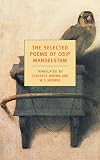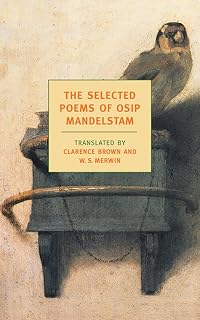
Selected Poems
by Osip Mandelstam
On This Page
Description
"Osip Mandelstam is a central figure not only in modern Russian but in world poetry, the author of some of the most haunting and memorable poems of the twentieth century. A contemporary of Anna Akhmatova, Marina Tsvetayeva, and Boris Pasternak, a touchstone for later masters such as Paul Celan and Robert Lowell, Mandelstam was a crucial instigator of the "revolution of the word" that took place in St. Petersburg, only to be crushed by the Bolshevik Revolution. Mandelstam's last poems, show more written in the interval between his exile to the provinces by Stalin and his death in the Gulag, are an extraordinary testament to the endurance of art in the presence of terror." "This book represents a collaboration between the scholar Clarence Brown and W.S. Merwin, one of contemporary America's finest poets and translators. It also includes Mandelstam's "Conversations on Dante," an uncategorizable work of genius containing the poet's deepest reflections on the nature of the poetic process."--Jacket. show lessTags
Recommendations

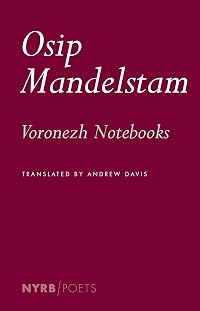
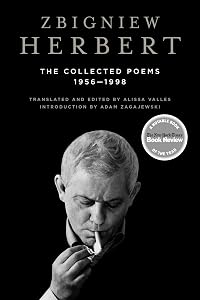
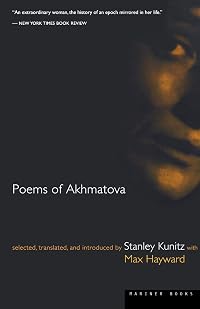

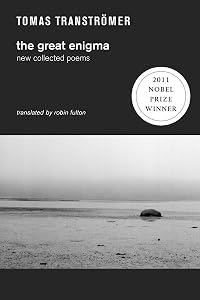






Member Reviews
The first poem here was written/published when Mandelstam was around seventeen or eighteen and is, like most of the poems of his earlier years, on nature and ephemerality.
The shy speechless sound
of a fruit falling from its tree,
and around it the silent music
of the forest, unbroken…?
As the years go by, a world war, a revolution, and what at the very least can be called violent suppression, occur and the poems focus more on violence, betrayal, despair, so that even reflections of images and memories of better times dissipate.
O Lord, help me live through this night—
I’m in terror for my life, your slave:
to live in Petersburg is to sleep in a grave.
Mandelstam didn’t escape the censorship, surveilling, arrests, imprisonments, and show more death that faced poets and artists and others in the Soviet Union under Stalin. That he still had courage to write and recite poetry that spoke directly to the terror and the sycophancy of those around Stalin is unbelievable. Of course, he paid for it dearly with arrest and exile and the conditions of poverty caused by this, and later imprisonment and death, but one of the most touching things I’ve ever read is this part of a poem that alludes to his wife Nadezhda, who memorized a lot of his poetry and kept his work and story alive even after his death, and their misery.
You’re still alive, you’re not alone yet—
she’s still beside you, with her empty hands,
and a joy reaches you both across immense plains
Through mists and hunger and flying snow. show less
The shy speechless sound
of a fruit falling from its tree,
and around it the silent music
of the forest, unbroken…?
As the years go by, a world war, a revolution, and what at the very least can be called violent suppression, occur and the poems focus more on violence, betrayal, despair, so that even reflections of images and memories of better times dissipate.
O Lord, help me live through this night—
I’m in terror for my life, your slave:
to live in Petersburg is to sleep in a grave.
Mandelstam didn’t escape the censorship, surveilling, arrests, imprisonments, and show more death that faced poets and artists and others in the Soviet Union under Stalin. That he still had courage to write and recite poetry that spoke directly to the terror and the sycophancy of those around Stalin is unbelievable. Of course, he paid for it dearly with arrest and exile and the conditions of poverty caused by this, and later imprisonment and death, but one of the most touching things I’ve ever read is this part of a poem that alludes to his wife Nadezhda, who memorized a lot of his poetry and kept his work and story alive even after his death, and their misery.
You’re still alive, you’re not alone yet—
she’s still beside you, with her empty hands,
and a joy reaches you both across immense plains
Through mists and hunger and flying snow. show less
Apesar de achar Tristia a grande obra-prima do Mandelstam, não tem como não se emocionar com sua poesia póstuma que envolve toda a poesia feita durante a perseguição stalinista, provando mais uma vez que quem gosta de arte não pode nem remotamente simpatizar com o stalinismo e o que os poetas sofreram na União Soviética é motivo suficiente pra isso.
*Não dou cinco estrelas porquea tradução foi muito fragmentada.
*Não dou cinco estrelas porquea tradução foi muito fragmentada.
Mandelstam and Anna Akhmatova are the foremost poetic witnesses to the effects of the Russian Revolution and its aftermath on the Russian intelligentsia. Mandelstam's terrible fate - imprisonment and extinguishment at Stalin's whim - should not obscure the brilliance of his poetry, which shone brighter the darker his personal circumstances. Mandelstam's work is lyrical, tender, and occasionally cutting; his landscape poetry is without equal. I'm slightly less impressed with the translations in this volume, which seem rather flat in comparison to other translations of Mandelstam I have seen; but that's a minor criticism of a fine book.
In his preface, Clarence Brown, the "scholar" (as opposed to the "poet") of this translating team, has basically written my little review for me: "Merwin has translated Mandelstam into Merwin." Much as I like Merwin, and this is considerably much, Merwin is no Mandelstam. This is not a qualitative judgment, a la Kennedy/Quayle; it's just a relatively obective observation. One issue that perplexes me: since no attempt is made to replicate Mandelstam's metrics or rhyme schemes, why do Brown & Merwin consistently rearrange the sequencing of lines, when more faithful renderings would at least preserve a little of Mandelstam's poetic logic?
Osip Mandelstam's poetry is exquisite and relevant to our age through his influence on others like Celan and Lowell. This is a small volume whose value exceeds the bounds of its covers.
A good selection. The best aspect of this edition is the parallel presentation with Russian on the left page and the English on the right. McDuff provides translations that are faithful to the "meaning" of the lines, but which fail to convey the rythyms and ryhmes of the originals. Without question, that's asking for an awful lot. But competent translations do only scant justice to inspired originals.
This LibraryThing entry has combined translations by various people. The copy I have to refernce has the sense of the first poem (quotd by another reviewer) but with completely different English words. This copy selectes 60 poems from the 3 books published in Mandelstam's lifetime pluse the posthumous poems. It does not attempt to duplicate the rhyme and meter of the Russian, but to retain the essence of the poems.
Members
- Recently Added By
Lists

Tonikat reading completed on Librarything journals
329 works; 2 members

Harold Bloom - The Western Canon: D. The Chaotic Age
833 works; 24 members

Philip Ward's Lifetime Reading Plan
592 works; 22 members
Author Information

217+ Works 2,341 Members
Osip Mandelstam was born in Warsaw, Poland and grew up in St.Petersburg, Russia Mandelstam was taught by tutors and governesses at his home. He attended the prestigious Tenishev School from 1900 to 1907 and traveled then to Paris from 1907 to 1908 and Germany from 1908 to 1910, where he studied Old French literature at the University of show more Heidelberg. In 1911 till 1917, he studied philosophy at St. Petersburg University but did not graduate. Mandelstam was a member of the 'Poets Guild' from 1911 and had close personal ties with Anna Akhmatova and Nikolai Gumilev. His first poems appeared in 1910 in the journal Apollon. In 1918 he worked briefly for Anatoly Lunacharskii's Education Ministry in Moskow. In the 1920s Mandelstam supported himself by writing children's books and translating works by Upton Sinclair, Jules Romains, Charles de Coster and others. He did not compose poems from 1925 to 1930 but turned to prose. In 1930 he made a trip to Armenia to escape his influential enemies. Mandelstam's Journey to Armenia (1933) became his last major work published during his life time. Mandelstam was arrested the first time in 1934 for an epigram he had written on Joseph Stalin. In the transit camp, Mandelstam was already so weak that he couldn't stand. He died in the Gulag Archipelago in Vtoraia rechka, near Vladivostok, on December 27, 1938.His body was taken to a common grave. International fame came to Mandelstam in the 1970s, when his works were published in the West and in the Soviet Union. (Bowker Author Biography) show less
Some Editions
Series
Belongs to Publisher Series
Common Knowledge
- Canonical title
- Selected Poems
- People/Characters
- Osip Mandelstam
Classifications
- Genres
- Poetry, Fiction and Literature
- DDC/MDS
- 891.713 — Literature & rhetoric Literatures of other languages East Indo-European and Celtic literatures Russian and East Slavic languages Russian poetry 1800–1917
- LCC
- PG3476 .M355 .A23 — Language and Literature Slavic languages and literatures. Baltic languages. Albanian language Slavic. Baltic. Albanian Russian literature Individual authors and works 1917-1960
- BISAC
Statistics
- Members
- 577
- Popularity
- 50,487
- Reviews
- 7
- Rating
- (4.18)
- Languages
- English, Polish, Russian
- Media
- Paper, Ebook
- ISBNs
- 17
- ASINs
- 7