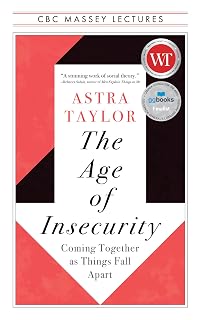
The Age of Insecurity: Coming Together as Things Fall Apart
by Astra Taylor
On This Page
Description
"These days, everyone feels insecure. We are financially precarious, overwhelmed and anxious, and worried about the future. While millions endure the stress of struggling to make ends meet, in reality, the status quo isn't working for anyone, even the affluent and comparatively privileged; they, too, are deeply insecure. What is going on? The Age of Insecurity exposes how seemingly disparate crises -- our suffering mental health and rising inequality, the ecological emergency, and the threat show more of fascism -- are tied to the fact that our social order runs on insecurity. Across disparate sectors, from policing and the military to the wellness and beauty industries, the systems that promise us security instead actively undermine it. We are all made insecure on purpose, and our endless striving shapes how we feel about ourselves and others -- including what we believe is personally and collectively possible. The Age of Insecurity sheds new light on our contemporary predicament, exposing the psychological and political costs of the insecurity-generating status quo, while proposing ways to forge a new path forward."-- show lessTags
Recommendations














Member Reviews
Some things in life are so familiar to us that they seem inevitable, even natural. That’s probably how you feel about the idea that, to secure life’s basic necessities, you must spend the majority of your waking moments “earning a wage” from your “employer,” a legal entity that works as hard as it can to ensure that it has no social or ethical responsibilities to you whatsoever, beyond paying your wage. You might even think that if you question this arrangement, that this means that you are “lazy,” “unproductive,” even morally corrupt. You couldn’t really be blamed for this, as it’s been beaten into your head your entire life.
If that’s the case, then Canadian-American writer, filmmaker, and activist Astra show more Taylor’s latest book, The Age of Insecurity: Coming Together as Things Fall Apart, will make you question all of these dubious assumptions and more. It turns out that there is nothing “natural”—or even preferable—about living in an environment of cutthroat capitalism.
Taylor’s key idea is that modern capitalism relies on what she refers to as “manufactured insecurity,” which is not a side effect of capitalism, but rather a core feature. Capitalism, by nature, requires unrelenting growth, which relies on consumption, which itself depends on a thriving public relations and advertising industry that has to convince us that what we have, regardless of how much we have, is never enough. It’s all very calculated, with one goal in mind—ever-increasing profits. If the environment, consumer safety, or worker rights get in the way, to hell with them.
Now, to be honest, if the output of all this capitalist production was more evenly distributed, this would be less of a problem (except for environmental concerns). If we all were, for example, more or less guaranteed affordable housing, a basic income, and access to education and healthcare, then capitalism in general would be easier to swallow, maybe even preferred (see Scandinavian social democracy).
However, this is unequivocally not what happens, especially in the US, as Taylor so painstakingly documents. While we actually have enough economic output to go around, people are still financially ruined by our healthcare system when they get a cancer diagnosis, or are otherwise buried in ridiculous levels of debt from a college education or even from purchasing a modest family home.
Inequality itself has truly become absurd. As Taylor writes, “Inequality is, indeed, out of control, with ten billionaire men possessing six times more wealth than the poorest three billion people on earth.” And yet many of us just shrug this off.
The reason things have gotten so bad in the US, as Taylor correctly points out, is that we obsess over negative rights—or the freedom from tyrannical government rule—at the total exclusion of positive rights—or the rights to government-ensured affordable housing, education, and healthcare. We consistently conflate totalitarian rule with government-provided benefits.
But as the anthropologist David Graeber said, “The ultimate, hidden truth of the world is that it is something that we make, and could just as easily make differently.” Things, in other words, could be better, and we need look no further than across the Atlantic for examples. Scandinavian countries, for instance, are both capitalist and have governments that support positive rights, reducing insecurity across the board and resulting in a happier, more productive population.
Finland, for example, is a great model for the reduction of homelessness. As Taylor writes:
“In Finland, where housing is constitutionally guaranteed, 16 percent of homes are social housing, and over a quarter of new construction is supposed to fit into that category….These policies have made Finland the only country in the European Union with falling homelessness rates.”
The fact is, there are solutions to our major social problems; the issue, of course, is that the market won’t provide them, as big business has no interest in addressing them. Reducing homelessness simply doesn’t fit into the invest-produce-consume cycle that maximizes profits for the already wealthy. Why build affordable housing when you can build more profitable luxury housing serving as second homes for the rich? Housing obviously requires a public solution, as Finland demonstrates.
Taylor provides countless additional examples of how we might fix healthcare, education, and more, to create a more secure society, which, after all, is truly better for everyone. Well, except for the billionaires, who do stand to lose some of their money and power. But I wouldn’t lose too much sleep over that.
I suppose the counter-argument is that, if you create too much security, productivity and the incentive to work disappears. If everything is handed to me, why would I exert any effort at all? The inherent risk associated with destitution spurs creativity, innovation, and productivity.
This argument, however, has always struck me as manifestly absurd and unnecessarily cynical. The idea that people only work when forced to is actually inconsistent with human nature; the reality is that when people are more secure—when they don’t have to live paycheck-to-paycheck, forgo necessary medical care, and work to fill a landlord’s pockets—they become more curious, confident, and productive. Consistent with Maslow’s hierarchy of needs, once people are liberated from the bottom rungs of material necessity, they can then properly address concerns of self-actualization. But this isn’t going to happen when almost the entirety of your McDonald’s paycheck is going to your landlord—who just raised rent for the third time this year because there are no regulations stopping him from doing so. (When will we realize that housing is not a commodity but a right?!)
Overall, this book is effective in that it brings political attention back to economic concerns, where the left ultimately thrives. If we start to think in terms of reducing insecurity, we can see that economically progressive reforms—which have already been implemented successfully elsewhere in the world—are the way forward, if we want to get out of this polarized mess. show less
If that’s the case, then Canadian-American writer, filmmaker, and activist Astra show more Taylor’s latest book, The Age of Insecurity: Coming Together as Things Fall Apart, will make you question all of these dubious assumptions and more. It turns out that there is nothing “natural”—or even preferable—about living in an environment of cutthroat capitalism.
Taylor’s key idea is that modern capitalism relies on what she refers to as “manufactured insecurity,” which is not a side effect of capitalism, but rather a core feature. Capitalism, by nature, requires unrelenting growth, which relies on consumption, which itself depends on a thriving public relations and advertising industry that has to convince us that what we have, regardless of how much we have, is never enough. It’s all very calculated, with one goal in mind—ever-increasing profits. If the environment, consumer safety, or worker rights get in the way, to hell with them.
Now, to be honest, if the output of all this capitalist production was more evenly distributed, this would be less of a problem (except for environmental concerns). If we all were, for example, more or less guaranteed affordable housing, a basic income, and access to education and healthcare, then capitalism in general would be easier to swallow, maybe even preferred (see Scandinavian social democracy).
However, this is unequivocally not what happens, especially in the US, as Taylor so painstakingly documents. While we actually have enough economic output to go around, people are still financially ruined by our healthcare system when they get a cancer diagnosis, or are otherwise buried in ridiculous levels of debt from a college education or even from purchasing a modest family home.
Inequality itself has truly become absurd. As Taylor writes, “Inequality is, indeed, out of control, with ten billionaire men possessing six times more wealth than the poorest three billion people on earth.” And yet many of us just shrug this off.
The reason things have gotten so bad in the US, as Taylor correctly points out, is that we obsess over negative rights—or the freedom from tyrannical government rule—at the total exclusion of positive rights—or the rights to government-ensured affordable housing, education, and healthcare. We consistently conflate totalitarian rule with government-provided benefits.
But as the anthropologist David Graeber said, “The ultimate, hidden truth of the world is that it is something that we make, and could just as easily make differently.” Things, in other words, could be better, and we need look no further than across the Atlantic for examples. Scandinavian countries, for instance, are both capitalist and have governments that support positive rights, reducing insecurity across the board and resulting in a happier, more productive population.
Finland, for example, is a great model for the reduction of homelessness. As Taylor writes:
“In Finland, where housing is constitutionally guaranteed, 16 percent of homes are social housing, and over a quarter of new construction is supposed to fit into that category….These policies have made Finland the only country in the European Union with falling homelessness rates.”
The fact is, there are solutions to our major social problems; the issue, of course, is that the market won’t provide them, as big business has no interest in addressing them. Reducing homelessness simply doesn’t fit into the invest-produce-consume cycle that maximizes profits for the already wealthy. Why build affordable housing when you can build more profitable luxury housing serving as second homes for the rich? Housing obviously requires a public solution, as Finland demonstrates.
Taylor provides countless additional examples of how we might fix healthcare, education, and more, to create a more secure society, which, after all, is truly better for everyone. Well, except for the billionaires, who do stand to lose some of their money and power. But I wouldn’t lose too much sleep over that.
I suppose the counter-argument is that, if you create too much security, productivity and the incentive to work disappears. If everything is handed to me, why would I exert any effort at all? The inherent risk associated with destitution spurs creativity, innovation, and productivity.
This argument, however, has always struck me as manifestly absurd and unnecessarily cynical. The idea that people only work when forced to is actually inconsistent with human nature; the reality is that when people are more secure—when they don’t have to live paycheck-to-paycheck, forgo necessary medical care, and work to fill a landlord’s pockets—they become more curious, confident, and productive. Consistent with Maslow’s hierarchy of needs, once people are liberated from the bottom rungs of material necessity, they can then properly address concerns of self-actualization. But this isn’t going to happen when almost the entirety of your McDonald’s paycheck is going to your landlord—who just raised rent for the third time this year because there are no regulations stopping him from doing so. (When will we realize that housing is not a commodity but a right?!)
Overall, this book is effective in that it brings political attention back to economic concerns, where the left ultimately thrives. If we start to think in terms of reducing insecurity, we can see that economically progressive reforms—which have already been implemented successfully elsewhere in the world—are the way forward, if we want to get out of this polarized mess. show less
THE AGE OF INSECURITY is a book about society, about perception, about the more-than-human world, and about activism. In the following, I’ll offer a review of Astra Taylor’s prior work, summarize a number of themes in the book—from the legal history of the concept of security to the psychological aspects of security—and pick up threads of animism and phenomenology where Taylor leaves off.
PRIOR WORKS
I first came across Astra Taylor with her publication of THE PEOPLE’S PLATFORM: TAKING BACK POWER AND CULTURE IN THE DIGITAL AGE. Although published in 2014, I didn’t read it until shortly after I had deleted my Facebook account in 2015, and shortly before I cofounded a blockchain startup. So I was her ideal audience. By this show more era, observant people had realized that the internet was no longer the land of possibility that the cypherpunks envisioned, but rather a world in which people are products, in which democracies are commons to be enclosed, and in which existing inequalities can be multiplied ad infinitum.
Fast forward to the first Trump presidency, and Taylor publishes DEMOCRACY MAY NOT EXIST, BUT WE’LL MISS IT WHEN IT’S GONE. There may not have been a more timely book. Rather than define democracy, Taylor instead took a Sanfordian approach, establishing eight continua and examining a range of tensions inherent in the concept of democracy, such as expertise and mass opinion, freedom and equality, and inclusion and exclusion. She—rightly so, in my opinion—minimizes the role of voting. By the time a group moves into voting, the sense of the meeting has already been lost, or at least is gravely endangered.
But you showed up to hear my thoughts about *this* book, so why am I expounding on Taylor’s bibliography? And I haven’t even told you about the book she co-authored with Leah Hunt-Hendrix in 2024, SOLIDARITY: THE PAST, PRESENT, AND FUTURE OF A WORLD-CHANGING IDEA. I’m giving you this background to help establish Taylor’s résumé as that of the perfect person to be writing a book about insecurity, at the perfect time. We’re in the second Trump presidency, heading into the midterm elections. Affordability is the number-one political issue (despite a long list of contenders). If you want a book that gets to the heart of the current moment, look no further.
THE PHILOSOPHY AND PSYCHOLOGY OF SECURITY
When contemplating this title, my first thought was, “security is not the opposite of insecurity.” Why did I arrive at this conclusion? Although we can and should limit insecurity, to be alive is to embrace hazard, to leverage risk, to accept death. Both literally and philosophically, absolute security is always synthetic: to find a place that is truly secure, one must first leave this world.
Luckily for you, Taylor is not abstrusely academic in her treatment of the subject. In fact, the book is exceedingly approachable to the lay reader.
Although security and insecurity have very real physical thresholds, much of the sphere of security and insecurity is psychological. For example, many doctors in the United States, although they are in the top 10% of income earners, fear that a family member will experience a medical event not covered by their insurance and bankrupt the family. Given that they’re so well off, are they being paranoid? Maybe not. If they’ve been in the field for a while, hundreds of their patients will have gone through bankruptcy themselves, and not a few of them will have been well off when they started.
Part of this is a personal question—the question of “enough.” This is something we can and should work to change away from a culture of hoarding. But on a more foundational level, these are societal structures. When the U.S. fails to provide adequate universal health care, everyone—even wealthy families—is anxious as a result. And that anxiety drives an uptick in risk at a societal level, when people decide to put away excess cash in a rainy-day fund rather than help a community member in need.
HISTORY
Taylor is Canadian-American. As such, she looks at the concept of the right to the “security of the person,” part of the Canadian Charter of Rights and Freedoms. She traces the history of this concept of security back to a much older document, established in 1217 in England. Whereas the better-known Magna Carta was written by a compact of barons pushing back against the king two years earlier (an inherently aristocratic frame), the Charter of the Forest was written by commoners. We also learn about the Levellers, who wanted to level hedges and level inequality, and the more radical Diggers, who wanted to be able to plant food everywhere. The Diggers greeted one another as “fellow creature,” in solidarity with the more-than-human world.
In the aftermath of World War II, the United Nations ratified the Universal Declaration of Human Rights. Notable signatories include the United States, Canada, and China (the Soviet Union abstained). The committee drafting the declaration was chaired by Eleanor Roosevelt and was partially inspired by FDR’s concept of a Second Bill of Rights.
UNSCHOOLING
The book takes a turn toward memoir in a way I find quite touching, with Taylor reflecting on her upbringing as an unschooler. I had an unconventional upbringing myself and now serve on the board of an independent nature-based elementary school. Taylor’s personal experience with unschooling—the realization that another world, one rich with possibility and creativity, is possible—helped reinforce her conviction that there is a hidden world of possibility in which society itself could be a place of security for most people.
ORGANIZATIONAL PHENOMENOLOGY
Taylor then returns to the story of enclosure, this time picking up with the Hudson’s Bay Company’s “Fur Desert” project, which focused on decimating beaver populations in the Oregon Territory to corner the fur market. To improve profitability, the Hudson’s Bay Company perpetrated ecocide. With the loss of beavers, wetlands disappeared—by far the most biodiverse areas of these temperate bioregions (this is the meaning of “keystone species”: remove the keystone and the arch of life collapses). Ethics aside, how could a company endorse such apocalyptic nihilism? Coming at the question from a phenomenological lens, let’s consider the umwelt of an institution such as the Hudson’s Bay Company. How can such an entity perceive the world?
I was struck by a chilling image: the idea that the world is invisible to the Western mind (and Western institutions) until it is bisected. You might think, “What’s the harm in invisibility?” But quickly things start to fall apart. Have you heard of people with a genetic disorder preventing them from feeling pain? Very few of them ever make it to adulthood. With a mind that can only perceive through bisection, rivers become property lines rather than centers and meeting places. Keystone species (beavers) become luxury goods (felt hats). Colonists claimed that Native Americans weren’t “improving” the land and therefore had no right to it (resulting in the genocide of First Nations). But just like the result of an executioner’s axe, this act of bisection resulted in the death of the bisected. Thriving ecosystems became infertile grids of square plots, stripped of trees, with topsoil eroded.
You can imagine the Hudson’s Bay Company like a blind man who has never encountered another person, wandering through a crowded room while holding down the trigger of a machine gun. At first, he doesn’t “encounter” anyone—they’re all running away, keeping as much space as possible between themselves and their executioner. He hears screaming; turning toward the sound, bullets strafe in the direction of his attention. At first, he still isn’t sure whether he is alone, his feet treading on the smooth floor, having yet to actually touch another. But as he guns down one person after the next, pushing forward in his blind charge, his feet begin treading on the corpses of his own “perceptive act.” Finally—something to interact with, something to apprehend. And something is so much better than nothing, isn’t it?
I grew up with the idea that Cartesian coordinates are a grid we can overlay on the world. The grid itself is harmless, isn’t it? Just a lens through which we can see the world? But what if the wires of the grid are like an extruding die in a sausage maker—although the same material comes out the other side, it is bereft of structure, just a mush of pink goo where formerly there were veins and muscle fibers and fat (the multitude of textures of enfleshed bodies)? It is as though the world is a vivacious and wild pig, but we Western minds can only “see” the pig once it has become sausage. I don’t mean this poetically. I mean: what if the Western concept of “observation” is fundamentally destructive? In this image, I’m going far beyond the quantum idea that all observation is relational and changes the observed.
You’ve had enough meditation on annihilation? I’ll reassure you: it doesn’t have to be this way. There are other modes of perception that are compatible with aliveness. They begin by allowing the umwelt of the other to meet us in the middle. Perception only becomes destruction when we force our organs of perception so deeply into our interlocutor that they penetrate clear through to the other side—a kind of perception through cessation of resistance. But what if we began considering the other as soon as we encountered the faintest signs of resistance? In the dark forest, I can gently turn my head as I move through space, listening to how ambient sounds shift as they are absorbed or refracted by trees, rocks, moss. Returning to my bed after dark, I can feel the warm humidity of my partner’s breath on my cheek as I gently approach her to snuggle in.
What if we allowed our institutions the sensitivity to perceive the world with such care? If we interrogate the concept of security a little further, we find that it must begin with integrity. Once integrity is lost, there can be no security. The world is peopled with organisms of interpenetrating scale and complexity. When a human “disintegrates,” they die. The same can be said of a bacterium, an ecosystem, or the planet. Disintegration and death are synonymous (although it is the ability of one organism to disintegrate, digest, and ultimately integrate another that forms the basis of metabolism).
In the book, Taylor mentions rights of nature and notes that human security is premised on more-than-human security—that of the teeming, boisterous, exuberant Earth community. Such considerations quickly lead us to an animist frame: the cosmology in which each being—blue whale, destroying angel mushroom, granite—has its own wisdom and deserves dignity. Turning our gaze back to the human sphere, what becomes possible when we apply an animistic frame to our institutions, to organizational theory, to our frameworks for governance, for assemblage, for constituting? What is society, after all, but a superorganism, resplendent in the emergent genius of collectivity and mutualism? Maybe it is time we ask: how can our multinationals, our NGOs, our municipalities develop the richness of olfaction of wolves, the multispectral vision of butterflies, the caring empathy of dolphins, the minute tactile perceptivity of moles, and the reflective interoception of elephants?
INSURANCE AND POLICING
Now it is time to turn our attention back to the book. After examining the Hudson’s Bay Company, Taylor notes that FDR believed risk should be treated as a commons and explores how insurance can be a radical act of mutualism. Did you know that the absurdist author Franz Kafka was employed as an insurance bureaucrat in the Austro-Hungarian Empire? Much of his writing reflects the failure of societal structures to adequately defray risk.
Taylor then moves into a section on policing. Did you know that in some communities, upwards of 40% of traffic violations are issued to the less-than-1% of the population that is unhoused? Taylor shows how much of policing resembles an attempt to treat chronic inflammation with radiotherapy: not only excessively harsh, but often simply the wrong tool for the job. Fines levied against individuals, and our punitive justice system more broadly, represent an individualized and myopic “solution” to a systemic problem—one of those “you can’t get there from here” situations. This kind of non sequitur leads to the flawed logic that says, “Well, crime rates aren’t going down, so we must not be spending enough on policing!” But if policing and large segments of crime related to economic insecurity are non-correlated, no marginal increase in policing will improve crime outcomes. Taylor rightly calls out municipalities for being fiscally profligate in the name of conservatism—lavishing police budgets while costs related to homelessness skyrocket. What if unhoused people simply need help, not punishment? Finland, it turns out, has reached this conclusion and is one of the only nations where homelessness is declining rather than rising.
People often fall into the trap of putting physical security first, without realizing that this single-mindedness often makes them less secure overall, not more. Early in the book, Taylor notes that although gun owners fare no better than non-gun-owners in break-ins or other incidents involving the threat of physical violence, they do have much higher rates of suicide, domestic violence, and accidental death. Nixon fell into this trap, pushing for more policing—but he didn’t start there. In the 1960s, the Black Panthers were advocating for a guaranteed income for Black communities as a form of reparations. Nixon picked this up in his Family Assistance Plan of 1969, re-envisioned as a negative income tax for poor families (per the literature of the era). Nixon lacked the political momentum to see the plan through and ultimately pivoted to ratcheting up police violence as an alternative strategy for supposedly increasing security.
UNIVERSAL BASIC INCOME
Pretty much every time ideas like Universal Basic Income have been tried, they’ve been wildly successful. Taylor documents the Manitoba Basic Annual Income Experiment (“Mincome”) of the 1970s, a pilot project in Canada. Ironically, the program’s funding was pulled before the results were studied. Decades later, researchers returned to the archives and contacted families who had participated in the pilot. Not only did the program increase the sense of security among participating families; it also increased the sense of security among families not in the program, who could trust that their neighbors were more likely to have their backs—and that if their own endeavors fell through, there would be a floor ready to catch them.
You might say, “But UBI is expensive!” Well, yes—but so are policing, incarceration, uninsured emergency-room visits, addiction, depression, school shootings, war, ecocide, and apocalypse. All of a sudden, UBI starts sounding quite affordable by comparison.
To touch on politics for a moment: insecurity is a key driver of discrimination. Some people argue that Trump was elected because a majority of voters are irredeemably sexist and racist. But this confuses cause and effect. The first Trump administration undermined the economic security of millions of Americans. When you tell someone they might lose their job or health insurance, and then tell them that women and people of color are making the problem worse, it doesn’t take much pre-existing animosity for them to put people like themselves ahead of others. This dynamic then laid the groundwork for Trump to win the popular vote in his second presidency. Did the country suddenly become more racist between Trump’s presidencies? That is a surface-level analysis. It is more useful to observe that the country became less secure—economically and geopolitically—and that this insecurity amplified latent discriminatory tendencies.
Although the United States is the home of the American Dream, 90% of people, when given the choice between economic security and upward mobility, choose the former. In other words, almost everyone would rather not be poor than have a chance at being rich. And yet our tax code, judicial system, and much of our legal and cultural architecture are optimized for the latter. Taylor invokes the spirit of her mentor David Graeber: we can change all of this.
CONCLUSION
In conclusion, Astra Taylor has done it again, writing what may very well be my favorite book of the year. She takes in the totality of the societal sphere and deftly zooms in on key nodal issues demanding attention at our present civilizational moment. As readers, we’re left with a more nuanced understanding of how the world works, with greater empathy for one another, and with the will and tools to actually do something about it. show less
PRIOR WORKS
I first came across Astra Taylor with her publication of THE PEOPLE’S PLATFORM: TAKING BACK POWER AND CULTURE IN THE DIGITAL AGE. Although published in 2014, I didn’t read it until shortly after I had deleted my Facebook account in 2015, and shortly before I cofounded a blockchain startup. So I was her ideal audience. By this show more era, observant people had realized that the internet was no longer the land of possibility that the cypherpunks envisioned, but rather a world in which people are products, in which democracies are commons to be enclosed, and in which existing inequalities can be multiplied ad infinitum.
Fast forward to the first Trump presidency, and Taylor publishes DEMOCRACY MAY NOT EXIST, BUT WE’LL MISS IT WHEN IT’S GONE. There may not have been a more timely book. Rather than define democracy, Taylor instead took a Sanfordian approach, establishing eight continua and examining a range of tensions inherent in the concept of democracy, such as expertise and mass opinion, freedom and equality, and inclusion and exclusion. She—rightly so, in my opinion—minimizes the role of voting. By the time a group moves into voting, the sense of the meeting has already been lost, or at least is gravely endangered.
But you showed up to hear my thoughts about *this* book, so why am I expounding on Taylor’s bibliography? And I haven’t even told you about the book she co-authored with Leah Hunt-Hendrix in 2024, SOLIDARITY: THE PAST, PRESENT, AND FUTURE OF A WORLD-CHANGING IDEA. I’m giving you this background to help establish Taylor’s résumé as that of the perfect person to be writing a book about insecurity, at the perfect time. We’re in the second Trump presidency, heading into the midterm elections. Affordability is the number-one political issue (despite a long list of contenders). If you want a book that gets to the heart of the current moment, look no further.
THE PHILOSOPHY AND PSYCHOLOGY OF SECURITY
When contemplating this title, my first thought was, “security is not the opposite of insecurity.” Why did I arrive at this conclusion? Although we can and should limit insecurity, to be alive is to embrace hazard, to leverage risk, to accept death. Both literally and philosophically, absolute security is always synthetic: to find a place that is truly secure, one must first leave this world.
Luckily for you, Taylor is not abstrusely academic in her treatment of the subject. In fact, the book is exceedingly approachable to the lay reader.
Although security and insecurity have very real physical thresholds, much of the sphere of security and insecurity is psychological. For example, many doctors in the United States, although they are in the top 10% of income earners, fear that a family member will experience a medical event not covered by their insurance and bankrupt the family. Given that they’re so well off, are they being paranoid? Maybe not. If they’ve been in the field for a while, hundreds of their patients will have gone through bankruptcy themselves, and not a few of them will have been well off when they started.
Part of this is a personal question—the question of “enough.” This is something we can and should work to change away from a culture of hoarding. But on a more foundational level, these are societal structures. When the U.S. fails to provide adequate universal health care, everyone—even wealthy families—is anxious as a result. And that anxiety drives an uptick in risk at a societal level, when people decide to put away excess cash in a rainy-day fund rather than help a community member in need.
HISTORY
Taylor is Canadian-American. As such, she looks at the concept of the right to the “security of the person,” part of the Canadian Charter of Rights and Freedoms. She traces the history of this concept of security back to a much older document, established in 1217 in England. Whereas the better-known Magna Carta was written by a compact of barons pushing back against the king two years earlier (an inherently aristocratic frame), the Charter of the Forest was written by commoners. We also learn about the Levellers, who wanted to level hedges and level inequality, and the more radical Diggers, who wanted to be able to plant food everywhere. The Diggers greeted one another as “fellow creature,” in solidarity with the more-than-human world.
In the aftermath of World War II, the United Nations ratified the Universal Declaration of Human Rights. Notable signatories include the United States, Canada, and China (the Soviet Union abstained). The committee drafting the declaration was chaired by Eleanor Roosevelt and was partially inspired by FDR’s concept of a Second Bill of Rights.
UNSCHOOLING
The book takes a turn toward memoir in a way I find quite touching, with Taylor reflecting on her upbringing as an unschooler. I had an unconventional upbringing myself and now serve on the board of an independent nature-based elementary school. Taylor’s personal experience with unschooling—the realization that another world, one rich with possibility and creativity, is possible—helped reinforce her conviction that there is a hidden world of possibility in which society itself could be a place of security for most people.
ORGANIZATIONAL PHENOMENOLOGY
Taylor then returns to the story of enclosure, this time picking up with the Hudson’s Bay Company’s “Fur Desert” project, which focused on decimating beaver populations in the Oregon Territory to corner the fur market. To improve profitability, the Hudson’s Bay Company perpetrated ecocide. With the loss of beavers, wetlands disappeared—by far the most biodiverse areas of these temperate bioregions (this is the meaning of “keystone species”: remove the keystone and the arch of life collapses). Ethics aside, how could a company endorse such apocalyptic nihilism? Coming at the question from a phenomenological lens, let’s consider the umwelt of an institution such as the Hudson’s Bay Company. How can such an entity perceive the world?
I was struck by a chilling image: the idea that the world is invisible to the Western mind (and Western institutions) until it is bisected. You might think, “What’s the harm in invisibility?” But quickly things start to fall apart. Have you heard of people with a genetic disorder preventing them from feeling pain? Very few of them ever make it to adulthood. With a mind that can only perceive through bisection, rivers become property lines rather than centers and meeting places. Keystone species (beavers) become luxury goods (felt hats). Colonists claimed that Native Americans weren’t “improving” the land and therefore had no right to it (resulting in the genocide of First Nations). But just like the result of an executioner’s axe, this act of bisection resulted in the death of the bisected. Thriving ecosystems became infertile grids of square plots, stripped of trees, with topsoil eroded.
You can imagine the Hudson’s Bay Company like a blind man who has never encountered another person, wandering through a crowded room while holding down the trigger of a machine gun. At first, he doesn’t “encounter” anyone—they’re all running away, keeping as much space as possible between themselves and their executioner. He hears screaming; turning toward the sound, bullets strafe in the direction of his attention. At first, he still isn’t sure whether he is alone, his feet treading on the smooth floor, having yet to actually touch another. But as he guns down one person after the next, pushing forward in his blind charge, his feet begin treading on the corpses of his own “perceptive act.” Finally—something to interact with, something to apprehend. And something is so much better than nothing, isn’t it?
I grew up with the idea that Cartesian coordinates are a grid we can overlay on the world. The grid itself is harmless, isn’t it? Just a lens through which we can see the world? But what if the wires of the grid are like an extruding die in a sausage maker—although the same material comes out the other side, it is bereft of structure, just a mush of pink goo where formerly there were veins and muscle fibers and fat (the multitude of textures of enfleshed bodies)? It is as though the world is a vivacious and wild pig, but we Western minds can only “see” the pig once it has become sausage. I don’t mean this poetically. I mean: what if the Western concept of “observation” is fundamentally destructive? In this image, I’m going far beyond the quantum idea that all observation is relational and changes the observed.
You’ve had enough meditation on annihilation? I’ll reassure you: it doesn’t have to be this way. There are other modes of perception that are compatible with aliveness. They begin by allowing the umwelt of the other to meet us in the middle. Perception only becomes destruction when we force our organs of perception so deeply into our interlocutor that they penetrate clear through to the other side—a kind of perception through cessation of resistance. But what if we began considering the other as soon as we encountered the faintest signs of resistance? In the dark forest, I can gently turn my head as I move through space, listening to how ambient sounds shift as they are absorbed or refracted by trees, rocks, moss. Returning to my bed after dark, I can feel the warm humidity of my partner’s breath on my cheek as I gently approach her to snuggle in.
What if we allowed our institutions the sensitivity to perceive the world with such care? If we interrogate the concept of security a little further, we find that it must begin with integrity. Once integrity is lost, there can be no security. The world is peopled with organisms of interpenetrating scale and complexity. When a human “disintegrates,” they die. The same can be said of a bacterium, an ecosystem, or the planet. Disintegration and death are synonymous (although it is the ability of one organism to disintegrate, digest, and ultimately integrate another that forms the basis of metabolism).
In the book, Taylor mentions rights of nature and notes that human security is premised on more-than-human security—that of the teeming, boisterous, exuberant Earth community. Such considerations quickly lead us to an animist frame: the cosmology in which each being—blue whale, destroying angel mushroom, granite—has its own wisdom and deserves dignity. Turning our gaze back to the human sphere, what becomes possible when we apply an animistic frame to our institutions, to organizational theory, to our frameworks for governance, for assemblage, for constituting? What is society, after all, but a superorganism, resplendent in the emergent genius of collectivity and mutualism? Maybe it is time we ask: how can our multinationals, our NGOs, our municipalities develop the richness of olfaction of wolves, the multispectral vision of butterflies, the caring empathy of dolphins, the minute tactile perceptivity of moles, and the reflective interoception of elephants?
INSURANCE AND POLICING
Now it is time to turn our attention back to the book. After examining the Hudson’s Bay Company, Taylor notes that FDR believed risk should be treated as a commons and explores how insurance can be a radical act of mutualism. Did you know that the absurdist author Franz Kafka was employed as an insurance bureaucrat in the Austro-Hungarian Empire? Much of his writing reflects the failure of societal structures to adequately defray risk.
Taylor then moves into a section on policing. Did you know that in some communities, upwards of 40% of traffic violations are issued to the less-than-1% of the population that is unhoused? Taylor shows how much of policing resembles an attempt to treat chronic inflammation with radiotherapy: not only excessively harsh, but often simply the wrong tool for the job. Fines levied against individuals, and our punitive justice system more broadly, represent an individualized and myopic “solution” to a systemic problem—one of those “you can’t get there from here” situations. This kind of non sequitur leads to the flawed logic that says, “Well, crime rates aren’t going down, so we must not be spending enough on policing!” But if policing and large segments of crime related to economic insecurity are non-correlated, no marginal increase in policing will improve crime outcomes. Taylor rightly calls out municipalities for being fiscally profligate in the name of conservatism—lavishing police budgets while costs related to homelessness skyrocket. What if unhoused people simply need help, not punishment? Finland, it turns out, has reached this conclusion and is one of the only nations where homelessness is declining rather than rising.
People often fall into the trap of putting physical security first, without realizing that this single-mindedness often makes them less secure overall, not more. Early in the book, Taylor notes that although gun owners fare no better than non-gun-owners in break-ins or other incidents involving the threat of physical violence, they do have much higher rates of suicide, domestic violence, and accidental death. Nixon fell into this trap, pushing for more policing—but he didn’t start there. In the 1960s, the Black Panthers were advocating for a guaranteed income for Black communities as a form of reparations. Nixon picked this up in his Family Assistance Plan of 1969, re-envisioned as a negative income tax for poor families (per the literature of the era). Nixon lacked the political momentum to see the plan through and ultimately pivoted to ratcheting up police violence as an alternative strategy for supposedly increasing security.
UNIVERSAL BASIC INCOME
Pretty much every time ideas like Universal Basic Income have been tried, they’ve been wildly successful. Taylor documents the Manitoba Basic Annual Income Experiment (“Mincome”) of the 1970s, a pilot project in Canada. Ironically, the program’s funding was pulled before the results were studied. Decades later, researchers returned to the archives and contacted families who had participated in the pilot. Not only did the program increase the sense of security among participating families; it also increased the sense of security among families not in the program, who could trust that their neighbors were more likely to have their backs—and that if their own endeavors fell through, there would be a floor ready to catch them.
You might say, “But UBI is expensive!” Well, yes—but so are policing, incarceration, uninsured emergency-room visits, addiction, depression, school shootings, war, ecocide, and apocalypse. All of a sudden, UBI starts sounding quite affordable by comparison.
To touch on politics for a moment: insecurity is a key driver of discrimination. Some people argue that Trump was elected because a majority of voters are irredeemably sexist and racist. But this confuses cause and effect. The first Trump administration undermined the economic security of millions of Americans. When you tell someone they might lose their job or health insurance, and then tell them that women and people of color are making the problem worse, it doesn’t take much pre-existing animosity for them to put people like themselves ahead of others. This dynamic then laid the groundwork for Trump to win the popular vote in his second presidency. Did the country suddenly become more racist between Trump’s presidencies? That is a surface-level analysis. It is more useful to observe that the country became less secure—economically and geopolitically—and that this insecurity amplified latent discriminatory tendencies.
Although the United States is the home of the American Dream, 90% of people, when given the choice between economic security and upward mobility, choose the former. In other words, almost everyone would rather not be poor than have a chance at being rich. And yet our tax code, judicial system, and much of our legal and cultural architecture are optimized for the latter. Taylor invokes the spirit of her mentor David Graeber: we can change all of this.
CONCLUSION
In conclusion, Astra Taylor has done it again, writing what may very well be my favorite book of the year. She takes in the totality of the societal sphere and deftly zooms in on key nodal issues demanding attention at our present civilizational moment. As readers, we’re left with a more nuanced understanding of how the world works, with greater empathy for one another, and with the will and tools to actually do something about it. show less
While reading this book I felt, interesting as it was, that Taylor's argument was a bit rambling. But her 'Coda' at the end was a very good explainer of what she had been up to; and her ideas were neatly tied up. Recommend.
Excellent synthesis of social history with commentary on our current capitalist system. This is one of the better Massey Lectures published by the CBC and House of Anansi Press. My favourites are Payback by Margaret Atwood and A Short History of Progress by Ronald Wright. The Age of Insecurity by Astra Taylor ranks just below those two.
Ratings
Members
- Recently Added By
Lists

Globe and Mail | Canadian Non-Fiction: September 16, 2023
10 works; 1 member
Globe and Mail | Canadian Non-Fiction: September 30, 2023
10 works; 1 member
Globe and Mail | Canadian Non-Fiction: October 7, 2023
10 works; 1 member
Author Information

10+ Works 820 Members
Astra Taylor is the author of The People's Platform (winner of the American Book Award) and made three documentary films, What Is Democracy? Zizek! and Examined Life. Taylor's writing has appeared in the New York Times, the Washington Post, n+1, and The Baffler, where she is a contributing editor. She lives in New York City.
Awards and Honors
Series
Belongs to Publisher Series
CBC Massey Lectures (2023)
Common Knowledge
- Canonical title
- The Age of Insecurity: Coming Together as Things Fall Apart
Classifications
Statistics
- Members
- 91
- Popularity
- 352,777
- Reviews
- 4
- Rating
- (4.14)
- Languages
- English
- Media
- Paper, Ebook
- ISBNs
- 3
- ASINs
- 1