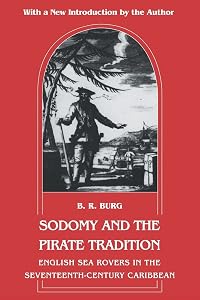
Sodomy and the Pirate Tradition
by B. R. Burg
On This Page
Description
Pirates are among the most heavily romanticized and fabled characters in history. From Bluebeard to Captain Hook, they have been the subject of countless movies, books, children's tales, even a world-famous amusement park ride. In Sodomy and the Pirate Tradition, historian B. R. Burg investigates the social and sexual world of these sea rovers, a tightly bound brotherhood of men engaged in almost constant warfare. What, he asks, did these men, often on the high seas for years at a time, do show more for sexual fulfillment? Buccaneer sexuality differed widely from that of other all- male institutions such as prisons, for it existed not within a regimented structure of rule, regulations, and oppressive supervision, but instead operated in a society in which widespread toleration of homosexuality was the norm and conditions encouraged its practice. In his new introduction, Burg discusses the initial response to the book when it was published in 1983 and how our perspectives on all-male societies have since changed. show lessTags
Recommendations
































Member Recommendations
by anonymous user, fugitive
Member Reviews
Quite an interesting survey of buccaneer sexuality, touching upon many subjects—English legal codes, the evolving Western perception of sodomy, British island colonialism, masculinity, Restoration class structure—as it examines the sociosexual practises of freebooters in the West Indies circa 1640.
Worth a read if you’re interested in the workings of specific insular communities throughout history, how they adapt to unique stressors, and what daily life was like for a terror of the high seas.
Worth a read if you’re interested in the workings of specific insular communities throughout history, how they adapt to unique stressors, and what daily life was like for a terror of the high seas.
Despite the racy title (which makes it great fun to place on a shoulder-high shelf to watch for friends double taking), this is a rather dry, very scholarly tome about a subject that had only slightly impinged upon my world and that mostly through off-color jokes -- how DID those savage men on board lonely ships for months at a time spend their long hours? And did they really wear dresses?
This book looks at the conditions in England that lead to the rise of the now famous Caribbean Pirate -- the poverty, the population problems, the short duration of a pre-Victorian, peasant or working-class childhood, and the lack of experience with females and family life many boys and young men experienced. It talks of the press gangs kidnapping men show more and boys for Naval service -- a harsh, often short life of brutal employment.
And, it does cast an interesting light (for those with the proper twisted turn of mind) onto Johnny Depp's Jack Sparrow and Orlando Bloom's William.
It also serves as an interesting bit of historical background to the Aubrey and Maturin novels by [a:Patrick O'Brian|5600|Patrick O'Brian|http://photo.goodreads.com/authors/1212630063p2/5600.jpg]. show less
This book looks at the conditions in England that lead to the rise of the now famous Caribbean Pirate -- the poverty, the population problems, the short duration of a pre-Victorian, peasant or working-class childhood, and the lack of experience with females and family life many boys and young men experienced. It talks of the press gangs kidnapping men show more and boys for Naval service -- a harsh, often short life of brutal employment.
And, it does cast an interesting light (for those with the proper twisted turn of mind) onto Johnny Depp's Jack Sparrow and Orlando Bloom's William.
It also serves as an interesting bit of historical background to the Aubrey and Maturin novels by [a:Patrick O'Brian|5600|Patrick O'Brian|http://photo.goodreads.com/authors/1212630063p2/5600.jpg]. show less
Burg blends social history, anthropology, sociology and psychology to create a speculative account of piratical sexuality. He begins with a discussion of sexual attitudes in the Stuart era, moves along to the circumstances that led men to become pirates, (with particular emphasis on the sexuality demanded by these circumstances), and finishes off with an in-depth discussion of pirate sexuality. It's occasionally quite dry, but it's interesting nonetheless.
Burg has certainly done his research here, and I think he's drawn some likely conclusions. I'm inclined to agree with him in most areas. He's backed his ideas up with plenty of examples and some decent cross-cultural comparisons. My one major complaint is that he's under emphasized the show more speculative nature of his research, and it's impossible to say how much he's ignored in his quest for sources that support his thesis. He occasionally reminds us that there are few primary sources dealing with either homosexuality or piracy during this time period, but he often writes as though he's found enough evidence to fully substantiate his claims. He hasn't. He's done an excellent job of dealing with those few primary sources we do have, but his conclusions are entirely his own. And I can't provide any concrete proof here, but I believe there may be some areas where he's ignored particular facts that may have undermined his thesis.
Still, this is most definitely worth reading if you have any interest in either pirates or LGBT studies. The interdisciplinary nature of Burg's research makes it suitable for scholars from a number of different subject areas, and it's readable enough that even nonacademics should find it fairly accessible.
(A slightly different version of this review originally appeared on my blog, Stella Matutina). show less
Burg has certainly done his research here, and I think he's drawn some likely conclusions. I'm inclined to agree with him in most areas. He's backed his ideas up with plenty of examples and some decent cross-cultural comparisons. My one major complaint is that he's under emphasized the show more speculative nature of his research, and it's impossible to say how much he's ignored in his quest for sources that support his thesis. He occasionally reminds us that there are few primary sources dealing with either homosexuality or piracy during this time period, but he often writes as though he's found enough evidence to fully substantiate his claims. He hasn't. He's done an excellent job of dealing with those few primary sources we do have, but his conclusions are entirely his own. And I can't provide any concrete proof here, but I believe there may be some areas where he's ignored particular facts that may have undermined his thesis.
Still, this is most definitely worth reading if you have any interest in either pirates or LGBT studies. The interdisciplinary nature of Burg's research makes it suitable for scholars from a number of different subject areas, and it's readable enough that even nonacademics should find it fairly accessible.
(A slightly different version of this review originally appeared on my blog, Stella Matutina). show less
With a title like this, how can you NOT buy it? This is actually a serious scholarly work on the subject of homosexuality and pirates (duh). There's a lot of conjecture, but the author (a historian) backs it up with a lot of fascinating detail. Recommended for both fans of pirates AND sodomy!
Ratings
Members
- Recently Added By
Author Information
7 Works 382 Members
B. R. Burg is Professor of History at Arizona State University, USA.
Common Knowledge
- Canonical title
- Sodomy and the Pirate Tradition
- Alternate titles
- Sodomy and the Perception of Evil: English Sea Rovers in the Seventeenth-Century Caribbean
- Original publication date
- 1995-01-31
- People/Characters
- Arnold Joose Van Kepple; John Atherton; John Avery; Francis Bacon; Captain Bannister; Richard Barnfield (show all 172); William Batten; William Beeston; Sam Bellamy aka Black Sam; Nicholas Bernard; William Betagh; Irving Bieber; Alan P. Bell; Bartholomew Roberts; Edward Teach; Richard Blome; Thomas Blood; Stede Bonnet; Robert Bradenham; Roc Brasiliano; George Villiers, 1st Duke of Buckingham; John Bunyan; Mervin Touchet, 2nd Earl of Castlehaven; Charles Howard, 1st Earl of Carlisle; Elizabeth Cellier; King Charles I; King Charles II; Colley Cibber; Captain Cockram; Edward Coke; Richard Cornish; Council of Trade and Plantations; John Aubrey; William Wycherley; William A. Cowley; John Coxon; Richard Crompton; Henry Cromwell; Oliver Cromwell; Richard Cromwell; John Crown; George Cusak; William Dampier; Thomas Dangerfield; Thomas Dekker; John Dennis; Francis Dilly; Bertrand D'Ogerton; George Dowdeny; Francis Drake; John Durrant; William Lambarde; Queen Elizabeth I; Edward England; George Ethrege; John Evans; John Evelyn; Alexander O. Exquemelin; George Farquhar; Celia Fiennes; John White; Anthony Fitzherbert; Lionel Gatford; Erving Goffman; Thomas Handasyd; Thomas Harmon; Sarah Harwood; Elias Hasket; Margaret Heathcote; King Henry VIII; Robert Hewett; Thomas Hill; William Prynne; John Hockenhull; William Holdbrook; Evelyn Hooker; Laud Humphreys; Christopher Isherwood; King James I; King James II; Christopher Jeaffreson; Charles Johnson; Henry Johnson; John Johnston; William Kidd; Thomas Killigrew; Gregory King; Richard Kingston; Kights Templar; Jean-Baptisy Labat; William Lambarde; George Larkin; Louis Adhemar Timothée Le Golif; Richard Ligon; Gardner Lindzey; François l'Olonnais; Edward Ravenscroft; Edward Low; George Lowther; Narcissus Luttrell; Thomas Lynch; Dennis Macarty; Joseph Mennes; Brian Miller; Hender Molesworth; Thomas Morris; Henry Morgan; Tomas Modyford; George Monck; James Scott, 1st Duke of Monmouth; Jean-Davis Nau; Samuel Norman; Titus Oates; Samuel Organ; Thomas Pendrill; William Penn; Samuel Pepys; John Phillips; John Bunyan; John Powell; William Prynne; John Quelch; Edward Randolph; Edward Ravenscroft; Abdul Rhyme; Captain Rigby; Basil Ringrose; John Wilmot; Woodes Rogers; Royal Navy; Earl of Strafford; Captain Sawkins; Alexander Selkirk; Charles Sedley; Thomas Shadwell; Society for the Reformation of Manners; John Starr; Bartolomew Sharp; Lawrence Stone; Lord Stafford; Richard Simpson; George Shelvocke; Nicholas Sension; Matthew Stuart; Charles Johnson; Harry Stack Sullivan; Charles Swan; Henry Teonge; Dalby Thomas; Ensign Thorne; John Thurlow; Nicholas Trott; Randolph Trumback; Nicholas Udall; John Vanbrugh; Charles Vane; Nicholas Vanhorn; John Vaughn; Robert Venables; George Villiers; Thomas Shadwell; Thomas Walduck; John Atherton; John Watling; Martin S. Weinberg; D.J. West; John White; King William III; John Wilmot; John Winthrop; John Winthrop, Jr.; William Wycherly
- Important places
- Antigua; Bahamas; Barbados; Bermuda; Cape Horn, Chile; Cartagena, Colombia (show all 35); Church of England; Havana, Cuba; Hispaniola; House of Lords; Indian Ocean; Isthmus of Panama; Jamaica; Jamestown, Virginia; Leeward Islands; Maracaibo, Venezuela; Maryland, USA; Massachusetts Bay Colony, USA; Montserrat; Nevis; New Providence; Panama; Plymouth Colony, USA; Guilford, Connecticut, USA; Porto Bello, Panama; Port Royal; Isla de Providencia, Colombia; Saint Christopher; Sint Eustatius; Saint Thomas; Straits of Magellan; Surinam; Tortuga; Virginia, USA; Virgin Islands
- Important events
- 16th century; 17th century; 19th century; Gay Liberation Movement; Popish Plot; Treaty of Ryswich
- Epigraph
- "No interviews!" the pirate cried. "Especially no interviews granted to little girls."
-Donald Barthelme - Dedication
- To Bill Camwell and Alice Watterson
- Original language
- English
Classifications
- Genres
- Nonfiction, History, LGBTQ+, General Nonfiction, Sexuality and Gender Studies
- DDC/MDS
- 305.38 — Society, government, & culture Social sciences, sociology & anthropology Social group - Age, Gender, Ethnicity People by gender or sex Specific groups of men
- LCC
- HQ76.2 .C27 .B87 — Social sciences The family. Marriage, Women and Sexuality The Family. Marriage. Women Sexual life Homosexuality. Lesbianism
- BISAC
Statistics
- Members
- 269
- Popularity
- 120,051
- Reviews
- 6
- Rating
- (3.60)
- Languages
- English, Italian
- Media
- Paper, Ebook
- ISBNs
- 11
- ASINs
- 6