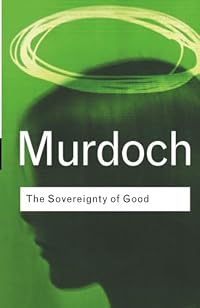
The Sovereignty of Good
by Iris Murdoch 
On This Page
Description
Iris Murdoch once observed: 'philosophy is often a matter of finding occasions on which to say the obvious'. What was obvious to Murdoch, and to all those who read her work, is that Good transcends everything, even God. Throughout her distinguished and prolific writing career, she explored questions of Good and Bad, myth and morality. The framework for Murdoch's questions, and her own conclusions, can be found here. Iris Murdoch was one of the great philosophers and novelists of the show more twentieth century and The Sovereignty of Good is her most important and enduring philosophical work. She argues that philosophy has focused, mistakenly, on what is right to do rather than what is good to be, and that only restoring the notion of 'vision' to moral thinking can this distortion be corrected. This brilliant work shows why Iris Murdoch remains essential reading: a vivid and uncompromising style, a commitment to foreful argument, and a courage to go against the grain. The Sovereignty of Good is masterfully narrated by Daisy-May Parsons. show lessTags
Recommendations











Member Reviews
“We use our imagination not to escape the world but to join it” (88).
This volume is a collection of three philosophical papers by Iris Murdoch in which she lays the foundation for her concept of “moral vision,” a cultivated way of looking at the world without filtering it through the self. A significant part of the problem, as Murdoch sees it, is our attention to “will” as a lens through which we see reality in light of our desires and as a world of potential defined in terms of our motivated, utilitarian outlooks. If you have read The Sea, The Sea you will instantly recognize a dramatization of this affliction in the main character, Charles Arrowby. This kind of intentional way of seeing the world is not apprehension but is show more instead an imposition of the self on the world through which we make the world ready to hand for us. There are all kinds of moral implications that follow from this, not the least of which is the failure to appreciate others as agents in their own rights and struggling toward their own ends.
The antidote to a “will” based view on the world is to cultivate “attention,” which Murdoch likens to a “loving gaze” on the world in which we seek the perfect that is imperfectly reflected to us in the world. For some, the focal point of “attention” is God (as it was to Simone Weil from whom Murdoch borrows the concept). For Murdoch it will be art. It is through attention that we bracket off all of the biased, situated, self-centered, and motivated ways of seeing a person or idea or thing and try to comprehend a reflection of the thing in itself, what it is without being articulated in a web of motives and desires.
One of the ways that we cultivate this gaze is through art, which when done well gives a glimpse of the ideal, visible around the edges and that comes into greater (but still imperfect) focus through skilled iteration done with humility and honesty. I like the idea of thinking about this practice as a kind of craft/art that one cultivates, a “techne” as Murdoch borrows from Plato; although, I am less certain of how one approaches the perfect without the focus provided by intent. Perhaps this, too, is part of the honesty of the craft, which is the continual recognition and bracketing of will-full interpretations of the real.
The third essay in the book, “The Sovereignty of Good Over Other Concepts” reads like the most complete articulation of Murdoch’s ideas. And anyone interested in Murdoch’s moral outlook, which she often explores through her characters will find the essay enlightening. show less
This volume is a collection of three philosophical papers by Iris Murdoch in which she lays the foundation for her concept of “moral vision,” a cultivated way of looking at the world without filtering it through the self. A significant part of the problem, as Murdoch sees it, is our attention to “will” as a lens through which we see reality in light of our desires and as a world of potential defined in terms of our motivated, utilitarian outlooks. If you have read The Sea, The Sea you will instantly recognize a dramatization of this affliction in the main character, Charles Arrowby. This kind of intentional way of seeing the world is not apprehension but is show more instead an imposition of the self on the world through which we make the world ready to hand for us. There are all kinds of moral implications that follow from this, not the least of which is the failure to appreciate others as agents in their own rights and struggling toward their own ends.
The antidote to a “will” based view on the world is to cultivate “attention,” which Murdoch likens to a “loving gaze” on the world in which we seek the perfect that is imperfectly reflected to us in the world. For some, the focal point of “attention” is God (as it was to Simone Weil from whom Murdoch borrows the concept). For Murdoch it will be art. It is through attention that we bracket off all of the biased, situated, self-centered, and motivated ways of seeing a person or idea or thing and try to comprehend a reflection of the thing in itself, what it is without being articulated in a web of motives and desires.
One of the ways that we cultivate this gaze is through art, which when done well gives a glimpse of the ideal, visible around the edges and that comes into greater (but still imperfect) focus through skilled iteration done with humility and honesty. I like the idea of thinking about this practice as a kind of craft/art that one cultivates, a “techne” as Murdoch borrows from Plato; although, I am less certain of how one approaches the perfect without the focus provided by intent. Perhaps this, too, is part of the honesty of the craft, which is the continual recognition and bracketing of will-full interpretations of the real.
The third essay in the book, “The Sovereignty of Good Over Other Concepts” reads like the most complete articulation of Murdoch’s ideas. And anyone interested in Murdoch’s moral outlook, which she often explores through her characters will find the essay enlightening. show less
Iris Murdoch, following G.E.M. Anscombe’s foundational 1958 critique of modern moral theories, refines and narrows the critique to address the specific problem of the ideal moral agent in The Sovereignty of Good (1970). She critiques the formulation of the moral exemplar as a generic, abstract, independent, rational, and emotionally neutral being who creates value exclusively by fiat of will. While she begins with Kant’s infamously formal view of moral agency, she finds these problems to be present in traditions as diverse as British analytic philosophy and Existentialism. In all cases, the agent allegedly creates value for himself, rather than recognizing, discovering, or responding to value as a potentially given feature of our show more place in the world.
Murdoch unpacks Anscombe’s call for an adequate psychological account of ethics by focusing on moral perception, specifically how an accurate view of the world requires an attention to it that is already invested in seeing it for itself, in its particularity--she calls this particularity its “reality” and she calls this attention “love.” Loving, according to Murdoch is an act of “unselfing”: of seeing the other (and the world) from an unselfish, unoccluded perspective. Love, not disinterested reason, offers us the only accurate picture of reality.
According to Murdoch, understanding ethics as a way of perceiving requires “the liberation of morality, and of philosophy as a study of human nature, from the domination of science: or rather from the domination of inexact ideas of science which haunt philosophers and other thinkers.”(26) The worst of these ‘inexact ideas’ is the idea that morality has access to objective facts that can be impartially and “empirically” relied upon for moral judgment. How we evaluate any given moral situation is ineliminably a product of one’s own perspective--the “facts” of a moral situation are already judgments. There is no impersonal perspective to occupy when we perceive our moral lives, and therefore neither the facts nor judgments of morality can conform to the requirements of scientific objectivity and impartiality.
While these concerns may appear abstract and theoretical, Murdoch illustrates their everyday relevance through a detailed example of the moral difficulties of a mother (M) who disapproves of her daughter-in-law (D), and undertakes the moral work of changing her perception of D. Murdoch provides many possible accounts of M’s motivation to see D in a favorable light, ranging from the self-interested desire to simply abide D’s intrusion in her life to the moral desire to see D fairly and honestly. From the outside, M appears no different, despite her change in moral perspective. While modern moral theories dispute the value of inner life in favor of concrete action, Murdoch wants to say what M has done is a morally commendable act of loving, and that she has in fact undergone a significant change that needs to be recognized by moral philosophers. show less
Murdoch unpacks Anscombe’s call for an adequate psychological account of ethics by focusing on moral perception, specifically how an accurate view of the world requires an attention to it that is already invested in seeing it for itself, in its particularity--she calls this particularity its “reality” and she calls this attention “love.” Loving, according to Murdoch is an act of “unselfing”: of seeing the other (and the world) from an unselfish, unoccluded perspective. Love, not disinterested reason, offers us the only accurate picture of reality.
According to Murdoch, understanding ethics as a way of perceiving requires “the liberation of morality, and of philosophy as a study of human nature, from the domination of science: or rather from the domination of inexact ideas of science which haunt philosophers and other thinkers.”(26) The worst of these ‘inexact ideas’ is the idea that morality has access to objective facts that can be impartially and “empirically” relied upon for moral judgment. How we evaluate any given moral situation is ineliminably a product of one’s own perspective--the “facts” of a moral situation are already judgments. There is no impersonal perspective to occupy when we perceive our moral lives, and therefore neither the facts nor judgments of morality can conform to the requirements of scientific objectivity and impartiality.
While these concerns may appear abstract and theoretical, Murdoch illustrates their everyday relevance through a detailed example of the moral difficulties of a mother (M) who disapproves of her daughter-in-law (D), and undertakes the moral work of changing her perception of D. Murdoch provides many possible accounts of M’s motivation to see D in a favorable light, ranging from the self-interested desire to simply abide D’s intrusion in her life to the moral desire to see D fairly and honestly. From the outside, M appears no different, despite her change in moral perspective. While modern moral theories dispute the value of inner life in favor of concrete action, Murdoch wants to say what M has done is a morally commendable act of loving, and that she has in fact undergone a significant change that needs to be recognized by moral philosophers. show less
In three essays, Murdoch challenges the prevailing view in moral philosophy. This she describes as the Kantian / Existentialist world view, where moral choices are made by a free agent who comes to a dispassionate view of the situation, sets out the options available, then chooses from among these after much consideration and thought, thereby expressing their personal moral character. Murdoch challenges the tenets of this view, and introduces a new framework of moral philosophy here that provides an appealing alternative, with a focus not on the moment of choice, but on the use of attention of the moral agent.
In this system the description of the situation (the moral problem) is coloured by the personal history, limited knowledge, show more biases, prejudices, and perhaps ignorance of the moral agent, and this results in a default choice among the available alternatives that is more or less unavoidable given their understanding / framing of the moral situation. Here, the moral burden is placed on the agent in their use of attention. If they attend to the situation, and strive to understand it properly, give it dispassionate attention with the aim of understanding it correctly and without prejudice, then this will result in their having enough information available so that a just action will naturally result. Where the agent does not give attention to understanding the situation, for example if their focus of attention is influenced by ego, or prejudice, or laziness, or no desire to see the truth, then what results is an inaccurate framing of the situation, and thus often a morally bad choice results. This also brings in the role of language, the language we use in our head perhaps, or that we hear from other people discussing a situation. Words are always value-laden, and a situation can often just as accurately be described in words with negative affect, or that carry derogatory connotations, as those with positive overtones, or that are psychologically neutral.
Murdoch then builds upon this system to claim that what drives attention to the truth of reality is Love. Love is central here in the moral agent's use of attention, and Murdoch supports this with some resurrection of Plato's ideas on this topic. Hence Love becomes the path toward right action, and she restores its central position in philosophy to the prominence it once held under Plato.
Overall this is a very stimulating group of essays that present a coherent and plausible alternative to the predominant view of moral philosophy. They are clear and easily readable, with helpful illustrations. As a work of moral philosophy this is original and productive in its explanations within the sphere of moral philosophy. show less
In this system the description of the situation (the moral problem) is coloured by the personal history, limited knowledge, show more biases, prejudices, and perhaps ignorance of the moral agent, and this results in a default choice among the available alternatives that is more or less unavoidable given their understanding / framing of the moral situation. Here, the moral burden is placed on the agent in their use of attention. If they attend to the situation, and strive to understand it properly, give it dispassionate attention with the aim of understanding it correctly and without prejudice, then this will result in their having enough information available so that a just action will naturally result. Where the agent does not give attention to understanding the situation, for example if their focus of attention is influenced by ego, or prejudice, or laziness, or no desire to see the truth, then what results is an inaccurate framing of the situation, and thus often a morally bad choice results. This also brings in the role of language, the language we use in our head perhaps, or that we hear from other people discussing a situation. Words are always value-laden, and a situation can often just as accurately be described in words with negative affect, or that carry derogatory connotations, as those with positive overtones, or that are psychologically neutral.
Murdoch then builds upon this system to claim that what drives attention to the truth of reality is Love. Love is central here in the moral agent's use of attention, and Murdoch supports this with some resurrection of Plato's ideas on this topic. Hence Love becomes the path toward right action, and she restores its central position in philosophy to the prominence it once held under Plato.
Overall this is a very stimulating group of essays that present a coherent and plausible alternative to the predominant view of moral philosophy. They are clear and easily readable, with helpful illustrations. As a work of moral philosophy this is original and productive in its explanations within the sphere of moral philosophy. show less
The nature of goodness is an issue today in the writings of Iris Murdoch. The Sovereignty of Good includes three essays by her. In reading her essay, "The Sovereignty of Good over other concepts", I found her returning to the allegory of the cave and the metaphor of the Sun that I first read in Plato. Murdoch claims that "'Good is a transcendent reality' means that virtue is the attempt to pierce the veil of selfish consciousness and join the world as it really is." (p 91) For Murdoch this is a claim that Art is the way that humans can reach this unity in that,
"The mind which has ascended to the vision of the Good can subsequently see concepts through which it has ascended (art, work, nature, people, ideas, institutions, situations, show more etc.) in their true nature and in their proper relationships to each other." (p 92)
The discussion of the good by Iris Murdoch reconsiders this and other themes found in Marcus Aurelius and Plato. It is a difficult but worthwhile read. show less
"The mind which has ascended to the vision of the Good can subsequently see concepts through which it has ascended (art, work, nature, people, ideas, institutions, situations, show more etc.) in their true nature and in their proper relationships to each other." (p 92)
The discussion of the good by Iris Murdoch reconsiders this and other themes found in Marcus Aurelius and Plato. It is a difficult but worthwhile read. show less
A collection of 3 essays that starts out with the toughest going. This is a book that I expect to re-read because it is both so insightful and sums up so much.
This short volume of Murdoch's moral philosophy is, in many ways, an important key to interpreting her work and ideas.
Iris Murdoch argues that morality and the quest for Good is missing from modern philosophy.
Members
- Recently Added By
Lists

Filosofía - Clásicos
217 works; 1 member

Art of Reading
188 works; 5 members

Little philosophical challang
4 works; 1 member

Better for Who?
11 works; 1 member

What is morality?
12 works; 1 member

In Our Time books
4,934 works; 2 members
Author Information

97+ Works 29,200 Members
Iris Murdoch was one of the twentieth century's most prominent novelists, winner of the Booker Prize for The Sea. She died in 1999. (Publisher Provided) Iris Murdoch was born in Dublin, Ireland on July 15, 1919. She was educated at Badminton School in Bristol and Oxford University, where she read classics, ancient history, and philosophy. After show more several government jobs, she returned to academic life, studying philosophy at Newnham College, Cambridge. In 1948, she became a fellow and tutor at St. Anne's College, Oxford. She also taught at the Royal College of Art in London. A professional philosopher, she began writing novels as a hobby, but quickly established herself as a genuine literary talent. She wrote over 25 novels during her lifetime including Under the Net, A Severed Head, The Unicorn, and Of the Nice and the Good. She won several awards including the James Tait Black Memorial Prize for The Black Prince in 1973 and the Booker Prize for The Sea, The Sea in 1978. She died on February 8, 1999 at the age of 79. (Bowker Author Biography) show less
Iris Murdoch has a Legacy Library. Legacy libraries are the personal libraries of famous readers, entered by LibraryThing members from the Legacy Libraries group.
Some Editions
Awards and Honors
Awards
Notable Lists
Series
Belongs to Publisher Series
Common Knowledge
- Original publication date
- 1970
- Dedication
- To Stuart Hampshire
- First words
- It is sometimes said, either irritably or with a certain satisfaction, that philosophy makes no progress.
- Last words
- (Click to show. Warning: May contain spoilers.)And although he is not by definition the good man perhaps he is the kind of man who is most likely of all to become good.
- Blurbers
- Jarrett-Kerr, Martin; Quinton, Anthony
- Canonical DDC/MDS
- 170
Classifications
Statistics
- Members
- 646
- Popularity
- 44,623
- Reviews
- 9
- Rating
- (3.95)
- Languages
- 8 — Dutch, English, French, German, Japanese, Portuguese, Spanish, Turkish
- Media
- Paper, Audiobook, Ebook
- ISBNs
- 30
- ASINs
- 12