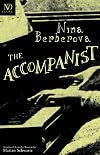
The Accompanist
by Nina Berberova
On This Page
Description
A spellbinding short novel set in post-revolutionary Russia about a young girl's jealousy. The fifth book of Nina Berberova to be published by New Directions,The Accompanist, written in 1936, proved to be a literary phenomenon in Europe where it was first published. A spellbinding, short novel set in post-revolutionary RussiaThe Accompanist portrays with extraordinary sensitivity the entangled relationships of three intriguing characters. Sonechka is a talented but shy young pianist hired by show more a beautiful soprano (Maria Nikolaevna) and her devoted, bourgeois husband. Maria is everything Sonechka is notglamorous and flamboyant. Her voice brings with it "something immortal and indisputable, something which gives reality to the human being's dream of having wings." Doomed to live in her mentor's shadow, the young girl secretly schemes to expose the singer's infidelities. But as she awaits her chance, the diva's husband takes matters into his own hands, bringing events to a surprising resolution. This intense and beautiful little novel was published in America almost fifty years after it was written; sadly out of print for a number of years, it is a wonderfully compelling and crucial addition to Nina Berberova's growing number of published fictional works. show lessTags
Recommendations



































Member Reviews
Nina Berberova seems, sadly, to have become a largely forgotten writer. Born in St. Petersburg in 1901, she left in 1922, eventually settling in Paris where she became an editor at two different émigré literary journals. She wrote several novels but is better known for her short stories; her works are particularly known for addressing the lives of exiles. She moved to the United States in 1950 where she taught at two major universities (Yale and Princeton); she died in 1993. The Accompanist is a novella about the complicated relationship between Maria, a beautiful and ambitious soprano, her bourgeois husband, and the plain young woman who becomes her accompanist and lives in the shadow of her employer’s achievements. Indeed, show more Sonechka, the accompanist, was destined for some such life. Born an illegitimate child of a spinster piano teacher, ashamed of her background and upbringing, Sonechka’s hope of making a living as a pianist is destroyed by the 1918 revolution. She becomes the accompanist of the title, traveling first to Moscow and then Paris as the soprano’s career takes off. Sonechka hates (and loves) her mistress, a conflict that tempts her to tell Maria’s hisband about her infidelities, a way of damaging Maria’s otherwise flawless life. But before she can act, Maria’s husband acts, leading to a wholly unexpected conclusion. Berberova’s portrayal of the life of exiles is wonderful; her depiction of her characters somewhat less so. Sonechka’s life is boring but sadly, I found it difficult if not impossible to sympathize with her, an obstacle that made the novella less than successful for me. That said, The Accompanist was enormously popular in Europe and very well reviewed in the USA as well. A fascinating view of a lost world but not enough to convince me of Berberova’s talent. show less
If Dostoevsky’s Crime and Punishment could have a sister, it would be The Accompanist by Nina Berberova. Written in 1936 while Berberova lived in France, this slim volume’s Raskolnikov is Sonechka, a young poverty-stricken pianist who finds work as an accompanist to a glamorous soprano. Sonechka is alternately enraptured and repulsed by her employer, Maria Nikolaevna. Soon she plots her course:
“I have to earn it [Maria’s trust], deserve it, so that later, when the time comes, out of the blue, I can shield her from some misfortune, rescue her suddenly, serve her so slavishly that she doesn’t even know it’s me. I have to make myself indispensable, irreplaceable, utterly faithful, without a thought for myself … Or else some show more day betray her, all her beauty and her voice, just to prove that there are things more powerful than she, that there are things that can make her cry, that there is a limit to her invincibility.”
Sonechka escapes Bolshevik Russia with Maria and her husband and ultimately lands in Paris where Maria finally pursues her vocal artistry to great acclaim. Though Sonechka’s belly is no longer empty and her clothes are finer, she continues to watch for her chance to bring down Maria. The appearance of a mysterious man from Maria’s past presents Sonechka with her opportunity. Ultimately, the ending twists and surprises and Sonechka’s tale becomes one of “be careful what you wish for …” Even Dostoevsky would approve of Berberova’s sensitive portrait of Sonechka’s life and her moral dilemmas. The Accompanist is a long-buried gem happily unearthed.
(This review can also be found on my blog at http://karenvanuska.livejournal.com/21632.html) show less
“I have to earn it [Maria’s trust], deserve it, so that later, when the time comes, out of the blue, I can shield her from some misfortune, rescue her suddenly, serve her so slavishly that she doesn’t even know it’s me. I have to make myself indispensable, irreplaceable, utterly faithful, without a thought for myself … Or else some show more day betray her, all her beauty and her voice, just to prove that there are things more powerful than she, that there are things that can make her cry, that there is a limit to her invincibility.”
Sonechka escapes Bolshevik Russia with Maria and her husband and ultimately lands in Paris where Maria finally pursues her vocal artistry to great acclaim. Though Sonechka’s belly is no longer empty and her clothes are finer, she continues to watch for her chance to bring down Maria. The appearance of a mysterious man from Maria’s past presents Sonechka with her opportunity. Ultimately, the ending twists and surprises and Sonechka’s tale becomes one of “be careful what you wish for …” Even Dostoevsky would approve of Berberova’s sensitive portrait of Sonechka’s life and her moral dilemmas. The Accompanist is a long-buried gem happily unearthed.
(This review can also be found on my blog at http://karenvanuska.livejournal.com/21632.html) show less
Subservience, resentment, jealousy and infidelity are central to this poignantly tragic Russian novella. The Accompanist is a realist tale with the spirit of Balzac.
Poignant tale of a melancholy Russian woman pianist who lives in the shadow of the passionate diva who employs her. More a long short story than a novel, "The Accompanist" is set in chaotic Russia following the 1917 revolution, and in a gray and wintry interwar Paris.
"The Accompanist" was originally written in Russian by emigré Nina Berberova (1901-1993) in 1936. The text was neglected for many years, then was translated and published first in French, then English, in the late 1980s.
"The Accompanist" was originally written in Russian by emigré Nina Berberova (1901-1993) in 1936. The text was neglected for many years, then was translated and published first in French, then English, in the late 1980s.
Non ho capito bene l'intento dell'autrice perchè il significato di questo romanzetto resta per me un po' sospeso.
Le premesse sono classiche: una ragazza di umilissime origini non propriamente bella ma musicalmente dotata, diventa l'accompagnatrice col pianoforte di una bellissima e famosa cantante. Presto in lei si genererà un ambiguo sentimento di invidia e di ammirazione che non sarà in grado di gestire anche per via dei conflitti irrisolti con la madre e del suo risentimento verso il genere umano.
L'analisi psicologica del personaggio di Sonečka non mi è dispiaciuta, quello che ho trovato poco originale è la storia e il finale un po' scontato che avrei preferito venisse sviluppato meglio.
Un libro veloce che conferma le mie show more difficoltà con la scrittura russa... show less
Le premesse sono classiche: una ragazza di umilissime origini non propriamente bella ma musicalmente dotata, diventa l'accompagnatrice col pianoforte di una bellissima e famosa cantante. Presto in lei si genererà un ambiguo sentimento di invidia e di ammirazione che non sarà in grado di gestire anche per via dei conflitti irrisolti con la madre e del suo risentimento verso il genere umano.
L'analisi psicologica del personaggio di Sonečka non mi è dispiaciuta, quello che ho trovato poco originale è la storia e il finale un po' scontato che avrei preferito venisse sviluppato meglio.
Un libro veloce che conferma le mie show more difficoltà con la scrittura russa... show less
The inner conflicts of a russian émigré pianist working for a famous lirical singer, and their friendship-envy-hate relationship amid the lonelyness of exile life in 1920s Paris. When this novel was first published in french translation, in 1985, it achieved for the author instant (although, considering she was born in 1901, rather belated) recognition as one of the greaters russian writers of the century.
wonderful film with lovely singing, including nuits d'ete by Berlioz
Members
- Recently Added By
Lists

Top Five Books of 2016
795 works; 228 members
Author Information

81+ Works 1,941 Members
Born in 1901 in pre-Revolutionary St. Petersburg, Russia, Nina Berberova emigrated in 1922, living in several European countries before settling in the United States. She wrote frequently for the leading journals and anthologies of the first wave of the Russian emigration. The Italics Are Mine (1969), her autobiography, is an important record of show more that period. (Bowker Author Biography) show less
Some Editions
Series
Belongs to Publisher Series
Work Relationships
Common Knowledge
- Canonical title
- The Accompanist
- Original title
- Аккомпаниаторша
- Original publication date
- 1935
- Original language*
- Ruso
*Some information comes from Common Knowledge in other languages. Click "Edit" for more information.
Classifications
- Genres
- Fiction and Literature, General Fiction
- DDC/MDS
- 891.73 — Literature & rhetoric Literatures of other languages East Indo-European and Celtic literatures Russian and East Slavic languages Russian fiction
- LCC
- PG3476 .B425 .A63 — Language and Literature Slavic languages and literatures. Baltic languages. Albanian language Slavic. Baltic. Albanian Russian literature Individual authors and works 1917-1960
- BISAC
Statistics
- Members
- 298
- Popularity
- 107,607
- Reviews
- 9
- Rating
- (3.52)
- Languages
- 16 — Catalan, Danish, Dutch, English, Finnish, French, German, Icelandic, Italian, Norwegian (Bokmål), Portuguese, Romanian, Russian, Spanish, Swedish, Turkish
- Media
- Paper, Audiobook, Ebook
- ISBNs
- 37
- ASINs
- 5