On This Page
Description
Coursing through Austerity Britain is an astonishing variety of voices - vivid, unselfconscious, and unaware of what the future holds. A Chingford housewife endures the tribulations of rationing; a retired schoolteacher observes during a royal visit how well-fed the Queen looks; a pernickety civil servant in Bristol is oblivious to anyone's troubles but his own. An array of working-class witnesses describe how life in post-war Britain is, with little regard for liberal niceties or the show more feelings of their 'betters'. Many of these voices will stay with the reader in future volumes, jostling alongside well-known figures like John Arlott (here making his first radio broadcast, still in police uniform), Glenda Jackson (taking the 11+) and Doris Lessing (newly arrived from Africa, struck by the levelling of poverty of post-war Britain. David Kynaston weaves a sophisticated narrative of how the victorious 1945 Labour government shaped the political, economic and social landscape for the next three decades. Deeply researched, often amusing and always intensely entertaining and readable, the first volume of David Kynaston's ambitious history offers an entirely fresh perspective on Britain during those six momentous years. show lessTags
Recommendations
















Member Reviews
Whew! Six weeks and 692 pages after cracking it open, I finally turned the last page in this history of Britain in the years immediately following World War II. The first word that comes to mind is NOT "exhausting" — rather it's "fascinating". As long as it took to read, I was sorry to see it end, and you can't say that about every 600-page book you read!
I was completely absorbed in Kynaston's meticulously detailed and annotated social history. He draws on public records, contemporaneous media reports, and most of all the personal diaries of scads of ordinary and not-so-ordinary Britons to lay bare not only the facts of what happened, when, and by whom, but how people from all walks of life felt and coped with it. Now and then I show more spotted the name of a Brit who was unknown then and has since become famous, but I suspect I missed a number that would have been recognizable to their fellow countrymen. One that I didn't miss sent a bit of a chill up my spine, as Kynaston scatters without fanfare a few informational nuggets about an unsuccessful young Tory politician named Margaret Roberts, who had yet to marry her eventual husband, Denis Thatcher. We've all seen how that movie ends.
The beauty of Kynaston's approach of mining personal diaries for information is the sheer depth and breadth of his depiction of the era's impact on the people of Great Britain. Even though I consider myself a history junkie I confess I had no idea how seriously difficult the country's economic situation was once VE- and VJ-Day had come and gone. Anecdotes about massive housing shortages, the continuing rationing of just about every household good you can imagine, and mandatory electrical blackouts for hours every day to conserve energy took a tremendous toll on the quality of people's physical and emotional lives. Despite the landslide victory by the Labour Party in 1945, the government struggled to implement democratic socialist policies that were meant to ease the post-war pain and jump-start the economy. Kynaston does a good job of laying out the reasons for their only sporadic success. (The one program that was popular from the start was the National Health Service, which this American read about with wistful envy.)
The only blemish keeping this from being a 5-star book for me might not be a factor for others: The book is clearly written for a British audience, and Kynaston tosses out names of sports teams and players, radio and television programmes and actors with little or no context. More than once he related an anecdote about a big crowd at some sporting event or other without specifying what sport he was talking about. I'm sure to Britons it's all perfectly clear, but I felt a bit at sea with these pop-culture and other insular references.
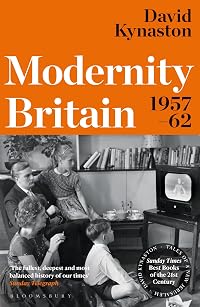
There are two further books (so far) in this historical series, [Family Britain: 1951-57] and [Modernity Britain 1957-62]. I believe Kynaston intends to take the series up to Thatcher's ascension to prime minister in 1979. I'm already on the lookout for a reasonably priced ebook of the next, as I can't imagine not continuing to learn more about this utterly fascinating topic. show less
I was completely absorbed in Kynaston's meticulously detailed and annotated social history. He draws on public records, contemporaneous media reports, and most of all the personal diaries of scads of ordinary and not-so-ordinary Britons to lay bare not only the facts of what happened, when, and by whom, but how people from all walks of life felt and coped with it. Now and then I show more spotted the name of a Brit who was unknown then and has since become famous, but I suspect I missed a number that would have been recognizable to their fellow countrymen. One that I didn't miss sent a bit of a chill up my spine, as Kynaston scatters without fanfare a few informational nuggets about an unsuccessful young Tory politician named Margaret Roberts, who had yet to marry her eventual husband, Denis Thatcher. We've all seen how that movie ends.
The beauty of Kynaston's approach of mining personal diaries for information is the sheer depth and breadth of his depiction of the era's impact on the people of Great Britain. Even though I consider myself a history junkie I confess I had no idea how seriously difficult the country's economic situation was once VE- and VJ-Day had come and gone. Anecdotes about massive housing shortages, the continuing rationing of just about every household good you can imagine, and mandatory electrical blackouts for hours every day to conserve energy took a tremendous toll on the quality of people's physical and emotional lives. Despite the landslide victory by the Labour Party in 1945, the government struggled to implement democratic socialist policies that were meant to ease the post-war pain and jump-start the economy. Kynaston does a good job of laying out the reasons for their only sporadic success. (The one program that was popular from the start was the National Health Service, which this American read about with wistful envy.)
The only blemish keeping this from being a 5-star book for me might not be a factor for others: The book is clearly written for a British audience, and Kynaston tosses out names of sports teams and players, radio and television programmes and actors with little or no context. More than once he related an anecdote about a big crowd at some sporting event or other without specifying what sport he was talking about. I'm sure to Britons it's all perfectly clear, but I felt a bit at sea with these pop-culture and other insular references.
There are two further books (so far) in this historical series, [Family Britain: 1951-57] and [Modernity Britain 1957-62]. I believe Kynaston intends to take the series up to Thatcher's ascension to prime minister in 1979. I'm already on the lookout for a reasonably priced ebook of the next, as I can't imagine not continuing to learn more about this utterly fascinating topic. show less
David Kynaston begins his book, the first of a planned multi-volume survey of Britain, on a high note by chronicling the celebrations of V-E Day. It is a joyous starting point for his ambitious goal, which is to chart the evolution of the nation from the end of the Second World War to the election of Margaret Thatcher's Conservative government in 1979. It is an era that began with the commitment to nationalizing industries and creating the modern welfare state and ended with a government winning power with a promise to undo many of these programs, and Kynaston plans to show how the country developed over this period. This he does by focusing on the people who lived in those times, drawing from the early work of Mass-Observation, show more contemporary press accounts and the private writings of diarists to provide a sprawling portrait of Britain in the late 1940s.
What particularly stands out is how much different the nation was back then. The Britain that emerges from these pages is a nation driven by an industrial economy, with an overwhelmingly white and predominantly male workforce in physically demanding jobs producing a quarter of the world's manufactured goods. The everyday lives of these Britons was different as well, lacking not only the modern conveniences that the author notes early in the text but even many of the basics of prewar life, basics which had been sacrificed to the exigencies of war. Kynaston notes their growing frustration with ongoing scarcity, a frustration that illustrated the gulf between their harsh realities and the idealistic dreams of government planners that is a persistent theme of the book.
Richly detailed, superbly written, and supplemented with excellent photographs, Kynaston's book is an outstanding account of postwar Britain. It offers readers an evocative account of a much different era of British history, yet one with all-too familiar concerns over youth, crime, and an emerging multiracial society. Having devoured its pages, I look forward eagerly to the next installment and the insights Kynaston will offer. show less
What particularly stands out is how much different the nation was back then. The Britain that emerges from these pages is a nation driven by an industrial economy, with an overwhelmingly white and predominantly male workforce in physically demanding jobs producing a quarter of the world's manufactured goods. The everyday lives of these Britons was different as well, lacking not only the modern conveniences that the author notes early in the text but even many of the basics of prewar life, basics which had been sacrificed to the exigencies of war. Kynaston notes their growing frustration with ongoing scarcity, a frustration that illustrated the gulf between their harsh realities and the idealistic dreams of government planners that is a persistent theme of the book.
Richly detailed, superbly written, and supplemented with excellent photographs, Kynaston's book is an outstanding account of postwar Britain. It offers readers an evocative account of a much different era of British history, yet one with all-too familiar concerns over youth, crime, and an emerging multiracial society. Having devoured its pages, I look forward eagerly to the next installment and the insights Kynaston will offer. show less
An absolutely brilliant social/political history of Britain in the first five years after World War II. David Kynaston covers everything from the political skirmishes within the Labor & Tory parties, to who were the outstanding sports figures of the day. In-between he draws a vivid picture of just how hard life was for the average Britain when, instead of being able to enjoy their victory in the war, they were faced with continuing shortages, rationing and sub-standard housing.
This is the first book in a series that is planned to take Britain through the Thatcher years and I, for one, am looking forward to reading his subsequent books.
This is the first book in a series that is planned to take Britain through the Thatcher years and I, for one, am looking forward to reading his subsequent books.
This is a very rich, multi-layered account of life in Britain in the immediate post-war years, covering the years of the reforming Attlee Government, starting from VE day and ending in spring of 1951 just after the death of Ernest Bevin. It covers all aspects: political, economic, social, cultural, sporting, etc. There are many quotes from interviews taking place as part of the wonderful Mass Observation programme, as well as a lot of quotes from other sources, all of which cumulatively show the rich textures of life, the frustrations with austerity and deprivation even after years of peace, mixed with, for many, a real feeling that a marvellous new social direction had been undertaken, with the creation of the NHS and the welfare state show more and a feeling that mass unemployment had been banished forever. It was, in retrospect certainly, an era of ideological certainty and great hope for a better future, though the very granular picture shown in this book demonstrates that, as so often, hindsight oversimplifies the situation and gives to a whole era a plain gloss that masks the contradictions and complexities that always lie beneath. This is the first book of a projected series of six volumes covering the period 1945-79, the period during which the post-war consensus in favour of the welfare state more or less held firm. It promises to be a fascinating ride through this crucial period of modern history. 5/5 show less
https://nwhyte.livejournal.com/2886816.html
I read an greatly enjoyed the second book of this series a couple of years ago; I'm glad to say that the first is just as good, a detailed internal history of England (with a bit of Wales, less Scotland and no Northern Ireland) during basically the term of Attlee's Labour government. Kynaston's sympathy for the detail is tremendously engaging, and humanises a surprisingly alien place and time. There are some imporessive recurrent themes: rationing remained a constant reality (and of course enabled the black market to flourish), with most food remaining rationed until after the period covered in this book. Despite the Labour victory, government remained firmly in the hands of the civil service show more whose upper ranks shared a deep Establishment background - it was the 60s before anyone really challenged this. This was true also of the fledgling BBC, which did not even cover the 1950 World Cup (in which England was famously defeated by the Unites States). Some interesting people pop up again and again - Glenda Jackson and Pete Wyman, promising teenagers; the diarists both obscure (Henry St.John); and well-known (Molly Panter-Downs).
In contrast to the second book in the series, there is plenty of party politics here. The Labour Party, having won power (on the ideas framed by Michael Young, a figure I had forgotten about), successfully created the National Health Service and nationalised the coal mines, and crucially threw its lot in with Truman rather than Stalin. But I was unaware of the role that sudden death played in the politics of the day - Ellen Wilkinson, the Minister of Education, died in 1947, and Ernest Bevin, the Foreign Secretary and the Lord Privy Seal, in 1951. (This just doesn't happen any more. The last British cabinet minister to die in office, of this writing, was Lord Williams of Mostyn in 2003; the last of the same weight as Wilkinson or Bevin was Anthony Crosland in 1977.)
The Labour government's reputation for competence was hit early on by an event for which it bore no responsibility and whose consequences it would have been very difficult for any government to mitigate: the exceptionally cold winter of 1946/47. Six weeks of very cold weather from late January to early March were followed by heavy rain, which added to the thaw to flood towns and countryside. The winter of 1962-63 was colder, but I guess that the country's infrastructure was better able to cope (and it was not immediately followed by heavy rain, as had happened in 1947). The bad weather hit industrial and agricultural productivity very hard, and certainly prolonged rationing and post-war hardship. Kynaston describes all of this vividly but unsentimentally, possibly the best passage of the book.
In summary, well worth reading. show less
I read an greatly enjoyed the second book of this series a couple of years ago; I'm glad to say that the first is just as good, a detailed internal history of England (with a bit of Wales, less Scotland and no Northern Ireland) during basically the term of Attlee's Labour government. Kynaston's sympathy for the detail is tremendously engaging, and humanises a surprisingly alien place and time. There are some imporessive recurrent themes: rationing remained a constant reality (and of course enabled the black market to flourish), with most food remaining rationed until after the period covered in this book. Despite the Labour victory, government remained firmly in the hands of the civil service show more whose upper ranks shared a deep Establishment background - it was the 60s before anyone really challenged this. This was true also of the fledgling BBC, which did not even cover the 1950 World Cup (in which England was famously defeated by the Unites States). Some interesting people pop up again and again - Glenda Jackson and Pete Wyman, promising teenagers; the diarists both obscure (Henry St.John); and well-known (Molly Panter-Downs).
In contrast to the second book in the series, there is plenty of party politics here. The Labour Party, having won power (on the ideas framed by Michael Young, a figure I had forgotten about), successfully created the National Health Service and nationalised the coal mines, and crucially threw its lot in with Truman rather than Stalin. But I was unaware of the role that sudden death played in the politics of the day - Ellen Wilkinson, the Minister of Education, died in 1947, and Ernest Bevin, the Foreign Secretary and the Lord Privy Seal, in 1951. (This just doesn't happen any more. The last British cabinet minister to die in office, of this writing, was Lord Williams of Mostyn in 2003; the last of the same weight as Wilkinson or Bevin was Anthony Crosland in 1977.)
The Labour government's reputation for competence was hit early on by an event for which it bore no responsibility and whose consequences it would have been very difficult for any government to mitigate: the exceptionally cold winter of 1946/47. Six weeks of very cold weather from late January to early March were followed by heavy rain, which added to the thaw to flood towns and countryside. The winter of 1962-63 was colder, but I guess that the country's infrastructure was better able to cope (and it was not immediately followed by heavy rain, as had happened in 1947). The bad weather hit industrial and agricultural productivity very hard, and certainly prolonged rationing and post-war hardship. Kynaston describes all of this vividly but unsentimentally, possibly the best passage of the book.
In summary, well worth reading. show less
Bombed-out and bankrupt, Britain remained a blindly optimistic place in 1945, so much so that it elected a Labour government once the war was done. The British Empire's victory over the Axis powers had been facilitated by an unprecedented expansion of the machinery of the state. The wartime experience of ruthlessly centralised economic planning seemed to have demonstrated the feasibility of the socialist model of societal organisation. Sadly for the elected Attlee government, the transferral of wartime planning to peacetime redevelopment exposed the weakness of their Keynesian model almost immediately. What had worked in an exemplary fashion in the desperate times that had engaged the majority of the population in a united endeavour show more against Nazism, fell to pieces in the hope of liberation from hardship that the war's end engendered. Expecting the fruits of victory, the British populace in fact experienced more of the same economic misery that war had brought, but with added left-wing preaching about how wonderful was the communitarian experiment that Attlee tried to impose. David Kynaston aggregates a remarkably wide array of sources to contrast the grinding frustration and glorious innocence of the period. Sir Cliff Richard's childhood memories of homelessness rub up against Janet Street-Porter's wide-eyed recollections of visiting the nation's first launderettes. Beneath the amusing quotes is an engaging examination of that first socialist government's failure to build enough houses, its failure to sustain a wholly free National Health Service, its surprisingly cack-handed labour relations and its bizarre attachment to the imperial ideals that the Labour Party had spent the 'thirties decrying. It's a remarkably satisfying study of a formative time in British history. show less
David Kynaston takes a very simple, but effective approach, to his social history of Britain in the immediate post war years. He has scanned the newspapers and magazines of the day, read the diaries of the famous and the not so famous, made a lot of use of Mass Observation and the nascent public opinion polling of the day to construct both a people's narrative of 1945 to 1951 but also to explore in more depth issues such as nationalisation, the setting up of the welfare state, women in the workplace, urban planning and reconstruction and others.
All of which makes it highly readable, and one is struck both by the conservatism of British society (even though a reformist, overtly Socialist Labour government was elected to power in 1945) show more and the determination to create social justice (The New Jerusalem of the title) in Britain with scant regard for the situation in Britain's many colonies. Indeed one of the most striking arguments put forward in the book is that an early abandonment of the colonial project and deployment of the resources it took up into trade and industry may have resulted in Britain at least maintaining its pre war position as one of the great powers, rather than standing by as that preeminence gradually dribbled away
If there are any criticisms of this work, it is probably reflects the sources available to Kyanaston. There is no mention of Northern Ireland, little of Wales (other than the South Wales collieries) and little of the northern parts of England. Scotland is mainly discussed in the context of the urban planning of Glasgow
But as I say, this may be due to a lack of sources from those areas. What is a little more puzzling is a lack of discussion of the reintegration into society of demobilised servicemen - surely a key issue of the time?
But none the less an excellent history, I am looking forward to reading Family Britain, the next volume show less
All of which makes it highly readable, and one is struck both by the conservatism of British society (even though a reformist, overtly Socialist Labour government was elected to power in 1945) show more and the determination to create social justice (The New Jerusalem of the title) in Britain with scant regard for the situation in Britain's many colonies. Indeed one of the most striking arguments put forward in the book is that an early abandonment of the colonial project and deployment of the resources it took up into trade and industry may have resulted in Britain at least maintaining its pre war position as one of the great powers, rather than standing by as that preeminence gradually dribbled away
If there are any criticisms of this work, it is probably reflects the sources available to Kyanaston. There is no mention of Northern Ireland, little of Wales (other than the South Wales collieries) and little of the northern parts of England. Scotland is mainly discussed in the context of the urban planning of Glasgow
But as I say, this may be due to a lack of sources from those areas. What is a little more puzzling is a lack of discussion of the reintegration into society of demobilised servicemen - surely a key issue of the time?
But none the less an excellent history, I am looking forward to reading Family Britain, the next volume show less
Members
- Recently Added By
Published Reviews
This is a classic; buy at least three copies - one for yourself and two to give to friends and family. It is a classic because its portrayal of that unheroic, slightly shabby yet formative era that was Attlee's Britain is utterly convincing - and more than that, evocative. No one born in this country between 1939 and 1959 will fail to recognise what is being described in passages such as this: show more "Got ahead with the ironing and then felt I must go in quest of meat as that little chop left over from our Sunday joint will not make a very nourishing Shepherd's pie"; or "Yet middle class standards are somehow still kept up. Meals are eaten in the dining-room, though it would be less work to eat in the kitchen. The children still go out for a walk in the afternoon, but mother is now the nursemaid, and often has to furnish the housework when the children are in bed."
As the middle classes struggled to accommodate themselves to the new austerity, and the workers to the privations of even less bread and fewer homes, the country's new rulers planned their way to Utopia via Coventry's new city centre. As an evocation of an age that now seems as remote as the Renaissance, this is unsurpassed; as a portrait of the age which shaped much of modern Britain, it is also unsurpassed. show less
As the middle classes struggled to accommodate themselves to the new austerity, and the workers to the privations of even less bread and fewer homes, the country's new rulers planned their way to Utopia via Coventry's new city centre. As an evocation of an age that now seems as remote as the Renaissance, this is unsurpassed; as a portrait of the age which shaped much of modern Britain, it is also unsurpassed. show less
added by John_Vaughan
Lists

Non-Fiction Worth Reading
1,015 works; 261 members
Author Information

David Kynaston is currently a visiting professor at Kingston University.
Some Editions
Awards and Honors
Series

Work Relationships
Contains
Has the (non-series) sequel
Common Knowledge
- Canonical title
- Austerity Britain: 1945-51
- Original publication date
- 2007
- Important places
- United Kingdom
- Important events
- VE Day (1945)
- Dedication
- This book is dedicated to Lucy
- First words
- Eleven a.m. on Tuesday, 8 May 1945, overheard by a Mass-Observation investigator at a newsagent's somewhere in central London.
- Last words
- (Click to show. Warning: May contain spoilers.)Meanwhile, Matthews, in Green's words, 'slipped quietly from the scene'.
Classifications
- Genres
- History, Nonfiction, General Nonfiction
- DDC/MDS
- 941.0854 — History & geography History of Europe British Isles Historical periods of British Isles 1837- Period of Victoria and House of Windsor 1945-1999 1945-1949
- LCC
- DA588 .K96 — History of Europe, Asia, Africa and Oceania Great Britain History of Great Britain England History By period Modern, 1485- 20th century
- BISAC
Statistics
- Members
- 632
- Popularity
- 45,952
- Reviews
- 15
- Rating
- (4.09)
- Languages
- English
- Media
- Paper, Ebook
- ISBNs
- 6
- ASINs
- 6