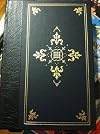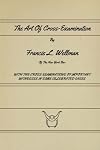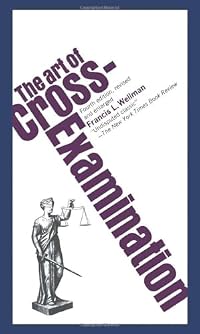
The Art of Cross-Examination
by Francis L. Wellman
On This Page
Description
First published in 1903, this book is a compulsively readable theory of cross-examination, enriched with entertaining and enlightening examples drawn from Wellman's own practice and those from the infamous cases of the day. As Professor Michael E. Tigar says in his new foreword to the book. Until I reread this book, I had not realized how much I had gained from studying Wellman's approach. I think you will find this book worthy of your time.Tags
Recommendations




















Member Reviews
At first glance, The Art of Cross-Examination is a period piece. The first edition appeared over a century ago, in 1903, and the last dates from the 1930's. Yet if there is a more useful how-to book for practicing lawyers, I haven't come across it. Even for those, like me, who never conduct a trial, Mr. Wellman offers valuable guidance on the necessary tasks of extracting accurate information from sometimes recalcitrant clients and preparing them to be quizzed by others.
Because cross-examination is, as the book's title states, an "art", for which laying down scientific laws is impossible, the best way to study it is through examples, of which one here finds a treasure trove. Some are masterpieces, such as Edward Carson's devastating show more questioning of the candy magnate George Cadbury in the Evening Standard libel case (1908). Others highlight common mistakes. While trials have changed over the past 70 years, the differences are not great enough to obsolesce the vicarious experience gathered here.
This is not, however, merely instruction for the legal profession. The author has chosen his examples for their entertainment value as well as their technical interest. Laymen will enjoy reading them - and may learn something, too. The court room is hardly the only venue for hard questions. show less
Because cross-examination is, as the book's title states, an "art", for which laying down scientific laws is impossible, the best way to study it is through examples, of which one here finds a treasure trove. Some are masterpieces, such as Edward Carson's devastating show more questioning of the candy magnate George Cadbury in the Evening Standard libel case (1908). Others highlight common mistakes. While trials have changed over the past 70 years, the differences are not great enough to obsolesce the vicarious experience gathered here.
This is not, however, merely instruction for the legal profession. The author has chosen his examples for their entertainment value as well as their technical interest. Laymen will enjoy reading them - and may learn something, too. The court room is hardly the only venue for hard questions. show less
This book is now outdated. But, still it is a good read, just to read several interesting stories and to know how cross-examination was done historically. Now, cross-examination is not so much an art, though few exceptional artist may come up every now and then. But, now mostly it is about thorough preparation, and going about systematically and scientifically. Much like business management, what was probably an art decades ago, but now it is now more like science, though few exceptional artist in management may come up every now and then.
Still rated good, just for its readability and several good stories.
Still rated good, just for its readability and several good stories.
I became aware of this book through a reference in "Stranger in a strange land". It's not a book that I'd have picked up otherwise.
I'm not a legal professional, but I found it an easy and interesting read from a layman's perspective. I can't comment on how accurate or useful it is for a modern barrister though.
It mainly consists of "war stories" from the author's career as a barrister, which are used as examples of what and what not to do when conducting a cross-examination.
I'm not a legal professional, but I found it an easy and interesting read from a layman's perspective. I can't comment on how accurate or useful it is for a modern barrister though.
It mainly consists of "war stories" from the author's career as a barrister, which are used as examples of what and what not to do when conducting a cross-examination.
Good for new attorneys.
p. 18, quoting David Graham, "A lawyer should never ask a witness on cross-examination a question unless in the first place he knew what the answer would be, or in the second place he didn't care."
p. 53, Concerning theoretical questions: "...it is not usually not the truth of the answer, but the truth and accuracy of the question which requires their [the jury's] consideration"
p. 53, Concerning theoretical questions: "...it is not usually not the truth of the answer, but the truth and accuracy of the question which requires their [the jury's] consideration"
KF8920 .W45 1986 (VJH)
Ratings
Members
- Recently Added By
Lists

Trinity College Booklist (1951): Class Two, Social and Psychological Scienc
60 works; 3 members
Author Information
8 Works 367 Members
Series
Belongs to Publisher Series
Work Relationships
Common Knowledge
- Canonical title
- The Art of Cross-Examination
Classifications
Statistics
- Members
- 345
- Popularity
- 90,958
- Reviews
- 6
- Rating
- (3.80)
- Languages
- English
- Media
- Paper, Ebook
- ISBNs
- 27
- ASINs
- 18