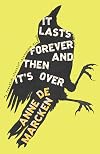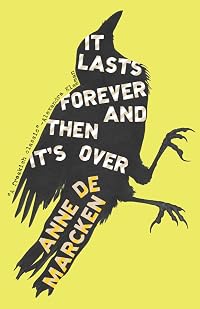
It Lasts Forever and Then It's Over
by Anne de Marcken
On This Page
Description
The heroine of the spare and haunting It Lasts Forever and Then It's Over is voraciously alive in the afterlife. Adrift yet keenly aware, she notes every bizarre detail of her new reality. And even if she has forgotten her name and much of what connects her to her humanity, she remembers with an implacable and nearly unbearable longing the place where she knew herself and was known (and loved), and she is determined to get back there at any cost. Our dead heroine travels across the show more landscapes of time and space (heading always west and carrying a dead but laconically opinionated crow in her chest), encountering and losing parts of her body and her self in one terrifying, hilarious, and heartbreaking situation after another. A bracing writer of great nerve and verve, Anne de Marcken bends reality (and the reader's mind) with throwaway assurance. It Lasts Forever and Then It's Over plumbs mortality and how it changes everything, except possibly love. Delivering a near-Beckettian whopping to the reader's imagination, this is one of the sharpest and funniest novels of recent years, a tale for our dispossessed times. show lessTags
Recommendations


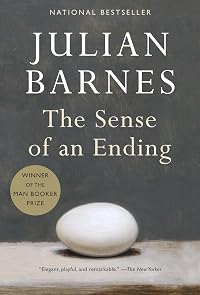
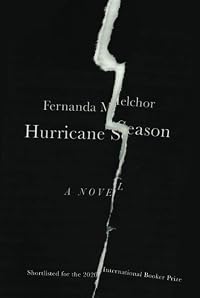
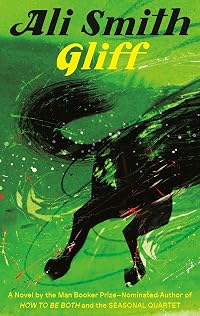
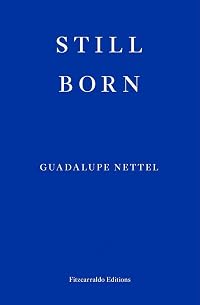
Member Recommendations
Member Reviews
After the end of the world, undead existence can get a bit monotonous. You’re always losing things like your name or your arm or your reason for existence (as opposed to your reason for living). When all you’ve got left to hold on to is the absence of that special someone whose name you no longer recall or whose face you can’t visualize, you may need a crow. Well, there’s not a lot that could more fittingly stand in for your grief, I suppose. And when you finally decide to give up on that, it’s time to head west.
Anne de Marcken’s novel might sound unlikely in brief but it kind of works in full. It’s unclear whether our narrator is in something like the bardo, or whether the post-apocalypse should be taken at face value. In show more any case, the narrative voice holds your attention right through to the end of this short novel.
Gently recommended. show less
Anne de Marcken’s novel might sound unlikely in brief but it kind of works in full. It’s unclear whether our narrator is in something like the bardo, or whether the post-apocalypse should be taken at face value. In show more any case, the narrative voice holds your attention right through to the end of this short novel.
Gently recommended. show less
This is one of those rare well-written books that I did not particularly enjoy reading.
Don't get me wrong: I'm glad I read it because the writing is genuinely beautiful and some of its imagery will stay with me forever. There are so many passages that are lyrical and haunting by themselves, but as a novel, I found myself admiring the craftsmanship more than becoming invested in the story.
As for the story itself, my take on it is that the zombie/undead (?) plot device is a metaphor for grief. The loss of someone important in your life rips something out of you (perhaps your life force? I don't completely understand this metaphor) and leaves a hole in you. I've felt this myself in times of extreme loss, and the pain is intense and very show more real. The image of the raven filling the hole in the narrator's chest really hit home for me, because in those times I would do anything to alleviate that pain.
I get that some of the scenes in this book parallel the stages of grief. (Warning for some spoilers ahead.) A zombie/undead's murderous hunger could mirror the anger phase, perhaps. But what phase of the grieving cycle pairs up with self-immolation? Or screaming into a hole in the ground (which, itself, appears to be a bottomless rip into the void of existence itself) spewing a cloud of black... bees, was it?Or impaling your own severed head on a spike while you watch your body get swept away in the ocean. Maybe my experience with grief is just too different from the author's for me to understand all of this.
Also, I prefer stories with a clear narrative arc, where scenes build on one another and events lead naturally to what comes next. This novel intentionally avoids that structure. It reads like a series of poetic vignettes that are thematically connected, and individually interesting, but they do not build a larger story. This left me without a sense of momentum or destination. I never felt that satisfying progression where each chapter raises the stakes or deepens the story in a meaningful way.
It was as if the author kept a journal of random thoughts and ideas, most of them interesting in their own right, and decided to sprinkle in a copious number of them throughout her debut novel, loosely tied together through the narrative link that began with the idea: "What would a zombie think about after she had succumbed? How would she handle the pain and loss of the life and love left behind?"
(And this might be my ignorance of the ever-evolving zombie genre, but I didn't credit them with that much internal dialog, not to mention emotional intelligence. Admittedly, this is a sticking point for me that I failed to get past as I read this book.)
I also prefer a novel that showcases some form of character development. Maybe I'm asking too much here of a main character that is basically undead, but there was no development to speak of. She was on a journey, which ended. Full stop. As for other characters...? Yes, there were other characters. Another full stop.
Finally, if your novel is lacking all of the above (a plot that builds to a conclusion, characters that grow and evolve), you'd better have a point, and you need to nail the landing on that point. This novel, however, felt deliberately obscure in that regard. Its minimalist nature felt like an avoidance of its actual thesis. I don't mind stories that require interpretation—in fact, I enjoy them—but I occasionally felt that the ambiguity, here, became a shield (or a crutch) against saying anything actually profound. I can appreciate that in a short story. This novel/novella dragged that out probably 60 more pages than I was willing to grant it.
Or, put another way, if the apex of your profundity is to claim that grief, to a zombie, is easily confused with hunger, you are setting the bar low for philosophical revelations in your short 127-page novel. show less
Don't get me wrong: I'm glad I read it because the writing is genuinely beautiful and some of its imagery will stay with me forever. There are so many passages that are lyrical and haunting by themselves, but as a novel, I found myself admiring the craftsmanship more than becoming invested in the story.
As for the story itself, my take on it is that the zombie/undead (?) plot device is a metaphor for grief. The loss of someone important in your life rips something out of you (perhaps your life force? I don't completely understand this metaphor) and leaves a hole in you. I've felt this myself in times of extreme loss, and the pain is intense and very show more real. The image of the raven filling the hole in the narrator's chest really hit home for me, because in those times I would do anything to alleviate that pain.
I get that some of the scenes in this book parallel the stages of grief. (Warning for some spoilers ahead.) A zombie/undead's murderous hunger could mirror the anger phase, perhaps. But what phase of the grieving cycle pairs up with self-immolation? Or screaming into a hole in the ground (which, itself, appears to be a bottomless rip into the void of existence itself) spewing a cloud of black... bees, was it?
Also, I prefer stories with a clear narrative arc, where scenes build on one another and events lead naturally to what comes next. This novel intentionally avoids that structure. It reads like a series of poetic vignettes that are thematically connected, and individually interesting, but they do not build a larger story. This left me without a sense of momentum or destination. I never felt that satisfying progression where each chapter raises the stakes or deepens the story in a meaningful way.
It was as if the author kept a journal of random thoughts and ideas, most of them interesting in their own right, and decided to sprinkle in a copious number of them throughout her debut novel, loosely tied together through the narrative link that began with the idea: "What would a zombie think about after she had succumbed? How would she handle the pain and loss of the life and love left behind?"
(And this might be my ignorance of the ever-evolving zombie genre, but I didn't credit them with that much internal dialog, not to mention emotional intelligence. Admittedly, this is a sticking point for me that I failed to get past as I read this book.)
I also prefer a novel that showcases some form of character development. Maybe I'm asking too much here of a main character that is basically undead, but there was no development to speak of. She was on a journey, which ended. Full stop. As for other characters...? Yes, there were other characters. Another full stop.
Finally, if your novel is lacking all of the above (a plot that builds to a conclusion, characters that grow and evolve), you'd better have a point, and you need to nail the landing on that point. This novel, however, felt deliberately obscure in that regard. Its minimalist nature felt like an avoidance of its actual thesis. I don't mind stories that require interpretation—in fact, I enjoy them—but I occasionally felt that the ambiguity, here, became a shield (or a crutch) against saying anything actually profound. I can appreciate that in a short story. This novel/novella dragged that out probably 60 more pages than I was willing to grant it.
Or, put another way, if the apex of your profundity is to claim that grief, to a zombie, is easily confused with hunger, you are setting the bar low for philosophical revelations in your short 127-page novel. show less
This is a 'concept' book more than a story - definitely an element of cli-fi and also a poetic exploration of life and death. It reminded me of Split Tooth by Tanya Tagaq because the 'topic' of the book is so disturbing, but the writing is transcendent. The narrator here is unnamed (she has forgotten it) and she is undead - shades of Lincoln in the Bardo - but a little more gruesome - presumbably she is a zombie because she feasts on flesh on a couple occasions - not easy scenes to stomach (ha, ha). But the insatiable hunger is later named as grief. Memories of life float by like clouds; there is an unidentified 'you' addressed who was a husband, lover, partner and the connection is poignant. We don't know how she died and as she walks show more among the living occasionally, there are not many left and they have resorted to a feral existence, clustered in rudimentary towns with mob mentality. Some climate or zombie apocalypse? But none of that matters, per se. It is "about life, death, and the eerily vast space between." (book blurb). I think it is about retaining the self (soul?) amid myriad influences, what lingers after death, and what lasts from life. "she remembers with unbearable longing the place where she knew herself and was known - where she loved and was loved." (book blurb) It is structured in 7 parts, each with an epigraph, and she journeys physically and spiritually in that span and this is where the poetic writing is most charged. Examples: "Everything I encounter has the quality of having been encountered before. An always already feeling. And at the same time, everything I encounter is strange to me...what is familiar because I have seen it before and what is just part of a familiar story? What is remembered and what is received? What is strange because I have forgotten it, or because it is new, or because this time I am on foot, or because this time I am undead, or because this time I am without you?" (53) "Emptiness spills into me. My ear is the Panama Canal connecting two oceans of emptiness. The emptiness out there and an emptiness in me. Dark. Entire. Impossible. Emptiness teeming with cold silence. It is so silent it is loud. It is unbearable. It is so familiar." (25) "The earth holds things in its body. In clay. In ice. The real. The unreal. Time. Each other. All the chances we had." (55) "The sky is low and charged with snow that has not yet begun to fall. A flock of starlings keeps lifting off and landing, lifting off and landing. The sound of their wings all at once is soft and explosive. A hundred feathered concussions." (93) "I realize now that when I was playing these silent movies of life after our life, you were still there. You were sitting with me, the two of us alone in the theater, still together. This sadness is not an empty church and not an empty house. It is the whole empty world and I am in it and it is in me." (118) As a debut novelist, she is impressive for what she is able to imagine and to articulate and this would be 5 unequivocal stars if not for the zombie parts that made for uncomfortable reading. show less
A hard-to-describe philosophical zombie novella full of wonderful observations and turns of phrase.
It's free of most of the usual cliches so it can focus on the important stuff. The stuff of life (and the afterlife). This would be rewarding to reread at some point.
It's free of most of the usual cliches so it can focus on the important stuff. The stuff of life (and the afterlife). This would be rewarding to reread at some point.
One of the more interesting books I've read recently. A kind of zombie book written from the voice of an undead woman- what exactly does it mean to be undead? Curious and thought provoking, filled with feelings of loss and longing.
Can't work out if I'm reacting to this purely on its merits, or relative to the hype and blurb on the cover (which is all I picked it on, in a bookshop). The hype really, really bigs it up, but...
The central idea is pretty pedestrian: zombie apocalypse but from the zombie's perspective. That this *is* the central idea is hidden for a while, so when it becomes clear it's kind of a disappointment: that's it? There's some inventive bits-of-body stuff, mind.
There are some lovely, affecting moments and passages, but overall there is a sense of writing and style trying just a bit too hard to be different and deep and falling same and shallow: overwrought and weighty similes, inert symbolism, that kind of thing. Somehow even this very short show more book has a feeling of redundancy in the expression. Oh, and the epigraphs before each chapters almost seem drawn from a list of the people you should quote to appear smart.
I think I would have liked it more had I not been so primed to love it. One does wonder whether the praise is the kind of thing that Private Eye condemns as log-rolling. show less
The central idea is pretty pedestrian: zombie apocalypse but from the zombie's perspective. That this *is* the central idea is hidden for a while, so when it becomes clear it's kind of a disappointment: that's it? There's some inventive bits-of-body stuff, mind.
There are some lovely, affecting moments and passages, but overall there is a sense of writing and style trying just a bit too hard to be different and deep and falling same and shallow: overwrought and weighty similes, inert symbolism, that kind of thing. Somehow even this very short show more book has a feeling of redundancy in the expression. Oh, and the epigraphs before each chapters almost seem drawn from a list of the people you should quote to appear smart.
I think I would have liked it more had I not been so primed to love it. One does wonder whether the praise is the kind of thing that Private Eye condemns as log-rolling. show less
Para leer con calma y atención, como un buen poema. Es bello e inteligente. Dicho esto, no lo terminé de sentir y es un libro que te lo pide.
Members
- Recently Added By
Lists

Llibres que he llegit el 2025
81 works; 2 members

Books Read in 2025
4,091 works; 97 members
Author Information
2+ Works 367 Members
Some Editions
Awards and Honors
Awards
Distinctions
Common Knowledge
- Original title
- It Lasts Forever and Then It's Over
- Original publication date
- 2024-03-01
- Epigraph
- We're stories telling stories, nothing.
-Fernando Pessoa - First words
- I lost my left arm today. It came off clean at the shoulder. Janice 2 picked it up and brought it back to the hotel. I would have thought it would affect my balance more than it has. It is like getting a haircut. The air movi... (show all)ng differently around the remaining parts of me. Also by turns a sense of newness and lessness - free me, undead me, don't look at me.
- Canonical DDC/MDS
- 813.6
- Canonical LCC
- PS3604.E1289 I8
Classifications
Statistics
- Members
- 369
- Popularity
- 85,068
- Reviews
- 10
- Rating
- (3.61)
- Languages
- Dutch, English, German, Spanish
- Media
- Paper, Audiobook, Ebook
- ISBNs
- 13
- ASINs
- 4