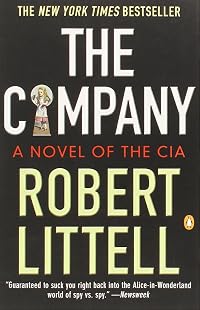
The Company
by Robert Littell
On This Page
Description
This realistic New York Times-bestselling epic spy novel captures the thrilling story of CIA agents in the latter half of the Twentieth Century. The New York Times bestselling spy novel The Company lays bare the history and inner workings of the CIA. This critically acclaimed blockbuster from internationally renowned novelist Robert Littell seamlessly weaves together history and fiction to create a multigenerational, wickedly nostalgic saga of the CIA-known as "the Company" to insiders. show more Racing across a landscape spanning the legendary Berlin Base of the '50s, the Soviet invasion of Hungary, the Bay of Pigs, Afghanistan, and the Gorbachev putsch, The Company tells the thrilling story of agents imprisoned in double lives, fighting an amoral, elusive, formidable enemy-and each other-in an internecine battle within the Company itself. "Compulsive reading from start to finish." -The Boston Globe "Hugely entertaining . . . A serious look at how our nation exercises power. . . . Popular fiction at its finest." -The Washington Post Book World "As it happens, this longest spy novel ever written turns out to be one of the best." -Chicago Tribune "Reads like a breeze . . . guaranteed to suck you right back into the Alice-in-Wonderland world of spy vs. spy." -Newsweek "If Robert Littell didn't invent the American spy novel, he should have." -Tom Clancy "It's gung-ho, hard-drinking, table-turning fun." -Publishers Weekly. show lessTags
Recommendations











Member Reviews
Littell's book is a brick: 896 pages; 34.5 hours on audio. Littell manages to make a story about the CIA entirely human by turning it into a family saga, in more ways than one. Yale University undergrads and best friends Jack McAuliffe, Leo Kritzky and Ebby Ebbitt are recruited to "The Company, the successor to the World War II OSS, right after its inception.
The story begins in Berlin, at the start of the Cold War, and we take a time-and-distance trip through some of the key moments in the intelligence war: Budapest during the 1956 Hungarian uprising, the failed Bay of Pigs invasion of Cuba, the Russian war in Afghanistan, and the 1991 attempted right-wing coup against Soviet president Mikhail Gorbachev. Littell blends fiction so well show more with these historical events that I kept going back to Wikipedia and historical reference books to see where the seams were between fact and fiction.
Jack, Leo and Ebby grow up in the service; they meet their wives, marry, and have children who follow their path into The Company. The book also follows key KGB agents and features regular appearances by colorful characters like the Falstaffian senior agent Harvey Torriti, aka "the Sorcerer," whose obsession with hunting moles within the CIA and British intelligence lasts even into his retirement, and the Sorcerer's old friend Ezra ben Ezra, aka "the Rabbi," of Israel's Mossad, who can be counted on to swap key information and get his hands dirty when the CIA is occasionally forced to back off. A thread running throughout the book is the mystery of Sasha, the code name for the KGB sleeper agent whom the CIA believes has infiltrated its upper echelons. Trying to figure out Sasha's identity is just one of the pleasures of this lively and intricate story.
Though there is a large cast of characters, Littell's characterization skills make them easy to distinguish and remember. Mixed in with the fictional characters, and helping to ground the story, are many real historical figures, like the CIA's Bill Casey and James Jesus Angleton (whose paranoia virtually crippled the CIA during the Cold War), Kim Philby (the so-called Third Man in the Cambridge Spy Ring that spied for the KGB from within British intelligence), Jack and Bobby Kennedy (the latter of whom has an intense confrontation with the Sorcerer during the Bay of Pigs invasion), Ronald Reagan, and Russians Nikita Kruschev, Mikhail Gorbachev and Boris Yeltsin.
Littell's characters are all ideologically committed, but that doesn't mean that they all see eye to eye. Jack, who was with the rebels in Budapest in 1956, is so scarred by the US refusal to intervene when the Russian tanks came it that he forever after takes a hard interventionist line, all the way to favoring the assassination of troublesome politically powerful figures in other countries. Ebby, on the other hand, believes strongly that the CIA's sole mission is and should be intelligence, not intervention. On the KGB side, Starik, the mastermind of the KGB's efforts to undermine the CIA, is a far-right , anti-Semitic, Russian nationalist, while his protégé, Yevgeny, who spends decades in deep cover in the US, is thrilled, upon his return to Russia, with Gorbachev's glasnost and perestroika initiatives.
The different viewpoints of the characters help illustrate, by putting it in human terms, the checkered history of the CIA, from its thrilling feats of derring-do to its dirty tricks and political assassinations of unfriendly political figures in foreign countries. Through his characters, Littell makes us see how men who think of themselves as good guys--and who are good guys, on the whole--can use the same compromised morality as the bad guys. And, of course, we're still struggling with the issues of ends and means, and the unanticipated consequences that may result from some intelligence decisions, like the US decision to arm the mujahideen in Afghanistan when they were fighting the Russians.
Littell doesn't shy away from depicting the internal politics and downright incompetence that have dogged some of the Company's operations over the years, either. I could pick a few nits over some factual errors, Littell's clumsiness with female characters, and a gratuitous and repulsive subplot involving Starik's sexual perversion, but on the whole this is a standout historical novel and tale of espionage. show less
The story begins in Berlin, at the start of the Cold War, and we take a time-and-distance trip through some of the key moments in the intelligence war: Budapest during the 1956 Hungarian uprising, the failed Bay of Pigs invasion of Cuba, the Russian war in Afghanistan, and the 1991 attempted right-wing coup against Soviet president Mikhail Gorbachev. Littell blends fiction so well show more with these historical events that I kept going back to Wikipedia and historical reference books to see where the seams were between fact and fiction.
Jack, Leo and Ebby grow up in the service; they meet their wives, marry, and have children who follow their path into The Company. The book also follows key KGB agents and features regular appearances by colorful characters like the Falstaffian senior agent Harvey Torriti, aka "the Sorcerer," whose obsession with hunting moles within the CIA and British intelligence lasts even into his retirement, and the Sorcerer's old friend Ezra ben Ezra, aka "the Rabbi," of Israel's Mossad, who can be counted on to swap key information and get his hands dirty when the CIA is occasionally forced to back off. A thread running throughout the book is the mystery of Sasha, the code name for the KGB sleeper agent whom the CIA believes has infiltrated its upper echelons. Trying to figure out Sasha's identity is just one of the pleasures of this lively and intricate story.
Though there is a large cast of characters, Littell's characterization skills make them easy to distinguish and remember. Mixed in with the fictional characters, and helping to ground the story, are many real historical figures, like the CIA's Bill Casey and James Jesus Angleton (whose paranoia virtually crippled the CIA during the Cold War), Kim Philby (the so-called Third Man in the Cambridge Spy Ring that spied for the KGB from within British intelligence), Jack and Bobby Kennedy (the latter of whom has an intense confrontation with the Sorcerer during the Bay of Pigs invasion), Ronald Reagan, and Russians Nikita Kruschev, Mikhail Gorbachev and Boris Yeltsin.
Littell's characters are all ideologically committed, but that doesn't mean that they all see eye to eye. Jack, who was with the rebels in Budapest in 1956, is so scarred by the US refusal to intervene when the Russian tanks came it that he forever after takes a hard interventionist line, all the way to favoring the assassination of troublesome politically powerful figures in other countries. Ebby, on the other hand, believes strongly that the CIA's sole mission is and should be intelligence, not intervention. On the KGB side, Starik, the mastermind of the KGB's efforts to undermine the CIA, is a far-right , anti-Semitic, Russian nationalist, while his protégé, Yevgeny, who spends decades in deep cover in the US, is thrilled, upon his return to Russia, with Gorbachev's glasnost and perestroika initiatives.
The different viewpoints of the characters help illustrate, by putting it in human terms, the checkered history of the CIA, from its thrilling feats of derring-do to its dirty tricks and political assassinations of unfriendly political figures in foreign countries. Through his characters, Littell makes us see how men who think of themselves as good guys--and who are good guys, on the whole--can use the same compromised morality as the bad guys. And, of course, we're still struggling with the issues of ends and means, and the unanticipated consequences that may result from some intelligence decisions, like the US decision to arm the mujahideen in Afghanistan when they were fighting the Russians.
Littell doesn't shy away from depicting the internal politics and downright incompetence that have dogged some of the Company's operations over the years, either. I could pick a few nits over some factual errors, Littell's clumsiness with female characters, and a gratuitous and repulsive subplot involving Starik's sexual perversion, but on the whole this is a standout historical novel and tale of espionage. show less
This is going to be a little long and disjointed, because I want to vent some stuff about this book. THPOILERTH from here on out are to be expected.
The Company is a book that, for whatever reason, is steeped in Alice in Wonderland (more on this later), and there's a quotation from it towards the end that made me tear my bookmark in half because I wanted to remember it for when I wrote this:
"...there would be no harm, she thought, in asking if the game was over. "Please, would you tell me--" she began, looking timidly at the Red Queen."
I was first exposed to The Company through the rather fun TNT miniseries, which has some great casting (Alfred Molina is perfect as the alcoholic spymaster Harvey "The Sorcerer" Torriti, Michael Keaton as show more James Jesus Angleton is almost as good as Matt Damon's fictionalized substitute, Edward Wilson, Sr.). I grabbed the book a long time ago and never really had the time to get into it, and frankly, the miniseries seemed to work a lot better.
The miniseries is much more condensed, covering three main areas: Berlin immediately following WW2, the Bay of Pigs invasion, and 1980s America as the USSR falls apart. This is a great idea because it leaves out the God-awful Russian-adventurism-in-Afghanistan interlude in the book, which seems to serve little purpose besides letting Littell wink at the CIA Stinger missile program and bin Laden's activities in the area during this time period. (The Alice quote I posted above comes from just after that section, and I really did find myself wishing that the game was over.)
Ultimately, the frustrating part of The Company is that it starts off great. The early parts of the book, with Jack learning at the feet of Harvey Torriti and his college roommate returning to Russia to do the same with Russian spymaster Starik, are great stuff. The parts discussing the CIA leaving the Hungarian Revolution out to dry while Ebby tries to survive are also pretty darn good. Somewhere around the Bay of Pigs, however, it falls apart: there's one long scene of Kennedy and his advisors discussing the details of the invasion that had me bored to tears and wondering where all the characters I cared about had gone.
The Bay of Pigs is made up for by the AE/PINNACLE chapters, which introduce a Soviet defector who seems to hold the key to the identity of SASHA, the CIA mole that the characters have been pursuing since the beginning. This is great, tense stuff, with Angleton's true nature revealed and Leo put through the wringer as he's accused of having worked for the Russians all along. An eleventh-hour revelation on Jack's part saves Leo, and then the book really goes to hell.
The Afghanistan section of the book flat-out sucks. The characterization of historical figures has at least been interesting to this point, but Littell clearly has an enormous bone to pick with Reagan, because every single scene with Reagan made me think of the artificial-intelligence-Reagan from The Dark Knight Returns (WAY TO WORK BATMAN INTO THIS SOMEHOW MIKE) that was a walking, talking caricature. It starts out kind of fun - finally, a leader the CIA can work with - but just ends up feeling boring and somehow petty. Oh, and then it turns out Leo has been SASHA all along, and he meets up with Eugene/Yevgeny and escapes the Americans, but it's okay, because they all team up again in THE NEXT CHAPTER WHY ISN'T THIS BOOK OVER where they try to get together some kind of plan to stop the 90s coup against Gorbachev. The whole thing just feels like Littell didn't know where to stop and decided to just cover as much of CIA history as possible until he couldn't think of anything else to say.
A few other points:
- Alice in Wonderland. Seriously, what's up with this? Angleton and Starik are somehow both obsessed with it as a metaphor for espionage, but it never seems to get explained. I guess it's just supposed to be a coincidence, but with how many times it gets referenced, you'd think that it would turn out to have some Bigger Significance for them.
- Starik being revealed as a pedophile seemed like a cheap way for Littell to say "HERE IS YOUR ANTAGONIST". It left a bad taste in my mouth that Littell introduces that best-of-things, an antagonist/villain who you can actually understand/understand why they do what they do, and then tosses in "by the way, he's a serial molester that uses the Soviet government to procure girls" as if to say "SEE HE'S THE BAD GUY". Blech. BLECH.
- Props to Littell for passing the Bechdel test, though. The scene with Tessa and Vanessa figuring out the KGB quiz-show-code brought a big old smile to my face.
Overall: if you really want to read 900 kind-of-meandering pages about the CIA and the KGB, go for it. Otherwise, just go watch the miniseries or The Good Shepherd. show less
The Company is a book that, for whatever reason, is steeped in Alice in Wonderland (more on this later), and there's a quotation from it towards the end that made me tear my bookmark in half because I wanted to remember it for when I wrote this:
"...there would be no harm, she thought, in asking if the game was over. "Please, would you tell me--" she began, looking timidly at the Red Queen."
I was first exposed to The Company through the rather fun TNT miniseries, which has some great casting (Alfred Molina is perfect as the alcoholic spymaster Harvey "The Sorcerer" Torriti, Michael Keaton as show more James Jesus Angleton is almost as good as Matt Damon's fictionalized substitute, Edward Wilson, Sr.). I grabbed the book a long time ago and never really had the time to get into it, and frankly, the miniseries seemed to work a lot better.
The miniseries is much more condensed, covering three main areas: Berlin immediately following WW2, the Bay of Pigs invasion, and 1980s America as the USSR falls apart. This is a great idea because it leaves out the God-awful Russian-adventurism-in-Afghanistan interlude in the book, which seems to serve little purpose besides letting Littell wink at the CIA Stinger missile program and bin Laden's activities in the area during this time period. (The Alice quote I posted above comes from just after that section, and I really did find myself wishing that the game was over.)
Ultimately, the frustrating part of The Company is that it starts off great. The early parts of the book, with Jack learning at the feet of Harvey Torriti and his college roommate returning to Russia to do the same with Russian spymaster Starik, are great stuff. The parts discussing the CIA leaving the Hungarian Revolution out to dry while Ebby tries to survive are also pretty darn good. Somewhere around the Bay of Pigs, however, it falls apart: there's one long scene of Kennedy and his advisors discussing the details of the invasion that had me bored to tears and wondering where all the characters I cared about had gone.
The Bay of Pigs is made up for by the AE/PINNACLE chapters, which introduce a Soviet defector who seems to hold the key to the identity of SASHA, the CIA mole that the characters have been pursuing since the beginning. This is great, tense stuff, with Angleton's true nature revealed and Leo put through the wringer as he's accused of having worked for the Russians all along. An eleventh-hour revelation on Jack's part saves Leo, and then the book really goes to hell.
The Afghanistan section of the book flat-out sucks. The characterization of historical figures has at least been interesting to this point, but Littell clearly has an enormous bone to pick with Reagan, because every single scene with Reagan made me think of the artificial-intelligence-Reagan from The Dark Knight Returns (WAY TO WORK BATMAN INTO THIS SOMEHOW MIKE) that was a walking, talking caricature. It starts out kind of fun - finally, a leader the CIA can work with - but just ends up feeling boring and somehow petty. Oh, and then it turns out Leo has been SASHA all along, and he meets up with Eugene/Yevgeny and escapes the Americans, but it's okay, because they all team up again in THE NEXT CHAPTER WHY ISN'T THIS BOOK OVER where they try to get together some kind of plan to stop the 90s coup against Gorbachev. The whole thing just feels like Littell didn't know where to stop and decided to just cover as much of CIA history as possible until he couldn't think of anything else to say.
A few other points:
- Alice in Wonderland. Seriously, what's up with this? Angleton and Starik are somehow both obsessed with it as a metaphor for espionage, but it never seems to get explained. I guess it's just supposed to be a coincidence, but with how many times it gets referenced, you'd think that it would turn out to have some Bigger Significance for them.
- Starik being revealed as a pedophile seemed like a cheap way for Littell to say "HERE IS YOUR ANTAGONIST". It left a bad taste in my mouth that Littell introduces that best-of-things, an antagonist/villain who you can actually understand/understand why they do what they do, and then tosses in "by the way, he's a serial molester that uses the Soviet government to procure girls" as if to say "SEE HE'S THE BAD GUY". Blech. BLECH.
- Props to Littell for passing the Bechdel test, though. The scene with Tessa and Vanessa figuring out the KGB quiz-show-code brought a big old smile to my face.
Overall: if you really want to read 900 kind-of-meandering pages about the CIA and the KGB, go for it. Otherwise, just go watch the miniseries or The Good Shepherd. show less
There is an unusual type of dramatic irony in Robert Littell's "The Company." When a defector reveals to his CIA handler, the presence of a mole in M16 in 1950 the reader with even a minimal knowledge of history latches onto Kim Philby. Consequently when the information is handed over by a senior analyst, Angleton, to a stuttering M16 liaison officer it is difficult not to shout "don't do it, damn it."
Sometime later, the author lets us know explicitly, "Angleton's luncheon partner, Harold Adrian Russell Philby - Kim to his colleagues in M16, Adrian to a handful of old Ryder Street pals like Angleton." The author proceeds to take us down Alice's rabbit hole and through her looking glass into a view of the apparently schizophrenic world show more of spies of both sides of the cold war.
The world of "The Company" includes real events and real people, Allen Dulles, Frank Gardiner Wisner, James Jesus Angleton, Khrushchev, Philby, Chicago mobster, John Rosselli and many others interact with the fictional characters. Some of the real events include the Bay of Pigs failed insurgency, the failed Hungarian revolution, and the failed Putsch in Moscow in mid August 1991.
The book offers insiders' views of tradecraft and jargon: for example, "walking the cat," to trace back along path of deception to its origins to discover a "mole." some of the cryptonyms used by the fictional agents include: MOTHER - Jim Angleton, SORCERER - Harvey Torriti, SORCERER'S APPRENTICE- Jack McAuliffe, SWEET JESUS- Silwan I, FALLEN ANGEL - Silwan II, RAINBOW - Helga Agnes Mittag de la Fuente, SNIPER - Professor Ernst Ludwig Loffler, SNOWDROP - Konstantin Vishnevsky. The Russians used cryptonyms also - PARSIFAL - Kim Philby, , STARIK, Pavel Semyonovich Zhilov - GREGORY OZOLIN - Yevgeni Alexandrovich Tsipin.
"The Company" is filled beginning to end with the very best spy fiction and a lot of downright insight into the real world confrontation between the U.S. and the U.S.S.R. show less
Sometime later, the author lets us know explicitly, "Angleton's luncheon partner, Harold Adrian Russell Philby - Kim to his colleagues in M16, Adrian to a handful of old Ryder Street pals like Angleton." The author proceeds to take us down Alice's rabbit hole and through her looking glass into a view of the apparently schizophrenic world show more of spies of both sides of the cold war.
The world of "The Company" includes real events and real people, Allen Dulles, Frank Gardiner Wisner, James Jesus Angleton, Khrushchev, Philby, Chicago mobster, John Rosselli and many others interact with the fictional characters. Some of the real events include the Bay of Pigs failed insurgency, the failed Hungarian revolution, and the failed Putsch in Moscow in mid August 1991.
The book offers insiders' views of tradecraft and jargon: for example, "walking the cat," to trace back along path of deception to its origins to discover a "mole." some of the cryptonyms used by the fictional agents include: MOTHER - Jim Angleton, SORCERER - Harvey Torriti, SORCERER'S APPRENTICE- Jack McAuliffe, SWEET JESUS- Silwan I, FALLEN ANGEL - Silwan II, RAINBOW - Helga Agnes Mittag de la Fuente, SNIPER - Professor Ernst Ludwig Loffler, SNOWDROP - Konstantin Vishnevsky. The Russians used cryptonyms also - PARSIFAL - Kim Philby, , STARIK, Pavel Semyonovich Zhilov - GREGORY OZOLIN - Yevgeni Alexandrovich Tsipin.
"The Company" is filled beginning to end with the very best spy fiction and a lot of downright insight into the real world confrontation between the U.S. and the U.S.S.R. show less
Reading (or even listening to) The Company is a real commitment because it is so long. Even though I knew the novel was multigenerational covering almost 50 years of history, I almost gave up when the story set in Germany taking place in the divided Berlin came to an end. Although I didn't and I enjoyed the complete novel, I don't think it ever became as brilliant again.
I knew so little about some of the events (like the Hungarian Revolution) that I started looking up the details and was delighted to find that some of the characters were real people. From that point on, I always looked up the people and events covered in this huge novel. It added something to the story and certainly added to my historical knowledge.
The personalities of show more the fictional characters are not really fleshed out but as I was busy creating them as fully rounded people in my own brain, that didn't matter in this basically plot/history driven novel.
I probably won't read it again (so many books, so little time) but I'm very glad that I did invest the time required to read it once. show less
I knew so little about some of the events (like the Hungarian Revolution) that I started looking up the details and was delighted to find that some of the characters were real people. From that point on, I always looked up the people and events covered in this huge novel. It added something to the story and certainly added to my historical knowledge.
The personalities of show more the fictional characters are not really fleshed out but as I was busy creating them as fully rounded people in my own brain, that didn't matter in this basically plot/history driven novel.
I probably won't read it again (so many books, so little time) but I'm very glad that I did invest the time required to read it once. show less
Robert Littell's The Company no doubt ranks up there as one of the best spy novels written. It is a substantial, fairly massive, undertaking (nearly 900 pages) that attempts to present a fictionalized history of the Central Intelligence Agency, from its early days (shortly after WWII) up through the dissolution of the USSR.
The story revolves around a group of agents - Elliot Ebbitt, Jack McCauliffe and Leon Kritzky - recruited at the beginning of the CIA, and who spend their entire careers being involved in the major events of the Cold War: the Hungarian Revolt, the Bay of Pigs, the Russian involvement in Afghanistan, and the death throes of Russian Communism.
The fictional characters go about their business, with the story weaving show more around historical personages such as Eisenhower, Kennedy, Reagan (who is portrayed rather unflatteringly), Gorbachev, Yeltsin, and other real characters. Littell makes an effort to explain some of the reasoning that goes behind intelligence activities, the reasons why presidents made some of the decisions they made, and the frustrations that arise when diplomacy, politics and national interest conflict.
The story might not be as hard-edged as it might have been (I don't know that intelligence agents are as sympathetic as they are described here, and while Russian agents are portrayed as tough man capable of doing heavy-handed things with little compunction, American agents tend to be romanticized a little bit), and some parts seems somewhat melodramatic (the Hungarian uprising being the most glaring example).
This is a good read, a substantial read, and an exciting read. show less
The story revolves around a group of agents - Elliot Ebbitt, Jack McCauliffe and Leon Kritzky - recruited at the beginning of the CIA, and who spend their entire careers being involved in the major events of the Cold War: the Hungarian Revolt, the Bay of Pigs, the Russian involvement in Afghanistan, and the death throes of Russian Communism.
The fictional characters go about their business, with the story weaving show more around historical personages such as Eisenhower, Kennedy, Reagan (who is portrayed rather unflatteringly), Gorbachev, Yeltsin, and other real characters. Littell makes an effort to explain some of the reasoning that goes behind intelligence activities, the reasons why presidents made some of the decisions they made, and the frustrations that arise when diplomacy, politics and national interest conflict.
The story might not be as hard-edged as it might have been (I don't know that intelligence agents are as sympathetic as they are described here, and while Russian agents are portrayed as tough man capable of doing heavy-handed things with little compunction, American agents tend to be romanticized a little bit), and some parts seems somewhat melodramatic (the Hungarian uprising being the most glaring example).
This is a good read, a substantial read, and an exciting read. show less
History as thriller/page-turner. Simplified, romanticized account of the CIA costarring many real characters from the past (some names were changed to protect someone??, but it's easy to figure out who's who with wikipedia.) Among others, Andropov drops in, Castro comes by, and Nixon is off in the wings.
Also a little mild lovey-dovey. Lots of plots, liquor, and subplots. Multiple generations of Yale-trained US spies and their counterparts from Moscow hunt each other and snoop and beget more spies.
Starts when Stalin and Truman were nose-to-nose, and plays the Great Game thru Afganistan(sound familiar, you history buffs). Hungary, Berlin, Bay or Pigs, all make an appearance, too. A hot read for a long voyage (nearly 1000 pages). The show more question here is what is real and what is fiction. It scares me to think so much was probably real. show less
Also a little mild lovey-dovey. Lots of plots, liquor, and subplots. Multiple generations of Yale-trained US spies and their counterparts from Moscow hunt each other and snoop and beget more spies.
Starts when Stalin and Truman were nose-to-nose, and plays the Great Game thru Afganistan(sound familiar, you history buffs). Hungary, Berlin, Bay or Pigs, all make an appearance, too. A hot read for a long voyage (nearly 1000 pages). The show more question here is what is real and what is fiction. It scares me to think so much was probably real. show less
The Bildungsroman follows the careers of three American and one Russian spying for the CIA and KGB from the 1950s to the 1990s. The main stations are Berlin 1950, Budapest 1956, Cuba 1961, Washington 1974, Afghanistan 1983 and Moscow 1991. Apart from the Bay of Pigs invasion, the novel stresses the CIA successes and mentions only en passant the disastrous actions in South America and Asia. The ivy-league and family clan-oriented recruiting (is it true that whole families work for the CIA?) defeat their main adversary by default, as the Soviet empire collapses.
Members
- Recently Added By
Lists

TED 2013 Summer Reading List
190 works; 13 members

The 100 Best Crime Novels and Thrillers since 1945
100 works; 6 members
Author Information

36 Works 4,649 Members
Awards and Honors
Distinctions
Common Knowledge
- Canonical title
- The Company
- Original title
- The Company
- Original publication date
- 2002
- People/Characters
- Allen Dulles; James Angleton
- Related movies
- The Company (2007 | IMDb)
- Dedication
- For the witnesses, Michael and Jimmie Ritchie / And the guardian angel Ed Victor
- First words
- High over the city, a rack of clouds drifted across the hunter's moon so rapidly it looked as if a motion picture had been speeded up..
- Last words
- (Click to show. Warning: May contain spoilers.)"You may be on to something, Harv."
- Blurbers
- Winks, Robin W.; Clancy, Tom; Cussler, Clive; Cheuse, Alan; King, Larry; DeMille, Nelson (show all 7); McCarry, Charles
Classifications
- Genres
- Fiction and Literature, General Fiction, Suspense & Thriller, Historical Fiction
- DDC/MDS
- 813.54 — Literature & rhetoric American literature in English American fiction in English 1900-1999 1945-1999
- LCC
- PS3562 .I7827 .C66 — Language and Literature American literature American literature Individual authors 1961-
- BISAC
Statistics
- Members
- 1,422
- Popularity
- 16,646
- Reviews
- 28
- Rating
- (4.00)
- Languages
- 8 — Dutch, English, French, German, Italian, Polish, Portuguese, Spanish
- Media
- Paper, Audiobook, Ebook
- ISBNs
- 37
- UPCs
- 4
- ASINs
- 14