On This Page
Description
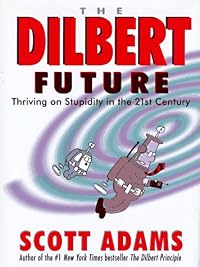
Step aside, Nostradamus. Here comes the real soothsayer, and he'sturning his eagle eye on everything from new work-avoiding technologyto sex with aliens. With predictions that run the gamut ona wide range of hot-buttons, Scott Adams' absurdist, outrageously funnynew audio, The Dilbert Future, may be his greatest achievement yet.In his inimitable style, Adams predicts we'll learn to harness the mostabundant resource in the universe: stupidity.As always, Adams' keen wit is dead-on. Prediction: show more The Dilbert Future will be the most anticipated and well-received businessbook of the year. (It doesn't take a psychic to figure that out.)Check out Scott Adams' other Dilbert books, TheDilbert Principle and Dogbert'sTop Secret Management Handbook.When he's not cartooning or writing bestsellers, Scott Adamsspends his time speaking at corporate functions and conferences. show lessTags
Recommendations














Member Reviews
This is the book where Scott Adams finally pissed me off. There were accusations that he was simply exploiting the market to make money, but that didn't bother me so much.
What got me was his theory of gravity. He provides this as an example of an alternative to mainstream thinking. I don't think he seriously believes that gravity works the way he describes, but he claims that this theory has not had any serious criticism from scientists when he circulated it on his mailing list. The idea is so ludicrous, however, that it is possible no-one felt it worth the time to point out the obvious flaws. He takes this as an indication that he is onto something, though.
Anyway, maybe it was all a joke that I just didn't get, but it made me look at show more Dilbert in a slightly different light than before, and I don't think I could go back. show less
What got me was his theory of gravity. He provides this as an example of an alternative to mainstream thinking. I don't think he seriously believes that gravity works the way he describes, but he claims that this theory has not had any serious criticism from scientists when he circulated it on his mailing list. The idea is so ludicrous, however, that it is possible no-one felt it worth the time to point out the obvious flaws. He takes this as an indication that he is onto something, though.
Anyway, maybe it was all a joke that I just didn't get, but it made me look at show more Dilbert in a slightly different light than before, and I don't think I could go back. show less
Scott Adams is a cartoonist. He is not a stand-up comedian nor is he Dave Barry, though this book makes it quite clear that he really wants to be. Still, there is a reason he tells jokes in three-panel comic strips instead of 30-minute monologues. Here he addresses various aspects of life and makes tongue-in-cheek predictions, interspersed with Dilbert cartoons. It was obviously written in sections rather than as a whole, and the entire time all I could think about was how much more fitting these musings would be in somebody's blog than a hardbound tome published by Harper Business, especially since so many of the predictions have gone out of date since its publication (such as his erroneous predictions for the futures of the cable show more modem and ISDN). There were some vaguely amusing parts but nothing was anywhere near laugh-out-loud funny, and I had to yawn a bit at the tired "women really rule the world" section - that idea was beaten to death decades ago and hasn't gotten any funnier in the meantime. Frankly, the most humorous parts were the cartoons, and if I wanted to read those I could have just picked up a collection.
The final chapter, "A New View of the Future," was inappropriate in this context. For this section Adams "turned the humor mode off" and discussed his personal philosophies. They were interesting but did not fit whatsoever with the rest of the book. His ideas on perception and cause and effect would also have been much more compelling had he bothered to actually research any of the theories and experiments he mentioned. I understand that the goal of this section was nothing more than to make the reader think about the universe a little differently, but it would have been much more effective had he spent an hour at the library finding a couple of references to cite. Saying things like "I'll simplify the explanation, probably getting the details wrong in the process, but you'll get the general idea" does not instill in me a desire to take him very seriously. That said, I am giving thought to trying out those affirmations.
Despite the incongruity of the chapter, I still enjoyed it about as much as I did the rest of the book, but for different reasons (the first part was vaguely amusing, the second vaguely intriguing). Ultimately this felt like a Dilbert collection trying to be a Dave Barry book. I think I'll stick with the comic strips from now on. show less
The final chapter, "A New View of the Future," was inappropriate in this context. For this section Adams "turned the humor mode off" and discussed his personal philosophies. They were interesting but did not fit whatsoever with the rest of the book. His ideas on perception and cause and effect would also have been much more compelling had he bothered to actually research any of the theories and experiments he mentioned. I understand that the goal of this section was nothing more than to make the reader think about the universe a little differently, but it would have been much more effective had he spent an hour at the library finding a couple of references to cite. Saying things like "I'll simplify the explanation, probably getting the details wrong in the process, but you'll get the general idea" does not instill in me a desire to take him very seriously. That said, I am giving thought to trying out those affirmations.
Despite the incongruity of the chapter, I still enjoyed it about as much as I did the rest of the book, but for different reasons (the first part was vaguely amusing, the second vaguely intriguing). Ultimately this felt like a Dilbert collection trying to be a Dave Barry book. I think I'll stick with the comic strips from now on. show less
I understand that, when people are writing a humor book, you shouldn't assume they believe everything they are writing. Still, there are some incredibly problematic chapters in this book, one where he insists that voting is stupid and a waste of time, and then one where he says women secretly run the world and then ascribes all the stupid things that happen in the world to women. It may all be intended as humorous, but at the end of the day, this book just isn't that funny. Its got a lot less comic strips in it than the other Dilbert books, and its very disappointing.
In The Dilbert Principle and Dogbert’s Top Secret Management Handbook, Scott Adams skewered the absurdities of the corporate world. Now he takes the next logical step, turning his keen analytical focus on how human greed, stupidity and horniness will shape the future. Featuring the same irresistible amalgam of essays and cartoons that made Adams’ previous works so singularly entertaining, this uproariously funny, dead-on-target tome offers half-truthful, half-farcical predictions that push all of today’s hot buttons – from business and technology to society and government.
* Children – they are our future, so we’re pretty much hosed. Tip: Grab what you can while they’re still too little to stop us.
* Human Potential – show more we’ll finally learn to use the 90 percent of the brain we don’t use today, and find out that there wasn’t anything in that part.
* Computers – Technology and homeliness will combine to form a powerful type of birth control. show less
* Children – they are our future, so we’re pretty much hosed. Tip: Grab what you can while they’re still too little to stop us.
* Human Potential – show more we’ll finally learn to use the 90 percent of the brain we don’t use today, and find out that there wasn’t anything in that part.
* Computers – Technology and homeliness will combine to form a powerful type of birth control. show less
Another fun Dilbert comic read. Despite not working in that career type I've always found the Dilbert comics pretty funny, even as a kid. The two books I've read of his (so far) have been no different.
This book was funny and a bit poignant (him discussing Terrorism, when this was written in 1998), but the end of the book goes into a bit of a tail-dive with the paranormal stuff. Not sure the point/reasoning behind it's inclusion, and its not exactly meant to be funny and just is a poor way to wrap up the work.
This book was funny and a bit poignant (him discussing Terrorism, when this was written in 1998), but the end of the book goes into a bit of a tail-dive with the paranormal stuff. Not sure the point/reasoning behind it's inclusion, and its not exactly meant to be funny and just is a poor way to wrap up the work.
This is true Scott Adams humor. But unless you are a devoted follower of his bitter ray of sunshine approach, you may find it more tedious and tiresome than funny. Personally, I find Adams to be a sharp social critic who rarely misses the mark. He skewers the absurdities perpetrated in the name of business.
The second of Scott Adams' "non-fiction" books looking at how life, business and everything else wil be in the future.
I find when Adams writes about the absurdities of the business world he is very entertaining. When he tries a more serious vein (as he does in the final chapter), I find him obnoxious, patronising and - worst of all - boring.
I find when Adams writes about the absurdities of the business world he is very entertaining. When he tries a more serious vein (as he does in the final chapter), I find him obnoxious, patronising and - worst of all - boring.
Members
- Recently Added By
Author Information

199+ Works 34,778 Members
Scott Adams, Cartoonist Scott Adams was born and raised in Windham, New York in the Catskill Mountains. He received a B.A. in economics from Hartwick College, Oneonta, NY and an MBA from the University of California, Berkeley. He is also a certified hypnotist. Adams worked in a bank for eight years and, while a bank teller, was robbed twice at show more gunpoint. He also worked for Pacific Bell for nine years and describes both jobs as "humiliating and low paying jobs." It was during this time, that Adams created the character Dilbert. He was entertaining himself during meetings by drawing insulting cartoons of his co-workers and bosses. In 1988, he mailed some sample comic strips featuring Dilbert to some major cartoon syndicates. He was offered a contract and Dilbert was launched in approximately fifty papers in 1989. Adams began working on Dilbert full time as well as speaking, writing, doing interviews, and designing artwork for licensed products. Dilbert is published in over 1,200 newspapers and has a hard cover business book called "The Dilbert Principle." (Bowker Author Biography) show less
Some Editions
Awards and Honors
Distinctions
Series

Work Relationships
Common Knowledge
- Canonical title
- The Dilbert Future: Thriving on Stupidity in the 21st Century
- Original title
- The Dilbert Future: Thriving on Stupidity in the 21st Century
- Original publication date
- 1997
- People/Characters
- Dilbert; Dogbert
- Important places
- United States of America
- Dedication
- Dedicated to my parents, Paul and Virginia Adams, so they won't be too mad that I made jokes about them
- First words
- There are two types of people in the world: the bright and attractive people like yourself who read Dilbert books, and the 6 billion idiots who get in our way.
- Last words
- (Click to show. Warning: May contain spoilers.)Personally, I can't wait.
- Original language
- English
Classifications
- Genres
- Nonfiction, Graphic Novels & Comics
- DDC/MDS
- 741.5973 — Arts & recreation Drawing & decorative arts Drawing Comic books, graphic novels, fotonovelas, cartoons, caricatures, comic strips History, geographic treatment, biography North American United States (General)
- LCC
- PN6162 .A345 — Language and Literature Literature (General) Literature (General) Collections of general literature Wit and humor By region or country
- BISAC
Statistics
- Members
- 2,174
- Popularity
- 9,285
- Reviews
- 19
- Rating
- (3.72)
- Languages
- 9 — Chinese, Dutch, English, Finnish, French, German, Italian, Portuguese, Spanish
- Media
- Paper, Audiobook, Ebook
- ISBNs
- 20
- UPCs
- 1
- ASINs
- 10