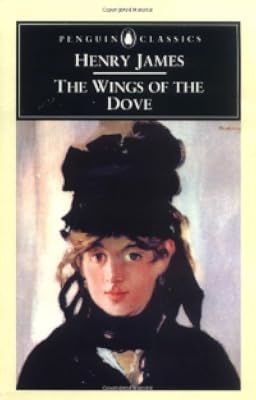
The Wings of the Dove
by Henry James
On This Page
Description
Young Londoners Kate and Merton are engaged, but have no money to marry on. When the wealthy but terminally ill American heiress Milly arrives in London, Kate schemes for a way to inherit her fortune. But when Kate achieves all she had hoped for, she finds that the money and the gentle, beautiful Milly have changed everything.Tags
Recommendations














Member Reviews
In The Wings of the Dove, Henry James pours on layers of conscious and subconscious motivations, knowing characterizations, banal (on purpose) dialogue, a whole host of enigmatic "Oh!"s, some delightful Venetian settings, and a perfect last line to what is, on its surface, a pretty standard love triangle / inheritance story with a dash of British classism. Kate Croy is beautiful and sassy, but she has no money and her father is a scoundrel. Her rich aunt Maude has brought her into her home as a companion with sights on making a very good marriage to a rich someone, but Kate has fallen in love with the penniless journalist Merton Densher (when else has a romantic lead been named Merton?). Separately, the very rich and very alone and also show more semi-secretly dying of a mysterious illness American heiress Milly Theale has struck up an intense and sudden friendship with the very New Englandy Susan Stringham and the two of them head off to Europe to have adventures on Milly's dime. Prior to their departure, Milly meets Merton while he is on assignment sending dispatches from America to his paper. And when Milly and Susan get to London, Susan thinks to look up her old boarding school friend, who happens to be Aunt Maude. Merton loves Kate but feels a sisterly friendship for Milly, Milly loves Merton and is fascinated by Kate, Susan is desperately loyal to Milly, Maude loves Milly for her social currency, and Kate loves Merton but also seems to be keeping her options open. Things get ethically dicey when Kate works Merton into agreeing to pretend to love Milly so that she will leave him her money when she dies, which would allow Kate and Merton to get married with Aunt Maude's blessing. While this sounds like a soap opera, the style of writing and the structure of the book make this a much slower and more floaty affair. And, as a person who is not as rich or oddly beautiful or strange as Milly, but who is (not so secretly) living with a terminal illness, I loved that she was more than just a plot point for Kate and Merton's actions to hang off of. Her relationship with her doctor, her intense friendships, and her views on how she wants to spend her remaining time are all complex and unique and very refreshing.
Here's a taste of James, and one of the most delightful descriptions of love at first sight I've ever read:
"They had found themselves looking at each other straight, and for a longer time on end than was usual even at parties in galleries, but that, after all, would have been a small affair, if there hadn't been something else with it. It wasn't, in a word, simply that their eyes had met; other conscious organs, faculties, feelers had met as well, and when Kate afterwards imaged to herself the sharp, deep fact she saw it in the oddest way, as a particular performance. She had observed a ladder against a garden wall, and had trusted herself to to climb it as to be able to see over into the probable garden on the other side. On reaching the top she had found herself face to face with a gentleman engaged in like calculation at the same moment, and the two enquirers had remained confronted on their ladders. The great point was that for the rest of that evening they had been perched they had not climbed down; and indeed, during the time that followed, Kate at least had had the perched feeling -- it was as if she were there aloft without a retreat." show less
Here's a taste of James, and one of the most delightful descriptions of love at first sight I've ever read:
"They had found themselves looking at each other straight, and for a longer time on end than was usual even at parties in galleries, but that, after all, would have been a small affair, if there hadn't been something else with it. It wasn't, in a word, simply that their eyes had met; other conscious organs, faculties, feelers had met as well, and when Kate afterwards imaged to herself the sharp, deep fact she saw it in the oddest way, as a particular performance. She had observed a ladder against a garden wall, and had trusted herself to to climb it as to be able to see over into the probable garden on the other side. On reaching the top she had found herself face to face with a gentleman engaged in like calculation at the same moment, and the two enquirers had remained confronted on their ladders. The great point was that for the rest of that evening they had been perched they had not climbed down; and indeed, during the time that followed, Kate at least had had the perched feeling -- it was as if she were there aloft without a retreat." show less
It took me more than a year to get through this book. It has my maiden name inside the front cover so I know for sure how long it has been languishing on my tbr pile. I think I've admitted before that I used to be a real literature snob, only reading "worthy" novels, an attitude I developed on my own but had strongly reinforced in graduate school. I have since become less of a jerk (and I didn't stay in academia). But I still had this book on my shelves and thought I should finally read it. Well, my mother told me not to say anything if I couldn't say anything nice but I've never been a completely compliant child so I'm ignoring that advice. And let me tell you, the nicest thing I can say about reading this book is that it was a show more mind-numbing chore.
Bare bones, the plot in a nutshell : poor but beautiful young woman falls in love with poor journalist. They cannot marry because they are poor. Rich American heiress who has previously met the journalist and fallen for him comes to London and meets the young woman. They become friends. Heiress is convinced she's dying. Poor woman is also convinced and decides the journalist should marry the heiress so he'll inherit the money when the heiress dies and then they can afford to marry each other. Things don't entirely go as planned. I mean, it doesn't sound terrible, does it? But in James' hands, it is. He took almost 500 pages to get through this small and unremarkable plot. The man wrote in circles, repeating things over and over ad nauseum. Nothing about the book is head on, everything is obtuse and drawn out. His characters never speak plainly either and there are pieces that are completely baffling. In fact, the plan for the future stays completely unstated until the last quarter (eighth?) of the novel. Our journalist is rather dim until he asks his sweetheart, Kate, to come to his rooms or he won't fall in with her plan. Merton has been unobjectionable until this point and suddenly he's taking advantage of his one true love. Kate is not a greedy Machiavelli until near the end. She is observant but it's still a mystery of sorts how she knows that our heiress is dying given that even the fancy doctor won't say it, only exhorting Milly to "live" and suggesting to Milly's companion that if she just falls in love and marries, she'll come out right in the end. If I had to read a character calling Milly a "magnificent" dove one more time, I was going to heave the book at the wall. The only thing that seemed to make her magnificent was that she had a lot of money and was in danger of being relieved of it. Honestly, by the end, I was hate-reading this byzantine insomnia cure. And by byzantine, I'm definitely referring to the writing and not the plot. Unless you are the snobbiest of literary classic readers, I recommend giving this one a wide berth for sure. show less
Bare bones, the plot in a nutshell : poor but beautiful young woman falls in love with poor journalist. They cannot marry because they are poor. Rich American heiress who has previously met the journalist and fallen for him comes to London and meets the young woman. They become friends. Heiress is convinced she's dying. Poor woman is also convinced and decides the journalist should marry the heiress so he'll inherit the money when the heiress dies and then they can afford to marry each other. Things don't entirely go as planned. I mean, it doesn't sound terrible, does it? But in James' hands, it is. He took almost 500 pages to get through this small and unremarkable plot. The man wrote in circles, repeating things over and over ad nauseum. Nothing about the book is head on, everything is obtuse and drawn out. His characters never speak plainly either and there are pieces that are completely baffling. In fact, the plan for the future stays completely unstated until the last quarter (eighth?) of the novel. Our journalist is rather dim until he asks his sweetheart, Kate, to come to his rooms or he won't fall in with her plan. Merton has been unobjectionable until this point and suddenly he's taking advantage of his one true love. Kate is not a greedy Machiavelli until near the end. She is observant but it's still a mystery of sorts how she knows that our heiress is dying given that even the fancy doctor won't say it, only exhorting Milly to "live" and suggesting to Milly's companion that if she just falls in love and marries, she'll come out right in the end. If I had to read a character calling Milly a "magnificent" dove one more time, I was going to heave the book at the wall. The only thing that seemed to make her magnificent was that she had a lot of money and was in danger of being relieved of it. Honestly, by the end, I was hate-reading this byzantine insomnia cure. And by byzantine, I'm definitely referring to the writing and not the plot. Unless you are the snobbiest of literary classic readers, I recommend giving this one a wide berth for sure. show less
Nobody else could put you through the torture of 500 pages of infinitesimally-qualified, soul-destroyingly-tentative prose and — almost — get away with it. There is a terrible tragedy tucked away under all that one-step-forward-two-steps-back ambiguity, and James's technique somehow manages to communicate the nature of that tragedy very powerfully at an emotional level whilst leaving you more than a little baffled as to what he is actually telling you in terms of the conventional landmarks of plot and character. So it is definitely worth reading, but I wish it wasn't...
This review is written with a GPL 4.0 license and the rights contained therein shall supersede all TOS by any and all websites in regards to copying and sharing without proper authorization and permissions. Crossposted at WordPress, Blogspot, & Librarything by Bookstooge’s Exalted Permission
Title: The Wings of the Dove
Authors: Henry James
Rating: 1 of 5 Stars DNF
Genre: Literature
Pages: 544 / 347
Words: 195K / 124K
★☆☆☆☆
There I was, reading a lengthy, wordy, utterly pointless and despicably worthless book. I'd been trapped in this book since January of 2021. I would take lunch and when I felt up to it, I'd read 1-5 pages. The author's determination to make everything as complicated, opaque and difficult as possible made me want show more to beat him over the head with this tome. But I didn't stop.
I was obviously a sick and addicted man. But it wasn't MY fault. I HAD to read this book to prove to all those Literature People that I was just as intelligent as them! Without this book, how could I show my face in public and discuss the principles of Historical Victorianism Viewed Through a Lens of Ironic Byronism? I NEEDED this book. I really needed a DNF but I hid my problem so well that nobody suspected, not even my closest friends. Without knowing I even had a problem, there was no way they could stage an intervention and get me the help I so desperately needed. So I was stuck in a self-destructive loop of Modern Literature and Pride.
I needed a Hero. Someone to rescue me. Someone to bash Henry James in the face while simultaneously shoving all 544 pages of this book down his scrawny throat. But in this Age of Grimdark Villains and Anti-Heroes, where would I even begin looking for such a Hero as I needed? Even when I asked Shrek to use this book as toilet paper, he read one sentence and simply ran away. Where Oh Where was my Hero!?
♪I need a hero♪
♪I'm holding out for a hero 'til the end of the night♪
♪He's gotta be strong♪
♪And he's gotta be fast♪
♪And he's gotta be fresh from the fight♪
♪I need a hero♪
♪I'm holding out for a hero 'til the morning light♪
♪He's gotta be sure♪
♪And it's gotta be soon♪
♪And he's gotta be larger than life♪
♪Larger than life♪
It turns out, My Hero was right next to me this whole time and I never even realized it until it was too late. My good friend, mild mannered energy drink, Mr Silver Ice came to work with me one day. Little did I know that HE was the Super Hero known as The Rockstar. When The Rockstar saw what was going on he realized only one thing could save me. That day, The Rockstar poured his life out for me and destroyed that book because I was unable to do it myself. I stand here before you all today ONLY because The Rockstar was a true, selfless and self-sacrificing hero. It still brings tears to my eyes when I think about. When I opened my bag at lunch and saw the sacrifice The Rockstar had made for me, the chains of bondage to that terrible book were broken and I DNF'd it right on the spot.
Friends, I hope my experience can help some of you. I know the addiction of being a completist, the siren call to just finish the book, no matter how terrible it is. The agony, the pain, the deception as you avoid your friends' eyes and tell them everything is fine. I KNOW. And I sympathize. But you have to accept that you can't do this alone. DNF'ing is a matter that can cut to the soul and most times we simply can't do it. While not everyone has a friend like The Rockstar to help them like I had, I vow, here and now, to help everyone I come across who is struggling with this issue. Do you need help DNF'ing a book? Then I will help you.
I will carry on the Legacy that The Rockstar started in my life. Bad Books and Jackass Authors will tremble at the mere sight of my shadow. The sound of my fingers typing will send them into paroxysms of terror. The Righteous Flames of Wrath will be so expressive from my eyes that their souls will writhe and shrivel to bother us no more.
So fear not, mortals, for this day, in your very sight, a New Defender has arisen. The Bookstooge will be the scourge of the Space Ways, protecting all who may need it (and even those who don't, sometimes anyway).
Mild mannered Bookstooge
and his alter-ego, The Bookstooge show less
Title: The Wings of the Dove
Authors: Henry James
Rating: 1 of 5 Stars DNF
Genre: Literature
Pages: 544 / 347
Words: 195K / 124K
★☆☆☆☆
There I was, reading a lengthy, wordy, utterly pointless and despicably worthless book. I'd been trapped in this book since January of 2021. I would take lunch and when I felt up to it, I'd read 1-5 pages. The author's determination to make everything as complicated, opaque and difficult as possible made me want show more to beat him over the head with this tome. But I didn't stop.
I was obviously a sick and addicted man. But it wasn't MY fault. I HAD to read this book to prove to all those Literature People that I was just as intelligent as them! Without this book, how could I show my face in public and discuss the principles of Historical Victorianism Viewed Through a Lens of Ironic Byronism? I NEEDED this book. I really needed a DNF but I hid my problem so well that nobody suspected, not even my closest friends. Without knowing I even had a problem, there was no way they could stage an intervention and get me the help I so desperately needed. So I was stuck in a self-destructive loop of Modern Literature and Pride.
I needed a Hero. Someone to rescue me. Someone to bash Henry James in the face while simultaneously shoving all 544 pages of this book down his scrawny throat. But in this Age of Grimdark Villains and Anti-Heroes, where would I even begin looking for such a Hero as I needed? Even when I asked Shrek to use this book as toilet paper, he read one sentence and simply ran away. Where Oh Where was my Hero!?
♪I need a hero♪
♪I'm holding out for a hero 'til the end of the night♪
♪He's gotta be strong♪
♪And he's gotta be fast♪
♪And he's gotta be fresh from the fight♪
♪I need a hero♪
♪I'm holding out for a hero 'til the morning light♪
♪He's gotta be sure♪
♪And it's gotta be soon♪
♪And he's gotta be larger than life♪
♪Larger than life♪
It turns out, My Hero was right next to me this whole time and I never even realized it until it was too late. My good friend, mild mannered energy drink, Mr Silver Ice came to work with me one day. Little did I know that HE was the Super Hero known as The Rockstar. When The Rockstar saw what was going on he realized only one thing could save me. That day, The Rockstar poured his life out for me and destroyed that book because I was unable to do it myself. I stand here before you all today ONLY because The Rockstar was a true, selfless and self-sacrificing hero. It still brings tears to my eyes when I think about. When I opened my bag at lunch and saw the sacrifice The Rockstar had made for me, the chains of bondage to that terrible book were broken and I DNF'd it right on the spot.
Friends, I hope my experience can help some of you. I know the addiction of being a completist, the siren call to just finish the book, no matter how terrible it is. The agony, the pain, the deception as you avoid your friends' eyes and tell them everything is fine. I KNOW. And I sympathize. But you have to accept that you can't do this alone. DNF'ing is a matter that can cut to the soul and most times we simply can't do it. While not everyone has a friend like The Rockstar to help them like I had, I vow, here and now, to help everyone I come across who is struggling with this issue. Do you need help DNF'ing a book? Then I will help you.
I will carry on the Legacy that The Rockstar started in my life. Bad Books and Jackass Authors will tremble at the mere sight of my shadow. The sound of my fingers typing will send them into paroxysms of terror. The Righteous Flames of Wrath will be so expressive from my eyes that their souls will writhe and shrivel to bother us no more.
So fear not, mortals, for this day, in your very sight, a New Defender has arisen. The Bookstooge will be the scourge of the Space Ways, protecting all who may need it (and even those who don't, sometimes anyway).
Mild mannered Bookstooge
and his alter-ego, The Bookstooge show less
I reread The Wings of the Dove, a book I didn't remember the details of from a previous reading in the early aughts, as part of a Catherine Project reading group. I wanted to give Henry James another chance, since he's a highly respected author. Color me still underwhelmed.
The novel centers around three characters, Milly Theale, a rich young American travelling in Europe, Kate Croy, a beautiful English woman of middle-class birth but upper-class aspirations, and Kate's fiancée, Morton Densher, a newspaperman with little concern for raising himself above his current economic station. Milly suffers from an incurable, fatal, unnamed disease which all the novel's characters, including her doctor, are loathe to discuss in specific terms. show more This reluctance typifies my first complaint about James: his maddening refusal to explain what is going on in the story or provide sufficient clues for the reader to interpret for themself. James frequently allows his character to respond to direct questions such as "What do you mean?" in vague terms: "Everything." and "You know." These exchanges explain nothing, yet somehow the characters involved in the supposed conversation understand each other's meaning completely.
Kate hatches a plot for Densher to marry Milly and inherit her money after she dies, solving the dilemma of Kate's unwillingness to live on Densher's limited income. Our reading group was split into distinct camps about Kate. Team Kate saw her doing whatever it takes to rise above her station and excused her machinations as the sincere efforts of a friend to help a dying girl realize her dreams of falling in love. Someone in the group likened this to the Make a Wish Foundation. Team Densher saw the nature of Kate's efforts as despicably self-centered, questioning whether she would have stood by and watched her lover woo another woman had there been no monetary reward involved. Densher himself is a reluctant accomplice, refusing to take advantage of Milly's feelings for him,although his extracting sex from Kate in exchange for his participation in the scheme implicates him equally .
When James writes directly about his characters' motivations and has them say exactly what they mean, he is as good as any other author I've read. Where his writing falls flat for me is his annoying habit (mentioned above) of avoiding specifics. Lengthy sections accomplish little (almost as if James were paid by the word); often I felt James withheld information in a dishonest effort to add suspense where none was needed. Even the ending— Kate seemingly ending their engagement, taking the money Milly leaves Densher and marrying a man she despises —remains unclear.
The Introduction in my copy discusses the impact of James dictating the novel, how we tend to use more words when speaking than when writing. I kept envisioning James interjecting a lot of unnecessary clauses ("no doubt", "it is true", et al) into his sentences as a stall for time while he thought through what he wanted to say. A good editor would have ignored James' stature at this point in his career and excised these phrases, yielding a shorter, cleaner novel.
I haven't changed my previous rating for The Wings of the Dove and despite thoroughly enjoying my reading group won't likely join upcoming sections reading other James’ novels. show less
The novel centers around three characters, Milly Theale, a rich young American travelling in Europe, Kate Croy, a beautiful English woman of middle-class birth but upper-class aspirations, and Kate's fiancée, Morton Densher, a newspaperman with little concern for raising himself above his current economic station. Milly suffers from an incurable, fatal, unnamed disease which all the novel's characters, including her doctor, are loathe to discuss in specific terms. show more This reluctance typifies my first complaint about James: his maddening refusal to explain what is going on in the story or provide sufficient clues for the reader to interpret for themself. James frequently allows his character to respond to direct questions such as "What do you mean?" in vague terms: "Everything." and "You know." These exchanges explain nothing, yet somehow the characters involved in the supposed conversation understand each other's meaning completely.
Kate hatches a plot for Densher to marry Milly and inherit her money after she dies, solving the dilemma of Kate's unwillingness to live on Densher's limited income. Our reading group was split into distinct camps about Kate. Team Kate saw her doing whatever it takes to rise above her station and excused her machinations as the sincere efforts of a friend to help a dying girl realize her dreams of falling in love. Someone in the group likened this to the Make a Wish Foundation. Team Densher saw the nature of Kate's efforts as despicably self-centered, questioning whether she would have stood by and watched her lover woo another woman had there been no monetary reward involved. Densher himself is a reluctant accomplice, refusing to take advantage of Milly's feelings for him,
When James writes directly about his characters' motivations and has them say exactly what they mean, he is as good as any other author I've read. Where his writing falls flat for me is his annoying habit (mentioned above) of avoiding specifics. Lengthy sections accomplish little (almost as if James were paid by the word); often I felt James withheld information in a dishonest effort to add suspense where none was needed. Even the ending—
The Introduction in my copy discusses the impact of James dictating the novel, how we tend to use more words when speaking than when writing. I kept envisioning James interjecting a lot of unnecessary clauses ("no doubt", "it is true", et al) into his sentences as a stall for time while he thought through what he wanted to say. A good editor would have ignored James' stature at this point in his career and excised these phrases, yielding a shorter, cleaner novel.
I haven't changed my previous rating for The Wings of the Dove and despite thoroughly enjoying my reading group won't likely join upcoming sections reading other James’ novels. show less
A complex, rewarding, novel though not without its drawbacks.
Clearly in The Wings of the Dove, James was experimenting in narrative structure. He seeks to describe each scene, each conversation, in its complete totality from all points of view. The only thing I can compare it to is to a Cubist painting, where the artist seeks to depict an object from all sides simultaneously. This necessitated a sentence structure which is obtuse, verbose and in seeking to encapsulate a moment over-extends itself (much like this review!). In its very nature it also creates a sense of time either being suspended (as in a still life painting) or stretched out to great lengths. Conversations, events, take much longer to describe than in actuality. James' show more innovation in this regard looks forward to the modernists like Joyce and Woolf.
The key to the novel is knowledge. Each character asks of the others 'How much do you know?' or 'Do you know the truth?'. Everybody believes they know the truth but ultimately they are deluded from Merton, Milly and Kate to Milly's doctor. Self-delusion is paramount throughout, Densher thinks he is morally superior to Lord Mark in his treatment of Milly although what they are after (her money) is exactly the same thing.
To hide their real motives many of the characters present a hypocritical facade and much of the self-reflection that goes on in the novel concerns how effective this facade is being maintained. Ultimately this hypocrisy brings about its own self-destruction at the end. Outward respectability is the facade of Lancaster Gate, but inside it is has the atmosphere of a darkened tomb. Only in the fading glories of the Venetian palace is the facade successful, its decline mirroring its occupant's within.
There is plenty to criticize this novel about. The sentence structure makes for difficult reading and whole paragraphs, even pages, sometimes need to be re-read to make sense of them. One piece of advice I found, never take a break mid-way through a chapter otherwise you will find it difficult to maintain the thread of what is happening. Structure can be sacrificed to narrative effect; conversations are often not placed sequentially, disrupting the flow of the story, to no obvious benefit. There is one particular clunky piece of nature symbolism, where Lord Mark arrives in Venice with his bad tidings for Milly in a middle of a typical English storm.
The Ambassadors, the novel that followed, built on the Dove's innovations to a much a greater effect and is, I think, the superior work. Nevertheless, despite its flaws, The Wings of the Dove was a bold experiment and still remains one of James' finest novels. show less
Clearly in The Wings of the Dove, James was experimenting in narrative structure. He seeks to describe each scene, each conversation, in its complete totality from all points of view. The only thing I can compare it to is to a Cubist painting, where the artist seeks to depict an object from all sides simultaneously. This necessitated a sentence structure which is obtuse, verbose and in seeking to encapsulate a moment over-extends itself (much like this review!). In its very nature it also creates a sense of time either being suspended (as in a still life painting) or stretched out to great lengths. Conversations, events, take much longer to describe than in actuality. James' show more innovation in this regard looks forward to the modernists like Joyce and Woolf.
The key to the novel is knowledge. Each character asks of the others 'How much do you know?' or 'Do you know the truth?'. Everybody believes they know the truth but ultimately they are deluded from Merton, Milly and Kate to Milly's doctor. Self-delusion is paramount throughout, Densher thinks he is morally superior to Lord Mark in his treatment of Milly although what they are after (her money) is exactly the same thing.
To hide their real motives many of the characters present a hypocritical facade and much of the self-reflection that goes on in the novel concerns how effective this facade is being maintained. Ultimately this hypocrisy brings about its own self-destruction at the end. Outward respectability is the facade of Lancaster Gate, but inside it is has the atmosphere of a darkened tomb. Only in the fading glories of the Venetian palace is the facade successful, its decline mirroring its occupant's within.
There is plenty to criticize this novel about. The sentence structure makes for difficult reading and whole paragraphs, even pages, sometimes need to be re-read to make sense of them. One piece of advice I found, never take a break mid-way through a chapter otherwise you will find it difficult to maintain the thread of what is happening. Structure can be sacrificed to narrative effect; conversations are often not placed sequentially, disrupting the flow of the story, to no obvious benefit. There is one particular clunky piece of nature symbolism, where Lord Mark arrives in Venice with his bad tidings for Milly in a middle of a typical English storm.
The Ambassadors, the novel that followed, built on the Dove's innovations to a much a greater effect and is, I think, the superior work. Nevertheless, despite its flaws, The Wings of the Dove was a bold experiment and still remains one of James' finest novels. show less
Reading "The Wings of a Dove" is like wandering for days through a thick heavy fog. At first the story is mildly entertaining and the characters show promise. But the entertainment factor soon wanes as the characters muddle along, pressing the reader for sympathy as James talks in circles, leading the reader through pages upon pages of dry verbose prose.
The basic plot is a story of Kate - an attractive young girl of modest means. Her well-to-do socialite Aunt Maud hopes to arrange a marriage between Kate and Lord Mark, a man who seems to have money but not much of anything else. The problem is that Kate is already in love with Mr. Densher and of course, Mr. Densher does not live up to Aunt Maud’s standards because he’s a poor show more working man. So when a fragile (very ill) American heiress named Milly comes to London and befriends Kate, Kate pushes Mr. Densher to start an affair with Milly in the hopes that he will inherit all her money when she dies. It’s a brilliant plot!
So, you ask, where did James go wrong?
For one thing, the characters remain vague and inaccessible. For instance, James tells us, Mr. Densher “looked vague without looking weak - idle without looking empty” (page 64), however through most of the story he does look weak and empty. And the entire story is so impersonal to James, he never gets past the point of referring to this primary character as Mr. Densher. And the other important characters are no more definitive.
As for the nature of his writing, it would not be appropriate to generalize and say the Jamesian style in itself is bland and boring. For example, James created an entertaining plot, bold characters, and showed some humor in "The Ambassadors". But as the narrator of "The Wings of a Dove", James is pompous and self-imposing. With long run-on obscure and vapid sentences, the dense fog sets in with an occasional glimpse of color and sharp images mostly devoted to the authors vivid descriptions of the scenery in Venice.
Just the pace of the story alone is a clear indictor of what life was like at the turn of the century... slow, rambling, and full of formalities. And that’s fine - it’s to be expected. But that is no excuse for this tedious mind-numbing prose. I’ve read all 4,347 pages of Marcel Proust’s long-winded seven volume epic compilation of "In Search of Lost Time" which encompasses the same time line, and was not bored for one single minute.
In my opinion, the imperceivable characters, the lack of emotion and humor, and the unnatural, lifeless dialogue in "The Wings of a Dove", doomed the story to insignificance - unworthy of it’s rating at number 26 on the Modern Library list of 100 greatest novels. Reading it was educational, in the sense of viewing the evolution of literature, but I would not recommend it for leisurely reading. show less
The basic plot is a story of Kate - an attractive young girl of modest means. Her well-to-do socialite Aunt Maud hopes to arrange a marriage between Kate and Lord Mark, a man who seems to have money but not much of anything else. The problem is that Kate is already in love with Mr. Densher and of course, Mr. Densher does not live up to Aunt Maud’s standards because he’s a poor show more working man. So when a fragile (very ill) American heiress named Milly comes to London and befriends Kate, Kate pushes Mr. Densher to start an affair with Milly in the hopes that he will inherit all her money when she dies. It’s a brilliant plot!
So, you ask, where did James go wrong?
For one thing, the characters remain vague and inaccessible. For instance, James tells us, Mr. Densher “looked vague without looking weak - idle without looking empty” (page 64), however through most of the story he does look weak and empty. And the entire story is so impersonal to James, he never gets past the point of referring to this primary character as Mr. Densher. And the other important characters are no more definitive.
As for the nature of his writing, it would not be appropriate to generalize and say the Jamesian style in itself is bland and boring. For example, James created an entertaining plot, bold characters, and showed some humor in "The Ambassadors". But as the narrator of "The Wings of a Dove", James is pompous and self-imposing. With long run-on obscure and vapid sentences, the dense fog sets in with an occasional glimpse of color and sharp images mostly devoted to the authors vivid descriptions of the scenery in Venice.
Just the pace of the story alone is a clear indictor of what life was like at the turn of the century... slow, rambling, and full of formalities. And that’s fine - it’s to be expected. But that is no excuse for this tedious mind-numbing prose. I’ve read all 4,347 pages of Marcel Proust’s long-winded seven volume epic compilation of "In Search of Lost Time" which encompasses the same time line, and was not bored for one single minute.
In my opinion, the imperceivable characters, the lack of emotion and humor, and the unnatural, lifeless dialogue in "The Wings of a Dove", doomed the story to insignificance - unworthy of it’s rating at number 26 on the Modern Library list of 100 greatest novels. Reading it was educational, in the sense of viewing the evolution of literature, but I would not recommend it for leisurely reading. show less
Members
- Recently Added By
Lists

1001 Books You Must Read Before You Die
1,448 works; 1,137 members

The Guardian's 1000 Novels Everyone Must Read
1,005 works; 549 members

Radcliffe's 100 Best Novel of the 20th Century
100 works; 32 members

Unread books
1,063 works; 87 members

Books Set in Italy
167 works; 19 members
20th Century Literature
1,161 works; 55 members
1,001 BYMRBYD Concensus
723 works; 27 members

Best First Lines
133 works; 8 members
The Modern Library's 100 Best Novels: The Board's List
85 works; 6 members

Europe
205 works; 6 members

Americans Abroad
11 works; 6 members

.
396 works; 1 member
Canon de la narrativa universal del s. XX (cicutadry)
499 works; 3 members
Harold Bloom - The Western Canon: C. The Democratic Age
336 works; 15 members

Authors from the United States
245 works; 3 members

Animals in the Title
498 works; 11 members

A Novel Cure
742 works; 23 members

Watched the Movie, Probably Won't Read the Book
185 works; 34 members
Modern Library's 100 Best Novels
100 works; 2 members
Talk Discussions
Past Discussions
Group Read, June 2023: The Wings of the Dove in 1001 Books to read before you die (June 2023)
Author Information

1,061+ Works 87,953 Members
Some Editions
Awards and Honors
Notable Lists
Series
Belongs to Publisher Series
The Bodley Head Henry James (Volume VII)
Work Relationships
Is contained in
Contains
Has the adaptation
Is abridged in
Has as a student's study guide
Common Knowledge
- Canonical title
- The Wings of the Dove
- Original title
- The Wings of the Dove
- Original publication date
- 1902
- People/Characters
- Kate Croy; Merton Densher; Milly Theale; Susan Stringham; Maud Lowder; Sir Luke Strett
- Important places
- London, England, UK; Venice, Veneto, Italy
- Related movies
- The Wings of the Dove (1997 | IMDb)
- First words
- She waited, Kate Croy, for her father to come in, but he kept her unconscionably, and there were moments at which she showed herself, in the glass over the mantel, a face postiively pale with the irritation that had brought h... (show all)er to the point of going away without the sight of him.
- Quotations
- "She fixed upon me herself, settled on me with her wonderful gilded claws."
- Last words
- (Click to show. Warning: May contain spoilers.)'We shall never be again as we were!'
- Blurbers
- James, William; Mowbray, J. P.; Woolf, Virginia; Conrad, Joseph
- Original language
- English
Classifications
Statistics
- Members
- 3,777
- Popularity
- 4,244
- Reviews
- 49
- Rating
- (3.65)
- Languages
- 12 — Chinese, English, French, German, Hungarian, Italian, Portuguese, Romanian, Slovenian, Spanish, Swedish, Turkish
- Media
- Paper, Audiobook, Ebook
- ISBNs
- 156
- ASINs
- 66