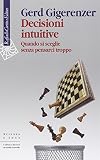
Gut Feelings: The Intelligence of the Unconscious
by Gerd Gigerenzer
On This Page
Description
Gigerenzer is one of the researchers of behavioral intuition responsible for the science behind Malcolm Gladwell's bestseller Blink. Gladwell showed how snap decisions often yield better results than careful analysis. Now, Gigerenzer explains why intuition is such a powerful decision-making tool. Drawing on a decade of research, Gigerenzer demonstrates that gut feelings are actually the result of unconscious mental processes--processes that apply rules of thumb that we've derived from our show more environment and prior experiences. The value of these rules lies precisely in their difference from rational analysis--they take into account only the most useful bits of information rather than attempting to evaluate all possible factors. By examining various decisions we make, Gigerenzer shows how gut feelings not only lead to good practical decisions, but also underlie the moral choices that make our society function.--From publisher description. show lessTags
Recommendations

















Member Reviews
In all candor, the book was a bit too "wonky" for me. It's not that one must be an expert in neuroscience to glean some fascinating insights. But I do think the work could have been made more accessible if it included additional anecdotal material. It gets a bit dense and even feels somewhat redundant as a reader hits the midway point. Still, the author serves up some interesting perspectives.
Da ingegnere ero partito in università ad osannare parole come "ottimizzazione", "minimizzare", "estremi", e ad apprezzare la razionalità bayesiana in quanto normativa e da approssimare per quanto possibile.
E' anche vero che l'overfitting e l'eccesso di informazione venivano comunque visti negativamente.
Poi è arrivata la psicologia cognitiva, e sono passato ad un approccio descrittivo della ir-razionalità dei decisori reali, facendomi grasse risate alle spalle degli economisti e dei teorici dei giochi.
Ora con Gigerenzer bisogna togliersi, insieme a Darwin, il cappello e riconoscere quanto l'adattamento alla scarsità di informazione e l'uso di metodi semplici possa portare lontano, ricordando che l'ottimo è nemico del bene.
Detto show more questo, la prima metà del libro è densa di esperimenti interessanti, poco noti (a me), o noti ma interpretati da un'angolatura nuova.
Man mano che si procede verso la seconda subentra un po' troppo l'aneddoto, la ripetizione e, in ultima analisi, la noia. show less
E' anche vero che l'overfitting e l'eccesso di informazione venivano comunque visti negativamente.
Poi è arrivata la psicologia cognitiva, e sono passato ad un approccio descrittivo della ir-razionalità dei decisori reali, facendomi grasse risate alle spalle degli economisti e dei teorici dei giochi.
Ora con Gigerenzer bisogna togliersi, insieme a Darwin, il cappello e riconoscere quanto l'adattamento alla scarsità di informazione e l'uso di metodi semplici possa portare lontano, ricordando che l'ottimo è nemico del bene.
Detto show more questo, la prima metà del libro è densa di esperimenti interessanti, poco noti (a me), o noti ma interpretati da un'angolatura nuova.
Man mano che si procede verso la seconda subentra un po' troppo l'aneddoto, la ripetizione e, in ultima analisi, la noia. show less
After hearing this book described as the "science behind Malcolm Gladwell's Blink," I thought that it might be inaccessible and filled with jargon. Instead, I found that Gigerenzer directs his entertaining and controversial book to the average reader.
His scientific study of intuition in decision-making is fascinating. Throughout the book he defends simple, unconscious thought processes (what we would call intuition), which are usually ignored in favor of complex formulas. For example, many scientists—and average people—believe that looking at and carefully weighing twenty factors will lead to a better decision than relying on only one or two factors. But as Gigerenzer illustrates, a basic evolutionary rule of thumb, like “one good show more reason is enough” often leads to better predictions than an involved multiple regression!
Every chapter had something to surprise me. Besides offering an easy-to-read version of his scientific evidence, Gigenrenzer also provides some real world applications of his theories. I’d still like to read Blink and see how Gladwell draws upon or expands on Gigerenzer’s ideas. show less
His scientific study of intuition in decision-making is fascinating. Throughout the book he defends simple, unconscious thought processes (what we would call intuition), which are usually ignored in favor of complex formulas. For example, many scientists—and average people—believe that looking at and carefully weighing twenty factors will lead to a better decision than relying on only one or two factors. But as Gigerenzer illustrates, a basic evolutionary rule of thumb, like “one good show more reason is enough” often leads to better predictions than an involved multiple regression!
Every chapter had something to surprise me. Besides offering an easy-to-read version of his scientific evidence, Gigenrenzer also provides some real world applications of his theories. I’d still like to read Blink and see how Gladwell draws upon or expands on Gigerenzer’s ideas. show less
A really good introduction into modern research on psychological heuristics. The book is based on three main ideas: 1) many of our decisions are based on fast and frugal rules of thumb (as opposed to exhaustive calculations); 2) these rules are successful because they confer evolutionary advantage (and for this same reason, they are not consciously accessible, i.e. they present themselves as 'gut feelings'); 3) their predictive power comes from the fact that by being simple they avoid overfitting the data. I found this book much better written than the average popular science book. In addition to being very clearly written and containing very well chosen entertaining examples, it surprised me with a couple of some really interesting show more analyses. The first one is an analysis of the one dimensional voter (chapter 8) where Gigerenzer shows experimentally how a) Left-Right linear ordering immediately induces a complete ordering of preferences b) issues that seem orthogonal to Left-Right distinctions very readily get mapped on the same axis by the amount of support that an issue receives from a candidate who already has a location on that axis. The second one is the analysis of 'split-brain' organizations, i.e. organizations that employ very robust heuristics for their decisions ('let's not get sued!') but then confabulate a completely independent set of principles to explain/justify their decisions. show less
Flatly, this wasn't one of the best books on behavioral economics. There were far better ones trying to explain how irrationally our mind works, from those of Dan Ariely to Daniel Kahneman. But what this book was good for was about how intuition can help us make our decisions correctly most of the time.
The subject is a can of worms. With each school going at it from both ends. What Dr. Gigerenzer has managed to do is give us more than a decent share of examples and cases where intuition has worked better than logic or reasoning.
So, if you ever want to understand that feeling in the pit of your stomach, this book may be able to answer some questions that you might have.
The subject is a can of worms. With each school going at it from both ends. What Dr. Gigerenzer has managed to do is give us more than a decent share of examples and cases where intuition has worked better than logic or reasoning.
So, if you ever want to understand that feeling in the pit of your stomach, this book may be able to answer some questions that you might have.
MUCH better than Gladwell's "Blink". "Blink" reads like a series of interesting case studies, but by the end of that book you still have no clue about how intuition truly works.
Gigerenzer, who is a scientist and has done much of the original research in this field (unlike Gladwell who is a science writer that tries to capture the public's imagination), relates in very clear and precise terms HOW some forms of intuition are thought to work at this time.
Gigerenzer, who is a scientist and has done much of the original research in this field (unlike Gladwell who is a science writer that tries to capture the public's imagination), relates in very clear and precise terms HOW some forms of intuition are thought to work at this time.
It was so nice to read a book written by a researcher instead of a book that quotes other research.
What I got out of the book:
Simple decision strategies often
- Are faster
- Have a higher accuracy rate
Than strategies that utilize more information.
Simple decision strategies work better than more complex strategies when there is more randomness or noise in the environment.
I enjoyed this book.
What I got out of the book:
Simple decision strategies often
- Are faster
- Have a higher accuracy rate
Than strategies that utilize more information.
Simple decision strategies work better than more complex strategies when there is more randomness or noise in the environment.
I enjoyed this book.
Members
- Recently Added By
Author Information

25 Works 2,208 Members
Gerd Gigerenzer is director of the Center for Adaptive Behavior and Cognition at the Max Planck Institute for Human Development in Berlin, Germany. He has taught at several universities, including the University of Chicago and the University of Virginia, and has been a Fellow at the Center of Advanced Study in the Behavioral Sciences at Stanford show more University show less
Awards and Honors
Common Knowledge
- Original publication date
- 2007
- Dedication
- In affectionate memory of my mother and her courage, humor, and patience
Classifications
- Genres
- Nonfiction, Science & Nature, General Nonfiction
- DDC/MDS
- 153.44 — Philosophy and Psychology Psychology Conscious mental processes and intelligence Thought, thinking, reasoning, intuition, value, judgment Intuition
- LCC
- BF315.5 .G54 — Philosophy, Psychology and Religion Psychology Psychology Consciousness. Cognition
- BISAC
Statistics
- Members
- 791
- Popularity
- 34,898
- Reviews
- 10
- Rating
- (3.69)
- Languages
- 8 — Dutch, English, French, German, Italian, Japanese, Portuguese, Spanish
- Media
- Paper, Audiobook, Ebook
- ISBNs
- 26
- ASINs
- 9