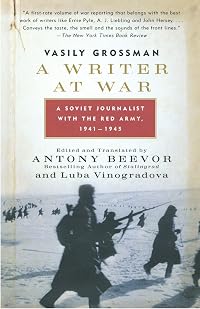
A Writer at War. Vasily Grossman with the Red Army 1941-1945
by Vasily Grossman (Author), Antony Beevor
On This Page
Description
A special correspondent for The Red Star, the Red Army's newspaper, documents the savage battles of World War II, the siege of Stalingrad, the great tank battle of Kursk, the defense of Moscow, and early revelations about the Holocaust. Based on the notebooks in which Vasily Grossman gathered the raw materials for his newspaper articles, this book depicts as never before the crushing condition on the Eastern Front during World War II and the lives and deaths of infantrymen, tank drivers, show more pilots, snipers, and civilians. Deemed unfit for service when the Germans invaded the Soviet Union in 1941, Grossman became a special correspondent for 'The Red Star, ' the Red Army newspaper. A portly novelist in his mid-thirties with no military experience, he was given a uniform and hastily taught how to use a pistol. Remarkably, he spent three of the next four years at the front, observing with a writer's eye the most pitiless fighting ever recorded. Grossman witnessed almost all the major events of the Eastern Front: the appalling defeats and desperate retreats of 1941, the defense of Moscow, and the fighting in the Ukraine. In August 1942 he was posted to Stalingrad, where he remained during four brutal months of street fighting. Grossman was present at the battle of Kursk (the largest tank engagement in history), and, as the Red Army advanced, he reached Berdichev, where his worst fears for his mother and other relatives were confirmed. A Jew himself, he undertook the faithful recording of Holocaust atrocities as their extent dawned. His supremely powerful report 'The hell of Treblinka' was used in evidence at the Nuremberg tribunal. Anthony Beever, a historian, along with Luba Vinogradova, have woven Grossman's notebooks into a fluid, compelling narrative that gives us one of the best descriptions- at once unflinching and sensitive- of what Grossman called 'the ruthless truth of war.' -- from Book Jacket. show lessTags
Recommendations





Member Recommendations
Member Reviews
This book is one of the best accounts of the Soviet front out there. It is fascinating (although I may be biased, I do love accounts focusing on the actual people on the ground). It is fantastically edited in an attempt to tell a complete story. The raw quotes hit deep and hard, they are exquisite. I highly recommend it, if you won't read anything else about the USSR during this time period, at least read this.
This is the book that introduced me to Vasily Grossman, and I am now determined to read all his novels. His writing style is gripping, but so are his observations. I enjoyed how he focused on the specific everyday person. It is refreshing, compared to many other war time books that focus on the commandants and officers or war show more strategies.
On a personal note, this book changed my outlook on life in general and the USSR. It was a gripping read but heavy, I got through it slowly, I annotated, this was all I could talk about for months. I genuinely believe this is one of those books I will carry with me wherever I move and reread often. show less
This is the book that introduced me to Vasily Grossman, and I am now determined to read all his novels. His writing style is gripping, but so are his observations. I enjoyed how he focused on the specific everyday person. It is refreshing, compared to many other war time books that focus on the commandants and officers or war show more strategies.
On a personal note, this book changed my outlook on life in general and the USSR. It was a gripping read but heavy, I got through it slowly, I annotated, this was all I could talk about for months. I genuinely believe this is one of those books I will carry with me wherever I move and reread often. show less
Vasily Grossman wrote one of my favourite novels, [b:Life and Fate|88432|Life and Fate|Vasily Grossman|https://images.gr-assets.com/books/1320447178s/88432.jpg|2435598]. It is astounding that the novel was only published because a friend had a copy of the manuscript, which was smuggled into Switzerland years later. Grossman died thinking that his magnificent book would be suppressed forever. In 'A Writer At War' the reader finds the seeds of [b:Life and Fate|88432|Life and Fate|Vasily Grossman|https://images.gr-assets.com/books/1320447178s/88432.jpg|2435598], as Grossman reported from the Eastern Front throughout the war. He observed the disastrous Soviet losses of 1941, the Battle of Stalingrad, the turning of the tide against the show more Axis, and the rush to Berlin. The book is for the most part a digest of his notebooks, with excepts from his colleagues' writing, contextual notes, and some of the pieces he filed for Red Star (the Red Army newspaper).
Much of the book thus consists of fragments, although it holds together very well. Grossman was embedded within the Red Army and interviewed all the soldiers he could, of every rank, as well as civilians. He had an eye for interesting details and anecdote. There is an interesting tension between his idealistic desire to report individual experiences and his patriotic duty to produce good propaganda. Grossman complained in letters to his relatives that his pieces were edited and changed in ways he disliked. Moreover, the contents of his notebooks would have brought him trouble had they been read by the authorities. Although he was wholly loyal to the Soviet regime, there was zero tolerance of criticism in Stalinist Russia. The fact that he recorded mistakes, desertions, and bad behaviour within the Red Army would have been suspect in itself. It is also notable that Grossman’s idealistic view of the army, which was perhaps at its height during the terrible days of Stalingrad’s defence, declined once the army advanced beyond Russia’s borders. The looting, rape, and vengeful violence enacted by the army was chronicled by Grossman, along with the victorious advance.
There are two elements of this book that will really stick in my memory. The first is Kuznechik the camel, who accompanied the 308th Rifle Division on their advance from Stalingrad to Berlin. Upon arrival in Berlin, he was allegedly led to the Reichstag in order to spit upon its ruins. He also received a medal 'For the Defence of Stalingrad'. Given the appalling level of casualties during the Battle of Stalingrad in particular and on the Eastern Front in general, there is something magical and charming about the idea that a camel could survive it all.
The most memorable part of the book, however, is the section on Treblinka. Unlike the rest of the chapters, it is a long contiguous piece of Grossman’s writing, presented with only brief initial context. This essay, titled ‘The Hell of Treblinka’ was quoted at the Nuremberg trials. It is utterly incredible, the part of the book that most clearly shows Grossman’s immense writing talent. When I reached the end of it, I looked up from the book and listened to my breathing for a moment to remind myself that I was still alive. Grossman saw Treblinka and interviewed the handful of survivors found by the Red Army. The piece is as devastating and horrific as any first hand account of the Holocaust I’ve read. What gives it exceptional impact is the insight into the psychology of the concentration camp. Grossman attempts to explain how twenty-five or so SS men and around a hundred Ukrainian auxiliaries were able to destroy an estimate eight hundred thousand people, through deception, manipulation, and dehumanisation. He ends by describing the grotesque attempts to dismantle and cover up the camp, finally presenting the image of the earth being unable to hide evidence of the massacres. Amongst the lupins that grew on the site of Treblinka, he found items belonging to those murdered, even locks of their hair. The full text of ‘The Hell of Treblinka’ can be found here: http://dl.dropboxusercontent.com/u/47875651/TheHellOfTreblinka.html I think it is a very important thing to read.
Given the power of this piece, I was shocked that Grossman was not actually asked to report on the concentration camps the Red Army discovered in Poland. The colleague who did, Simonov, was careful to avoid mentioning that the vast majority of victims were Jewish. As the editors comment, 'the Stalinist line refused to accept any special categories of suffering'. Grossman’s articles on Nazi atrocities were censored to reduce 'emphasis on the Jews as victims,' and to suppress evidence that former Soviet states had collaborated in the Holocaust.
'A Writer At War' is fascinating, powerful, and moving as history, as war reporting, as biography, as autobiography, and as context for some of the best novels of the twentieth century. I highly recommend it. show less
Much of the book thus consists of fragments, although it holds together very well. Grossman was embedded within the Red Army and interviewed all the soldiers he could, of every rank, as well as civilians. He had an eye for interesting details and anecdote. There is an interesting tension between his idealistic desire to report individual experiences and his patriotic duty to produce good propaganda. Grossman complained in letters to his relatives that his pieces were edited and changed in ways he disliked. Moreover, the contents of his notebooks would have brought him trouble had they been read by the authorities. Although he was wholly loyal to the Soviet regime, there was zero tolerance of criticism in Stalinist Russia. The fact that he recorded mistakes, desertions, and bad behaviour within the Red Army would have been suspect in itself. It is also notable that Grossman’s idealistic view of the army, which was perhaps at its height during the terrible days of Stalingrad’s defence, declined once the army advanced beyond Russia’s borders. The looting, rape, and vengeful violence enacted by the army was chronicled by Grossman, along with the victorious advance.
There are two elements of this book that will really stick in my memory. The first is Kuznechik the camel, who accompanied the 308th Rifle Division on their advance from Stalingrad to Berlin. Upon arrival in Berlin, he was allegedly led to the Reichstag in order to spit upon its ruins. He also received a medal 'For the Defence of Stalingrad'. Given the appalling level of casualties during the Battle of Stalingrad in particular and on the Eastern Front in general, there is something magical and charming about the idea that a camel could survive it all.
The most memorable part of the book, however, is the section on Treblinka. Unlike the rest of the chapters, it is a long contiguous piece of Grossman’s writing, presented with only brief initial context. This essay, titled ‘The Hell of Treblinka’ was quoted at the Nuremberg trials. It is utterly incredible, the part of the book that most clearly shows Grossman’s immense writing talent. When I reached the end of it, I looked up from the book and listened to my breathing for a moment to remind myself that I was still alive. Grossman saw Treblinka and interviewed the handful of survivors found by the Red Army. The piece is as devastating and horrific as any first hand account of the Holocaust I’ve read. What gives it exceptional impact is the insight into the psychology of the concentration camp. Grossman attempts to explain how twenty-five or so SS men and around a hundred Ukrainian auxiliaries were able to destroy an estimate eight hundred thousand people, through deception, manipulation, and dehumanisation. He ends by describing the grotesque attempts to dismantle and cover up the camp, finally presenting the image of the earth being unable to hide evidence of the massacres. Amongst the lupins that grew on the site of Treblinka, he found items belonging to those murdered, even locks of their hair. The full text of ‘The Hell of Treblinka’ can be found here: http://dl.dropboxusercontent.com/u/47875651/TheHellOfTreblinka.html I think it is a very important thing to read.
Given the power of this piece, I was shocked that Grossman was not actually asked to report on the concentration camps the Red Army discovered in Poland. The colleague who did, Simonov, was careful to avoid mentioning that the vast majority of victims were Jewish. As the editors comment, 'the Stalinist line refused to accept any special categories of suffering'. Grossman’s articles on Nazi atrocities were censored to reduce 'emphasis on the Jews as victims,' and to suppress evidence that former Soviet states had collaborated in the Holocaust.
'A Writer At War' is fascinating, powerful, and moving as history, as war reporting, as biography, as autobiography, and as context for some of the best novels of the twentieth century. I highly recommend it. show less
Vasili Semenovich Grossman was a decorated Soviet military journalist best known in the West for his epic novel, Life and Fate (New York Review Books Classics). In 'A Writer at War' editors and translators Anthony Beevor (Stalingrad: The Fateful Siege: 1942-1943), an esteemed historian and author in his own right, and Luba Vinogradova, follow Grossman's progression through the war by piecing together stories from his notebooks and writings. At times one would have liked a bit more context to be provided by Beevor, but that is a minor quibble.
Grossman, while still a loyal Communist at this point, managed to maintain a relatively objective viewpoint. He often pushed his editors to allow him to write stories they did not want written, in show more particular regarding the fate of the Jews in the Ukraine under German occupation and the role of the Ukrainians.
While at time the stories have to be stitched together from bits and pieces, `A Writer at War' is a gold mine and provides a rare view into the inner workings of the Soviet military and Soviet military journalism in particular. Grossman experienced the initial German onslaught and the Russian flight from it, Stalingrad, the tank battle at Kursk, and the death camps. The book includes an extensive article on the workings of the German death camp Treblinka. Earns the highest recommendation. show less
Grossman, while still a loyal Communist at this point, managed to maintain a relatively objective viewpoint. He often pushed his editors to allow him to write stories they did not want written, in show more particular regarding the fate of the Jews in the Ukraine under German occupation and the role of the Ukrainians.
While at time the stories have to be stitched together from bits and pieces, `A Writer at War' is a gold mine and provides a rare view into the inner workings of the Soviet military and Soviet military journalism in particular. Grossman experienced the initial German onslaught and the Russian flight from it, Stalingrad, the tank battle at Kursk, and the death camps. The book includes an extensive article on the workings of the German death camp Treblinka. Earns the highest recommendation. show less
A Writer at War is a very good book and much of the writing, especially concerning the battle of Stalingrad, provided material for Grossman's masterpiece, Life and Fate. Antony Beevor and Luba Vinogradova translated and edited Grossman's war diaries, and explain the historical contexts in short notes which are very helpful. In some ways, this book is a nice complement to Catherine Merridale's, Ivan's War: Life and Death in the Red Army 1939-1945. Grossman was there, and reported on, many of the pivotal moments of the war: the original battle for Moscow, the battle of Stalingrad, the great tank battle at Kursk, the invasion of Poland, Warsaw, and the entry into Berlin, plus he was in the advance guard that liberated the camps of Majdanek show more and Treblinka.
Grossman was honest about what he saw and what he wanted to write about. This sometimes ran him afoul of the authorities, especially when he wanted to write about the murder of Jews and the collaboration of Ukrainians and others. Such things simply could not be published in his main paper, Krasnaya Zveda (Red Star), but he did manage to publish some accounts, suitably sanitized to protect himself, in a Jewish journal and through his work on The Black Book that was intended to chronicle the German murder of Jews in the Soviet Union. The Black Book never saw the light of day after the war.
Grossman had a fine eye for the details that paint the bigger picture whether it was a battle or a destroyed village. He was a favourite among the troops because he understood their feelings and their privations while he at the same time wrote about their bravery. This was never more evident than in his dispatches from the hell of Stalingrad. Grossman describes the panic and despair of the early months of the war when all seemed lost and the Red Army was continually falling back when it was not being surrounded and destroyed. The turning point was the successful defense of Moscow after which there was a growing sense that victory could be possible, however, more terrible setbacks were in store, and it wasn't until after Stalingrad that the tide had clearly turned. At the battle of Kursk, the Wehrmacht had been decisively outfought and, "The Red Army had proved once again the dramatic improvement in the professionalism of its commanders, the morale of its soldiers and the effective application of force." Although, even then, Grossman was not blind to continuing defects such as his observation that, "...units continued to suffer from the inability of Red Army commanders and staff officers to think things through." Grossman is unsparing in his assessment of army commanders, the good, the bad and the ugly; nor does he even try to gloss over the continuing tensions among the nationalities of the Soviet Union, the too-free use of manpower in wasted attacks, the contempt and hatred of the ordinary soldier for the political advisors, the drunkenness, the looting, the mass rapes through Poland and into Germany, even including Russian women who had been prisoners of the Germans and who were at first overjoyed to be liberated by the Red Army.
Grossman also maintained a broader historical perspective and, again, an eye for the detail that carries a thousand images. For instance, his description of wandering through the ruined Reichschancellery, Speer's monument to the grandiosity of the Nazi regime that thought it would live for a thousand years:
"The new Reichschancellery. It's a monstrous crash of the regime, ideology, plans, everything, everything. Hitler kaputt....Hitler's office. The reception hall. A huge foyer, in which a young Kazakh, with dark skin and broad cheekbones, is learning to ride a bicycle, falling off it now and then. Hitler's armchair and table. A huge metal globe, crushed and crumpled, plaster, planks of wood, carpets. Everything is mixed up. It's chaos. Souvenirs, books with dedicatory inscriptions to the Fuhrer, stamps, etc."
Throughout his reporting, Grossman often dwelt upon the sufferings of ordinary people. He understood them, he talked to them at every opportunity, and he wrote about them and their shattered lives. Yet, despite what he saw and experienced, and the fact that he was tormented all his life by the murder of his mother because she was Jewish, he was able to maintain the distinction between Hitler's men and ordinary Germans. He does not come across a bitter man.
Treblinka was almost too much for Grossman to absorb, as a Jew, and as a human being, but his account, his description of it is one of the most moving I have read...an attempt to describe the indescribable and to pay homage to those murdered there by remembering the humanity that had been stripped from them. His article on this was read out at the Nuremberg trial.
After the war, Grossman fell onto hard times because he was Jewish, because he was outspoken, and because he did not always toe the Party line. Beevor and Vinogradova maintain that he was saved from the Gulag only by Stalin's death. His great novel, Life and Fate was not published in his lifetime; in fact the Soviet authorities tried their best to find and destroy every single copy, and one of the chief ideological authorities said the book would not be published for 200 years in the Soviet Union. Luckily, a friend had managed to save one copy and it eventually make its way to the west where it was published. The book will still be around 200 years from now but of course it is the Soviet Union itself that has long been consigned to the dustbins of history.
To the end of his life, Grossman retained a love and a respect for the ordinary soldier who had experienced extraordinary events and had made extraordinary sacrifices. I would say that as much as anyone can, through language and description, try to portray those events and sacrifices, Grossman did so in these diaries and reports. show less
Grossman was honest about what he saw and what he wanted to write about. This sometimes ran him afoul of the authorities, especially when he wanted to write about the murder of Jews and the collaboration of Ukrainians and others. Such things simply could not be published in his main paper, Krasnaya Zveda (Red Star), but he did manage to publish some accounts, suitably sanitized to protect himself, in a Jewish journal and through his work on The Black Book that was intended to chronicle the German murder of Jews in the Soviet Union. The Black Book never saw the light of day after the war.
Grossman had a fine eye for the details that paint the bigger picture whether it was a battle or a destroyed village. He was a favourite among the troops because he understood their feelings and their privations while he at the same time wrote about their bravery. This was never more evident than in his dispatches from the hell of Stalingrad. Grossman describes the panic and despair of the early months of the war when all seemed lost and the Red Army was continually falling back when it was not being surrounded and destroyed. The turning point was the successful defense of Moscow after which there was a growing sense that victory could be possible, however, more terrible setbacks were in store, and it wasn't until after Stalingrad that the tide had clearly turned. At the battle of Kursk, the Wehrmacht had been decisively outfought and, "The Red Army had proved once again the dramatic improvement in the professionalism of its commanders, the morale of its soldiers and the effective application of force." Although, even then, Grossman was not blind to continuing defects such as his observation that, "...units continued to suffer from the inability of Red Army commanders and staff officers to think things through." Grossman is unsparing in his assessment of army commanders, the good, the bad and the ugly; nor does he even try to gloss over the continuing tensions among the nationalities of the Soviet Union, the too-free use of manpower in wasted attacks, the contempt and hatred of the ordinary soldier for the political advisors, the drunkenness, the looting, the mass rapes through Poland and into Germany, even including Russian women who had been prisoners of the Germans and who were at first overjoyed to be liberated by the Red Army.
Grossman also maintained a broader historical perspective and, again, an eye for the detail that carries a thousand images. For instance, his description of wandering through the ruined Reichschancellery, Speer's monument to the grandiosity of the Nazi regime that thought it would live for a thousand years:
"The new Reichschancellery. It's a monstrous crash of the regime, ideology, plans, everything, everything. Hitler kaputt....Hitler's office. The reception hall. A huge foyer, in which a young Kazakh, with dark skin and broad cheekbones, is learning to ride a bicycle, falling off it now and then. Hitler's armchair and table. A huge metal globe, crushed and crumpled, plaster, planks of wood, carpets. Everything is mixed up. It's chaos. Souvenirs, books with dedicatory inscriptions to the Fuhrer, stamps, etc."
Throughout his reporting, Grossman often dwelt upon the sufferings of ordinary people. He understood them, he talked to them at every opportunity, and he wrote about them and their shattered lives. Yet, despite what he saw and experienced, and the fact that he was tormented all his life by the murder of his mother because she was Jewish, he was able to maintain the distinction between Hitler's men and ordinary Germans. He does not come across a bitter man.
Treblinka was almost too much for Grossman to absorb, as a Jew, and as a human being, but his account, his description of it is one of the most moving I have read...an attempt to describe the indescribable and to pay homage to those murdered there by remembering the humanity that had been stripped from them. His article on this was read out at the Nuremberg trial.
After the war, Grossman fell onto hard times because he was Jewish, because he was outspoken, and because he did not always toe the Party line. Beevor and Vinogradova maintain that he was saved from the Gulag only by Stalin's death. His great novel, Life and Fate was not published in his lifetime; in fact the Soviet authorities tried their best to find and destroy every single copy, and one of the chief ideological authorities said the book would not be published for 200 years in the Soviet Union. Luckily, a friend had managed to save one copy and it eventually make its way to the west where it was published. The book will still be around 200 years from now but of course it is the Soviet Union itself that has long been consigned to the dustbins of history.
To the end of his life, Grossman retained a love and a respect for the ordinary soldier who had experienced extraordinary events and had made extraordinary sacrifices. I would say that as much as anyone can, through language and description, try to portray those events and sacrifices, Grossman did so in these diaries and reports. show less
From the extensive quotes from Grossman and the authors commentaries on them one can only wonder what was left out because of Stalin and his censor's watchful eyes. There is enough here to be of interest but the suspicion is there could be so much more. However, Grossman, a Jew, does not miss the barbarities inflicted on his kind in the Ukraine and the Nazi horrors of the concentration camps in Poland. This is still a must read because where would we go to find such intimate and first hand detail.
Quotes: (page 95) “Grossman was so deeply affected by the genuine spirit of sacrifice among ordinary soldiers and front-line officers that he became quite emotional on the subject.
At war, a Russian puts on a white shirt. He may live in sin, show more but he dies like a saint. At the front {there is} a purity of thought and soul, a kind of monastic austerity.
The rear [the civilian part of the country] lives by different laws and it would never be able to merge morally with the front. Its law is life, and struggle for survival. We Russians don't know how to live like saints, we only know how to die like saints. The front [represents] the holiness of Russian death, the rear is the sin of Russian life.”
(page 187) “One of Grossman's most celebrated articles in Krasnaya Zvezda was entitled 'The Stalingrad Battle', a collection of descriptions, some just vignettes.
In the light of the rockets one sees destroyed buildings, the land covered with trenches, the bunkers in the cliff and gullies, deep holes protected from bad weather by pieces of tin and planks of wood.
'Hey, can you here me? Have they brought dinner yet?' asks a soldier, who is sitting by the entrance of the bunker.
'They left a long time ago to fetch it, and look, they haven't returned yet,' a voice answers from the darkness.
'They either had to shelter somewhere, or they're never coming back. [Enemy] fire around the field kitchen is too heavy.'
'What louses! I badly want dinner,' says the sitting soldier in an unhappy voice, and yawns...
(pages 250-251) “ In the Autumn of 1943 he had written an article entitled 'Ukraine without Jews' . This appears to have been turned down by Krasnaya Zvezda and it appeared in Einikeit, the journal of the Jewish Anti-Fascist Committee.
There are no Jews in the Ukraine, Nowhere – Poltava, Kharkov, Kremenchug, Borispol, Yagotin – in none of the cities, hundreds of towns, or thousands of villages will you see the black, tear-filled eyes of little girls: you will not see the dark face of a hungry baby. All is silence. Everything is still. A whole people has been brutally murdered,” show less
Quotes: (page 95) “Grossman was so deeply affected by the genuine spirit of sacrifice among ordinary soldiers and front-line officers that he became quite emotional on the subject.
At war, a Russian puts on a white shirt. He may live in sin, show more but he dies like a saint. At the front {there is} a purity of thought and soul, a kind of monastic austerity.
The rear [the civilian part of the country] lives by different laws and it would never be able to merge morally with the front. Its law is life, and struggle for survival. We Russians don't know how to live like saints, we only know how to die like saints. The front [represents] the holiness of Russian death, the rear is the sin of Russian life.”
(page 187) “One of Grossman's most celebrated articles in Krasnaya Zvezda was entitled 'The Stalingrad Battle', a collection of descriptions, some just vignettes.
In the light of the rockets one sees destroyed buildings, the land covered with trenches, the bunkers in the cliff and gullies, deep holes protected from bad weather by pieces of tin and planks of wood.
'Hey, can you here me? Have they brought dinner yet?' asks a soldier, who is sitting by the entrance of the bunker.
'They left a long time ago to fetch it, and look, they haven't returned yet,' a voice answers from the darkness.
'They either had to shelter somewhere, or they're never coming back. [Enemy] fire around the field kitchen is too heavy.'
'What louses! I badly want dinner,' says the sitting soldier in an unhappy voice, and yawns...
(pages 250-251) “ In the Autumn of 1943 he had written an article entitled 'Ukraine without Jews' . This appears to have been turned down by Krasnaya Zvezda and it appeared in Einikeit, the journal of the Jewish Anti-Fascist Committee.
There are no Jews in the Ukraine, Nowhere – Poltava, Kharkov, Kremenchug, Borispol, Yagotin – in none of the cities, hundreds of towns, or thousands of villages will you see the black, tear-filled eyes of little girls: you will not see the dark face of a hungry baby. All is silence. Everything is still. A whole people has been brutally murdered,” show less
Wavered on the star rating for this one, but I'll go with four stars, since it was the reading experience and not the book itself I had trouble with. I read it as an ebook, and it just didn't translate well to electronic format: too many photos and maps, and long stretches of italic text that I found strenuous to read. (The print edition sets these off as block-quotes, which I'd have much preferred.)
It's a fascinating read. The editors do a remarkable job taking the raw material and streamlining it into coherence, considering how much of it began as spur-of-the-moment reflections jotted hastily into a notebook. Grossman doesn't attempt to paint a complete picture of the Soviet war effort. He's concerned, rather, with the lives of the show more men on the ground. His--and the everyday Soviet soldier's--experience is related in snapshots, vignettes, one- or two-sentence snippets, with no attempt at whitewashing or sanitizing or even reconciling contradictions. Grossman simply tells it as it is. He's determined to keep the "ruthless truth" of the war free of "ideological and artistic" convention, and he succeeds. show less
It's a fascinating read. The editors do a remarkable job taking the raw material and streamlining it into coherence, considering how much of it began as spur-of-the-moment reflections jotted hastily into a notebook. Grossman doesn't attempt to paint a complete picture of the Soviet war effort. He's concerned, rather, with the lives of the show more men on the ground. His--and the everyday Soviet soldier's--experience is related in snapshots, vignettes, one- or two-sentence snippets, with no attempt at whitewashing or sanitizing or even reconciling contradictions. Grossman simply tells it as it is. He's determined to keep the "ruthless truth" of the war free of "ideological and artistic" convention, and he succeeds. show less
Questo libro raccoglie alcuni racconti/reportage di guerra ed il famoso saggio su Treblinka, usato anche come testimonianza al processo di Norimberga. Era ancora il periodo nel quale Grossman era apprezzato dal regime ed i suoi scritti sono pieni di esaltazione nei confronti del regime stesso e della grandezza e unicità dell’Unione Sovietica. Sembra che la salvezza dell’umanità sia dipesa dagli eroici difensori di Stalingrado; eroici lo sono stati davvero ma da quello che ho letto più volte sembra che Stalingrado fosse stata solo una “vetrina” per i due regimi totalitari; l’importanza della città non era strategica ma solamente il fatto che portasse il nome del “piccolo padre”. Negli scritti successivi di Grossman show more questa visione idilliaca del regime stalinista è ormai infranta definitivamente. L’inferno a Treblinka lo avevo già letto in un’altra edizione e mi aveva giustamente colpito e commosso. Rileggendolo ora qualcosa mi suona male, sgradevole, fuorviante. Ci sono diverse imprecisioni ma quelle sono dovute al fatto che il libro è stato scritto non appena il campo è stato liberato e che si iniziasse allora a fare luce sulle mostruosità del nazismo (Auschwitz fu liberato dopo); non mi riferisco a queste cose. Quello che mi sembra pericoloso è il concetto che tutte le colpe fossero dei tedeschi o, meglio ancora, del nazismo. È come quando un pazzo va in un luogo pubblico, fa una strage e poi si suicida. Possiamo piangere le vittime ma non c’è più nessuno da giudicare e condannare e non c’è più niente da temere. Morto Hitler, finito il nazismo (il partito ufficiale), impiccati quelle due o tre bestie che non si sono suicidate, è tutto finito. Putroppo la Germania si è soltanto limitata ad organizzare con la pignoleria di un ragioniere (La banalità del male) quei sentimenti che in molte altre nazioni erano presenti da tantissimo. Le efferatezze fatte con piacere, sicuramente dovute anche a molti tedeschi, le vedo più dei popoli occupati. Mi torna in mente Elias Canetti che racconta che la madre dovette andare a fare l’università in Germania, ante nazismo, perché in Polonia era vietata agli ebrei. Purtroppo non ricordo chi (scampato ad un campo di sterminio) disse: “I tedeschi sono cattivi, i polacchi ancora di più, ma i più feroci sono gli ucraini”. Non ci scordiamo che i tedeschi dovettero “calmare” i Romeni presi da troppo entusiasmo nello sterminio degli ebrei come riporta Hannah Arendt (ora sui muri delle Sinagoghe romene ci sono lapidi in inglese che presentano i romeni come i più grandi difensori degli ebrei durante la Shoah), non ci scordiamo la ferocia degli ucraini sia in Ucraina, sia nei campi di sterminio, i lituani a Vilnius, in tutta l’Europa centrale ed orientale i tedeschi si sono soltanto limitati a “dare il permesso”, poi gli entusiasti cittadini si sono occupati di quasi tutto il lavoro. Alla periferia di Firenze, durante l’occupazione, c’era Villa Triste un luogo dove venivano sperimentate le forme più fantasiose di tortura; a gestirla non erano tedeschi ma gli italiani del maggiore Carità (mai nome fu tanto infelice). L’antisemitismo, il razzismo e la persecuzione efferata sono sempre esistiti ed esistono ancora anche senza nazisti. Proprio in questi giorni (dicembre 2011, vicini al natale quando tutti sono più buoni) c’è stata la spedizione punitiva e relativo incendio del campo Rom di Torino, semplice atto dei penultimi contro gli ultimi o odio cieco contro chi è diverso e quindi inferiore? Per concludere: se questo fosse un libro scritto ora gli darei due o tre stelle al massimo: stalinista e negazionista dell’antisemitismo feroce diffuso in tutta l’Europa centrale e orientale. Visto il momento nel quale è stato scritto, il valore di documento storico, i limiti di conoscenza ed i limiti di libertà, gli do quattro stelle. Un dubbio: Grossman viene presentato come ingegnere .... io sapevo che era un chimico. show less
Members
- Recently Added By
Lists

Witness from the front: accounts of war, revolution, and strife
23 works; 5 members

r/AskHistorians' Recommended Books
1,068 works; 18 members

Russian Literature
184 works; 35 members

Books Read in 2019
4,052 works; 108 members

r/History Recommended Reading List
603 works; 12 members

Books Read in 2018
4,360 works; 110 members

THE WAR ROOM
813 works; 24 members
Author Information

Grossman, a graduate in physics and mathematics from Moscow University, worked first as a chemical engineer and became a published writer during the mid-1930s. His early stories and novel deal with such politically orthodox themes as the struggle against the tsarist regime, the civil war, and the building of the new society. Grossman served as a show more war correspondent during World War II, publishing a series of sketches and stories about his experiences. Along with Ehrenburg, he edited the suppressed documentary volume on the fate of Soviet Jews, The Black Book. In 1952 the first part of his new novel, For the Good of the Cause, appeared and was sharply criticized for its depiction of the war. The censor rejected another novel, Forever Flowing (1955), which was circulated in samizdat and published in the West. The secret police confiscated a sequel to For the Good of the Cause, the novel Life and Fate, in 1961, but a copy was smuggled abroad and published in 1970. Grossman's books were issued in the Soviet Union in the late 1980s and have met with both admiration and, on part of the nationalist right wing, considerable hostility. (Bowker Author Biography) show less

49+ Works 19,819 Members
British historian Antony Beevor was born on December 14, 1946. He was educated at Winchester College and Sandhurst and studied under the well-known World War Two historian, John Keegan. Beevor was an officer with the 11th Hussars for five years before becoming a writer. His works have received awards including the Runciman Prize, the Samuel show more Johnson Prize, the Wolfson Prize for History, and the Hawthornden Prize for Literature. The French government made him a Chevalier de l'Ordre des Arts et des Lettres in 1997, and in 2008 the president of Estonia awarded him the Order of the Cross of Terra Mariana. In 1999 Beevor was elected a Fellow of the Royal Society of Literature. He received the 2014 Pritzker Military Museum and Library Literature Award for Lifetime Achievement in Military Writing. In 2015 he made The New Zealand Best Seller List with his title Ardennes 1944: Hitler's Last Gamble. (Bowker Author Biography) show less
All Editions
Some Editions
Common Knowledge
- Canonical title
- A Writer at War. Vasily Grossman with the Red Army 1941-1945
- Original title
- A Writer at War. Vasily Grossman with the Red Army 1941-1945
- Alternate titles*
- Een schrijver in oorlog
- Original publication date
- 2005; 2006 (Nederlandse vertaling) (Nederlandse vertaling)
- People/Characters
- Vasily Grossman
- Important places
- Berlin, Germany; USSR; Treblinka extermination camp, Treblinka, Masovia, Poland; Stalingrad, USSR (now Volgograd); Russia; Volgograd, Volgograd Oblast, Russia
- Important events
- World War II (1939 | 1945); World War II, Eastern Front (1941-06-22 | 1945-05-05)
- Epigraph
- [None]
- Dedication
- [None]
- First words
- Vasily Grossman's place in the history of world literature is assured by his masterpiece Life and Fate, one of the greatest Russian novels of the twentieth century. (Introduction)
Any translation from the Russian which hopes to be readable in English requires a slight compression of the original, through the deletion of superfluous words and repetitions. (Translator's note)
Front, when written with a capital letter refers to the Soviet equivalent of an army group, for example, Central Front, Western Front or Stalingrad Front. (Glossary)
Hitler's invasion of the Soviet Union began in the early hours on 22 June 1941. - Quotations
- The PPZh was the slang term for a ‘campaign wife’, because the full term, pokhodno polevaya zhena, was similar to PPSh, the standard Red Army sub-machine gun. Campaign wives were young nurses and women soldiers fro... (show all)m a headquarters—such as signalers and clerks—who usually wore a beret on the back of the head rather than the fore-and-aft pilotka cap. They found themselves virtually forced to become the concubines of senior officers. Grossman also scribbled down some bitter notes on the subject, perhaps for use in a story later.
- Women—PPZh. Note about Nachakho, chief of administrative supplies department. She cried for a week, and then went to him.
‘Who’s that?’
‘The general’s PPZh.’
‘And the commissar hasn’t got one.’
Before the attack. Three o’clock in the morning.
‘Where’s the general?’ [someone asks].
‘Sleeping with his whore,’ the sentry murmurs.
And these girls had once wanted to be ‘Tanya’, or Zoya Kosmodemyanskaya.
‘Whose PPZh is she?’
‘A member of the Military Council’s.’
Yet all around them tens of thousands of girls in military uniforms are working hard and with dignity.
A number of Soviet generals did not shrink from hitting even quite senior subordinates, although the striking of soldiers by officers and NCOs had been one of the most hated characteristics of the Tsarist Army.- Convers... (show all)ation of Colonels Shuba and Tarasov with the army commander:
‘“What?”
‘“May I say again...?”
‘“What?”
‘“May I say again...?”
‘He hit Shuba in the mouth. I [presumably Tarasov] stood still, drew my tongue in and clenched my teeth, because I was afraid to bite my tongue off or be left with no teeth.’
Suffering seemed to have become a universal face. Towards the end of the month, Grossman received a letter from his wife, Olga Mikhailovna, in which she recounted the death of her son, Misha, who had been killed by a bomb. He... (show all) wrote back in a clumsy attempt to mitigate her despair.- My own one, my good one. Today I received your letter which someone had brought from Moscow. It grieved deeply. Don’t let your spirits sink, Lyusenka. Don’t give way to despair. There is so much sorrow around us. I see so much of it. I’ve seen mothers who have lost three sons and a husband in this war, I’ve seen wives who’ve lost husbands and children, I’ve seen women whose little children have been killed in a bombing raid, and all these people don’t give way to despair. They work, they look forward to victory, they don’t lose their spirits. And in what hard conditions they have to survive! Be strong, too, my darling, hold on . . . You’ve got me and Fedya, you have love and your life has a meaning.
I’ve been recommended for the Order of the Red Star for the second time, but to no effect so far, just as before. I’ve got this letter taken from a dead soldier; it’s written in a child’s scribble. There are the following words at the end: ‘I miss you very much. Please come and visit, I so want to see you, if only for one hour. I am writing this, and tears are pouring. Daddy, please come and visit.’
Like the other snipers, Zaitsev seemed to be proud of taking revenge on any Russian woman seen associating with a German.- Zaitsev has killed a woman and a German officer: ‘They fell across each other.’
He also interviewed a teacher who had beenraped by a German officer. - Teacher (I decided not to ask her name and surname). At night, an officer, helped by his orderly, raped her. She was holding a six-month-ol... (show all)d baby in her arms. He fired at the floor, threatening to kill the baby. The orderly went away and locked the door. Some of our prisoners of war were in the next room. She cried out and called, but there was dead silence in the next room.
Terrible torments awaited those who arrived from the Warsaw ghetto. Women and children were separated from the crowd and taken to the places where corpses were burned instead of to the gas chambers. Mothers who went mad with ... (show all)terror were forced to lead their children between the glowing furnace bars on which thousands of dead bodies were writhing in flames and smoke, where corpses were squirming and jerking in the heat as if they had became alive again, where stomachs of dead pregnant women cracked from the heat, and unborn babies burned on the open wombs of the mothers. This sight could render even the strongest person insane.
It is infinitely hard even to read this. The reader must believe me, it is as hard to write it. Someone might ask: ‘Why write about this, why remember all that?’ It is the writer’s duty to tell this terrible truth, and it is the civilian duty of the reader to learn it. Everyone who would turn away, who would shut his eyes and walk past would insult the memory of the dead. Everyone who does not know the truth about this would never be able to understand with what sort of enemy, with what sort of monster, our Red Army started on its own mortal combat.
Inhabitants of the village of Wulka, the one closest to Treblinka, tell that sometimes the screams of women who were being killed were so terrible that the whole village would lose their heads and rush to the forest, in order... (show all) to escape from these shrill screams that carried through tree trunks, the sky and the earth. Then, the screams would suddenly stop, and there was a silence before a new series of screams, as terrible as the ones before, shrill, boring through the bones, through the skulls and the souls of those who heard them. This happened three or four times every day.
Horrifying things are happening to German women. An educated German whosewife has received ‘new visitors’—Red Army soldiers—is explaining with expressive gestures and broken Russian words, that she has alrea... (show all)dy been raped by ten men today. The lady is present.
Women’s screams are heard from open windows. A Jewish officer, whose whole family was killed by Germans, is billeted in the apartment of a Gestapo man who has escaped. The women and girls [left behind] are safe while he is there. When he leaves, they all cry and plead with him to stay.
Soviet girls liberated from the camps are suffering a lot now. Tonight, some of them are hiding in our correspondents’ room. During the night, we are woken up by screams: one of the correspondents couldn’t resist the temptation. A noisy discussion ensues, then order is re-established.
A story about a breast-feeding mother who was being raped in a barn. Her relatives came to the barn and asked her attackers to let her have a break, because the hungry baby was crying the whole time. - Last words
- (Click to show. Warning: May contain spoilers.)Grossman himself may have been dragged down by the wolfhound century, but his humanity and his courage have survived in his writing.
*Some information comes from Common Knowledge in other languages. Click "Edit" for more information.
Classifications
Statistics
- Members
- 1,204
- Popularity
- 20,746
- Reviews
- 26
- Rating
- (4.07)
- Languages
- 11 — Danish, Dutch, English, French, German, Italian, Norwegian (Bokmål), Polish, Portuguese, Spanish, Swedish
- Media
- Paper, Ebook
- ISBNs
- 44
- ASINs
- 19