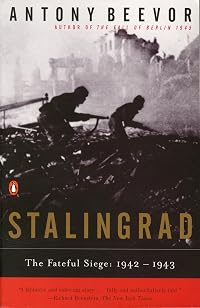
Stalingrad
by Antony Beevor
On This Page
Description
In June 1941, German forces swept across Soviet territory in an offensive that finally brought them within twenty-five miles of Moscow. But in August 1942, the overconfident Hitler chose the wrong target, Stalin?s namesake city on the Volga. The battle of Stalingrad is extraordinary in every way: the triumphant invader fought to a standstill; then the Soviet trap sprung, surrounding their attackers; and the terrible siege, with Germans starving and freezing, forced to fight on by a show more disbelieving Hitler.The story has never been told as Antony Beevor tells it here. He writes of the great Manichaean clash between Stalin and Hitler, and the strategic brilliance and fatal flaws of their generals. Stalingrad is first and foremost the story of the man on the ground, a soldier?s-eye view of fighting house-to-house on an urban battlefield, with helpless civilians caught in the crossfire. Beevor has gained access to Russian reports on desertions and executions that have never been seen by Western scholars, German transcripts of prisoner interrogations, and private letters and diaries. These help re-create the compelling human drama of the most terrible battle in modern warfare. show lessTags
Recommendations












Member Recommendations
Claire5555 Excellent 2nd World War book
The Wolf: How One German Raider Terrorized the Allies in the Most Epic Voyage of WWI by Richard Guilliatt
Claire5555 Excellent book, well worth a read
01
Member Reviews
A tour de force by Beevor, resulting in one of the best books I have read on war and the evil that men do. In the west, we tend to forget about how the Eastern Front was far bigger than the Western Front and more influential for the outcome of World War II. Beevor does extremely well in laying out the lead-up to Operation Barbarossa, the key figures involved, the German advance across Eastern Europe and then Stalingrad, the battle itself and (Warning: Spoiler alert) the German retreat.
My favourite part of "Stalingrad" is the very personal stories of the frontline soldiers that Beevor sources from letters and reports. Senior soldiers found comatose drunk near the front lines, defecting soldiers getting lost and, mistaking Russian show more officers for Germans, announcing his defection, and small orphaned children somehow surviving in the apocalyptic conditions of Stalingrad.
It's time to move on to read Beevor's "Berlin: The Downfall". show less
My favourite part of "Stalingrad" is the very personal stories of the frontline soldiers that Beevor sources from letters and reports. Senior soldiers found comatose drunk near the front lines, defecting soldiers getting lost and, mistaking Russian show more officers for Germans, announcing his defection, and small orphaned children somehow surviving in the apocalyptic conditions of Stalingrad.
It's time to move on to read Beevor's "Berlin: The Downfall". show less
Beevor manages a masterpiece of military history in Stalingrad. He covers this battle completely, from Operation Barbarossa, to the siege and the kessel, and the final disintegration of the Nazi 6th Army into Soviet prison camps and post-war ignominy. The narrative moves easily and naturally between Stalin and Hitler in their supreme HQs, staring at maps and radiotelegraphy reports, to the titanic clash of Panzer divisions, and air fleets, and above all, the dire struggle for survival face by the ordinary soldier. Stalingrad was a meatgrinder, fought by nations that did not give a whit for human life. Deaths on both sides were over one million; exactly how high we'll never know, given the paucity of records. The city was flattened, show more entire armies annihilated, and Beevors recounts again and again the last letters of men going to their death, and human cost of that battle.
What I did not expect was to feel sympathy for the Nazis. Soviet soldiers died horribly; without sufficient weapons or supplies to stop Panzers, executed under the arbitrary discipline of the commissars, but whether it was truth or effective propaganda, most of they knew they were selling their lives dearly in defense of the beloved rodina. Nazis soldiers died for Hitler's pride, in foolish hope that they would be rescued from encirclement. They died starving, frozen, crawling with lice, from disease and from Soviet mistreatment in prisoner-of-war camps. Even genocidal war criminals deserve better.
Stalingrad was the turning point of World War 2, the battle that broke the Wehrmacht, and proved Hitler incompetent. This is the single best book about that battle imaginable. show less
What I did not expect was to feel sympathy for the Nazis. Soviet soldiers died horribly; without sufficient weapons or supplies to stop Panzers, executed under the arbitrary discipline of the commissars, but whether it was truth or effective propaganda, most of they knew they were selling their lives dearly in defense of the beloved rodina. Nazis soldiers died for Hitler's pride, in foolish hope that they would be rescued from encirclement. They died starving, frozen, crawling with lice, from disease and from Soviet mistreatment in prisoner-of-war camps. Even genocidal war criminals deserve better.
Stalingrad was the turning point of World War 2, the battle that broke the Wehrmacht, and proved Hitler incompetent. This is the single best book about that battle imaginable. show less
The best book outlining a single battle that I have ever come across. Read it and it will haunt you. Be careful, seriously impactful and gave me nightmares. Few authors have ever been able to put forth the true horrors of war in a way that really hits home and even begins to hint at the unspeakable things that humans are able to sink to in combat.
Stalingrad is a contender for the single most brutal battle in all of human history. Imagine the Nazi war machine that had stormed across France, Belgium, Holland, North Africa, Norway, Yugoslavia, Greece, the western soviet states etc. suddenly coming to a grinding halt at this city on the Volga River. That war machine that was the bane of entire nations now found itself in a grinding fight show more for a tiny little strip of factories, homes, and warehouses right on the rivers edge. 600,000 German troops of the 6th army entered Stalingrad and something like 5,000 would ever make it home. And there's the countless numbers of soviet defenders who were hastily and wantonly thrown into the fray to die holding objectives that to our eyes seems so superficial; a house here, a grain elevator there.
By the end, the Nazis found themselves surrounded, choked off from supply or reinforcement. Stuck scratching out a living in the burned out shell of a city which they themselves had come to destroy. Most were frostbitten all over their bodies. Their skin took on a sickly greenish color from a lack of any sort of nutrition or sufficient amounts of water. All would be sick, wounded, in some stage of dying. The only orders they would receive would be to hold fast, to the last man, die where they stood.
Its impossible to comprehend but Beevor does it amazingly. You will never be able to hear mention of this battle again without shuddering.
(The Fall of Berlin by Antony beevor is this books logical sequel and is the same caliber.) show less
Stalingrad is a contender for the single most brutal battle in all of human history. Imagine the Nazi war machine that had stormed across France, Belgium, Holland, North Africa, Norway, Yugoslavia, Greece, the western soviet states etc. suddenly coming to a grinding halt at this city on the Volga River. That war machine that was the bane of entire nations now found itself in a grinding fight show more for a tiny little strip of factories, homes, and warehouses right on the rivers edge. 600,000 German troops of the 6th army entered Stalingrad and something like 5,000 would ever make it home. And there's the countless numbers of soviet defenders who were hastily and wantonly thrown into the fray to die holding objectives that to our eyes seems so superficial; a house here, a grain elevator there.
By the end, the Nazis found themselves surrounded, choked off from supply or reinforcement. Stuck scratching out a living in the burned out shell of a city which they themselves had come to destroy. Most were frostbitten all over their bodies. Their skin took on a sickly greenish color from a lack of any sort of nutrition or sufficient amounts of water. All would be sick, wounded, in some stage of dying. The only orders they would receive would be to hold fast, to the last man, die where they stood.
Its impossible to comprehend but Beevor does it amazingly. You will never be able to hear mention of this battle again without shuddering.
(The Fall of Berlin by Antony beevor is this books logical sequel and is the same caliber.) show less
The taking, destruction and retaking of Stalingrad. I read this book always thinking 'how could men endure this hell for so long?' Absolutely horrific conditions - Russian winters, starvation, nearly zero medical support and brutality brought on by both sides against not just each other, but also over their own brothers in arms. Both sides setting up special battalions whose only job was to shoot their own team if they retreated. Hitler and Stalin locked in a game over taking a city one wanted as a trophy and the other couldn't bear losing his namesake. The cost? Just all the people (soldiers & civilians) on the board of their little game. To hell with your life, defend that ground until you have one bullet left to use on yourself. The show more only thing that mattered was neither wanted to lose face. show less
Excellent, detailed account of Stalingrad. While Beevor can be critical of the German Sixth Army commander Friedrich von Paulus, he also points that that he lacked vital information of what was happening outside his command after he had been cut off. Beevor is much more critical of Field Marshal Erich von Manstein for failing to ensure that his von Paulus had the information that needed. One very interesting difference between Hitler and Stalin is that while the Soviet dictator could be overbearing, impatient, unrealistic, and demanding of his generals, he also took their advice (no matter how reluctantly) and altered his plans. This made the difference.
Very good book about a very bloody chapter of WW2. Starting from the initial German attack on Russia, initial successes and breakthroughs to finally settling on German 6th Army and attack on Stalingrad we follow deterioration of German military might and ever growing Soviet pressure that would start the major push westwards [that will end in Berlin itself].
Author shows the destruction Germans left in their wake, collusion between army and SS troops tasked with extermination of Slavs and creating the space for future German settlers and duplicity of German generals in these matters (Paulus and Manstein especially). All of this caused a very stubborn resistance (even suicidal in some areas) from Soviet Red Army and partisans troops. Not show more because they were fighting Germans as Germans but because they were fighting for the very survival. After initial heavy defeats it was clear what Germans had in mind for the entire country. Soviets weren't fighting for Stalinism as such, but organized around Stalin because he was the only rally point available. And it is not that Germans gave much other choice than to fight by tooth and nail.
Where author meanders and then stutters is unavoidable romantic depiction of German armies. This approach to history is a blot on historical cover of WW2 especially from western (and western influenced) countries. Germans by the end of the book are treated as defenders of Stalingrad (!) I mean what? And then there is cliche depiction of Soviets and Russians as ordinary peasants, always drinking, and always lacking something, led by merciless officers, sacrificing huge number of people to stop the Germans.
On the other side only Romanians are depicted as savages [even for their own troops], echo of very brutal feudal times. All other German allies that participated in this conflict - Hungarians, Austrians, contingents from area of Yugoslavia, even Slovaks (this surprised me a lot) - are always poetic souls (same as Germans) to the level it had me vomiting every so often.
What I find interesting is that in majority of books I read this idea that great Soviet casualties were not necessary. I am truly trying to figure out how they came to this conclusion - what was the other option? Surrender and vanish? Because when one fights for mere survival is it strange that drastic measures are used? They are bloody, but they worked - once front stabilized and industry was in full war footing, German armies were running back and at the end Germany was ruined. After Germans tried so much to touch, alter and end life of everyone in Soviet Union is it strange that Soviets decided to return the favor? Events that took place during German advancement were so final, literal point of no return, that to expect anything else but bloody revenge was wishful thinking (and Germans were aware of this).
Should we feel sorry for German army of WW2? No. They were treated in the same way they treated nations they conquered and brutalized during the 6 year period. They got what they deserved and it is truly sad that their ideals (and dehumanizing of the East) are again used and glorified in our times, 80 years later, not just by general propaganda but by the very German nation (that German sociologist/historian explaining on TV how Russians do not have same set of values as rest of Europe because they are Asian "mix" - bliiiimeeeeey! Disgusting).
Despite these shortcomings (which are to be honest shortcomings of majority of popular books in the western historical circles related to Eastern front (unfortunately more critical and objective books exist from 1960s but were never as popular as pro-German line)) book contains a lot of details on ordinary soldier's view of war and utter devastation of Stalingrad through available mail correspondence and diaries found on dead bodies after the major battles. This gives this very brutal theater of military operations a touch of humanity and shows how devastating war truly is (again something that was forgotten after these 80 years).
Recommended. show less
Author shows the destruction Germans left in their wake, collusion between army and SS troops tasked with extermination of Slavs and creating the space for future German settlers and duplicity of German generals in these matters (Paulus and Manstein especially). All of this caused a very stubborn resistance (even suicidal in some areas) from Soviet Red Army and partisans troops. Not show more because they were fighting Germans as Germans but because they were fighting for the very survival. After initial heavy defeats it was clear what Germans had in mind for the entire country. Soviets weren't fighting for Stalinism as such, but organized around Stalin because he was the only rally point available. And it is not that Germans gave much other choice than to fight by tooth and nail.
Where author meanders and then stutters is unavoidable romantic depiction of German armies. This approach to history is a blot on historical cover of WW2 especially from western (and western influenced) countries. Germans by the end of the book are treated as defenders of Stalingrad (!) I mean what? And then there is cliche depiction of Soviets and Russians as ordinary peasants, always drinking, and always lacking something, led by merciless officers, sacrificing huge number of people to stop the Germans.
On the other side only Romanians are depicted as savages [even for their own troops], echo of very brutal feudal times. All other German allies that participated in this conflict - Hungarians, Austrians, contingents from area of Yugoslavia, even Slovaks (this surprised me a lot) - are always poetic souls (same as Germans) to the level it had me vomiting every so often.
What I find interesting is that in majority of books I read this idea that great Soviet casualties were not necessary. I am truly trying to figure out how they came to this conclusion - what was the other option? Surrender and vanish? Because when one fights for mere survival is it strange that drastic measures are used? They are bloody, but they worked - once front stabilized and industry was in full war footing, German armies were running back and at the end Germany was ruined. After Germans tried so much to touch, alter and end life of everyone in Soviet Union is it strange that Soviets decided to return the favor? Events that took place during German advancement were so final, literal point of no return, that to expect anything else but bloody revenge was wishful thinking (and Germans were aware of this).
Should we feel sorry for German army of WW2? No. They were treated in the same way they treated nations they conquered and brutalized during the 6 year period. They got what they deserved and it is truly sad that their ideals (and dehumanizing of the East) are again used and glorified in our times, 80 years later, not just by general propaganda but by the very German nation (that German sociologist/historian explaining on TV how Russians do not have same set of values as rest of Europe because they are Asian "mix" - bliiiimeeeeey! Disgusting).
Despite these shortcomings (which are to be honest shortcomings of majority of popular books in the western historical circles related to Eastern front (unfortunately more critical and objective books exist from 1960s but were never as popular as pro-German line)) book contains a lot of details on ordinary soldier's view of war and utter devastation of Stalingrad through available mail correspondence and diaries found on dead bodies after the major battles. This gives this very brutal theater of military operations a touch of humanity and shows how devastating war truly is (again something that was forgotten after these 80 years).
Recommended. show less
I feel guilty for what I'm about to say because I've been a big fan of World War II history since childhood and I've read countless books on virtually every nation involved, as well as most of the various conflicts, etc. But I lacked a good book on Stalingrad, so I was happy when I stumbled across this book. I had high hopes for it. And it started promisingly. There's a slow buildup on getting the German forces even TO Stalingrad, which is somewhat understandable, and there's incredible detail on the Russian defense of the city and area surrounding it. There's fascinating information on Stalin, his mindset and that of his advisors, a little info on Hitler and his advisors. And then it begins. I'm about to admit that after awhile, I set show more it aside for awhile, hoping to pick it up later and regain my interest, only to do so, experience the same feelings, set it aside, pick it up later, etc. I've been doing so for 10 months and I STILL haven't finished it, though I'm very close to the end. But I'm done, I'm not going to finish, this is it. I've tried so hard and I've read so many military histories, but I've got to say it: this book bored the shit out of me! At first the various battles within Stalingrad were interesting, but after awhile it became so repetitive and predictable, I practically fell asleep after 2-3 pages at a time. My God! How many can you take of One Side attacks the other, the Other Side counterattacks; One Side is starving, the Other Side is starving; One Side is freezing, the Other Side is freezing; One Side is valiant, the Other Side is valiant; One Side seems to be winning, oh no, the Other Side Seems to be winning??? Holy shit, after awhile I just didn't.fucking.care anymore. There's only so much of that you can take, page after page, hundreds of pages after hundreds of pages, before you want one fucking side to just fucking WIN!!! I tried to give it a fair chance. I read most of it. But it was like the worst homework. It was a chore. I had to make myself keep picking it up. In the meantime, I've read fascinating books on the creation of the Israeli state, the Yom Kippur War, the creation of the NSA, the creation of DARPA and its history, a book on infamous spy Kim Philby, and much more. And all of these held my attention. I couldn't put them down. But this book? Sheer painful agony. The only reason I'm giving it two stars instead of one is that part of the book is interesting -- the part leading up to and the beginning of the battle for Stalingrad. After that the book frankly sucks. Surely there have to be other books on the battle that are more interesting, more captivating! Right? Please? Because this book is most definitely Not.Recommended! show less
Members
- Recently Added By
Published Reviews
Lists

Non-Fiction Worth Reading
1,025 works; 264 members

Books about Russia and the former USSR
67 works; 12 members

All Things Russia
459 works; 11 members

Favourite Books
1,820 works; 310 members

BBC Radio 4 Bookclub
341 works; 13 members

r/AskHistorians' Recommended Books
1,068 works; 19 members

THE WAR ROOM
813 works; 24 members

Books recommended in the history category on FiveBooks.com
329 works; 4 members

A Good Read (Radio 4)
287 works; 1 member
Author Information

48+ Works 19,815 Members
British historian Antony Beevor was born on December 14, 1946. He was educated at Winchester College and Sandhurst and studied under the well-known World War Two historian, John Keegan. Beevor was an officer with the 11th Hussars for five years before becoming a writer. His works have received awards including the Runciman Prize, the Samuel show more Johnson Prize, the Wolfson Prize for History, and the Hawthornden Prize for Literature. The French government made him a Chevalier de l'Ordre des Arts et des Lettres in 1997, and in 2008 the president of Estonia awarded him the Order of the Cross of Terra Mariana. In 1999 Beevor was elected a Fellow of the Royal Society of Literature. He received the 2014 Pritzker Military Museum and Library Literature Award for Lifetime Achievement in Military Writing. In 2015 he made The New Zealand Best Seller List with his title Ardennes 1944: Hitler's Last Gamble. (Bowker Author Biography) show less
Some Editions
Awards and Honors
Series
Belongs to Publisher Series
Le livre de poche (15095)
Work Relationships
Common Knowledge
- Canonical title
- Stalingrad
- Original title
- Stalingrad
- Alternate titles
- Stalingrad: The fateful siege, 1942-1943
- Original publication date
- 1998
- People/Characters
- Vasili Chuikov; Friedrich Paulus; Joseph Stalin; Adolf Hitler; Nikita Khrushchev; Colonel Wilhelm Adam (show all 79); Ion Antonescu; Ludwig August Theodor Beck; Winrich Behr; Valentin Berezhkov; Lavrenty Beria; Fedor von Bock; Gottfried Alexander Leopold, Graf von Bismarck-Schönhausen; Willi Bredel; Alexander Edler von Daniels; Vladimir Dekanozov; Hans Dibold; Alexander, Fürst zu Dohna-Schlobitten; Nikolay Dmitrevich Dyatlenko; Martin Fiebig; Bernd Freiherr Freytag von Loringhoven; Dr. Hans Girgensohn; Joseph Goebbels; Hermann Göring; Colonel Helmuth Groscurth; Vasily Grossman; Heinz Guderian; Franz Halder; Ferdinand Heim; Walter Heitz; Hermann Hoth; Hans-Valentin Hube; Hans Jeschonnek; Alfred Jodl; Wilhelm Keitel; Ewald von Kleist-Schmenzin; Gunther von Kluge; Otto Korfes; Andrey Grigoryevich Kravchenko; Martin Lattmann; Wilhelm List; Rodion Yakovlevich Malinovsky; Georgy Malenkov; Erich von Manstein; Dmitry Manuilsky; Erhard Milch; Vyacheslav Molotov; Max Pfeffer; Walther von Reichenau; Kurt Reuber; Wolfram Freiherr von Richthofen; Carl Rodenburg; Alexander Ilich Rodimtsev; Konstantin Konstantinovich Rokossovsky; Prokofy Logvinovich Romanenko; Gerd von Rundstedt; Helmuth Schlömer; Arthur Schmidt (soldier); Rudolf Schmundt; Walther Kurt von Seydlitz-Kurzbach; Aleksandr Sergeyevich Shcherbakov; Mikhail Stepanovich Shumilov; Konstantin Mikhailovich Simonov; Aleksandr Mikhailovich Smyslov; Alexander Stahlberg; Hyacinth Graf Strachwitz von Groß-Zauche und Camminetz; Karl Strecker; Semyon Konstantinovich Timoshenko; Henning von Tresckow; Walter Ulbricht; Aleksandr Mikhaylovich Vasilevsky; Vladislav Petrovich Vinogradov; Nikolay Nikolayevich Voronov; Maximilian Reichsfreiherr von Weichs; Erich Weinert; Andrey Ivanovich Yeryomenko; Kurt Zeitzler; Georgi Zhukov; Alexander Rodimtsev
- Important places
- Stalingrad, USSR; Berlin, Germany; USSR; Kharkiv, Ukraine; Demyansk, Russia; Kalach-na-Donu, Russia (show all 27); Kletskaya, Russia; Millerovo, Russia; Morozovsk, Russia; Moscow, Russia; Kotelnikovo, Russia; Leningrad, Russia; Poltava, Ukraine; Nizhne-Chirskaya, Russia; Novocherkassk, Russia; Perelazovski, Russia; Peskovatka, Russia; Rostov-on-Don, Russia; Rynok, Russia; Sevastopol, Ukraine; Smolensk, Russia; Spartakovka, Russia; Taganrog, Russia; Vertyachy, Russia; Voronezh, Russia; Voroponovo, Russia; Volgograd, Russia
- Important events
- World War II (1939 | 1945); World War II, Eastern Front (1941-06-22 | 1945-05-05); Battle of Stalingrad (1942 | 1943); Operation Barbarossa (1941-06-22 | 1941-12-05)
- First words
- "Russia", observed the poet Tyuchev, "cannot be understood with the mind". (Prologue)
Saturday, 21 June 1941, produced a perfect summer's morning. - Last words
- (Click to show. Warning: May contain spoilers.)The thousands of Soviet soldiers executed at Stalingrad on his orders never received a marked grace. As statistics, they were lost among the other battle casualties, which has a certain unintended justice.
- Blurbers
- Keegan, John
- Original language
- English
- Canonical DDC/MDS
- 940.5421785; 940.5421747
- Canonical LCC
- D764.3.S7
Classifications
- Genres
- History, General Nonfiction, Nonfiction
- DDC/MDS
- 940.5421785 — History & geography History of Europe History of Europe 1918- Military history of World War II Campaigns and battles by theatre European theatre Soviet Union
- LCC
- D764.3 .S7 — History of Europe, Asia, Africa and Oceania History (General) World War II (1939-1945)
- BISAC
Statistics
- Members
- 4,809
- Popularity
- 2,966
- Reviews
- 65
- Rating
- (4.21)
- Languages
- 20 — Czech, Danish, Dutch, English, Estonian, Finnish, French, German, Greek, Hebrew, Icelandic, Italian, Norwegian (Bokmål), Polish, Portuguese, Russian, Serbian, Spanish, Swedish, Turkish
- Media
- Paper, Audiobook, Ebook
- ISBNs
- 86
- UPCs
- 1
- ASINs
- 23