On This Page
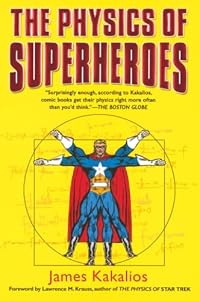
Description
"In The Physics of Superheroes acclaimed university professor James Kakalios shows that comic-book heroes and villains get their physics right more often than you think." "In this scientific survey of superpowers you'll learn what the physics of forces and motion can reveal about Superman's strength and the true cause of the destruction of his home planet, Krypton; what villains Magneto and Electro can teach us about the nature of electricity; and finally get the definitive answer about show more whether it was the Green Goblin or Spider-Man's webbing that killed the Wall Crawler's girlfriend Gwen Stacy in that fateful plunge from the George Washington Bridge!" "Along the way, The Physics of Superheroes explores everything from energy, to thermodynamics, to solid state physics, and Kakalios relates the physics in comic books to such real-world applications as automobile air bags, microwave ovens, and transistors. You'll also see how comic books have often been ahead of science in explaining recent topics in quantum mechanics (with Kitty Pryde of the X-Men) and string theory (with Crisis on Infinite Earths)." "This is the book you need to read if you ever wondered how the Invisible Woman of the Fantastic Four can see when she turns transparent, if the Atom could travel on an electron through a phone line, or if electromagnetic theory can explain how Professor X reads minds. Fun, provocative, and packed with more superheroes and superpowers than an Avengers-Justice League crossover, The Physics of Superheroes will make both comic-book fans and physicists exclaim, 'Excelsior!'"--Jacket. show lessTags
Recommendations

























Member Recommendations
Magus_Manders Learn a subject! Expand your mind! Plan your friends in every comic debate!
Member Reviews
This book is what happens when you cross a comic book geek with a science nerd, but in a good way. Full of actual formulae, this is rather a more intellectual look at how Superman leaps tall buildings and why the Flash needs more skin lotion than the average guy. By the way - Thor's magic hammer that helps him fly? Scientifically accurate. So there.
A fun read by an educator who clearly loves and appreciates comics. Although the science is rather basic for anyone who majored in the field, the exploration of how super-powers might actually work was informative for those of us who lack such a background. And it probably kept a few students more awake in his classes.
A gift from my buddy Bob Rudolph, this is a physics reference I could have used in my college days. The author, who is obviously well-acquainted with superhero comics of the Silver Age, uses the powers of the heroes and situations they have been in to teach physics in an interesting and clear manner that nearly rivals the abilities of Isaac Asimov. Kakalios tries as much as possible to keep the math to a manageable level. I like his premise of granting the occasional "miracle exception" for which no physical explanation can be construed, and then proceeding from there to explain the plausibility of the scenarios from the comics. His physics classes must be a lot more interesting than the ones I went to.
Un buon libro di divulgazione fisica; fornisce alcuni spunti e idee interessanti su come spiegare i principi della fisica con immagini semplici e comprensibili.
If I weren't working on a PhD in physical chemistry, I would have found this book more enjoyable, but the physics were much too basic. I kind of knew that going in, but I was hoping for more focus on the comic book aspects.
Kakalios uses examples from Silver Age and Golden Age comic book heroes (and villains) to describe concepts from classical, quantum, and relativistic physics. The classical physics descriptions were much better, with a lot more focus on comic characters. Once he got to quantum physics, he had to use a lot more exposition to explain the physics before getting to the comic book example, which often felt (to me) a bit stretched. While it isn't that surprising that there would be fewer examples of superheroes that use show more quantum mechanical tunneling than super strength in the course of their duties, it made the end feel a lot more like a textbook.
For someone looking for a fun intro to physics concepts, this would be a fine place to start. If you already have a background in physics, however, I wouldn't bother. show less
Kakalios uses examples from Silver Age and Golden Age comic book heroes (and villains) to describe concepts from classical, quantum, and relativistic physics. The classical physics descriptions were much better, with a lot more focus on comic characters. Once he got to quantum physics, he had to use a lot more exposition to explain the physics before getting to the comic book example, which often felt (to me) a bit stretched. While it isn't that surprising that there would be fewer examples of superheroes that use show more quantum mechanical tunneling than super strength in the course of their duties, it made the end feel a lot more like a textbook.
For someone looking for a fun intro to physics concepts, this would be a fine place to start. If you already have a background in physics, however, I wouldn't bother. show less
I thought it would be a critique of the physics of comic books, but it’s not. Rather, it’s more of a physics for jocks, using comic books as the vehicle to make physics interesting.
James Kakalios is a professor at the University of Minnesota, where he teaches a seminar for freshman titled Everything I Needed To Know About Physics I Learned From Reading Comic Books. My understanding is this book grew from that seminar.
(Full review at my blog)
James Kakalios is a professor at the University of Minnesota, where he teaches a seminar for freshman titled Everything I Needed To Know About Physics I Learned From Reading Comic Books. My understanding is this book grew from that seminar.
(Full review at my blog)
It is about the physics of superheroes. It explains the real science behind the people, powers, etc. It explains how the hulk is able to transform, and his shorts don't fall of. It even explains if Vibrainium (Captain America's shield) can block Adimantium (Wolverine's claws. Vibrainium wins, because it absorbs the sound, of the claws, meaning there is no damage. The reason why hulk's pants stay on is because of the CCA (Comic Code Authority), it wouldn't exactly be appropriate for children. This is all accurate because the author is a professor of the School of Physics and Astronomy, in the University of Minnesota. Oh, and he loves superheroes.
It is an amazing book, because it shows the science in a fun way. I completely adore show more superheroes, as does many people in the world. Knowing that this book exists, is awesome. It teaches science in the most fun way possible. However, some of the parts are confusing, but that is expected. It is also cool to know that the professor claims he knows the science, because he learned it from comic books. He discusses about all the best and most respected superheroes (OK, not all, but a lot). He uses the superheroes, to teach science in he most fun way possible, which is the coolest thing ever. show less
It is an amazing book, because it shows the science in a fun way. I completely adore show more superheroes, as does many people in the world. Knowing that this book exists, is awesome. It teaches science in the most fun way possible. However, some of the parts are confusing, but that is expected. It is also cool to know that the professor claims he knows the science, because he learned it from comic books. He discusses about all the best and most respected superheroes (OK, not all, but a lot). He uses the superheroes, to teach science in he most fun way possible, which is the coolest thing ever. show less
Members
- Recently Added By
Lists

Penguin Random House
458 works; 4 members
Author Information

James Kakalios is a professor in the School of Physics and Astronomy at the University of Minnesota.
Series

Belongs to Publisher Series
Common Knowledge
- Canonical title
- The Physics of Superheroes
- Original title
- The physics of superheroes
- Original publication date
- 2005-10
- People/Characters
- Superman; The Flash; Spider-Man; Batman
- First words
- (Foreword): While Wile E. Coyote is by no stretch of the imagination a superhero, I have to admit that it was this hapless villain -- who escaped almost certain death episode after episode while continuing to fruitlessly cha... (show all)se the Road Runner with almost Sisyphean intensity day in and day out -- who first got me thinking about the physics of illustrated characters.
(Preface): I was a comic-book fan as a kid, but like many of those who have come before and after me, I abandoned the hobby in high school upon discovering girls.
(Introduction): If I had ever wondered if my students found studying physics to be a waste of time, all doubt was removed several years ago.
Jerry Siegel and Joseph Shuster's original conception of Superman was of a pulp action hero with a liberal dose of science fiction added to lend an air of plausibility for their hero's great strength. - Last words
- (Click to show. Warning: May contain spoilers.)Face front, Fearless Reader!
- Blurbers
- Waid, Mark
- Original language
- English
Classifications
- Genres
- Science & Nature, Nonfiction, General Nonfiction
- DDC/MDS
- 530 — Natural sciences & mathematics Physics Physics
- LCC
- QC23.2 .K35 — Science Physics Physics General
- BISAC
Statistics
- Members
- 1,034
- Popularity
- 24,889
- Reviews
- 15
- Rating
- (3.68)
- Languages
- 5 — Czech, English, German, Italian, Spanish
- Media
- Paper, Ebook
- ISBNs
- 20
- ASINs
- 7