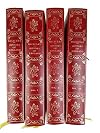
The History of England from the Accession of James II [complete set]
by Thomas Babington Macaulay
On This Page
Description
I purpose to write the history of England from the accession of King James the Second down to a time which is within the memory of men still living. I shall recount the errors which, in a few months, alienated a loyal gentry and priesthood from the House of Stuart. I shall trace the course of that revolution which terminated the long struggle between our sovereigns and their parliaments, and bound up together the rights of the people and the title of the reigning dynasty. I shall relate how show more the new settlement was, during many troubled years, successfully defended against foreign and domestic enemies; how, under that settlement, the authority of law and the security of property were found to be compatible with a liberty of discussion and of individual action never before known; how, from the auspicious union of order and freedom, sprang a prosperity of which the annals of human affairs had furnished no example; how our country, from a state of ignominious vassalage, rapidly rose to the place of umpire among European powers; how her opulence and her martial glory grew together; how, by wise and resolute good faith, was gradually established a public credit fruitful of marvels which to the statesmen of any former age would have seemed incredible; how a gigantic commerce gave birth to a maritime power, compared with which every other maritime power, ancient or modern, sinks into insignificance; how Scotland, after ages of enmity, was at length united to England, not merely by legal bonds, but by indissoluble ties of interest and affection; how, in America, the British colonies rapidly became far mightier and wealthier than the realms which Cortes and Pizarro had added to the dominions of Charles the Fifth; how in Asia, British adventurers founded an empire not less splendid and more durable than that of Alexander... David Hume show lessTags
Recommendations





















Member Reviews
One of the great achievements of historiography and of English prose. Macaulay had wanted to chronicle English history up to his own epoch, or at least until the reign of George III, in order to demonstrate in detail what has been called the "Whig interpretation of history," a view that human history conduces toward the achievement of greater personal freedom and progressive culture. In the event, he was able to reach the death of William III, and that only with the posthumous assistance of his sister. But what a tale it is, with a huge accumulation of incident and insight and a cast of characters that outdoes Dickens himself. Despite the intrinsic interest of the subject matter, though, the chief delight in reading Macaulay is his show more utter mastery of prose style. I can do no better than to quote a contemporary reviewer, Macaulay "succeeded in giving to the realities of history (which is generallly supposed to demand and require a certain grave austerity of style) the lightness, variety and attraction of a work designed only to amuse." How about just one little example, selected, I swear, completely at random? You can literally open the book anywhere and stick your finger blindfolded onto a choice formulation: "It was not only by means of the London Gazette that the government undertook to furnish political instruction to the people. That journal contained a scanty supply of news without comment. Another journal, published under the patronage of the court, consisted of comment without news." show less
I picked up this book with some trepidation. I have heard this book mentioned many times always in the context of criticizing so called "Whig Historians" of which Macaulay was one of the most prominent. I also thought that the book being a large and dusty tome would be hard to read at n=est and boring at worst.
In fact nothing could be further from the truth. MaCaulay's prose is both rich and interesting. The book flows almost as a novel. Regarding the Whig bias this did not disturb me. I recognise that every history book ever written must reflect the bias of its authors. Will not our modern histories of twentieth Century events sound biased to the reader in 50-10 years.
I feel taht I ma learning as much about the 19th century, the show more period when Macaulay was writing as about the 17th century. show less
In fact nothing could be further from the truth. MaCaulay's prose is both rich and interesting. The book flows almost as a novel. Regarding the Whig bias this did not disturb me. I recognise that every history book ever written must reflect the bias of its authors. Will not our modern histories of twentieth Century events sound biased to the reader in 50-10 years.
I feel taht I ma learning as much about the 19th century, the show more period when Macaulay was writing as about the 17th century. show less
At times long winded and rife 5 dollar words, these volumes captures the era well. The years 1650 to 1700 were turbulent times for England. The plague and Great fire of London, Civil War the beheading of a King and the abdication of another and the ascension of King William and Queen Mary, whose influence steadies the kingdom to the present day. It wasn't all smooth sailing, humans being what they are. The more things change the more they stay the same.
While nowadays Macaulay is considered too biased towards the Whigs and inaccurate in detail, there is no denying he is a
wonderfully vivid historical writer, and conveys the Whig belief in the rightness of the Glorious Revolution very effectively,
especially as regards Ireland.
wonderfully vivid historical writer, and conveys the Whig belief in the rightness of the Glorious Revolution very effectively,
especially as regards Ireland.
1354 History of England: From the Accession of James II in four volumes Volume One, by Thomas Babington Macaulay (read 15 Aug 1975) A couple years ago I waded thru four volumes of Motley's Rise of the Dutch Republic, and hated the bias of the author every page of the way. Apparently I am going thru a similar experience with Macaulay's four volume History of England. His anti-Catholicism irritates me so profoundly I give no credence to anything he talks about involving religion. This volume covers to 1686, beginning about 1685, but does sketchily cover events prior to 1685. Chapte IV starts with the death of Charles II, and Chapters V and VI deal with the first part of the reign of James II. He is very biased against James II, so I am show more continually annoyed. But I believe I will read the remaining 3 volumes.
1355 History of England: From the Accession of James II in four volumes Volume Two, by Thomas Babington Macaulay (read 24 Aug 1975) Recently I read that to be intellectually alive one should read a book one feels one won't like. Maybe that is why I am reading these volumes. Volume 2 only gets to July of 1689. He is very anti-James II, anti-Catholic, and it hurts me to read him. When he is dealing with other matters he has a pleasant sweep, e.g.: "But, in the days of William III, Killiecrankie was mentioned with horror by the peaceful and industrious inhabitants of the Perthshire lowland. It was deemed the most perilous of all three dark ravines thru which the marauders of the hills were wont to sally forth. The sound, so musical to modern ears, of the river brawling round the mossy rocks and among the smooth pebbles, the dark masses of crag and verdure worthy of the pencil of Wilson, the fantastic peaks bathed, at sunrise and sunset, with light rich as that which glows on the canvass of Claude, suggested to our ancestors thought of murderous ambuscades and of bodies stripped, gashed, and abandoned to the birds of prey."
1356 History of England: From the Accession of James II in four volumes Volume Three, by Thomas Babington Macaulay (read 5 Sept 1975) This volume only took the history to 1692--it began with 1685. I said "I will be glad when I am finished."
1357 History of England: From the Accession of James II in four volumes Volume Four, by Thomas Babington Macaulay (read 11 Sept 1975) This is the last volume, and only took the history up to 1699 and 1700, with a section on the death of James II on Sept 16, 1701, and on the death of William III on March 8, 1702 (called in those days 1701, but of course after Sept 16, 1701). I was glad I read the volumes even though Macaulay is a bigot and this shows throughout the work. The four volumes totaled 2383 pages and took me over a month to read. show less
1355 History of England: From the Accession of James II in four volumes Volume Two, by Thomas Babington Macaulay (read 24 Aug 1975) Recently I read that to be intellectually alive one should read a book one feels one won't like. Maybe that is why I am reading these volumes. Volume 2 only gets to July of 1689. He is very anti-James II, anti-Catholic, and it hurts me to read him. When he is dealing with other matters he has a pleasant sweep, e.g.: "But, in the days of William III, Killiecrankie was mentioned with horror by the peaceful and industrious inhabitants of the Perthshire lowland. It was deemed the most perilous of all three dark ravines thru which the marauders of the hills were wont to sally forth. The sound, so musical to modern ears, of the river brawling round the mossy rocks and among the smooth pebbles, the dark masses of crag and verdure worthy of the pencil of Wilson, the fantastic peaks bathed, at sunrise and sunset, with light rich as that which glows on the canvass of Claude, suggested to our ancestors thought of murderous ambuscades and of bodies stripped, gashed, and abandoned to the birds of prey."
1356 History of England: From the Accession of James II in four volumes Volume Three, by Thomas Babington Macaulay (read 5 Sept 1975) This volume only took the history to 1692--it began with 1685. I said "I will be glad when I am finished."
1357 History of England: From the Accession of James II in four volumes Volume Four, by Thomas Babington Macaulay (read 11 Sept 1975) This is the last volume, and only took the history up to 1699 and 1700, with a section on the death of James II on Sept 16, 1701, and on the death of William III on March 8, 1702 (called in those days 1701, but of course after Sept 16, 1701). I was glad I read the volumes even though Macaulay is a bigot and this shows throughout the work. The four volumes totaled 2383 pages and took me over a month to read. show less
i love to read T.B.M. for his style.
May be first American edition by Harpers (ABEBooks has similar volumes for 1849 for Boston and Cincinnatti) but no listing for Harpers. Engraving of Macauley ion the frontispiece of Vol. 1.
Members
- Recently Added By
Lists

Trinity College Booklist (1951): Class Four, History
120 works; 2 members
Author Information

381+ Works 3,813 Members
Thomas Babington Macaulay was born in Leicestershire, England on October 25, 1800. He was educated at Trinity College, Cambridge University. He became a lawyer, but continued to be interested in politics. He became a member of Parliament and rose to the peerage in 1857. Although he held a number of important cabinet posts, the effects of his show more sweeping educational reform, while in India, are his most enduring contribution to the Whig government. His main literary work was his multi-volume The History of England. He died on December 28, 1859. (Bowker Author Biography) show less
All Editions
Awards and Honors
Notable Lists
Series
Belongs to Publisher Series
Common Knowledge
- Canonical title
- The History of England from the Accession of James II [complete set]
- Alternate titles
- Macaulay's history of England
- Original publication date
- 1849-1961
- Important places
- England
- Disambiguation notice
- This is the complete edition of Macaulay's "The History of England from the Accession of James II), typically published in multiple volumes. Please DO NOT combine this work with any abridgement of this work or any incomplete... (show all) volumes. There are separate entries in LibraryThing for the abridged version(s) and for individual volumes and incomplete sets of the unabridged work.
Classifications
- Genres
- History, Nonfiction, General Nonfiction
- DDC/MDS
- 942.06 — History & geography History of Europe England and Wales England 1603–1714, House of Stuart and Commonwealth periods
- LCC
- DA435 .M14 — History of Europe, Asia, Africa and Oceania Great Britain History of Great Britain England History By period Modern, 1485- Later Stuarts
- BISAC
Statistics
- Members
- 546
- Popularity
- 54,548
- Reviews
- 11
- Rating
- (4.06)
- Languages
- English, German, Italian
- Media
- Paper, Ebook
- ISBNs
- 13
- ASINs
- 74