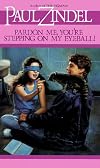
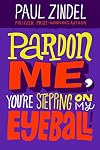
Pardon Me, You're Stepping On My Eyeball
by Paul Zindel
On This Page
Description
Two alienated teenagers learn to cope with their personal problems by being honest with each other.Tags
Recommendations












































Member Reviews
Edna Shinglebox and Louis “Marsh” Mellow are disaffected youth in the mid-1970s. When they are enrolled in a group therapy class at school they come to know each other and maybe help with each other’s emotional problems.
Everything in this book is bizarre, from Marsh’s stories his and his father’s exploits with women to Edna’s visit to a local psychic. The descriptions are wacky and vivid and very representative of the time period and the youth scene. Marsh and Edna are fully-realized characters, if a bit over-dramatic. It is likely that the intended audience for this book no longer exists, but a modern teen reader might appreciate getting a sense of teens and their struggles in a prior time period.
Everything in this book is bizarre, from Marsh’s stories his and his father’s exploits with women to Edna’s visit to a local psychic. The descriptions are wacky and vivid and very representative of the time period and the youth scene. Marsh and Edna are fully-realized characters, if a bit over-dramatic. It is likely that the intended audience for this book no longer exists, but a modern teen reader might appreciate getting a sense of teens and their struggles in a prior time period.
Ratings
Members
- Recently Added By
Author Information

71+ Works 9,257 Members
Paul Zindel Born on Staten Island, New York, Zindel was raised by a single mother who pursued a variety of odd and mostly unsuccessful jobs and took in terminally ill patients to supplement the family income. Due to her eccentricity and restlessness, the mother moved the family from one apartment to another, making it difficult for Zindel to form show more lasting friendships. As a consequence, the boy lived in the world of his imagination, developing interests in both science and writing. Zindel majored in chemistry at Wagner College on Staten Island, completing both bachelors and masters degrees. During this period he also took a creative-writing course offered by the playwright Edward Albee. After college he worked briefly as a technical writer for a chemical company and then discovered a more fulfilling vocation as a teacher of chemistry and physics at a Staten Island high school. It was during this period in the early 1960s that Zindel was able to develop his potential as a playwright by drawing on his own background as well as the experiences of his young students. The Effect of Gamma Rays on Man-in-the-Moon Marigolds premiered at the Alley Theater in Houston in 1965, was presented in a condensed version on television the following year, and finally opened off-Broadway at the Mercer-O'Casey Theater in 1970. Because of a fire in the theater, the play was moved, with a new cast, to the New Theater on Broadway, where it ran for a total of 819 performances. In addition to being enormously popular, Gamma Rays earned in 1970 an Obie Award as the best play of the season, the New York Drama Critics Circle Award as the best American play, and the Vernon Rice Drama Desk Award for most promising playwright. In 1971 the play was awarded the Pulitzer Prize in Drama. Gamma Rays is the story of an embittered, half-mad widow, Beatrice Hunsdorfer; her teenaged daughters, Ruth and Tillie; and Nanny, a decrepit old woman who boards with them. The family lives in chaos, with Beatrice dealing out petty vengeance to everyone. Nanny has been abandoned by her daughter. Ruth is wanton, untidy, and subject to seizures. Tillie, however, has become interested in science and enters her marigold experiment in the science fair; by exposing the marigold seeds to radiation, she shows that some produce normal plants, others produce mutations with beautiful double blooms, while still others die. The metaphor, of course, is that Tillie has emerged from her chaotic environment as a beautiful and whole person, a human "double bloom." Zindel's other plays include And Miss Reardon Drinks a Little (1971), The Secret Affairs of Mildred Wild(1973), Let Me Hear You Whisper (1973), and Ladies at the Alamo(1975). While these plays continue to show Zindel's skill in writing excellent roles for women, none of them have matched the critical and popular success of Gamma Rays. Since the late 1960s, Zindel has also written several novels for young adults. The Pigman (1968), which is about a lonely widower and two destructive teenagers, has sold more than 1 million copies. His other novels include My Darling, My Hamburger (1969), I Never Loved Your Mind (1970), Pardon Me, You're Stepping on My Eyeball (1976), Confessions of a Teenage Baboon (1977), and The Undertaker's Gone Bananas (1978). As in Gamma Rays, these works display not only a penchant for grotesque humor but an uncanny awareness of the problems of teenagers. Zindel's works, which also include several screenplays, explore the themes of loneliness, escapism, and eccentricity. His best works are humorous, perceptive, and warm; they present an affirmation of life emerging from desperate and grotesque circumstances. He is especially noted for his excellent women's roles, which has helped sustain him as a best-selling playwright for school and community groups. (Bowker Author Biography) show less
Awards and Honors
Distinctions
Work Relationships
Common Knowledge
- Canonical title
- Pardon Me, You're Stepping On My Eyeball
- Original publication date
- 1976
Classifications
- Genres
- Fiction and Literature, Teen, Children's Books, Young Adult
- DDC/MDS
- 813.54 — Literature & rhetoric American literature in English American fiction in English 1900-1999 1945-1999
- LCC
- PZ7 .Z647 .P — Language and Literature Fiction and juvenile belles lettres Fiction and juvenile belles lettres Juvenile belles lettres
- BISAC
Statistics
- Members
- 349
- Popularity
- 89,569
- Reviews
- 1
- Rating
- (3.47)
- Languages
- English, German
- Media
- Paper, Ebook
- ISBNs
- 19
- ASINs
- 5