
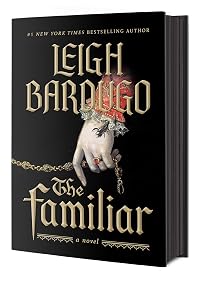
The Familiar
by Leigh Bardugo
On This Page
Description
In a shabby house in the new capital of Madrid, Luzia Cotado uses scraps of magic to get through her days of endless toil. But when her scheming mistress discovers her scullion is hiding a talent for little miracles, she demands Luzia use those gifts to win over the royal court. Determined to seize this chance to better her fortunes, Luzia plunges into a world of power-hungry nobility, desperate kings, holy men and seers, where the lines between magic, science and fraud blur. With the pyres show more of the Inquisition burning, she must use every bit of her wit and resilience to win fame and hide the truth of her ancestry - even if that means enlisting the help of an embittered immortal familiar, whose own secrets could cost her everything. show lessTags
Recommendations






Member Reviews
The Familiar - Bardugo
Audio performance by Lauren Fortgang
4 stars
This book begins like a typical Cinderella retelling. Luizia Cotado is an orphaned young woman working as a downtrodden scullion in the home of an abusive social climbing mistress. However, the story quickly diverts from the traditional Germanic Cinderella. The book is set in Madrid in the years following the humiliating defeat of Spain’s Armada. This scullion, Luizia, doesn’t need a fairy godmother because she has her own magic. It is a magic rooted in her carefully hidden Sephardic heritage. Her talent will either become her salvation or her damnation. She does not have a Prince Charming. Her love interest is another servant, a man enslaved by a centuries old show more enchantment. There is also the ever present threat of the Spanish Inquisition, its torture and burnings.
I thought the historical premise of this book was fascinating. Bardugo created a vivid and unsettling picture of 16th century Spain. It does not sound like a pleasant place to visit. This was a story of unrelenting tension. Luizia faced danger from so many directions. I wanted her to escape, although it seemed unlikely. I wanted her life to improve, although I wasn’t always sure that I liked her.
The saga did have occasional bits of sharp humor from other characters who were just as caught in the webs of court and church intrigue. I enjoyed these characters who seemed ready to spit in the eye of their inevitable tragic fates. Overall, the story was very dark. It was hard to believe in the unlikely positive outcome. show less
Audio performance by Lauren Fortgang
4 stars
This book begins like a typical Cinderella retelling. Luizia Cotado is an orphaned young woman working as a downtrodden scullion in the home of an abusive social climbing mistress. However, the story quickly diverts from the traditional Germanic Cinderella. The book is set in Madrid in the years following the humiliating defeat of Spain’s Armada. This scullion, Luizia, doesn’t need a fairy godmother because she has her own magic. It is a magic rooted in her carefully hidden Sephardic heritage. Her talent will either become her salvation or her damnation. She does not have a Prince Charming. Her love interest is another servant, a man enslaved by a centuries old show more enchantment. There is also the ever present threat of the Spanish Inquisition, its torture and burnings.
I thought the historical premise of this book was fascinating. Bardugo created a vivid and unsettling picture of 16th century Spain. It does not sound like a pleasant place to visit. This was a story of unrelenting tension. Luizia faced danger from so many directions. I wanted her to escape, although it seemed unlikely. I wanted her life to improve, although I wasn’t always sure that I liked her.
The saga did have occasional bits of sharp humor from other characters who were just as caught in the webs of court and church intrigue. I enjoyed these characters who seemed ready to spit in the eye of their inevitable tragic fates. Overall, the story was very dark. It was hard to believe in the unlikely positive outcome. show less
The setting is genuinely compelling: 16th-century Madrid, the Spanish Inquisition, a converso woman hiding her Jewish ancestry while navigating a court drunk on imperial ambition. The raw material here could have produced something sharp and unsettling about how power works on women, how they are used, exposed, discarded. Bardugo clearly did her research, and it shows.
Which makes it all the more frustrating that she chose to tell the same story she always tells.
Luzia starts the novel with wants of her own: safety, survival, freedom from servitude. By the end, her extraordinary power, the magic that put her life at risk and brought the Inquisition to her door, is being used every single morning to heal a man so they can stay together. show more Her abilities don't liberate her. They become a daily labor of love, performed in service of a relationship. The story began with a woman trying to survive on her own terms and ended with her tethered to a man's curse.
This is the pattern I keep seeing: strong women whose strength gets quietly absorbed into a romantic arc until there is no daylight between who they are and who they love. It is not that the romance is badly written. It is that the romance becomes the point, displacing everything that was supposed to matter. Luzia's Jewishness, her class, the very real danger surrounding her, these are the atmosphere. Santángel is the destination.
Bardugo is a skilled writer. But skill in service of a tired formula is still a tired formula. I wanted the book this could have been. show less
Which makes it all the more frustrating that she chose to tell the same story she always tells.
Luzia starts the novel with wants of her own: safety, survival, freedom from servitude. By the end, her extraordinary power, the magic that put her life at risk and brought the Inquisition to her door, is being used every single morning to heal a man so they can stay together. show more Her abilities don't liberate her. They become a daily labor of love, performed in service of a relationship. The story began with a woman trying to survive on her own terms and ended with her tethered to a man's curse.
This is the pattern I keep seeing: strong women whose strength gets quietly absorbed into a romantic arc until there is no daylight between who they are and who they love. It is not that the romance is badly written. It is that the romance becomes the point, displacing everything that was supposed to matter. Luzia's Jewishness, her class, the very real danger surrounding her, these are the atmosphere. Santángel is the destination.
Bardugo is a skilled writer. But skill in service of a tired formula is still a tired formula. I wanted the book this could have been. show less
I buddy read this over on StoryGraph but quick wrap-up of thoughts....
Hualit had warned her: the Church owned miracles and their saints performed them, not scullion girls with muddy family names.
Definitely read this in the Fall/Winter months, I think some of it went slower and was harder for me to get into because it was 90degrees and sunny when I was trying to read it. The dread and tension in this demands clouds and howling wind.
Stripped basics: Luzia, a scullion girl, accidentally on purpose reveals her magical abilities and the lady of the house, Valentina, wants to use it as a way to move her up the social ladder. Luzia's aunt Hualit warns her of the dangers of revealing herself but also sees it as a way to gain more favor with show more her patron, Victor. Victor's our solid villain and along with him is his servant, Santangel. Victor wants Santangel to train Luzia for a tournament that will pit magical people against each other for the honor of serving the king directly, if Luzia wins it will also help Victor gain the king's praise. This is set in late 1500s Spain, oh yeah, Luzia is out here being magical during Spanish Inquisition days. Remember that dread and tension I mentioned?
That's the basics but what makes this so atmospheric and emotional is how the author mixed and used historical fiction, fantasy/paranormal, and romance. Luzia and her aunt was a great contrast between life experience caution and young righteous anger, I wanted Luzia to reveal and become her true self as much as I was with Hualit that it made me fear for her, which I loved how the author intermingled it with Luzia's magical abilities and Jewish heritage. Luzia's magical but there's also something with Santangel and with that pairings dynamic, you get old world-weary, naive pride, and attraction. This has numerous povs but you don't really get Santangel's story until the latter second half, but he brings out and works in theater with Luzia's character beautifully.
From the messaging to the funny and emotional author's talent with turn of phrases, this should be on Halloween season book lists. There were some slow parts and the ending will rollercoaster you around in abrupt change of pace, but oof, well worth it. Valentina's journey actually ended up stealing the show for me but long live immortal happily ever afters. show less
Hualit had warned her: the Church owned miracles and their saints performed them, not scullion girls with muddy family names.
Definitely read this in the Fall/Winter months, I think some of it went slower and was harder for me to get into because it was 90degrees and sunny when I was trying to read it. The dread and tension in this demands clouds and howling wind.
Stripped basics: Luzia, a scullion girl, accidentally on purpose reveals her magical abilities and the lady of the house, Valentina, wants to use it as a way to move her up the social ladder. Luzia's aunt Hualit warns her of the dangers of revealing herself but also sees it as a way to gain more favor with show more her patron, Victor. Victor's our solid villain and along with him is his servant, Santangel. Victor wants Santangel to train Luzia for a tournament that will pit magical people against each other for the honor of serving the king directly, if Luzia wins it will also help Victor gain the king's praise. This is set in late 1500s Spain, oh yeah, Luzia is out here being magical during Spanish Inquisition days. Remember that dread and tension I mentioned?
That's the basics but what makes this so atmospheric and emotional is how the author mixed and used historical fiction, fantasy/paranormal, and romance. Luzia and her aunt was a great contrast between life experience caution and young righteous anger, I wanted Luzia to reveal and become her true self as much as I was with Hualit that it made me fear for her, which I loved how the author intermingled it with Luzia's magical abilities and Jewish heritage. Luzia's magical but there's also something with Santangel and with that pairings dynamic, you get old world-weary, naive pride, and attraction. This has numerous povs but you don't really get Santangel's story until the latter second half, but he brings out and works in theater with Luzia's character beautifully.
From the messaging to the funny and emotional author's talent with turn of phrases, this should be on Halloween season book lists. There were some slow parts and the ending will rollercoaster you around in abrupt change of pace, but oof, well worth it. Valentina's journey actually ended up stealing the show for me but long live immortal happily ever afters. show less
If the bread hadn't burned, this would be a very different story. If the cook's son hadn't come home late the night before, if the cook hadn't known he was hanging around that lady playwright, if she hadn't lain awake fretting for his immortal soul and weeping over the future fates of possible grandchildren, if she hadn't been tired and distracted, then the bread would not have burned and the calamities that followed might have belonged to some other house than Casa Ordoño, one some other street than Calle de Dos Santos.
Luzia is a scullion, a kitchen girl past the age when she should have married, an orphan of questionable lineage (the questionable part being the Jewish heritage that was dangerous in 16th century Spain), with nothing show more of value except magical powers passed through her mother's side of the family. She uses these to make her difficult life a little easier.
Her aunt had taught her the words, pulled from letters written in countries far across the sea, but the tune was always Luzia's. The songs just came into her head, the notes making a pleasant buzz on her tongue -- to double the sugar when there was no money for more, to start the fire when the embers had gone cold, to fix the bread when the top had burned so badly. Small ways to avert small disasters, to make the long days of work a little more bearable.
But then Luzia's mistress, Valentina, realizes what the little maid can do and tries to use these powers to raise her own social status. Soon Victor de Paredes, the luckiest man in Madrid, wants Luzia to be his entry in a contest to become King Philip's new champion. He assigns his servant Santángel to train Luzia in both courtly manners and competitive miracles, but Santángel is no ordinary man and Luzia is not the simple maid she appears to be. Will they be forced to be pawns in the machinations of their social superiors, or will they each find a way to live on their own terms?
I love the fairy tale tone to this mash-up of historical fiction and fantasy. I love Leigh Bardugo's complex, flawed characters, the way she reveals what has already happened, what could have been, and what will be, her intricate ways of turning phrases. This novel isn't perfect, but it's a solid 4.5 stars rounded up to 5 for originality. show less
Luzia is a scullion, a kitchen girl past the age when she should have married, an orphan of questionable lineage (the questionable part being the Jewish heritage that was dangerous in 16th century Spain), with nothing show more of value except magical powers passed through her mother's side of the family. She uses these to make her difficult life a little easier.
Her aunt had taught her the words, pulled from letters written in countries far across the sea, but the tune was always Luzia's. The songs just came into her head, the notes making a pleasant buzz on her tongue -- to double the sugar when there was no money for more, to start the fire when the embers had gone cold, to fix the bread when the top had burned so badly. Small ways to avert small disasters, to make the long days of work a little more bearable.
But then Luzia's mistress, Valentina, realizes what the little maid can do and tries to use these powers to raise her own social status. Soon Victor de Paredes, the luckiest man in Madrid, wants Luzia to be his entry in a contest to become King Philip's new champion. He assigns his servant Santángel to train Luzia in both courtly manners and competitive miracles, but Santángel is no ordinary man and Luzia is not the simple maid she appears to be. Will they be forced to be pawns in the machinations of their social superiors, or will they each find a way to live on their own terms?
I love the fairy tale tone to this mash-up of historical fiction and fantasy. I love Leigh Bardugo's complex, flawed characters, the way she reveals what has already happened, what could have been, and what will be, her intricate ways of turning phrases. This novel isn't perfect, but it's a solid 4.5 stars rounded up to 5 for originality. show less
Bardugo never disappoints! This is one fantastic story that I just didn’t want it to end, truly.
Luzia is a scullion in Madrid during the times of the Inquisition. Of course she has magical abilities and she tries to keep them hidden at all costs; but her mistress catches her one day, and all hell breaks loose as she is demanded to perform for her guests.
Word gets around, and powerful men come calling to use Luzia to gain favours with the king of Spain. Santangel, the servant of one of those men, starts training Luzia for a tournament, and she discovers he is not what he seems.
As they develop a relationship, things start to get out of hand; and with the Inquisition at their heels, they must figure out a way to get out of the mess they show more were dragged into.
Loved every bit of this book. Wish she would grace us with a second one. show less
Luzia is a scullion in Madrid during the times of the Inquisition. Of course she has magical abilities and she tries to keep them hidden at all costs; but her mistress catches her one day, and all hell breaks loose as she is demanded to perform for her guests.
Word gets around, and powerful men come calling to use Luzia to gain favours with the king of Spain. Santangel, the servant of one of those men, starts training Luzia for a tournament, and she discovers he is not what he seems.
As they develop a relationship, things start to get out of hand; and with the Inquisition at their heels, they must figure out a way to get out of the mess they show more were dragged into.
Loved every bit of this book. Wish she would grace us with a second one. show less
Magic doesn’t play well with the Spanish Inquisition, unless you can convince everyone that your powers come from God. Luzia is the descendant of conversos, always at risk of being denounced as a Judiazer, and she can also do magic. When she reveals this to her employer, she sets off a chain of events that leads her to great danger and great opportunity. I really liked that each person in the story was clearly the hero of their own narrative (or the villain).
Luzia Cotado is a scullion in a nobleman's house, but she hides a secret - she is able to perform small miracles. When her mistress discovers her secret, Luzia is forced to perform in front of others. This leads to Luzia becoming a pawn in a much deeper game, where disgraced nobles vie for the Spanish King's favor by trying to present him with someone who can perform these miracles to his advantage, and help him win the bloody war against England's heretic queen. Luiza seizes the chance for a better life for herself, but the competition is deadly and she'll need the help of Santangel, a brooding man who is the familiar to her noble patron. He has his own motives though, and they may not line up with Luiza's.
The Familiar was good, and show more it walks a line between fantasy and historical fiction, but I didn't enjoy it quite as much as I have Bardugo's other works. I never really felt the chemistry between Luiza and Santangel. I did like the depth of the characters though, especially Luiza. She's no wilting lily. She knows what she wants, and she's willing to take any risk to seize the chance for a better life. She's obviously still young, and makes some pretty bad choices due to that, but she is determined and unapologetic about wanting more. I love that.
I don't think it fulfilled it's potential in regards to the Jewish aspect of the story; this is set in a time when Spanish Jews were either forced to convert, leave Spain, or were hunted down and killed by the Spanish Inquisition. Much is talked about Luzia and her aunt desperately hiding their heritage, but nothing really comes of it. I think I would have liked more exploration of that, or to have it figure more into the plot.
I loved the torneo, the competition between the other miracle workers, and how each trial played out. I'm not sure if I loved the ending or just liked it, but I definitely wanted more and more of Luzia facing off against her competitors.
This was similar to the Grishaverse, but not much like Ninth House. If you like her previous dark fantasies, I think this is worth a try, but I think Ninth House and Six of Crows will still reign as my Bardugo favorites. show less
The Familiar was good, and show more it walks a line between fantasy and historical fiction, but I didn't enjoy it quite as much as I have Bardugo's other works. I never really felt the chemistry between Luiza and Santangel. I did like the depth of the characters though, especially Luiza. She's no wilting lily. She knows what she wants, and she's willing to take any risk to seize the chance for a better life. She's obviously still young, and makes some pretty bad choices due to that, but she is determined and unapologetic about wanting more. I love that.
I don't think it fulfilled it's potential in regards to the Jewish aspect of the story; this is set in a time when Spanish Jews were either forced to convert, leave Spain, or were hunted down and killed by the Spanish Inquisition. Much is talked about Luzia and her aunt desperately hiding their heritage, but nothing really comes of it. I think I would have liked more exploration of that, or to have it figure more into the plot.
I loved the torneo, the competition between the other miracle workers, and how each trial played out. I'm not sure if I loved the ending or just liked it, but I definitely wanted more and more of Luzia facing off against her competitors.
This was similar to the Grishaverse, but not much like Ninth House. If you like her previous dark fantasies, I think this is worth a try, but I think Ninth House and Six of Crows will still reign as my Bardugo favorites. show less
Members
- Recently Added By
Lists

Books Read in 2024
4,623 works; 126 members

Book of the Month Selections 2016 to Present
130 works; 5 members

2025 Hugo Awards -- Eligible Works -- Novels
33 works; 2 members

Adult Fantasy TBR
23 works; 1 member

Wishlist
71 works; 1 member
Author Information

71+ Works 96,128 Members
Leigh Bardugo was born in Jerusalem, Israel. She graduated from Yale University. Before becoming an author, she worked in advertising, journalism, and most recently, as a makeup and special effects artist in Hollywood. She is the author of The Grisha Trilogy and the Six of Crows Series. The second book of the Six of Crows Series, Crooked Kingdom, show more became a New York Times bestseller in 2016. (Bowker Author Biography) show less
Awards and Honors
Awards
Distinctions
Notable Lists
Work Relationships
Is abridged in
Common Knowledge
- Canonical title
- The Familiar
- Original title
- The Familiar
- Original publication date
- 2024
- People/Characters
- Luzia Cotado; Guillén Santángel; Hualit Cana/Catalina de Castro de Oro; Valentina Ordoño; Don Victor de Paredes; Don Marius Ordoño
- Important places
- Madrid, Spain
- Dedication
- For my family—converts, exiles, and ghosts.
A mi familia—conversos, exiliados, y fantasmas.
A mi famiya—konvertidos, surgunlis, i fantazmas. - First words
- If the bread hadn't burned, this would be a very different story.
- Last words
- (Click to show. Warning: May contain spoilers.)He kisses her fingers, and combs her hair, and he treasures her, as only a man who has lost his luck and found it once more ever can.
- Original language
- English
Classifications
Statistics
- Members
- 3,058
- Popularity
- 5,759
- Reviews
- 62
- Rating
- (3.78)
- Languages
- 7 — English, French, German, Hungarian, Italian, Portuguese, Spanish
- Media
- Paper, Audiobook, Ebook
- ISBNs
- 28
- ASINs
- 9