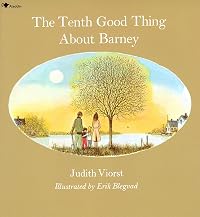
The Tenth Good Thing About Barney
by Judith Viorst
On This Page
Description
In an attempt to overcome his grief, a boy tries to think of the ten best things about his dead cat.Tags
Recommendations










Member Reviews
At roughly 2pm this afternoon (June 21st, 2009) my cat - friendly and loving little beast, hair-raising terror, and long-time companion - breathed her last. Sixteen years old, Kitty (no, I didn't name her) had been with me for half the span of my life, and although she had been ill for some time, it was still a heart-breaking decision to have her euthanized. As my mother and I sat with her while the injection took effect, we found ourselves recalling all the wonderful ways she had contributed to our home and family.
Kitty was my mother's "prayer cat," and would sit next to her every morning, purring as loudly as possible, while my mother said her daily "prayers and meditations." She was a sociable little beast (except when she wasn't) show more and I have fond memories of the many times she would come sit with me on the sofa, while I was curled up, reading a book. She had this adorable habit of coming out of her bed (or the forbidden closet) to greet me when I got home, lolling about on her back, hoping to trick me into petting her tummy. Little hussy - as if I didn't know it was all a ruse so she could give my hand a little nip! "Kisses, not nips!" I would intone, and she would lick my finger, as if in apology...
And so it is, as I sit here this evening, trying not to think about how empty the apartment seems without her, I am reminded of Judith Viorst's wonderful picture book, The Tenth Good Thing About Barney, in which a young boy struggles to cope with the loss of his beloved cat by compiling a list of "good things" about him. As someone who has been involved with children's books for many years, I have had more than one occasion to recommend this title, but had never, until today, understood its acute sensitivity to the rituals of grieving.
What could be more natural, at a time like this, than that we should want to recall all the ways in which our animal companion brought us happiness? And what could be more reassuring, especially for the young children at whom this book is aimed, than the fact that their instinctive reaction is one shared by many others? Highly, highly recommended. show less
Kitty was my mother's "prayer cat," and would sit next to her every morning, purring as loudly as possible, while my mother said her daily "prayers and meditations." She was a sociable little beast (except when she wasn't) show more and I have fond memories of the many times she would come sit with me on the sofa, while I was curled up, reading a book. She had this adorable habit of coming out of her bed (or the forbidden closet) to greet me when I got home, lolling about on her back, hoping to trick me into petting her tummy. Little hussy - as if I didn't know it was all a ruse so she could give my hand a little nip! "Kisses, not nips!" I would intone, and she would lick my finger, as if in apology...
And so it is, as I sit here this evening, trying not to think about how empty the apartment seems without her, I am reminded of Judith Viorst's wonderful picture book, The Tenth Good Thing About Barney, in which a young boy struggles to cope with the loss of his beloved cat by compiling a list of "good things" about him. As someone who has been involved with children's books for many years, I have had more than one occasion to recommend this title, but had never, until today, understood its acute sensitivity to the rituals of grieving.
What could be more natural, at a time like this, than that we should want to recall all the ways in which our animal companion brought us happiness? And what could be more reassuring, especially for the young children at whom this book is aimed, than the fact that their instinctive reaction is one shared by many others? Highly, highly recommended. show less
We've had this book for probably 35 years. Bought it for our second son when he was only 6 or 7. Now that son is 42, and his cat died this week. 'Whisper' was a feral kitten he and his wife found and rescued fifteen years ago. Their eight year-old son called today to tell us about it. "Mommy cried," he told us. He may not have seen his father cry, but I'm sure he did.
THE TENTH GOOD THING ABOUT BARNEY is a beautiful little book that teaches some important lessons - about living and dying, and how life transforms itself. And also expresses the belief that, if there is a heaven - and "we don't know too much about that" - then surely there is room in it for our beloved pets, whether it's a cat like Barney (or Whisper), a dog, or even a show more chicken. Barney's family buried him under a tree in the back yard. Whisper is buried in the garden. I have buried two much-loved 'best friends' myself beneath the grapevine in our back yard in the past few years. We get good grapes every year.
I just packaged up our tattered old copy of THE TENTH GOOD THING ABOUT BARNEY and mailed it off to my son and his family. I hope it helps. "Good girl, Whisper. Thanks for everything. Godspeed." show less
THE TENTH GOOD THING ABOUT BARNEY is a beautiful little book that teaches some important lessons - about living and dying, and how life transforms itself. And also expresses the belief that, if there is a heaven - and "we don't know too much about that" - then surely there is room in it for our beloved pets, whether it's a cat like Barney (or Whisper), a dog, or even a show more chicken. Barney's family buried him under a tree in the back yard. Whisper is buried in the garden. I have buried two much-loved 'best friends' myself beneath the grapevine in our back yard in the past few years. We get good grapes every year.
I just packaged up our tattered old copy of THE TENTH GOOD THING ABOUT BARNEY and mailed it off to my son and his family. I hope it helps. "Good girl, Whisper. Thanks for everything. Godspeed." show less
From the bottom of my heart, thank you Ms.Viorst
Pet deaths are hard, no matter if you are young or old, no matter if the pet is young or old. Ms. Viorst has written a story that isn't pandering but is kind and understanding, done gently and simply. She's done a generous thing by writing this story for us.
I have a little pet cemetery in my yard. We--my oldest daughter and my older grands--hold services there. It is part of our grieving process. It helps us to also know they are nearby, part of our family still.
I've let my family know that when I die I want to be cremated and my ashes scattered the next spring, among the West Texas wildflowers with a service not much different than we've done for our pets.
Wildflowers have given me joy show more all the years I've lived here, teaching myself their names, watching their seasons, and I want to rest among them. Then when it is spring, when the wildflowers bloom, my family will know I'm now part of the flowers just as I was part of them. show less
Pet deaths are hard, no matter if you are young or old, no matter if the pet is young or old. Ms. Viorst has written a story that isn't pandering but is kind and understanding, done gently and simply. She's done a generous thing by writing this story for us.
I have a little pet cemetery in my yard. We--my oldest daughter and my older grands--hold services there. It is part of our grieving process. It helps us to also know they are nearby, part of our family still.
I've let my family know that when I die I want to be cremated and my ashes scattered the next spring, among the West Texas wildflowers with a service not much different than we've done for our pets.
Wildflowers have given me joy show more all the years I've lived here, teaching myself their names, watching their seasons, and I want to rest among them. Then when it is spring, when the wildflowers bloom, my family will know I'm now part of the flowers just as I was part of them. show less
The Tenth Good Thing about Barney
Judith Viorst (1971)
I absolutely adored this book and think it is a great book for young children experiencing a first time death of their animal. I liked just about everything including the language, characters, and illustrations. The author wrote it from a young boy’s point of view and he expresses how he feels about the death of his cat, Barney. The language is descriptive and relatable and sets a calming mood. The characters also are a great examples of a family. The parents teach their son how to mourn the loss of his pet in the right way. The father tells his son “He’ll help grow the flowers, and he’ll help grow that tree and some grass. You know that’s a pretty nice job for a cat.” show more They turn what seems so negative into a positive experience. Although the pictures were not colorful, they were appropriate for the mood of the story and were very detailed and interesting t look at. Over all I think that the “big idea” is that with death comes new life. This message can teach children so many things about life and death and help them with new grief in their lives. show less
Judith Viorst (1971)
I absolutely adored this book and think it is a great book for young children experiencing a first time death of their animal. I liked just about everything including the language, characters, and illustrations. The author wrote it from a young boy’s point of view and he expresses how he feels about the death of his cat, Barney. The language is descriptive and relatable and sets a calming mood. The characters also are a great examples of a family. The parents teach their son how to mourn the loss of his pet in the right way. The father tells his son “He’ll help grow the flowers, and he’ll help grow that tree and some grass. You know that’s a pretty nice job for a cat.” show more They turn what seems so negative into a positive experience. Although the pictures were not colorful, they were appropriate for the mood of the story and were very detailed and interesting t look at. Over all I think that the “big idea” is that with death comes new life. This message can teach children so many things about life and death and help them with new grief in their lives. show less
"My cat Barney died this Friday. I was very sad. My mother said we could have a funeral for him, and I should think of ten good things about Barney so I could tell them..."
But the small boy who loved Barney can only think of nine. Later, while talking with his father, he discovers the tenth -- and begins to understand.
But the small boy who loved Barney can only think of nine. Later, while talking with his father, he discovers the tenth -- and begins to understand.
The Tenth Good Thing About Barney by Judith Viorst. Epiphany Oviedo ELCA library section 9 A: Juvenile (gr. K-5), Religion and Values. A little boy’s cat named Barney dies. Mom, Dad and the boy give Barney a funeral and bury him under a tree in the back yard. Mom asks the boy to tell ten good things about Barney. He was brave, and smart, and funny and clean. It was sweet to hear him purr and sometimes he slept on the boy’s stomach and kept it warm. Barney only caught a bird once. He was cuddly and handsome too. Mom says that is only nine things. The boy can’t think of any others. They cannot think of any songs to sing about cats so they sing one about a pussy willow.
The boy’s friend, Annie comes over. They quarrel. Annie says show more Barney is in heaven, but the boy says Barney is in the ground. “Who is right?” they ask Barney’s Dad. Dad says, “we really don’t know too much about heaven, and we can’t be absolutely sure he is there.” But Annie says with confidence, “but if heaven exists, there it is bound to be room for cats, cans of tuna and bowls of cream.”
Dad and the boy work in the yard. They trim bushes. They talk about how sad they feel now that Barney is gone. They plant some flower seeds. Dad says that Barney’s body will help the seeds grow into stems, plants and flowers. “And that’s a pretty nice job for a cat,” says Dad.
As mother puts the boy to bed, she asks him to once again tell the ten good things about Barney. This time the boy adds his Dad’s thought that making flowers grow is a pretty nice job for a cat.
This book is perfect for children who grieve over the death of a pet. It is thoughtful, calm, and bittersweet. It acknowledges the sadness that descends at a death, whether it be a pet or a loved one. Such feelings can be frightening to anyone, particularly a child. The family creates an observance by which they give thanks for the pet’s life, while reminding themselves that death, mourning and remembrance are a part of living. The drawings are brown pen and ink, which gives a late winter feel to the story. Tree branches are still bare; yet it’s time to till the flower garden plot and plant seeds. The mention of a song about pussy willows, and a jug of pussy willow branches on the kitchen table in one of the illustrations hints at new life about to burst forth in a few weeks. Planting flower seeds also illustrates this promise of new life. A great children’s book not only has a compelling story that deeply explores feelings in a nonthreatening way, but it serves as a catalyst for a discussion about faith. While this book does not get preachy, you can use it as a springboard to discuss your beliefs about life, death and heaven with your children as you share this book again and again. show less
The boy’s friend, Annie comes over. They quarrel. Annie says show more Barney is in heaven, but the boy says Barney is in the ground. “Who is right?” they ask Barney’s Dad. Dad says, “we really don’t know too much about heaven, and we can’t be absolutely sure he is there.” But Annie says with confidence, “but if heaven exists, there it is bound to be room for cats, cans of tuna and bowls of cream.”
Dad and the boy work in the yard. They trim bushes. They talk about how sad they feel now that Barney is gone. They plant some flower seeds. Dad says that Barney’s body will help the seeds grow into stems, plants and flowers. “And that’s a pretty nice job for a cat,” says Dad.
As mother puts the boy to bed, she asks him to once again tell the ten good things about Barney. This time the boy adds his Dad’s thought that making flowers grow is a pretty nice job for a cat.
This book is perfect for children who grieve over the death of a pet. It is thoughtful, calm, and bittersweet. It acknowledges the sadness that descends at a death, whether it be a pet or a loved one. Such feelings can be frightening to anyone, particularly a child. The family creates an observance by which they give thanks for the pet’s life, while reminding themselves that death, mourning and remembrance are a part of living. The drawings are brown pen and ink, which gives a late winter feel to the story. Tree branches are still bare; yet it’s time to till the flower garden plot and plant seeds. The mention of a song about pussy willows, and a jug of pussy willow branches on the kitchen table in one of the illustrations hints at new life about to burst forth in a few weeks. Planting flower seeds also illustrates this promise of new life. A great children’s book not only has a compelling story that deeply explores feelings in a nonthreatening way, but it serves as a catalyst for a discussion about faith. While this book does not get preachy, you can use it as a springboard to discuss your beliefs about life, death and heaven with your children as you share this book again and again. show less
Barney was a cat who died who died on a Friday. His young owner is sad, VERY, VERY sad. Working through his grief, wise beyond his years, the young boy, remembers the good things about Barney.
As he cannot sleep, eat or play, his overactive mind and his broken heart remember Barney. And, such is life! The joy and the pain of gaining and then losing.
Finally falling asleep thinking of nine good things of Barney, the next day at the funeral for Barney, there is a remembrance that
Barney was brave
Barney was smart
Barney was funny
Barney was clean
Barney was cuddly
Barney was handsome
Barney only ever ate one bird
It was a lovely sound to hear Barney's purr
It was special when Barney slept on the boy's belly
And, as Barney is gently lowered into the show more ground, the tenth good thing noted is that he will now nourish the ground, help to grow flowers, trees and grass.
And, as the young grieving man notes -- "You know, that's a pretty nice job for a cat!"
This is a wonderful book which tenderly shows the grief of a young boy losing a precious pet and the knowledge that Barney will continue to live on.
Recommended. show less
As he cannot sleep, eat or play, his overactive mind and his broken heart remember Barney. And, such is life! The joy and the pain of gaining and then losing.
Finally falling asleep thinking of nine good things of Barney, the next day at the funeral for Barney, there is a remembrance that
Barney was brave
Barney was smart
Barney was funny
Barney was clean
Barney was cuddly
Barney was handsome
Barney only ever ate one bird
It was a lovely sound to hear Barney's purr
It was special when Barney slept on the boy's belly
And, as Barney is gently lowered into the show more ground, the tenth good thing noted is that he will now nourish the ground, help to grow flowers, trees and grass.
And, as the young grieving man notes -- "You know, that's a pretty nice job for a cat!"
This is a wonderful book which tenderly shows the grief of a young boy losing a precious pet and the knowledge that Barney will continue to live on.
Recommended. show less
Members
- Recently Added By
Lists

Under The Chinaberry Tree
194 works; 1 member
Author Information

93+ Works 36,490 Members
Judith Viorst was born in Newark, New Jersey on February 2, 1931. She graduated from Rutgers University (1952) and the Washington Psychoanalytic Institute (1981). She has written extensively, her works include children's books, collections of poetry, lyrics to musicals, several works of fiction, and a cookbook. She has won a Silver Pencil award show more (for The Tenth Good Thing About Barney) and an Emmy (for poems used in an Anne Bancroft TV special). (Bowker Author Biography) Judith Viorst is the bestselling author of "Forever Fifty," "How Did I Get to Be Forty," "Necessary Losses," & several other works. She is also the author of the classic children's book "Alexander & the Terrible, Horrible, No Good, Very Bad Day." A graduate of the Washington Psychoanalytic Institute, she is the recipient of various awards for her journalism & psychological writings. She lives in Washington, D.C., with her husband, political writer Milton Viorst. They have three sons. (Publisher Provided) show less
Some Editions
Awards and Honors
Awards
Work Relationships
Common Knowledge
- Original publication date
- 1971
Classifications
Statistics
- Members
- 1,683
- Popularity
- 13,319
- Reviews
- 64
- Rating
- (4.16)
- Languages
- Dutch, English
- Media
- Paper
- ISBNs
- 18
- ASINs
- 5